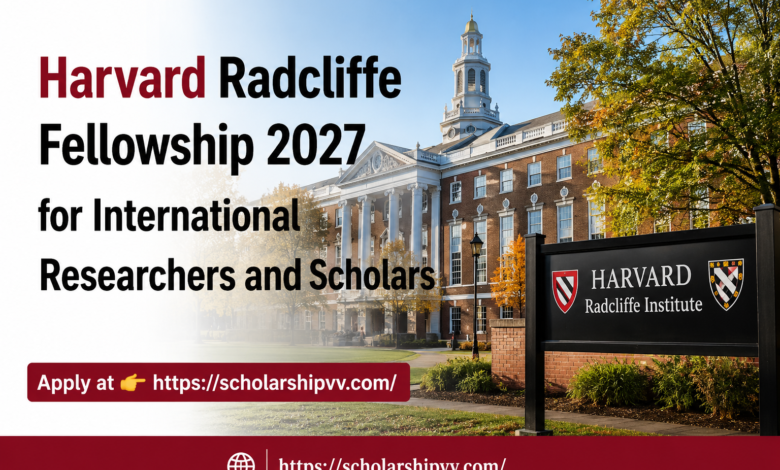
Harvard Radcliffe Fellowship 2027 for International Researchers and Scholars

Last Updated: 30 May 2026 at 11:20 AM
Updated By: Uwandu Chinwe
- What Is the Harvard Radcliffe Fellowship?
- Fellowship Overview: Key Facts at a Glance
- About the Radcliffe Institute for Advanced Study
- Who Is the Harvard Radcliffe Fellowship For?
- Detailed Eligibility Criteria by Discipline
- Humanities and Social Sciences
- Science, Engineering, and Mathematics
- Nonfiction and Journalism
- Creative Arts
- What the Fellowship Provides
- Stipend
- Additional Financial Support
- Office and Studio Space
- Harvard University Appointment
- Community and Professional Development
- The 2027-2028 Focus Areas
- How to Apply for the Harvard Radcliffe Fellowship 2027-2028
- Step 1: Create an Account on the Application Portal
- Step 2: Choose Your Application Area and Primary Discipline
- Step 3: Prepare Your Project Proposal
- Step 4: Prepare Your Curriculum Vitae
- Step 5: Prepare Your Writing or Work Sample
- Step 6: Arrange Your Letters of Recommendation
- Step 7: Submit Before the Deadline
- How Applications Are Reviewed
- What It Is Like to Be a Radcliffe Fellow
- Tips for a Strong Application
- Frequently Asked Questions
- Can international scholars apply for the Harvard Radcliffe Fellowship?
- Do I need to be affiliated with a university to apply?
- Is relocation to Cambridge required?
- Can I apply if my work is interdisciplinary?
- What is the fellowship stipend?
- When does the 2027-2028 fellowship begin and end?
- How competitive is the fellowship?
- Where can I apply?
- Final Thoughts
If you are a researcher, scholar, scientist, writer, or artist who has spent years building a body of work and wondering when you will finally get a full, uninterrupted year to pursue your most ambitious project, the Harvard Radcliffe Fellowship might be exactly what you have been waiting for. This is not a student scholarship or a postdoctoral program. This is a fellowship for people who have already proven themselves in their fields and simply need time, space, and world-class intellectual community to take their work to the next level. The 2027-2028 cycle is now open for applications, and this guide will walk you through every important detail you need to know.
What Is the Harvard Radcliffe Fellowship?
The Radcliffe Fellowship is administered by the Radcliffe Institute for Advanced Study at Harvard University, one of the most respected interdisciplinary research centers in the world. The program was established to support individuals who bring both a demonstrated record of achievement and exceptional promise to the Institute. Each year, the program selects approximately 50 fellows from across the United States and around the world, drawn from a remarkably wide range of academic, professional, and artistic fields.
What makes this fellowship genuinely special is its interdisciplinary nature. Fellows are not siloed into separate departments. They come together as a cohort, sharing their work with one another through weekly talks, collaborative workshops, and social events throughout the year. A climate scientist might find herself in conversation with a novelist over lunch. A legal scholar might discover that a film director’s approach to storytelling reframes the way he thinks about constitutional history. This cross-pollination of ideas is not accidental. It is by design, and it is part of what makes the Radcliffe Fellowship one of the most intellectually stimulating experiences available anywhere in higher education.
Past fellows include some of the most distinguished names in contemporary public life: Jill Lepore, Samantha Power, Zadie Smith, Elizabeth Warren, and Nobel Laureate Michael Kremer. The 2026-2027 cohort, recently announced by Harvard Radcliffe Institute, includes writers, scientists, legal scholars, musicians, and environmental researchers working on projects ranging from the first scholarly monograph on the work of Yoko Ono to new generations of surgical robots to investigations of how detective novels shaped modern medical diagnosis. The breadth of the fellowship is, itself, a statement about what Harvard Radcliffe Institute believes great scholarship looks like.
Fellowship Overview: Key Facts at a Glance
Before going into the details, here is a quick overview of the most important facts about the Harvard Radcliffe Fellowship for the 2027-2028 academic year:
| Detail | Information |
|---|---|
| Host Institution | Radcliffe Institute for Advanced Study, Harvard University |
| Fellowship Year | 2027-2028 (September 2027 through May 2028) |
| Number of Fellows Selected | Approximately 50 per year |
| Stipend | $78,000 plus $5,000 for project expenses |
| Duration | 9 months (September through May) |
| Location | Cambridge, Massachusetts, USA (in-person residency required) |
| Open to International Applicants | Yes, open to scholars and artists from around the world |
| Application Deadline (Humanities, Social Sciences, Creative Arts, Nonfiction and Journalism) | September 10, 2026, at 5:00 PM ET |
| Application Deadline (Science, Engineering, and Mathematics) | October 1, 2026, at 5:00 PM ET |
| Notification of Results | By end of March 2027 |
| Application Fee | None |
| Additional Benefits | Office space, Harvard Library access, healthcare support, relocation and housing funds, childcare support |
About the Radcliffe Institute for Advanced Study
The Radcliffe Institute for Advanced Study is located at 10 Garden Street in Cambridge, Massachusetts, within Radcliffe Yard, which the Institute describes as a sanctuary in the heart of Harvard University. It was formally established in 1999 when Radcliffe College, one of America’s most distinguished women’s colleges, became an institute for advanced study within Harvard University.
Since 1999, the Institute has selected 26 cohorts of fellows, building a community of alumni that spans virtually every field of human inquiry. The Institute is led by Dean Tomiko Brown-Nagin, who is also the Daniel P.S. Paul Professor of Constitutional Law at Harvard Law School and a professor of history in the Harvard Faculty of Arts and Sciences. In announcing the 2026-2027 fellows, she described the incoming class as offering “hope and purpose, a reminder of the vital importance of scholarly exploration and advanced study” at a time of heightened scrutiny of higher education institutions.
The Institute is also home to the Schlesinger Library on the History of Women in America, one of the premier research libraries in the country. Fellows gain access to its rich collections, and proposals that engage with questions of women, gender, and society are particularly welcomed by the Institute, though eligibility is by no means limited to this focus area.
Who Is the Harvard Radcliffe Fellowship For?
It is important to be clear about what kind of person the Radcliffe Fellowship is designed for, because it is quite specific. This is not an early-career grant for doctoral students or recent graduates. It is a fellowship for established professionals who have already built a track record of serious, recognized achievement. That said, the program is explicitly open to applicants at varying stages of their careers and does not require academics to hold tenure to apply.
Radcliffe fellows come from four broad application areas:
- Humanities and Social Sciences
- Science, Engineering, and Mathematics
- Nonfiction and Journalism
- Creative Arts (including film, visual arts, fiction, poetry, playwriting, and music composition)
The fellowship is genuinely open to international applicants. Fellows come to Cambridge from across the United States and from countries all over the world. There is no citizenship or residency requirement, and the fellowship has historically welcomed researchers and scholars from Europe, Asia, Africa, Latin America, and the Middle East. However, it is important to note that all fellows are required to relocate to and reside in the Cambridge and Boston area for the full nine-month fellowship period, from September through May. The fellowship cannot be conducted remotely.
Detailed Eligibility Criteria by Discipline
Eligibility requirements are specific to each application area. Reading through these carefully before applying will save you time and set clear expectations.
Humanities and Social Sciences
Applicants in the humanities and social sciences must have received their doctorate, or an equivalent terminal degree, in the area of their proposed project at least four years prior to their appointment as a fellow. For the 2027-2028 fellowship year, this means the degree must have been received by December 2023. Appropriate terminal degrees include the PhD, MD, JD, DPhil, and DEd. Applicants must also have published a monograph or at least two articles in refereed journals or edited collections.
Science, Engineering, and Mathematics
Applicants in science, engineering, and mathematics must also have received their doctorate in the area of their proposed project at least four years prior to their appointment, meaning by December 2023 for the 2027-2028 cycle. They must have published at least five articles in refereed journals. The Institute notes that most science, engineering, and mathematics fellows have published dozens of articles, so this is a minimum threshold rather than a typical profile.
Nonfiction and Journalism
For applicants working in journalism, a record of at least five years of professional journalism experience is required. For nonfiction writers, eligibility requires one of the following: one or more published books; a contract for the publication of a book-length manuscript; or at least three shorter published works that go beyond standard newspaper articles in length and depth.
Creative Arts
Creative arts applicants are subject to discipline-specific requirements:
- Film and Video: A body of independent work of significant achievement, typically having been exhibited in galleries or museums, shown in film or video festivals, or broadcast on television.
- Visual Arts: At least five years of professional artistic practice, including participation in several curated group shows and at least two professional solo exhibitions.
- Fiction: One or more published books, a publication contract for a book-length manuscript, or at least three shorter published works.
- Poetry: At least 20 poems or a book of poetry published in the last five years, with a manuscript currently in progress.
- Playwriting: A significant body of independent work, typically plays that have been produced or are under option.
- Music Composition: A PhD or DMA is desirable but not required. Most importantly, applicants must show strong evidence of achievement as a professional artist with a record of recent performances.
One important rule that applies across all categories: former Harvard Radcliffe fellows who participated in the program from 1999 to the present are not eligible to apply again. Additionally, individuals currently enrolled in a degree program of any kind are not eligible.
What the Fellowship Provides
The financial and practical support provided through the Radcliffe Fellowship is substantial, particularly when you consider that it is designed to free fellows from their regular professional obligations for a full academic year.
Stipend
Each fellow receives a stipend of $78,000 for the fellowship year, plus an additional $5,000 designated for project-related expenses. For fellows who are US citizens or permanent residents coming from a US-based home institution, the stipend can be paid either through the home institution or directly to the fellow. International fellows receive their stipend directly.
Additional Financial Support
Beyond the stipend, Harvard Radcliffe Institute makes a range of supplemental support available to help fellows make a smooth transition to Cambridge. This includes relocation assistance, housing support funds, and childcare funds for fellows with young children. Healthcare support is also made available on an as-needed basis. The Institute recognizes that moving your life to a new city for nine months is not a trivial undertaking, and these additional provisions reflect that understanding.
Office and Studio Space
Every fellow receives private office or studio space in Byerly Hall, located within Radcliffe Yard. Having a dedicated physical space is genuinely meaningful for deep intellectual work, and many fellows describe the simple luxury of a quiet, well-resourced office as one of the most underappreciated aspects of the fellowship year.
Harvard University Appointment
Fellows receive full-time Harvard University appointments as visiting fellows for the duration of the program. This appointment grants access to the Harvard Library system, one of the largest and most comprehensive academic library networks in the world, as well as access to Harvard’s athletic facilities. For researchers whose work depends heavily on archival sources, rare documents, or specialized academic databases, the Harvard Library access alone can be transformative.
Community and Professional Development
Throughout the year, fellows gather weekly to share their work in progress with one another. These talks are a central feature of the fellowship experience and are frequently described by alumni as one of the most intellectually enriching parts of the year. Fellows also participate in professional development workshops, social events, and the Radcliffe Research Partnership Program, which connects fellows with Harvard undergraduate and graduate students who assist with research tasks such as reviewing book chapters, locating sources, and discussing new methodological approaches.
The 2027-2028 Focus Areas
While the Radcliffe Fellowship is open to a very broad range of disciplines and topics, the Institute maintains multi-year thematic focus areas that are given particular emphasis in the selection process.
For the period from 2024 to 2029, the Institute’s primary focus area is academic freedom and connecting across difference. Within this theme, the Institute specifically welcomes proposals addressing intellectual virtues, free and open inquiry, diversity of thought, political polarization, peace and conflict, inequality, religious pluralism, and related policy issues as they affect institutions of higher education. Proposals that challenge disciplinary orthodoxies or advance potentially transformative perspectives are explicitly encouraged within this focus area.
A second focus area is climate change, with a particular emphasis on questions of impact and equity. This climate justice dimension has been formalized through the Radcliffe-Salata Climate Justice Fellowship, which supports environmental researchers whose work sits at the intersection of climate science, social equity, environmental planning, and related policy questions.
Additionally, the Institute has stated that it welcomes proposals in areas of science, technology, engineering, and mathematics that have been directly affected by recent federal research funding cuts. This is a notable and timely addition that reflects the Institute’s responsiveness to the broader conditions shaping the research landscape in the United States.
Beyond these focus areas, the Institute also welcomes proposals that focus on women, gender, and society, or that engage with the collections of the Schlesinger Library. This reflects Radcliffe’s historic roots as a women’s college and its ongoing commitment to scholarship that centers women’s lives and experiences.
How to Apply for the Harvard Radcliffe Fellowship 2027-2028
The application process is conducted entirely online through Harvard Radcliffe Institute’s application portal. There is no application fee. Here is a step-by-step breakdown of what you need to do.
Step 1: Create an Account on the Application Portal
To begin, you will need to register as a new user on the Radcliffe online application portal by providing your name, email address, and a password. Once registered, you can log in and select the application area that best matches your work: Humanities and Social Sciences; Creative Arts; Nonfiction and Journalism; or Science, Engineering, and Mathematics.
You can access the application portal through the Harvard Radcliffe Institute Application Information page, which contains the direct link to the online portal along with all current guidelines, eligibility criteria, and FAQ information.
Step 2: Choose Your Application Area and Primary Discipline
After logging in, you will select a primary discipline from the Institute’s discipline listing. If your work is interdisciplinary, the Institute advises applicants to choose the area that best fits both the proposed project and their educational or professional background, particularly the discipline for which they meet the eligibility requirements. You may also designate an additional disciplinary area to capture the interdisciplinary nature of your work.
Step 3: Prepare Your Project Proposal
The heart of the application is a 1,400-word project proposal, with a bibliography where appropriate. This proposal should clearly articulate what you plan to work on during your fellowship year, why it matters, and why a year at Radcliffe would advance the project in ways that your current circumstances do not permit. Strong proposals are specific and concrete rather than vague and expansive. They show reviewers exactly what you will produce and why the project is significant in its field and beyond.
The Institute explicitly encourages proposals that seek to engage audiences beyond academia. If your work has implications for public policy, artistic practice, community life, or other non-academic audiences, make that visible in your proposal. The Institute is not looking for ivory tower scholarship; it is looking for work that makes a difference.
Step 4: Prepare Your Curriculum Vitae
Your CV should be comprehensive and up to date, covering your educational background, academic or professional positions, publications or exhibitions or performances, awards and honors, grants received, and any other evidence of your professional record. For science, engineering, and mathematics applicants in particular, a strong publication record is central to the application.
Step 5: Prepare Your Writing or Work Sample
The work sample requirements vary by discipline. For humanities and social sciences applicants, the sample should be writing relevant to your proposed project if available, or a published article or book chapter, with a maximum length of 40 pages. Science, engineering, and mathematics applicants should submit three published articles. Nonfiction and journalism applicants should submit approximately 30 pages of relevant material. Creative arts applicants have discipline-specific requirements as detailed in the application guidelines, ranging from 10 poems for poetry applicants to 12 images for visual artists to 15 minutes of video for film and video applicants.
Step 6: Arrange Your Letters of Recommendation
The application requires contact information for three references who will be prompted by email to upload their letters of recommendation directly through the application portal. You should reach out to your references well in advance of the application deadline, explain the nature of the fellowship, and provide them with any materials that will help them write a strong and specific letter on your behalf. Letters that speak concretely to the quality and significance of your work are far more effective than generic endorsements.
Step 7: Submit Before the Deadline
The deadlines for the 2027-2028 cycle are firm. For applicants in the humanities, social sciences, creative arts, and nonfiction and journalism, the deadline is September 10, 2026, at 5:00 PM Eastern Time. For applicants in science, engineering, and mathematics, the deadline is October 1, 2026, at 5:00 PM Eastern Time. All materials, including letters of recommendation, must be submitted through the online portal by these deadlines.
All applicants will be notified of the result of their application by the end of March 2027.
How Applications Are Reviewed
The selection process at Radcliffe is two-tiered. First, applications are reviewed by experts in the relevant field who assess the quality and significance of the proposed project and the strength of the applicant’s record. Second, a multidisciplinary committee evaluates these assessments and selects a diverse class of fellows representing the highest levels of achievement and potential across all disciplines.
Applications are evaluated primarily on two things: the quality and significance of the proposed project, and the applicant’s intellectual or creative capacity as demonstrated by their record of achievement or evidence of extraordinary promise. The Institute also places explicit value on collegiality and openness to cross-disciplinary conversation, which reflects the reality that fellows will be spending nine months in close intellectual community with people who work very differently from themselves.
The acceptance rate for the Radcliffe Fellowship is extremely competitive. In the 2024-2025 cycle, the acceptance rate was reported at approximately 3.3 percent of applicants, making it one of the most selective fellowship programs in higher education globally.
What It Is Like to Be a Radcliffe Fellow
Former fellows consistently describe the Radcliffe year as among the most intellectually generative periods of their careers. ZZ Packer, the writer who held the Lillian Gollay Knafel Fellowship in 2014-2015, described it as truly life-changing, noting how the many interactions with others fed her work in countless ways. Edo Berger, a professor of astronomy at Harvard who held the Mildred Londa Weisman Fellowship in 2019-2020, called the Radcliffe Fellowship Program “by far the most intellectually stimulating experience I have had in my decade at Harvard.”
What fellows gain most from the year, beyond the tangible benefits of time and funding, is exposure. Exposure to brilliant people working in fields very different from their own. Exposure to new ways of framing old problems. Exposure to Harvard’s extraordinary intellectual infrastructure, from its libraries and archives to its faculty and student community. Many fellows report that conversations and connections made during their Radcliffe year continued to shape their work for years afterward.
Tips for a Strong Application
Given the extremely competitive nature of the fellowship, it is worth thinking carefully about how to present your application in the strongest possible light. Here are some honest, practical suggestions:
- Be specific in your project proposal. Reviewers read hundreds of applications. A proposal that clearly describes a particular book, film, research framework, or artistic project will stand out far more than one that describes broad themes or general interests.
- Show why now matters. Explain why this specific year at Radcliffe, at this specific moment in your career, is the right time for this project. What has changed in your thinking or your field that makes this the right moment?
- Connect to the Institute’s focus areas where genuine and honest. If your work truly touches on climate justice, academic freedom, women and gender, or the other themes the Institute has prioritized, make those connections explicit. But do not force them if they are not real.
- Choose references who know your current work well. The most valuable letters of recommendation are from people who can speak specifically and knowledgeably about the quality of your recent scholarship or practice, not from prestigious names who know you only in passing.
- Proofread everything carefully. This sounds basic, but a fellowship application to Harvard Radcliffe Institute should reflect the level of care and attention you bring to your professional work.
- Submit early. Do not wait until the final hours before the deadline. Technical issues with online portals do happen, and submitting early ensures that you and your references have time to address any problems.
Frequently Asked Questions
Can international scholars apply for the Harvard Radcliffe Fellowship?
Yes, absolutely. The fellowship is open to individuals from across the United States and from countries around the world. There is no citizenship or nationality requirement. International fellows receive their stipend directly rather than through a home institution.
Do I need to be affiliated with a university to apply?
No. The fellowship is open to independent scholars, journalists, artists, and professionals who are not currently affiliated with any academic institution, as long as they meet the eligibility criteria for their application area.
Is relocation to Cambridge required?
Yes. Fellows are required to reside in the Cambridge and Boston area for the full nine-month fellowship period, from September through May. The fellowship cannot be done remotely or on a part-time basis. Participation in the weekly fellows’ talks, professional development workshops, and community events is expected and central to the fellowship experience.
Can I apply if my work is interdisciplinary?
Yes. The Institute actively values interdisciplinary work. Applicants should select the application area that best fits their proposed project and background. On the application form, you can designate a primary discipline and an additional disciplinary area to reflect the cross-disciplinary nature of your work.
What is the fellowship stipend?
Fellows receive a stipend of $78,000 for the academic year, plus $5,000 for project-related expenses. Additional support for relocation, housing, childcare, and healthcare is also available as needed.
When does the 2027-2028 fellowship begin and end?
The fellowship year runs from September 2027 through May 2028, a period of nine months.
How competitive is the fellowship?
The fellowship is extremely competitive. In recent years, the acceptance rate has been reported at approximately 3.3 percent of all applicants, making it one of the most selective fellowship programs available to scholars and artists globally.
Where can I apply?
Applications are submitted through the online portal. You can find all current application information, eligibility guidelines, and the link to the portal on the Harvard Radcliffe Fellowship Application Information page.
Final Thoughts
The Harvard Radcliffe Fellowship is one of those rare programs that genuinely delivers on its promise. It offers established researchers, scholars, writers, scientists, and artists something that is increasingly hard to find in modern academic and professional life: a full year to think, to create, and to push your most important work forward, surrounded by some of the most brilliant and accomplished people working across every field of human inquiry.
If you meet the eligibility requirements and have a project that is ready for the kind of deep focus that only a year-long fellowship can provide, there is no reason not to apply. The process is competitive, but someone has to be in that cohort of 50. Why not you?
Start your application today by visiting the Become a Radcliffe Fellow page on the Harvard Radcliffe Institute website. If you have specific questions about the application process, you can reach the Institute’s fellowship team at HarvardRadcliffeFellowship@radcliffe.harvard.edu or submit a query through the Request for Information form available on their website.
The deadline for humanities, social sciences, creative arts, and nonfiction and journalism applicants is September 10, 2026. The deadline for science, engineering, and mathematics applicants is October 1, 2026. Start gathering your materials now, give yourself time to write a strong proposal, and put your name forward for one of the most meaningful fellowships in the world.