Last Updated: 31 May 2026 at 10:21 AM
Updated By: Uwandu Chinwe
- Background: Why the European Commission Is Funding Civil Society in Nigeria
- Overview of the Programme Structure
- Lot 1: Freedom of Religion or Belief
- Lot 2: Promotion of Digital Rights
- Lot 3: Digital Skills for Inclusion
- Lot 4: Education Policy and Advocacy
- Lot 5: Climate Change and Environmental Governance
- What Are the Shared Objectives Across Lots 3, 4, and 5?
- Who Can Apply: Eligibility Criteria
- Basic Eligibility Requirements
- Experience Requirements
- Project Duration
- Grant Amounts Available
- Key Deadlines You Need to Know
- How to Apply for the Civil Society and Human Rights Support Programme
- Step 1: Read the Guidelines for Applicants
- Step 2: Check Your Organisation Against the Eligibility Criteria
- Step 3: Design Your Project Around Expected Results
- Step 4: Prepare Your Concept Note
- Step 5: Submit Through the EU Portal
- Tips for Writing a Strong Application
- Be Honest About What You Can Deliver
- Ground Your Application in Evidence
- Show Your Grassroots Connections
- Plan Your Budget Carefully
- Consider Forming a Consortium
- The Broader Context: Civil Society Space in Nigeria
- Other Related Civil Society Funding Opportunities in Nigeria
- Frequently Asked Questions
- Can international NGOs apply as lead applicants?
- Can our organisation apply under more than one lot?
- Is there a minimum grant amount?
- What language must the application be submitted in?
- Can organisations that received funding in a previous round of this programme apply again?
- Final Thoughts
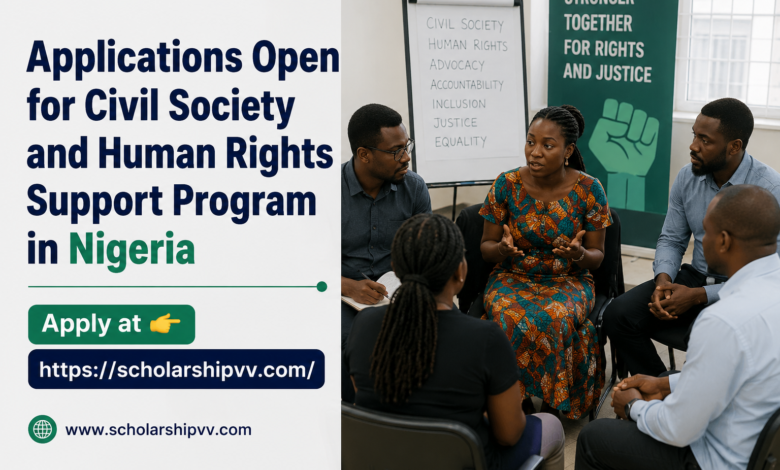
If your organisation works on human rights, good governance, digital rights, climate action, education, or any area of civic development in Nigeria, there is a significant funding opportunity that you should know about right now. The European Commission, through its Delegation to the Federal Republic of Nigeria and ECOWAS, has launched a major call for proposals under its Civil Society and Human Rights Support Programme. This programme is specifically designed to strengthen Nigerian civil society organisations and promote the protection of fundamental freedoms and human rights across the country.
This is not a small, routine grant. The programme covers multiple thematic areas, is structured across several lots, and carries a substantial budget aimed at supporting organisations working at both the national and sub-national level. Whether you run a registered NGO, a community-based organisation, or a faith-based institution that does development work, this guide will walk you through everything you need to know to decide if your organisation qualifies and how to prepare a strong application.
Background: Why the European Commission Is Funding Civil Society in Nigeria
The European Union has had a long-standing partnership with Nigeria built on shared interests in democratic governance, human rights, sustainable development, and regional stability. The EU delegation in Abuja works closely with Nigerian government institutions, civil society actors, and multilateral bodies including ECOWAS to advance these shared goals.
The Civil Society and Human Rights Support Programme is part of the broader European Commission thematic programme on human rights and democracy and its parallel thematic programme for civil society organisations. Both programmes are guided by the EU Human Rights and Democracy Country Strategy for Nigeria, which was adopted in 2021. That strategy identifies the priority areas where EU engagement can have the most meaningful impact, and this current call for applications is a direct product of that strategic framework.
At its core, the global objective of the thematic programme on human rights and democracy is to promote and protect human rights and fundamental freedoms, democracy and the rule of law worldwide. For Nigeria specifically, the global objective of the support to civil societies is to strengthen CSOs as independent actors of good governance and development in their own right.
The European Commission has been consistently investing in civil society capacity in Nigeria over the years, recognising that local organisations are often the most effective vehicles for reaching communities that government institutions do not always prioritise. This programme continues and deepens that commitment.
Overview of the Programme Structure
The current Civil Society and Human Rights Support Programme in Nigeria is divided into five lots, each targeting a different thematic area. Each lot has its own set of objectives, eligible activities, and expected results. Organisations apply under the specific lot that best aligns with their existing mandate and demonstrated experience.
It is important to understand from the start that you cannot apply under a lot that does not match your organisation’s documented history and track record. The European Commission uses a rigorous review process, and reviewers will check whether your organisation genuinely has the experience needed to implement the work described in your application. Generic applications that try to cover multiple unrelated thematic areas will not succeed.
Below is a responsive table summarising all five lots under the programme.
| Lot | Thematic Focus | Key Objectives | Programme Area |
|---|---|---|---|
| Lot 1 | Freedom of Religion or Belief | Support peacebuilding, address violent extremism and religious polarisation; protect persons prosecuted on religious or faith grounds; focus on women and youth participation | Human Rights and Democracy |
| Lot 2 | Promotion of Digital Rights | Promote rights in the digital sphere; harness opportunities and address challenges created by new technologies | Human Rights and Democracy |
| Lot 3 | Digital Skills for Inclusion | Strengthen digital skills of women, hard-to-reach youths and persons with disabilities; reduce the digital gender gap and gaps related to age, location, disability and migration status | Civil Society Organisations |
| Lot 4 | Education Policy and Advocacy | Enable CSOs to contribute to education policy dialogues; support advocacy to expand school curricula with labour-market skills; implement Sangaya Reformation at community and state levels | Civil Society Organisations |
| Lot 5 | Climate Change Action | Enable CSOs to contribute to climate change policies; support research on climate laws and institutions; promote youth-led and women-led solutions to climate-related fragility and conflict | Civil Society Organisations |
Each of these lots feeds into the EU Roadmap for engagement with civil society in Nigeria covering the period from 2021 to 2027. The roadmap has three main pillars: promoting civil society participation in multi-stakeholder policy processes at national and sub-national levels; strengthening CSO capacity to hold authorities accountable and represent citizen interests; and mainstreaming climate change, youth empowerment, and gender equality and social inclusion into EU engagement with Nigerian CSOs.
Lot 1: Freedom of Religion or Belief
Nigeria has one of the most religiously diverse populations in Africa, with roughly equal proportions of Christians and Muslims alongside significant communities following traditional religions. This diversity is a source of cultural richness, but it has also been a fault line for tension and in some cases violent conflict, particularly in the Middle Belt states and parts of the north.
Lot 1 supports relevant institutions, religious leaders and faith-based organisations as well as communities to address key issues such as peacebuilding, human rights, violent extremism, religious polarisation, with a strong focus on the participation of women and youth. It also supports the protection of people who have been prosecuted on religious or faith grounds.
Organisations applying under this lot should have a demonstrable track record in interfaith dialogue, community peacebuilding, religious tolerance programming, or the protection of religious minorities. If your organisation has been doing this work at the grassroots level in communities directly affected by religious tension or violence, this lot was designed with you in mind.
Lot 2: Promotion of Digital Rights
Nigeria has one of the largest internet user bases in Africa, with over 100 million people online and a rapidly growing digital economy. But with that growth comes significant risks: surveillance, censorship, online harassment, the spread of disinformation, and the use of digital tools to suppress dissent. Digital rights have emerged as one of the most important frontier areas of human rights advocacy in the country.
Lot 2 promotes the rights in the digital sphere, to harness opportunities and address challenges provided by new technologies. This could include work on freedom of expression online, protection of journalists and bloggers from digital harassment, advocacy around data protection legislation, digital security training for human rights defenders, or monitoring of state surveillance practices.
Civil society organisations working in this space need to demonstrate both technical competence and a clear human rights framework. The EU wants to fund organisations that can bridge the gap between technology and rights, connecting digital policy conversations to the lived experiences of ordinary Nigerians.
Lot 3: Digital Skills for Inclusion
While Lot 2 focuses on rights in the digital space, Lot 3 addresses the equally urgent problem of who gets to participate in that space at all. Millions of Nigerian women, rural youth, persons with disabilities, and internally displaced persons (IDPs) remain cut off from digital opportunities due to lack of skills, infrastructure, and confidence.
Lot 3 supports CSOs to strengthen digital skills of women, hard-to-reach youths and persons with disabilities in order to create an inclusive digital transformation. It supports and strengthens CSO capacity to reduce the digital gender gap and other gaps related to age, disability, location, social and economic status, discrimination and migration/refugee status.
If your organisation runs digital literacy training, vocational programmes, community technology centres, or advocacy work around internet accessibility for marginalised groups, this is the lot you should be applying under. The emphasis is on practical skills transfer and measurable inclusion outcomes rather than policy documents alone.
Lot 4: Education Policy and Advocacy
Nigeria faces a serious education crisis. According to multiple assessments, the country has one of the largest out-of-school children populations in the world. Even among children who are in school, the quality of education and its relevance to the job market is frequently questioned. Civil society has an important role to play in holding governments accountable for education commitments and in advocating for curriculum reform that prepares young people for the modern economy.
Lot 4 enables civil society to contribute to policy dialogues on education. It supports CSO advocacy to expand school curricula at sub-national level to include relevant labour-market skills particularly for women, vulnerable youths and persons with disabilities. It also supports CSOs to engage with relevant stakeholders on implementing Sangaya Reformation at community and state levels, and supports technical engagement between CSOs and key state institutions on mainstreaming gender and social inclusion in national and sub-national education policies.
The Sangaya Reformation mentioned in the lot description refers to educational reforms in Almajiri schooling, a traditional Islamic educational system prevalent in northern Nigeria, and the push to integrate formal education and vocational skills into those institutions. Organisations with specific experience in this area, or in education policy advocacy at the state level more broadly, will be well-positioned to apply under Lot 4.
Lot 5: Climate Change and Environmental Governance
Climate change is no longer a distant threat for Nigeria. It is already affecting livelihoods through flooding in the south, desertification and drought in the north, and increasing conflicts over land and water resources that drive displacement. Nigerian civil society has a critical role in pushing for climate-responsive governance and in helping communities adapt to these changes.
Lot 5 enables CSOs to contribute to policies that address climate change including issues related to fragility and conflicts. It supports CSOs to conduct research including mapping of laws and institutions on climate change, and supports CSO advocacy and institutionalising CSO-government engagements on climate change. It also supports youth-led and women-led solutions aimed at addressing and mitigating risks and vulnerabilities arising from climate change at community and sub-national levels.
This lot is particularly forward-looking. It recognises that climate change and conflict are deeply intertwined in Nigeria and that the voices of women and young people must be central to any credible climate response. Organisations doing community-based environmental work, climate research, or advocacy for stronger climate legislation will find this lot very relevant.
What Are the Shared Objectives Across Lots 3, 4, and 5?
The three lots under the Civil Society Organisations thematic programme share a common overarching framework. Selected actions aim to strengthen local civil society organisations’ engagement as actors of good governance and development at country level through: strengthening capacities of local CSOs to engage in policy dialogue at national level and in dialogue, implementation and monitoring of EU and national development plans and programmes; improving capacity and ability of local civil society partners to uphold and promote an enabling environment in respective partner country; and strengthening the capacity of local CSOs to engage in gender equality and youth inclusion and strengthened capacity of local women’s and youth partner CSOs.
What this means practically is that regardless of which lot you are applying under, your project design needs to demonstrate a clear connection to policy influence, institutional engagement, and the meaningful participation of women and young people.
Who Can Apply: Eligibility Criteria
Not every organisation can apply for this programme. The European Commission has specific eligibility requirements that all lead applicants must meet, and there are additional requirements related to the specific lot. Here is what you need to know.
Basic Eligibility Requirements
- Your organisation must be a legally registered civil society organisation. This includes NGOs, community-based organisations, faith-based organisations, professional associations, and networks of civil society actors. It does not include government bodies or for-profit companies.
- You must be registered and operating in Nigeria. International NGOs headquartered outside Nigeria may apply as co-applicants but generally cannot lead the application.
- Your organisation must be financially stable. The European Commission will review your financial statements and management systems as part of the evaluation process.
- You must not be subject to any exclusion criteria related to bankruptcy, fraud, corruption, or serious professional misconduct.
Experience Requirements
This is where many organisations fall short. The European Commission requires applicants to have documented experience in the specific thematic area of the lot they are applying for. You cannot apply for Lot 5 on climate change if your organisation’s track record is primarily in digital rights. The reviewers will check your project portfolio and financial statements carefully.
Critically, applicants must operate at the state or local government level in Nigeria with considerable experience working at the grassroots. Failing this, they must have a co-applicant operating at the state or local government level with considerable experience working at the grassroots.
Experience providing and managing sub-grants of up to EUR 60,000 to local organisations will be an added value. If your organisation has managed sub-granting mechanisms before, make sure this is clearly documented in your application because it strengthens your profile considerably.
Project Duration
The initial planned duration of an action may not be lower than 24 months nor exceed 36 months. This means all funded projects must run for a minimum of two years and a maximum of three years. Short-term interventions or pilot projects of less than 24 months will not qualify.
Grant Amounts Available
The programme carries a substantial budget. A previous round of this call under a related reference (EuropeAid/181129/DD/ACT) had a total budget of 3,740,000 Euro. Each lot within the programme has minimum and maximum grant amounts, and individual applications must fall within those bands. Applicants should check the specific guidelines for each lot carefully to understand the financial envelope available and the co-financing requirements.
It is worth noting that EU calls for proposals under programmes like this typically require a co-financing contribution from the lead applicant or their consortium. This means your organisation needs to bring some of its own resources or secure additional funding partners to cover a portion of the project costs. This co-financing requirement is meant to ensure that grantees have genuine ownership of the project and are not entirely dependent on EU funding.
Key Deadlines You Need to Know
The current open call under the Civil Society and Human Rights Support Programme in Nigeria has a deadline of June 19, 2026. This is a hard deadline and the EU Delegation does not extend deadlines for individual organisations except in exceptional circumstances that affect all applicants equally.
The EU call-for-proposals process typically involves a two-stage submission system. In the first stage, applicants submit a concept note, which is a shorter document outlining the project idea, the target group, the expected results, and the budget range. Organisations whose concept notes pass the first stage are then invited to submit a full application. You should begin preparing your concept note immediately if you intend to apply.
Past rounds of this programme required concept note submissions by a specific date, with full applications invited only from shortlisted organisations. Keep checking the official EU delegation page and the European Commission Funding and Tender Opportunities portal for the most current deadline details and any updates to the process.
How to Apply for the Civil Society and Human Rights Support Programme
The application process for EU-funded calls for proposals in Nigeria follows a structured procedure. Here is a step-by-step guide to help your organisation navigate it.
Step 1: Read the Guidelines for Applicants
The full guidelines for applicants are available on the European Commission Funding and Tender Opportunities portal. These guidelines are the definitive document for each lot and contain all the information about eligibility, evaluation criteria, co-financing requirements, financial management, and reporting obligations. Do not begin drafting your application until you have read these guidelines in full for the specific lot you are targeting. Many organisations make avoidable mistakes because they rely on summaries instead of reading the source document.
Step 2: Check Your Organisation Against the Eligibility Criteria
Before investing significant time in writing, do an honest internal check. Does your organisation meet all the eligibility criteria? Do you have documented experience in the lot theme? Do you have audited financial statements for the required number of years? Do you have a co-applicant with grassroots experience if your own organisation operates primarily at the national level? If there are gaps, identify them early and decide whether they can be addressed by forming a consortium with a stronger partner organisation.
Step 3: Design Your Project Around Expected Results
EU calls for proposals are results-oriented. This means your project design should start from the change you want to see in the world, then work backwards to the activities that will produce those changes. Use a logical framework or similar results-based management tool to structure your thinking. Your proposed activities should have a clear and credible link to the specific objectives and priorities of the lot you are applying under. Vague activities with unmeasurable outcomes will not score well.
Step 4: Prepare Your Concept Note
The concept note is typically three to five pages long and covers the core project idea, the problem being addressed, the target groups, the main activities, the expected results, and a rough budget estimate. Keep it focused and direct. Reviewers read hundreds of concept notes and have limited time for each one. Clarity and specificity will serve you better than ambitious language and broad aspirations.
Step 5: Submit Through the EU Portal
Submissions for EU-funded calls in Nigeria must be made through the European Commission’s online portal. Paper submissions or email submissions are not accepted. Your organisation will need to create an account on the portal if it does not already have one, and this process can take a few days, so do not leave it until the last moment. Ensure all attached documents are in the correct format and that your application is complete before you click submit.
You can begin the application process by visiting the European Commission Funding and Tenders Opportunities Portal and searching for the relevant call reference. For further details from the EU Delegation in Nigeria, visit the EU Delegation to Nigeria and ECOWAS official page, where grants, tenders, and calls for proposals are listed and regularly updated.
Tips for Writing a Strong Application
Applying for EU funding is competitive and demanding. The process rewards organisations that are well-organised, have a strong track record, and can articulate their work in a structured and evidence-based way. Here are some practical tips to improve your chances.
Be Honest About What You Can Deliver
One of the most common mistakes organisations make is over-promising. Reviewers are experienced and they can tell the difference between an ambitious but credible project and one that has been padded to look impressive. Propose activities that your team genuinely has the capacity and expertise to carry out. An honest, achievable project is far more likely to be funded than a spectacular one with no credible delivery plan.
Ground Your Application in Evidence
Use data, research findings, and documented needs assessments to demonstrate why the problem you are addressing is real and significant. Reference reputable sources like UNICEF, the World Bank, the Nigerian National Human Rights Commission, or credible civil society research. An application grounded in evidence signals to reviewers that your organisation understands the context it is working in and does not just respond to funding calls opportunistically.
Show Your Grassroots Connections
The EU values organisations that work directly with communities. If your organisation has field offices, community partners, or a history of community mobilisation, make sure this is visible in your application. Programme descriptions that speak only about reports, workshops, and policy papers without connecting to community-level change will score less well than ones that demonstrate real engagement with the people most affected by the issues being addressed.
Plan Your Budget Carefully
Your budget should be detailed, realistic, and directly linked to your planned activities. Every budget line should be justifiable in terms of what it will contribute to the project’s results. Reviewers scrutinise budgets carefully for coherence and value for money. Avoid inflated overheads or vague budget categories. If you are required to provide a co-financing contribution, be clear about where that money is coming from.
Consider Forming a Consortium
If your organisation is strong in policy advocacy but lacks grassroots reach, consider partnering with a community-based organisation that has strong local networks. If you have deep thematic expertise in climate change but limited experience managing large grants, consider bringing in a co-applicant with stronger financial management capacity. Consortiums that combine complementary strengths often produce stronger applications than single organisations trying to do everything on their own.
The Broader Context: Civil Society Space in Nigeria
To fully appreciate why this programme matters, it helps to understand the operating environment for civil society in Nigeria. The country has a long and distinguished history of civic activism, dating back to the struggles for independence and the campaigns against military rule in the 1980s and 1990s. Nigeria’s civil society has produced remarkable human rights defenders, journalists, lawyers, and community organisers who have contributed significantly to democratisation and accountability.
However, that space has faced increasing pressure in recent years. Legislation and regulatory frameworks governing NGO operations have at times been used to restrict civic activities. Digital platforms, while expanding the reach of civil society, have also been subject to government attempts at censorship and control. Human rights defenders have faced harassment and in some cases violence for their work.
The European Commission’s investment in this programme is therefore not just about funding projects. It is a statement of support for civil society as a necessary and legitimate actor in Nigerian development and governance. By strengthening the capacity of local CSOs, the programme is investing in the long-term health of Nigerian democracy.
Other Related Civil Society Funding Opportunities in Nigeria
While the European Commission programme is the major opportunity highlighted in this article, it is worth knowing that several other funders are currently active in the Nigerian civil society space. Organisations that are not eligible or ready for this particular call may find these alternatives useful.
The Nigeria Youth Futures Fund offers catalytic grants of up to US$50,000 for organisations focused on youth ecosystem building and governance. The CSR-Hub runs a programme on civic space protection and regulatory compliance open to civil society organisations in Nigeria, Ghana, and Senegal, targeting organisations that have been active for at least two years and have a clear commitment to social justice and human rights. For organisations working in immunisation and public health, Gavi, the Vaccine Alliance, has previously made funding available to Nigerian NGOs focused on increasing vaccination coverage. For digital civic innovation, the Digital Action Lab programme supports civil society organisations developing digital solutions that promote civic engagement and inclusive democracy.
If you want to stay updated on all available funding opportunities for Nigerian civil society, resources like fundsforNGOs Nigeria page and African NGOs funding roundups publish regular curated lists of grants relevant to Nigerian organisations.
Frequently Asked Questions
Can international NGOs apply as lead applicants?
Generally, the European Commission’s CSO thematic programme for Nigeria prioritises local Nigerian civil society organisations as lead applicants. International NGOs may participate as co-applicants or affiliated entities, but they typically cannot lead the application. Check the specific guidelines for each lot to confirm the nationality requirements for the lead applicant role in the current call.
Can our organisation apply under more than one lot?
It depends on the specific call guidelines. In some EU calls, organisations are permitted to apply under multiple lots as long as each application is genuinely distinct and the organisation can demonstrate relevant experience for each lot. However, submitting the same application under multiple lots or applying for lots outside your organisation’s documented experience area is a violation of the guidelines and will result in disqualification. Always check the specific rules in the guidelines for the current call.
Is there a minimum grant amount?
Yes. Any grant requested under this call for proposals must fall between the specified minimum and maximum amounts. The exact floor and ceiling for each lot are specified in the guidelines for applicants. Submitting a budget outside this range will make your application ineligible regardless of its quality.
What language must the application be submitted in?
All EU call-for-proposals applications must be submitted in English. Supporting documents that are in another language, including official certificates, audit reports, or registration documents, must be accompanied by certified English translations.
Can organisations that received funding in a previous round of this programme apply again?
Yes. Prior receipt of EU funding does not disqualify an organisation from applying to a new call. In fact, a documented track record of successfully managing EU-funded projects is often viewed positively by reviewers. However, organisations with outstanding compliance issues, unresolved audit findings, or unexplained underspending in previous grants may face additional scrutiny.
Final Thoughts
The Civil Society and Human Rights Support Programme in Nigeria is one of the most significant funding opportunities currently open to Nigerian civil society organisations. It covers five important thematic areas, is backed by the European Commission, and is structured to support organisations that are already doing real, credible work at the grassroots level. If your organisation works in any of the areas covered by the five lots, and if you can demonstrate the experience and capacity required, this programme is worth your full attention.
The deadline of June 19, 2026 is approaching, and the process of preparing a strong EU application takes time. Start by downloading the guidelines from the official portal, checking your eligibility honestly, and assembling your project team. Getting the documentation right from the beginning will save you enormous effort later in the process.
Ready to get started? Visit the European Commission Funding and Tenders Opportunities Portal to access the official guidelines, application forms, and submission system for all lots under this programme. You can also contact the EU Delegation to Nigeria and ECOWAS in Abuja directly through their official website for any programme-specific enquiries.
Good luck with your application. Nigeria’s civil society deserves strong, well-resourced organisations working on its behalf, and this programme is one of the most meaningful opportunities available right now to make that happen.