Last Updated: 06 Jun 2026 at 08:26 AM
Updated By: Uwandu Chinwe
- What is the World Trade Organization?
- Overview of the WTO Internship Programme 2026
- Why Is This Internship Particularly Special?
- The Three Streams of the WTO Internship Programme 2026
- What Divisions and Subject Areas Do WTO Interns Work In?
- Financial Benefits of the WTO Internship 2026
- What an Intern Roster Means for Your Application
- Eligibility Criteria for the WTO Internship 2026
- General Eligibility Requirements for All Streams
- Additional Requirements for the China LDC and Accessions Programme
- Additional Requirements for the WTO Support Programme for Doctoral Studies
- Language Requirements
- Required Documents for the WTO Internship Application
- How to Apply for the WTO Internship 2026 Step by Step
- Step 1: Visit the Official WTO Careers Portal
- Step 2: Create a Workday Account
- Step 3: Choose Your Internship Stream
- Step 4: Complete the Online Application Form
- Step 5: Upload Your Supporting Documents
- Step 6: Write a Strong Motivation Letter
- Step 7: Submit Before the Deadline
- Step 8: Wait for Contact from the WTO
- Living in Geneva, Switzerland as a WTO Intern
- Career Benefits of the WTO Internship
- Tips to Make Your WTO Internship Application Stand Out
- Frequently Asked Questions (FAQs)
- Is IELTS required to apply for the WTO Internship?
- Is there an application fee?
- Can undergraduate students apply?
- How much is the WTO internship stipend?
- Does the WTO cover travel expenses?
- What is the age limit for the WTO Internship?
- Can I apply if I have already done a WTO internship before?
- Will the internship lead to a permanent job at the WTO?
- What is the Swiss legitimation card type H?
- Important Dates to Remember
- Final Thoughts
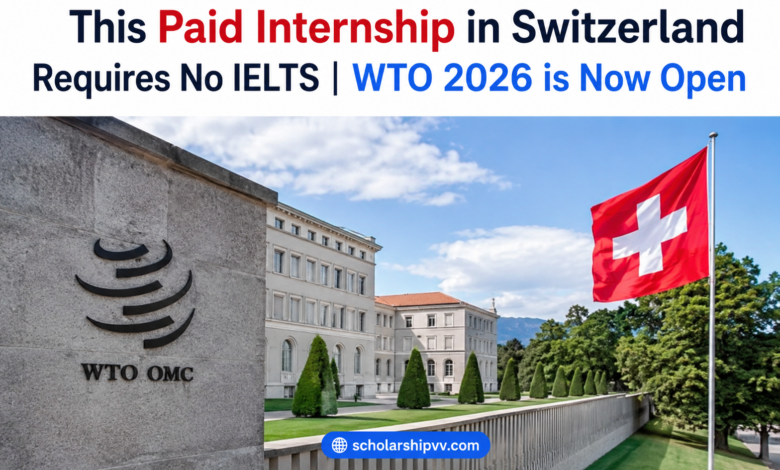
If you have ever dreamed of working at the center of global trade policy in one of the most internationally significant cities in the world, the World Trade Organization Internship 2026 in Switzerland could be exactly the opportunity you have been looking for. This is a paid internship program hosted at the WTO Secretariat in Geneva, Switzerland, and it is open to postgraduate students and recent graduates from countries around the world. No IELTS score is required to apply, there is no application fee, and selected interns receive a daily financial allowance while gaining real hands-on experience inside one of the most influential international organizations on the planet.
This article covers everything you need to know about the WTO Internship 2026, including what the organization does, the three internship streams available, who can apply, what the financial benefits look like, what documents you need, and a step-by-step guide to submitting your application. Whether you are studying economics, international law, trade policy, political science, or public administration, this program could be a game-changing entry point into a career in global governance and multilateral trade.
What is the World Trade Organization?
Before diving into the internship details, it helps to understand exactly what the WTO is and why an internship there is such a valuable career opportunity.
The World Trade Organization is the only international organization that deals exclusively with the rules of trade between nations. It was established on 1 January 1995, replacing the General Agreement on Tariffs and Trade (GATT), which had been governing international trade since 1948. The WTO is headquartered in Geneva, Switzerland, and currently has 164 member countries, representing more than 98 percent of global trade.
The WTO’s core function is to ensure that international trade flows as smoothly, predictably, and freely as possible. It does this by providing a framework of trade agreements that member governments negotiate and sign, a forum for ongoing trade negotiations, and a formal dispute settlement mechanism to resolve trade conflicts between nations. The organization also provides technical assistance and training to developing countries to help them integrate into the global trading system.
Working at the WTO means working at the intersection of law, economics, diplomacy, politics, and development. It means being part of a multilateral system that affects the lives of billions of people across every continent. For any student or young professional with ambitions in international affairs, global policy, trade economics, or international law, a WTO internship is one of the most credible and career-defining experiences available.
Overview of the WTO Internship Programme 2026
Here is a quick summary of the key facts about the WTO Internship Programme 2026 before we go into full detail:
- Host Organization: World Trade Organization (WTO)
- Location: WTO Secretariat, Geneva, Switzerland
- Internship Type: Paid
- Duration: Minimum 3 months, maximum 6 months
- Daily Allowance: CHF 60 per day (including weekends and official holidays) for the General Programme; CHF 90 per day for the China LDC and Accessions Programme
- Number of Streams: Three separate internship programs
- Eligible Nationalities: Nationals of WTO member states, observer governments, or accession countries
- IELTS Required: No
- Application Fee: None
- Age Requirement: Between 21 and 30 years old
- Application Deadline: 31 December 2026 (rolling applications)
- Application Method: Online via the WTO Workday recruitment portal
Why Is This Internship Particularly Special?
There are thousands of international internship programs around the world, so what makes the WTO internship stand out from the crowd? Here are a few reasons why students from over 100 countries compete for these positions every year.
First, the WTO is not just any organization. It shapes the rules that govern trillions of dollars in global trade annually. Working inside this institution gives you a view of international policy-making that no classroom, textbook, or online course can replicate. You see how trade disputes are resolved, how member countries negotiate, how technical assistance is delivered to developing nations, and how the multilateral trading system actually functions in practice.
Second, Geneva is one of the most important diplomatic and international cities in the world. It is home not only to the WTO but also to the United Nations European headquarters, the World Health Organization, the International Labour Organization, the International Committee of the Red Cross, and hundreds of other international bodies and non-governmental organizations. Spending three to six months in Geneva as a WTO intern puts you in the middle of a network of international professionals and institutions that is almost impossible to replicate anywhere else.
Third, IELTS is not required. This is a huge advantage for students from non-English-speaking countries who want to work at an international organization but do not have a formal English proficiency certificate. The WTO uses English as its primary working language, so strong English communication skills are expected, but you do not need to submit an IELTS or TOEFL score as part of your application. This opens the door for many talented students who would otherwise be excluded from international opportunities.
Finally, there is no application fee. The WTO does not charge any fee at any stage of the recruitment process, including application, interview, processing, or training. If you encounter any platform or agent asking you to pay to apply for this internship, that is a red flag and should be treated as a potential scam.
The Three Streams of the WTO Internship Programme 2026
The WTO maintains three distinct internship programs, each designed for a different profile of applicant. Understanding which stream applies to you is the first step in the application process.
| Program Stream | Who It Is For | Daily Allowance | Travel Covered? | Health Insurance | Duration |
|---|---|---|---|---|---|
| WTO General Internship Programme | Postgraduate students and recent graduates from all WTO member states and accession countries | CHF 60/day (including weekends and official holidays) | No. Travel to and from Geneva is the intern’s own responsibility | Intern must arrange own health insurance | 3 to 6 months |
| China LDC and Accessions Programme (China WTO Accession Internship Programme) | Nationals of Least Developed Countries (LDCs) and developing economies engaged in WTO accession processes; sponsored by the Government of China | CHF 90/day (higher rate than the General Programme) | Yes. Round-trip travel expenses to Geneva are covered | CHF 100/month health insurance subsidy provided | 6 months (split between Accessions Division and other WTO divisions) |
| WTO Support Programme for Doctoral Studies (PhD Internship Programme) | PhD candidates from developing countries conducting trade-related research at the writing-up stage (at least 75% of doctoral work completed) | CHF 60/day | Yes. Travel expenses to and from Geneva are covered | Medical insurance provided | 3 to 6 months (based on individual arrangements) |
The China LDC and Accessions Programme is managed jointly by the Institute for Training and Technical Cooperation (ITTC), the Accessions Division, and the Human Resources Division of the WTO, in coordination with the Government of China. Up to 10 internships are available annually under this stream, with 5 positions in the Accessions Division and 5 in other WTO divisions. The Government of China and the WTO meet annually to review the implementation and operation of this program.
The WTO Support Programme for Doctoral Studies is a more specialized track. It is designed for PhD students who are at an advanced stage of their research and can contribute meaningfully to the WTO’s own research and analytical work while completing their dissertation. Candidates must be working in English, French, or Spanish.
What Divisions and Subject Areas Do WTO Interns Work In?
One of the most attractive features of the WTO Internship Programme is the sheer breadth of subject areas and divisions that interns can be placed in. Your assignment within the WTO will depend on the needs of individual divisions at the time of your internship, as well as your academic background, skills, and areas of expertise.
The WTO Secretariat has divisions covering a wide range of specialized functions. Interns have been placed in divisions covering areas such as:
- Trade Law and Dispute Settlement: Legal analysis of WTO agreements, working on dispute settlement cases, and assisting with legal research related to multilateral trade rules
- Economics, Research, and Statistics: Quantitative analysis, economic policy research, trade data interpretation, and contributing to the WTO’s flagship reports and publications
- Trade Policy: Monitoring and analysis of trade measures, tariff and non-tariff barrier research, and policy documentation
- Finance and Corporate Services: Financial analysis, budgetary reporting, and administrative support for the WTO’s operational functions
- Human Resources Division: Recruitment processes, organizational development, and talent management in an international setting
- Information Technology: Digital tools for trade data management, database administration, and IT support
- Communications and External Relations: Media relations, public outreach, content creation, and managing communications for the organization
- Language Services: Translation, interpretation support, and terminology management for WTO documents and negotiations in English, French, and Spanish
- Information and Document Management: Records management, archiving, and knowledge organization
- Administration: Operational and logistical support for the Secretariat’s day-to-day functions
In some cases, an internship may even be split between two divisions, with three months in each, as long as the total does not exceed six months. This allows interns to gain cross-functional experience within the organization.
Financial Benefits of the WTO Internship 2026
Let us talk numbers, because this matters for anyone planning an internship abroad.
Interns on the General Programme receive a daily allowance of CHF 60. This allowance is paid including weekends and official holidays that fall within the selected internship period. Over a full six-month internship of approximately 180 days, this works out to a total allowance of approximately CHF 10,800. At current exchange rates, CHF 60 is roughly equivalent to USD 67 to USD 70 per day, or around USD 2,000 per month.
Interns on the China LDC and Accessions Programme receive a higher daily allowance of CHF 90, which reflects the additional financial challenges faced by candidates from least developed countries. This rate also includes travel expense coverage and a monthly health insurance subsidy of CHF 100, making the total support package for this stream considerably more generous.
It is important to be transparent about what the stipend does and does not cover. Geneva is one of the most expensive cities in the world. The CHF 60 per day allowance will help cover part of your living costs, but you will likely need additional savings or financial support to cover accommodation, food, local transportation, personal expenses, and health insurance if you are on the General Programme. The WTO estimates that living costs in Geneva can exceed CHF 2,500 to CHF 3,000 per month for a single person, depending on accommodation choices and lifestyle.
That said, many interns find affordable accommodation through WTO networks, university housing contacts, or shared flat arrangements in the wider Geneva region, including neighborhoods across the French border in neighboring areas. Planning your finances well before arriving is one of the most important things you can do to make your WTO internship experience genuinely enjoyable.
What an Intern Roster Means for Your Application
The WTO maintains a roster of suitable candidates from which interns are selected across the year. When you submit your application, if you meet the eligibility criteria and your profile is shortlisted, your name is added to this roster. Names are kept on the roster for one year.
Divisions within the WTO then draw from this roster when they have an internship need. This means that even if you are not immediately placed after applying, you may still be contacted for a placement later in the year as divisional needs arise. It is also worth knowing that in addition to the standard internship programme, the WTO sometimes recruits interns at short notice for specific tasks or projects. These short-notice placements are also drawn from the existing roster.
The practical takeaway here is that applying early is genuinely important. The sooner your application is submitted and you are added to the roster, the longer the window during which you could be contacted for a placement in 2026.
Eligibility Criteria for the WTO Internship 2026
Meeting the eligibility criteria is the foundation of a successful application. The WTO is very specific about who qualifies for each stream of the internship programme.
General Eligibility Requirements for All Streams
- Must be a national of a WTO member state, an observer government, or a country or customs territory currently engaged in accession negotiations with the WTO
- Must be between 21 and 30 years of age at the time of the internship
- Must have completed an undergraduate degree in a relevant discipline such as economics, law, political science, international relations, public policy, finance, computer science, communications, or a related field
- Must have completed at least one year of postgraduate studies, or must be a recent graduate holding an advanced university degree (master’s or PhD)
- Must not have previously participated in any WTO internship programme
- Must demonstrate the ability to cover additional costs of living in Geneva beyond the provided stipend
Additional Requirements for the China LDC and Accessions Programme
- Must be a national of a Least Developed Country (LDC) or a developing economy currently engaged in WTO accession negotiations
- Must be at postgraduate level or a recent graduate
- Must be aged 30 or under at the time of the internship
Additional Requirements for the WTO Support Programme for Doctoral Studies
- Must be a PhD candidate from a developing country or least developed country
- Must be at the thesis writing-up stage, with at least 75 percent of doctoral work completed
- Research topic must be related to trade and WTO disciplines
- Must be capable of conducting and presenting research in English, French, or Spanish
Language Requirements
English is the primary working language of the WTO Secretariat. All interns must have strong communication skills in English, both written and spoken. French is the second official working language and working proficiency in French is highly preferred and will strengthen any application significantly. Spanish is the third official language of the WTO. Knowledge of additional languages can be an advantage in certain divisions, particularly in Language Services. However, IELTS is not required. You do not need to submit a formal English proficiency test score with your application.
Required Documents for the WTO Internship Application
Before you sit down to apply, gather all of the following documents. Having everything ready in advance will save you time and ensure you can complete the online form in one session:
- An updated and well-structured curriculum vitae (CV) or resume, tailored to highlight experience relevant to trade, economics, law, or your chosen area
- A compelling motivation letter or statement of purpose explaining your interest in international trade, your career goals, and why you want to intern at the WTO specifically
- Official academic transcripts from your undergraduate and postgraduate institutions
- Proof of your postgraduate enrollment or completion (enrollment letter from your university, or your master’s/PhD degree certificate if already completed)
- A valid copy of your national passport or identity document confirming your nationality
- At least one to two reference letters or contact details for referees from academic supervisors or professional mentors who can speak to your qualifications and character
- For the PhD Programme only: a supervisor’s letter confirming your stage of doctoral research and confirming that at least 75 percent of your thesis work is complete
- Proof of health insurance coverage, or confirmation that you will obtain it before arriving in Geneva
Make sure your CV and motivation letter are tailored specifically for the WTO and for the division or subject area you are applying to. A generic application that could have been written for any organization is unlikely to compete successfully with a focused application that clearly demonstrates genuine knowledge of and interest in the WTO’s work and mandate.
How to Apply for the WTO Internship 2026 Step by Step
The application process for the WTO Internship 2026 is entirely online through the WTO’s official Workday recruitment portal. Here is a step-by-step walkthrough of exactly what you need to do:
Step 1: Visit the Official WTO Careers Portal
Go to the official WTO website and navigate to the Internship section under the Careers or Vacancies page. This is the only legitimate platform through which you should apply. Do not apply through third-party agents or platforms that charge a fee.
Step 2: Create a Workday Account
The WTO uses Workday as its online human resources and recruitment system. You will need to create a profile on this platform. Use a professional email address and make sure your profile accurately reflects your academic background and nationality.
Step 3: Choose Your Internship Stream
Identify which of the three internship streams you are eligible for and most suited to: the General WTO Internship Programme, the China LDC and Accessions Programme, or the WTO Support Programme for Doctoral Studies. Select the relevant stream in your application and tailor your submission accordingly.
Step 4: Complete the Online Application Form
Fill in all sections of the online application form carefully and completely. Double-check your personal details, nationality, academic qualifications, and language skills. Incomplete applications are typically disqualified without review.
Step 5: Upload Your Supporting Documents
Upload your CV, motivation letter, academic transcripts, proof of enrollment or degree completion, passport copy, and any reference letters. Make sure all files are clear, legible, and in the requested format (usually PDF). File names should be professional and descriptive.
Step 6: Write a Strong Motivation Letter
Your motivation letter is one of the most important parts of your application. Use it to clearly explain why you are interested in the WTO specifically, what you know about the multilateral trading system, how your academic background connects to the work of the WTO, and what you hope to contribute and gain during your internship. Be specific, not vague. Mention the division or subject area you are most interested in and why.
Step 7: Submit Before the Deadline
The application deadline for the WTO Internship 2026 is 31 December 2026. However, because applications are processed on a rolling basis and roster placements happen throughout the year, applying as early as possible gives you a significantly better chance of being considered for a placement in 2026. The sooner you are on the roster, the longer the window during which a WTO division can select you.
Step 8: Wait for Contact from the WTO
After submitting your application, only shortlisted candidates will be contacted. If you are shortlisted, you may be invited for an interview (usually conducted remotely or by phone). If successful, an internship agreement will be established between you and the Director of the Human Resources Division of the WTO, specifying the conditions of service, the start and end dates, and the financial arrangements.
To begin your application through the official WTO recruitment platform, use the link below:
Apply Now for the WTO Internship Programme 2026
Living in Geneva, Switzerland as a WTO Intern
Geneva is one of the most beautiful and culturally rich cities in the world, and living there for three to six months is an experience in itself. But it helps to go in with realistic expectations about what daily life as an intern in Geneva actually looks like.
Geneva sits on the shores of Lake Geneva (Lac Leman), surrounded by the Alps and the Jura mountains. The city is clean, safe, efficient, and extraordinarily international. With more than 40 percent of its residents being foreign nationals, and with dozens of international organizations headquartered there, Geneva has a genuinely cosmopolitan energy. The food, public transportation, parks, and cultural institutions are all world-class.
That said, Geneva is consistently ranked among the most expensive cities in the world. Accommodation is the single biggest expense. A furnished room in a shared apartment within the city costs roughly CHF 1,000 to CHF 1,400 per month. Some interns choose to live in nearby Swiss towns or across the French border, where rents can be significantly cheaper, and commute into Geneva by train or tram. The Swiss public transport system is excellent and makes this a very practical option.
Food costs can also be high if you eat out regularly. Cooking at home is the most practical way to manage living costs on the intern allowance. Most WTO interns also have access to subsidized meals at the WTO cafeteria during working hours, which helps reduce daily food expenses considerably.
Health insurance is mandatory in Switzerland. If you are on the General Programme, you are responsible for your own health insurance coverage. Make sure you arrange this before you arrive, as it is a legal requirement and you will need to show proof of coverage when you register with Swiss authorities.
Once you arrive, you will receive a Swiss legitimation card type “H,” which serves as both a residence and work permit for the duration of your internship. This card is issued through the WTO and gives you legal status to live and work in Switzerland for the internship period.
Career Benefits of the WTO Internship
Beyond the daily CHF 60 allowance and the unique experience of living in Geneva, the WTO internship offers career benefits that are genuinely hard to put a price on.
Working inside a major international organization gives you a professional credibility that is recognized globally. Former WTO interns have gone on to work in international law firms, central banks, finance ministries, United Nations agencies, development banks like the World Bank and the Asian Development Bank, think tanks, academic institutions, and international NGOs. The WTO internship is widely respected as a credential in the fields of international economics, trade law, development policy, and global governance.
The professional network you build in Geneva is one of the most lasting benefits. You will work alongside economists, lawyers, policy analysts, diplomats, and trade officials from dozens of countries. These professional relationships often extend well beyond the internship period and can open doors to future job opportunities, research collaborations, and career development that would otherwise take years to build.
It is also worth noting that while a WTO internship does not guarantee future employment at the WTO itself, interns who perform well are eligible to apply for external vacancy positions at the organization after their internship ends. Many former interns have returned to the WTO in full-time roles, often several years after their initial internship experience.
Tips to Make Your WTO Internship Application Stand Out
Competition for WTO internship positions is real. Thousands of students from around the world apply each year. Here are some honest and practical tips to give your application the best possible chance:
- Tailor your motivation letter to the WTO’s mandate: Show that you have done your homework. Demonstrate genuine knowledge of what the WTO does, what current challenges face the multilateral trading system, and how your background connects to that work. Generic motivation letters are immediately obvious and rarely successful.
- Highlight language skills: If you speak French in addition to English, make sure this is clearly stated and prominently featured in your application. French proficiency is a genuine differentiator for the WTO.
- Emphasize international exposure: Any experience you have of working in multicultural environments, studying abroad, or engaging with international organizations and projects should be clearly mentioned.
- Get strong references: A reference letter from a well-regarded academic supervisor who can speak specifically to your analytical abilities and research skills carries real weight. Choose referees who know your work closely, not just your name.
- Apply as early as possible: The rolling application process means early applicants have a longer window on the roster. Do not wait until late December when the deadline passes.
- Specify your area of interest: While the WTO assigns interns based on divisional needs, clearly stating which areas or divisions interest you most and why shows the selection team that you have thought carefully about how you can contribute.
- Make your CV clean and professional: A clear, well-structured CV without unnecessary decorations or overly creative formatting is more appropriate for an international organization of this type than a heavily designed template.
Frequently Asked Questions (FAQs)
Is IELTS required to apply for the WTO Internship?
No. IELTS is not required for the WTO Internship Programme 2026. English is the primary working language, and strong English communication skills are expected, but you do not need to submit a formal English language test score with your application.
Is there an application fee?
No. The World Trade Organization does not charge any fee at any stage of the recruitment process. This includes the initial application, any interview stage, document processing, and training. If any third-party platform asks you to pay a fee to apply, do not proceed, as this is not an authorized part of the process.
Can undergraduate students apply?
No. You must have completed your undergraduate degree and be enrolled in or have completed at least one year of postgraduate studies (master’s or PhD level). Undergraduate-only applicants are not eligible for any stream of the WTO Internship Programme.
How much is the WTO internship stipend?
Interns on the General Programme receive CHF 60 per day, including weekends and official holidays. Interns on the China LDC and Accessions Programme receive CHF 90 per day, plus travel expenses and a monthly health insurance subsidy of CHF 100. Over a full six-month placement, the General Programme stipend totals approximately CHF 10,800.
Does the WTO cover travel expenses?
For the General WTO Internship Programme, travel expenses to and from Geneva are the intern’s own responsibility and are not covered by the organization. For the China LDC and Accessions Programme and the WTO Support Programme for Doctoral Studies, travel expenses are covered.
What is the age limit for the WTO Internship?
Applicants must be between 21 and 30 years of age at the time of the internship. For the China LDC programme specifically, candidates must be 30 or under.
Can I apply if I have already done a WTO internship before?
No. The WTO Internship Programme is explicitly open only to candidates who have not previously participated in any WTO internship programme. Past interns are not eligible to apply again.
Will the internship lead to a permanent job at the WTO?
A WTO internship does not guarantee future employment at the organization. However, interns are eligible to apply for external vacancy positions after their internship ends, and many former interns have returned to the WTO in full-time roles later in their careers.
What is the Swiss legitimation card type H?
The Swiss legitimation card type H is a document issued to WTO interns that serves as both a residence permit and a work permit for the duration of the internship in Switzerland. It gives you legal status to live and work in Geneva during your placement.
Important Dates to Remember
- Application Portal: Open and accepting applications now on a rolling basis
- Application Deadline: 31 December 2026
- Roster Duration: Approved candidate profiles are kept on the roster for one year from the date of approval
- Internship Start Dates: Flexible; interns can commence at any time during the year based on divisional needs
- Internship Duration: Minimum 3 months, maximum 6 months with no extensions
Final Thoughts
The World Trade Organization Internship 2026 in Switzerland is one of the most prestigious and genuinely valuable international internship opportunities available to postgraduate students and recent graduates in the fields of trade, economics, law, policy, finance, and international relations. The fact that it is a paid opportunity in Geneva, requires no IELTS score, and charges no application fee makes it accessible to talented candidates from all over the world, regardless of their financial background or home country.
Yes, the competition is real and the selection process is merit-based and rigorous. But that is precisely what makes a WTO internship so valuable to your career. If you have the academic background, the genuine interest in global trade and multilateral policy, and the drive to contribute meaningfully to an international organization of this scale, you have every reason to put together a strong application and submit it as early as possible.
Geneva is waiting. The multilateral trading system needs the next generation of economists, lawyers, policy analysts, and trade experts. Start your application today and take the first step toward a career that genuinely matters on a global scale.
Click Here to Apply for the WTO Internship Programme 2026 on the Official WTO Website
Note: All program details, stipend rates, eligibility criteria, and deadlines are sourced from publicly available information and official WTO channels. Details are subject to change. Always verify the most current information directly on the official WTO Careers website before submitting your application.