Application Letter for Scholarship Request Format 2026 | Easy Guide
Ask any scholarship winner what made the difference in their application, and most will point to the same document: the application letter for scholarship. Grades travel in packages of dozens. Test scores blur together on a reviewer’s screen. Résumés start looking interchangeable after the first hundred. But a well-crafted, specific, and deeply personal scholarship application letter one that tells a real story, speaks directly to the committee’s mission, and makes a case that only you could make is the document that lifts an application from the pile and into the finalist shortlist.
This guide is the most comprehensive resource available on how to write a scholarship application letter in 2026. Whether you are a high school senior applying for a college scholarship, an undergraduate writing a merit-based scholarship letter, a graduate student requesting research funding, or an international student seeking a fully funded award, this article will walk you through every element of a winning scholarship application letter — from the correct format and header to the final sign-off with a sample structure, real examples, a full paragraph guide, and all the common mistakes you need to avoid.
What Is an Application Letter for Scholarship?
A scholarship application letter is a formal document submitted by a student to a scholarship committee, foundation, university, government agency, or private donor, explaining why the applicant deserves to be awarded the scholarship in question. It is one of the most important documents in the entire scholarship application package — serving as direct communication between the student and the committee — and it plays a role that no other document in the application can fully replicate.
While your academic transcript tells the committee what grades you earned, and your résumé lists your activities and achievements, and your recommendation letters describe how others see you, the scholarship application letter is the only place in your entire application where your authentic voice is heard. It gives you control over the narrative of your candidacy, and it allows you to present the parts of your story that numbers and lists cannot capture — your motivation, your values, your challenges, your character, and your vision for the future.
Scholarship letters are an essential part of applying for financial support across all levels and types of awards. They can take many forms, including application letters, recommendation letters, motivation letters, and thank-you letters, each with a specific purpose in the scholarship process. In this article, we focus exclusively on the application letter — the document written by the student to the committee to request the scholarship.
Why Scholarship Application Letters Matter So Much
Scholarship committees process hundreds — and at large programs, thousands — of applications every cycle. Many organizations get hundreds, if not thousands, of applications, so your essay and letter are the place to make a personal connection. A single strong letter could mean the difference between a $500 or $5,000 award. But the stakes go much higher than that for fully funded scholarships.
Consider what a scholarship committee actually sees when they open your application: a transcript with numbers, a list of activities on a résumé, test scores, and a set of recommendation letters. For competitive scholarships, many applicants will look almost identical at this level — similar GPAs, similar extracurriculars, similar standardized test scores. Scholarship committees often want to know not just what you’ve achieved, but what you’ve overcome and what motivates you. That context — the human context of your academic journey — can only be provided by your application letter.
Furthermore, the scholarship application letter serves a practical administrative function that is easy to overlook: it is a formal communication tool. An application letter demonstrates that the student can express themselves formally, follow proper structure, and present their request in a respectful manner. A letter that is poorly formatted, grammatically inconsistent, or incorrectly addressed signals to the committee that the applicant lacks the professionalism expected of a scholarship recipient. Conversely, a letter that is well-structured, clearly written, and formally correct signals competence, attention to detail, and respect for the process.
Types of Scholarship Application Letters
Not every scholarship requires the same type of application letter. Understanding the specific type of letter required by the scholarship you are applying for will help you calibrate your tone, length, and content appropriately.
General Scholarship Application Letter (Cover Letter Format): The most common type, submitted alongside a scholarship application form, résumé, and transcripts. It introduces the applicant, highlights key qualifications, explains financial need if applicable, and makes a case for why the applicant deserves the award. This is the format addressed most fully in this guide.
Motivation Letter for Scholarship: A longer, more narrative letter — typically one to two pages — used by graduate-level programs and major international scholarships such as DAAD, Erasmus Mundus, Commonwealth, and Chevening. The motivation letter goes deeper into the applicant’s research interests, academic journey, career goals, and the specific reasons they are applying to the scholarship and institution in question.
Letter of Intent for Scholarship: A more formal, goal-specific letter used for professional development scholarships, research grants, and fellowship applications. It states the applicant’s academic or research intentions with precision and demonstrates clear planning and preparation.
Financial Aid Scholarship Letter: Written specifically for need-based scholarships. This type of letter focuses on the applicant’s financial circumstances, the impact of the scholarship on their ability to access education, and their commitment to making the most of the investment.
For most undergraduate scholarships, merit scholarships, and local or institutional awards, the general scholarship application letter in cover letter format (500–750 words, one page) is what is required. The guidance in this article covers this format comprehensively, with notes where graduate-level or international scholarship applications call for a different approach.
Scholarship Application Letter Format: The Essential Header
Before writing a single sentence of content, you must format your scholarship application letter correctly. The format itself communicates professionalism, and errors in formatting — a missing date, an incorrectly addressed recipient, an informal email address — can undermine the impression created by otherwise excellent content.
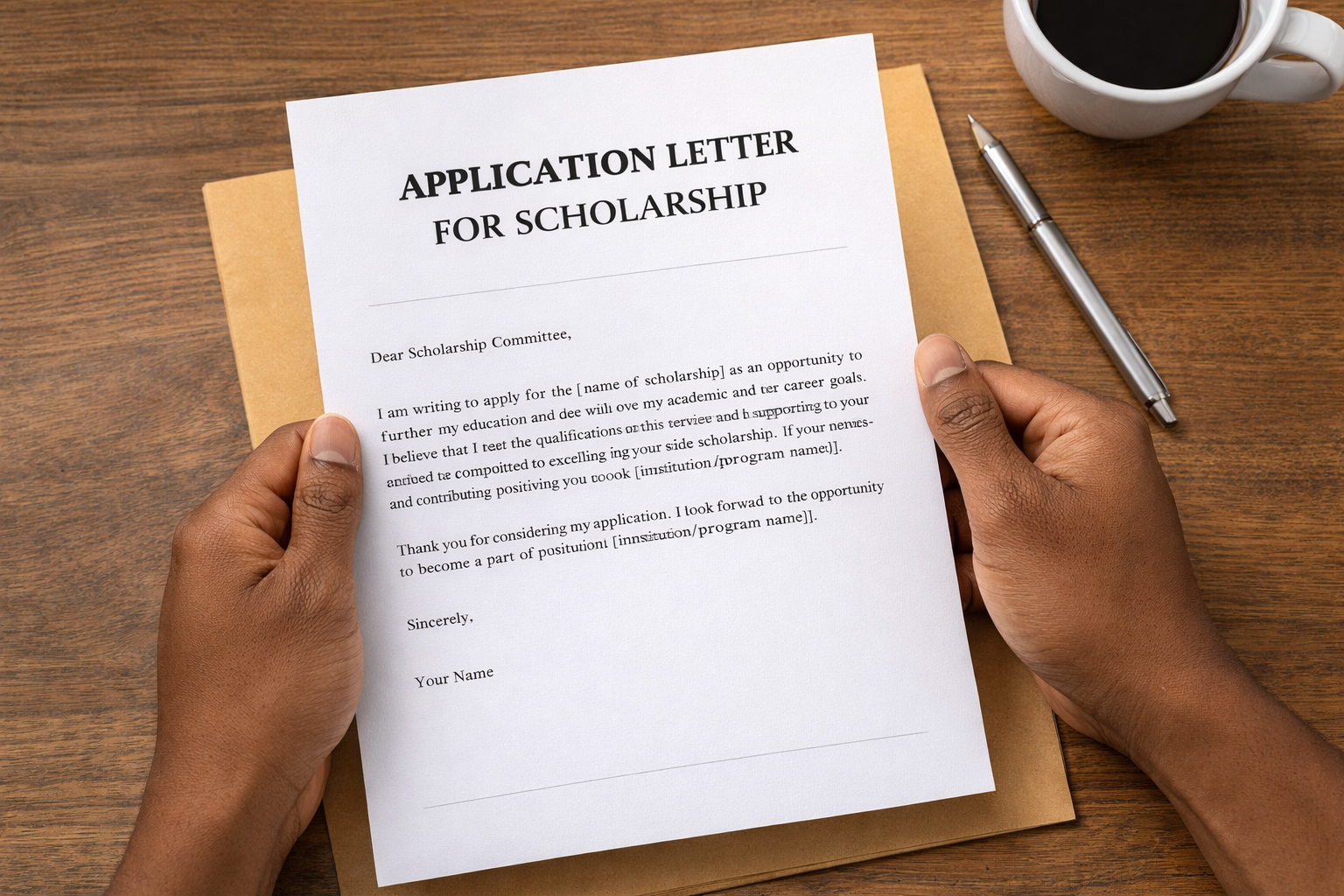
The standard format for a scholarship application letter header is as follows:
Your Name
Your Full Address (Street, City, State/Country, ZIP/Postal Code)
Your Phone Number
Your Professional Email Address
Date (written in full, e.g., March 15, 2026)
(Leave one blank line)
Name of Scholarship Committee Contact (if known)
Title of Contact Person
Name of Scholarship Organization or University
Address of Scholarship Organization
(Leave one blank line)
Salutation: “Dear [Name of Contact],” — if the contact’s name is known. If not, use “Dear Scholarship Selection Committee,” or “Dear [Name of Scholarship] Committee,”. Avoid generic salutations like “To Whom It May Concern” — they signal that you have not researched the program.
Subject Line (optional but recommended): “Re: Application for [Full Name of Scholarship] — [Your Full Name]”
Some important formatting rules to follow throughout the entire letter:
- Font: Times New Roman or Arial, size 12
- Line spacing: Single-spaced within paragraphs; one blank line between paragraphs
- Margins: 1 inch on all sides
- Length: One page (approximately 500–750 words) for most undergraduate and local scholarships; one to two pages for graduate-level motivation letters
- File format when submitting digitally: PDF, unless the portal specifies otherwise
- Email address: Use a professional email address (firstname.lastname@domain.com) — never use nicknames or informal handles in a scholarship letter header
Paragraph-by-Paragraph Guide: How to Write a Scholarship Application Letter
The most effective scholarship application letters follow a clear, logical structure that guides the reader from introduction to conclusion without confusion or unnecessary detour. Below is a detailed paragraph-by-paragraph writing guide designed to help you craft a compelling letter from the first line to the final sign-off.
Paragraph 1: The Opening — Introduce Yourself and State the Purpose
The first paragraph of your scholarship application letter must accomplish three things quickly and clearly: introduce you by name, name the scholarship you are applying for, and briefly signal why you are a strong candidate. This is not the place for a dramatic narrative hook — that belongs in a personal statement or motivation letter. Here, you are writing a formal letter, and your opening should be confident, direct, and professional.
A strong opening might read: “My name is [Full Name], and I am writing to apply for the [Full Name of Scholarship] for the [Academic Year]. I am currently [a final-year student / a recent graduate] of [Name of Institution], pursuing a [Degree Name] in [Field of Study]. I believe that my academic record, demonstrated commitment to [relevant field or cause], and long-term goals in [career field] make me a strong candidate for this award.”
This paragraph should be three to four sentences maximum. State your name, institution, programme, the name of the scholarship you are applying for, and a single-sentence preview of your strongest qualification. Nothing more is needed at this stage. If you know the name of the scholarship sponsor or a specific contact, use it. If not, “Dear Scholarship Committee” is perfectly acceptable.
Paragraph 2: Academic Qualifications and Achievements
The second paragraph is where you present your academic credentials. Describe your academic performance clearly your GPA or equivalent, any honours or distinctions, relevant coursework, academic prizes, or research achievements and connect them directly to your readiness for the programme or level of study you are applying for. Be specific and factual, but avoid turning this paragraph into a dry recitation of statistics.
The goal is to contextualize your academic record, not just restate it. If you earned a First Class Honours degree despite holding a part-time job throughout university, say so. If your thesis research was published or presented, mention it. If you achieved the highest grade in your faculty for a relevant subject, note it. Think of your essay and letter as your chance to move beyond test scores and GPAs — a well-written piece can show scholarship committees who you are, what you value, and why you deserve their support.
Paragraph 3: Extracurricular Activities, Leadership, and Community Involvement
Scholarship committees do not only fund scholars — they invest in leaders, contributors, and change-makers. The third paragraph of your application letter should describe your extracurricular activities, leadership roles, volunteer work, community service, or professional experiences that demonstrate qualities beyond academic performance.
Be selective and strategic. Choose the two or three experiences that best illustrate qualities relevant to the scholarship’s mission — whether that is leadership, community service, research, entrepreneurship, athletic achievement, or artistic excellence. Make good use of activities as references to share your experience, accomplishments, and awards to impress the scholarship committees. For each experience you mention, briefly state what you did, what impact it had, and what you learned. Committees respond to evidence of genuine engagement and tangible outcomes, not just a list of roles held.
Paragraph 4: Why This Scholarship and Why You Align with Its Mission
This is the paragraph that separates thoughtful applications from generic ones, and it is the paragraph most scholarship applicants get wrong. You must explain clearly and specifically why this particular scholarship — not just any scholarship — is the right fit for you. This requires genuine research. What is the scholarship’s stated mission? What values or priorities does the sponsoring organization, foundation, or government programme emphasize? How do your background, goals, and values align with those priorities?
Research the organization: identify the sponsoring organization’s core values and mission, then highlight skills and characteristics that align with their goals. Some organizations focus on academic performance, while others emphasize financial need or special circumstances. Whatever the scholarship’s emphasis, this paragraph must demonstrate that you understand it and embody it. A STEM scholarship committee wants to see passion for science and innovation. A leadership scholarship committee wants evidence of impact, influence, and initiative. A diversity scholarship wants to understand how your identity and perspective contribute to the broader learning community.
Never write a single generic paragraph that could apply to any scholarship. Even if the rest of your letter is strong, a vague, interchangeable alignment paragraph signals that you have not done your research — which is itself a disqualifying quality for most serious scholarship programmes.
Paragraph 5: Financial Need (For Need-Based Scholarships)
For scholarships that are partly or wholly need-based, this paragraph is essential. It must be written with care — factual, mature, and forward-looking in tone. State your financial situation clearly, note the absence or insufficiency of alternative funding sources, and frame the scholarship as an investment that will allow you to pursue your education without the distraction of financial hardship.
Be transparent: clearly explain your financial situation and the obstacles that hinder your educational pursuit. Provide accurate details without embellishments. Articulate how receiving the scholarship will positively impact your life and alleviate some of the financial burdens. Explain how it will allow you to focus on your studies and future goals. Connect your financial need with your long-term goals.
Do not write an emotionally overwrought account of hardship. The most effective need-based paragraphs are brief, direct, specific, and dignified. Mention approximate income figures or family circumstances factually, describe the specific financial barrier the scholarship will address, and pivot quickly to what you will do with the opportunity — not just what you lack without it.
For purely merit-based scholarships where financial need is not a selection criterion, skip this paragraph entirely.
Paragraph 6: Career Goals and Future Plans
Scholarship committees fund futures, not just present accomplishments. This paragraph presents your short-term and long-term career goals with specificity and connects them to the scholarship’s broader mission. Committees want to know that their investment will generate impact — that the student who receives this award will go on to make a meaningful contribution to their field, their community, or the world.
Your scholarship motivation letter should link your future plans with the goals of the scholarship. How will you benefit from continued education in this field? How will you use this knowledge to support the mission of the scholarship provider? The more specific and grounded your career goals are, the more credible and persuasive this paragraph becomes. Replace “I want to help my community” with “I intend to return to [specific region] after completing my degree to work with [type of organization] on [specific issue] — an area where my graduate training in [field] will directly apply.”
Paragraph 7: The Closing — Restate, Thank, and Call to Action
Your closing paragraph performs three functions: it briefly restates your case for the scholarship, it expresses genuine appreciation for the committee’s time and consideration, and it includes a professional call to action — inviting the committee to review the enclosed documents and contact you if further information is needed.
The way to close the letter is to finalize everything by restating your need for the scholarship, showing appreciation to the committees, and including a call-to-action to invite them to review your resume and contact you. In the end, use a respectful tone with a formal sign-off by using “Sincerely” or “Best regards” to show that you are worth investing in.
A strong closing might read: “I am deeply grateful for the opportunity to apply for the [Scholarship Name] and remain enthusiastic about the prospect of joining its community of scholars. I have enclosed my academic transcripts, curriculum vitae, and [any other requested documents] for your review. Please do not hesitate to contact me at [phone number] or [email address] if any further information would be helpful. I look forward to hearing from you.”
Follow the closing paragraph with your formal sign-off (“Sincerely,” or “Respectfully yours,”), followed by your full name. If submitting a printed letter, leave space for your handwritten signature between the sign-off and your typed name.
Full Sample Application Letter for Scholarship
The following is a complete sample application letter for a scholarship, demonstrating the full format and paragraph structure outlined above. This example is for a merit and need-based undergraduate scholarship in engineering.
Amara Osei
12 University Road, Kumasi, Ashanti Region, Ghana
+233 244 123 456
amara.osei@email.com
March 15, 2026
The Scholarship Selection Committee
ABC Foundation for Engineering Excellence
P.O. Box 400, Accra, Ghana
Dear ABC Foundation Scholarship Committee,
Re: Application for the ABC Foundation Engineering Scholarship 2026-2027 — Amara Osei
My name is Amara Osei, and I am writing to apply for the ABC Foundation Engineering Scholarship for the 2026-2027 academic year. I am currently a final-year student at Kwame Nkrumah University of Science and Technology (KNUST), pursuing a Bachelor of Science in Electrical Engineering. My strong academic record, experience in renewable energy research, and commitment to addressing Ghana’s energy access challenges align closely with the Foundation’s mission to fund the next generation of African engineers.
Throughout my undergraduate studies, I have maintained a cumulative GPA of 3.87 out of 4.0, consistently placing me among the top three students in my department of 72 students. I received the Dean’s Award for Academic Excellence in both my second and third years and was selected as a research assistant to the Energy Systems Laboratory, where I contributed to a project on low-cost solar inverter design for rural off-grid communities. Our team’s findings were presented at the 2025 IEEE Ghana Annual Conference, where I co-authored a conference paper that was recognized with a Best Undergraduate Research Award.
Beyond the classroom, I have served as President of the KNUST Engineering Students’ Association for two years, leading a team of 14 committee members in organizing professional development workshops, industry visits to Volta River Authority and GRIDCo, and a mentorship scheme that paired 30 junior engineering students with industry professionals. I also volunteer as a STEM tutor at a secondary school in my home district of Ejura, where I have worked with over 60 students to strengthen their mathematics and physics foundations in preparation for university entrance exams.
The ABC Foundation Engineering Scholarship represents exactly the kind of support I need to advance my goals and the kind of values I am proud to represent. Your Foundation’s emphasis on practical innovation, community impact, and local solutions to Africa’s infrastructure challenges reflects my own understanding of what engineering should accomplish in this decade. I am not interested in engineering as a theoretical pursuit — I am committed to engineering as a tool for human development, and your scholarship has been a visible force behind that vision in Ghana for over a decade.
I come from a family of four children, all of whom my parents — a public school teacher and a small-scale farmer — have supported through education on a combined monthly income of approximately GHS 3,200. While my parents have made tremendous sacrifices to support my undergraduate studies, funding a final year and postgraduate program without additional financial assistance is not feasible for our family. This scholarship would directly relieve the financial pressure my parents currently face and allow me to complete my degree with full academic focus, without the need for part-time employment during examination periods.
Upon completing my Bachelor’s degree, I intend to pursue a Master of Science in Sustainable Energy Engineering — ideally through a fully funded international scholarship — and then return to Ghana to work with the Energy Commission on expanding renewable energy access to underserved rural communities, beginning with the northern regions where energy poverty remains most acute. The research and professional network I develop through your scholarship will be foundational to that journey.
I am sincerely grateful for the ABC Foundation’s commitment to engineering education in Ghana and for your consideration of my application. I have enclosed my official academic transcript, my curriculum vitae, and two letters of recommendation from my faculty supervisor and my department head for your review. Please feel free to contact me at +233 244 123 456 or amara.osei@email.com should any additional information be required. I look forward to the opportunity to contribute to the ABC Foundation community of scholars.
Sincerely,
Amara Osei
What Scholarship Committees Are Looking for in an Application Letter
Understanding how scholarship committees evaluate application letters is the most direct way to calibrate your writing. While criteria vary by programme, four core qualities are assessed by virtually every serious scholarship review panel.
Authenticity: Committees can identify a generic letter or a heavily templated application within the first two sentences. They want to hear a real student’s real voice — not a polished, airbrushed performance. Scholarship essays should be genuine, exploring your life experiences and, ideally, how these experiences tie into your desire for the scholarship you are applying for. Authenticity does not mean informality — it means that the person described in your letter actually exists, and that the goals, values, and experiences you describe are genuinely yours.
Specificity: Vague language is the enemy of a strong scholarship letter. “I have always been passionate about science” tells the committee nothing. “During my second year, I designed a low-cost water quality sensor using Arduino components and field-tested it in three communities in my home district, reaching over 400 households” tells them everything. Replace every generalization in your letter with a specific, named, quantified example.
Alignment: Every paragraph of your letter must connect back to the scholarship’s mission, values, or priority areas. Scholarship programs often come from organizations or funds that have specific missions, and the more you can show you align with them, the better your chances. Always start by researching the sponsoring organization to understand what they value so that you can explain how your goals reflect those values.
Professionalism: Correct formatting, error-free grammar, appropriate tone, and a formal but warm register all contribute to a scholarship letter’s overall impression of professionalism. Errors in any of these areas — a misspelled committee name, an incorrect date, a grammatical error in the opening paragraph — will color the committee’s reading of everything that follows.
Common Mistakes in Scholarship Application Letters
Using the same letter for every application. This is the single most damaging habit in scholarship applications. Avoid using the same letter for multiple scholarships. Tailor each letter to the specific scholarship to demonstrate your genuine interest and suitability. At minimum, the salutation, the scholarship name, the alignment paragraph, and the closing must be individually customized for every application you submit.
Being arrogant or self-congratulatory. There is a meaningful difference between confident self-presentation and arrogance. Try to put yourself in the reviewer’s shoes and imagine if you read a letter claiming to always be at the top of the class and celebrating every report card not a very good impression. Present your achievements with evidence and context, not with boastfulness. Let the facts do the work.
Exceeding the length guidelines. A typical scholarship letter should not be more than 500–750 words long, or one page in length. Scholarship committees read hundreds of letters. A letter that runs to two or three pages when one was expected is not impressive it signals an inability to communicate concisely, which is itself a disqualifying quality.
Failing to proofread. Spelling errors, grammatical mistakes, and punctuation inconsistencies in a scholarship application letter undermine every strength the content might otherwise project. Proofread your letter at least three times, use grammar-checking tools, read it aloud to catch awkward phrasing, and have a teacher, mentor, or trusted peer review it before submission.
Writing an autobiography instead of a targeted letter. Your application letter is not the place for a comprehensive biography from childhood to the present. Every sentence must serve the single purpose of the letter: convincing this specific committee that you deserve this specific scholarship. Any detail that does not advance that argument should be removed.
Forgetting to include a call to action. Many applicants write excellent letters but forget to tell the committee what they want them to do next. End with a closing paragraph that restates your interest in the scholarship and why you should be a recipient. Include a call to action to inspire the committee to reach out to you — by saying you’d love the opportunity to schedule a call or a meeting, for instance.
Using the wrong name or scholarship title. Getting the scholarship name wrong — or addressing the letter to the wrong organization because you copied and pasted from a previous application is an instant red flag that signals carelessness. Triple-check the name of every scholarship, institution, and contact person in every application before submitting.
Tailoring Your Application Letter for Different Scholarship Types
Merit-Based Scholarship Letters: Emphasize academic achievements, research experience, awards, and intellectual contributions. Demonstrate that you have maximized every academic opportunity available to you and that the scholarship will enable further excellence. Financial need is typically not the focus, though it can be mentioned briefly if true and relevant.
Need-Based Scholarship Letters: Balance a clear, factual account of financial circumstances with a compelling case for your academic and personal merits. Committees funding need-based awards are looking for students whose potential would otherwise be unrealized due to economic barriers — not simply the most financially disadvantaged applicant in the pool.
STEM Scholarship Letters: Emphasize research experience, technical skills, specific projects, quantitative achievements, and your vision for applying scientific knowledge to real-world challenges. Reference faculty supervisors, labs, or research centres where relevant. Most STEM scholarships are mission-driven around specific scientific or technological challenges — align your letter with those challenges explicitly.
Leadership and Community Scholarship Letters: Focus on evidence of leadership impact — specific initiatives led, teams managed, outcomes achieved, and communities served. Quantify your impact wherever possible. Scholarship committees for leadership awards are looking for evidence that you do not just participate but that you inspire and build.
International Scholarship Letters (Fulbright, DAAD, Chevening, Commonwealth, Erasmus Mundus): These require the most tailored letters of all. Each programme has a specific thematic focus, national diplomatic purpose, or academic priority. Research each programme’s mission documentation thoroughly before writing a single sentence. Your letter must demonstrate that you understand the scholarship’s geopolitical, academic, or developmental purpose — and that your candidacy genuinely serves it.
Scholarship Application Letter Checklist Before You Submit
- Is the scholarship name spelled correctly and written in full?
- Is the salutation correctly addressed to the right committee or contact person?
- Does the opening paragraph state your full name, institution, programme, and the scholarship you are applying for?
- Does the letter include specific, quantified evidence of academic achievement?
- Does the letter demonstrate meaningful extracurricular involvement or leadership?
- Does the alignment paragraph specifically reference the scholarship’s mission and values?
- Is financial need addressed clearly, factually, and with appropriate tone (if required)?
- Are your career goals stated with specificity — named fields, roles, or organizations?
- Does the closing paragraph include a call to action and contact information?
- Is the letter within the required word count (typically 500–750 words for cover letter format)?
- Is the font size 12 in Times New Roman or Arial with 1-inch margins?
- Is the letter free of all spelling, grammar, and punctuation errors?
- Has a mentor, teacher, or trusted peer reviewed the letter?
- Is the file saved as a PDF (unless otherwise specified)?
- Have you confirmed that the letter is specifically tailored to this scholarship and not recycled from another application?
Final Thoughts: Your Application Letter Is Your Case for Investment
Writing a strong application letter for scholarship is one of the most important and most learnable skills in a student’s academic toolkit. It is not about being the most eloquent writer in the applicant pool — it is about being the most purposeful, the most specific, and the most aligned with the scholarship’s mission. Every sentence you write should serve the central argument: that you, among all applicants, are the right person for this particular award.
Start early. Research every scholarship’s mission before writing a word. Build your letter paragraph by paragraph using the framework in this guide. Be specific about your achievements, honest about your financial situation, and precise about your goals. Tailor every letter to every scholarship never recycle. Proofread relentlessly. Ask for feedback from people whose judgment you trust. And submit well before the deadline.
Scholarships do not fund résumés. They fund people people with stories, purposes, and the demonstrated capacity to multiply an investment through knowledge, service, and leadership. Your application letter is the place where you make that case. Write it with care, write it with precision, and write it as the person you genuinely are and the leader you intend to become. The right scholarship committee will recognize that person and fund them.