NDE Renewed Hope Employment Initiative Form 2026: Apply Now
If you have been searching for a government-backed opportunity to build real, marketable skills and improve your financial situation, then the NDE Renewed Hope Employment Initiative is something you need to know about right now. This programme has been creating a lot of buzz across Nigeria, and for good reason. It offers free vocational training, a monthly stipend, nationally recognised certification, starter packs, and access to business loans, all at no cost to you.
In this article, we are going to break everything down in a way that is easy to follow. We will explain what the programme is, who is behind it, what the different training options are, who can apply, what benefits you will receive, and exactly how to go through the application process step by step. Whether you are a young graduate, a school leaver, a woman looking for economic empowerment, a farmer, or someone who just wants to learn a new trade, this article is for you.
What is the NDE Renewed Hope Employment Initiative?
The NDE Renewed Hope Employment Initiative, commonly referred to as RHEI, is a federal government programme run by the National Directorate of Employment (NDE). The NDE is a government agency that was established with the mandate to design and implement programmes that combat mass unemployment across Nigeria. The RHEI is the agency’s flagship initiative under President Bola Ahmed Tinubu’s Renewed Hope Agenda, which places job creation, poverty reduction, and inclusive economic growth at the centre of national policy.
The programme was launched in two phases. The first phase, which ran during the third and fourth quarters of 2024, trained over 33,886 Nigerians across the country. Following that success, over 4,683 beneficiaries from the first phase were resettled with loans, starter packs, and business tools to help them establish small-scale enterprises. Building on this foundation, Phase 2 was launched in 2025 with an even more ambitious scale.
The National Directorate of Employment launched training for 41,307 unskilled and unemployed Nigerians under the second phase of the Renewed Hope Employment Initiative. The beneficiaries were drawn from all 8,809 electoral wards nationwide at a minimum of four persons per ward. This approach ensures that the programme does not just concentrate its efforts in big cities but reaches communities in every corner of the country, including rural and underserved areas.
The initiative is not just about giving people skills and sending them on their way. It is a comprehensive transformation agenda that covers vocational training, entrepreneurship development, agricultural empowerment, and public works engagement, all designed to move Nigerians from being job seekers to becoming job creators.
The Story Behind the Programme: NDE and the Renewed Hope Agenda
To fully understand why this initiative matters, it helps to understand the context in which it was created. Nigeria has one of the highest youth unemployment rates in Africa. Millions of young Nigerians graduate from schools and polytechnics every year only to find a labour market that does not have enough formal jobs to absorb them. Many more never get the chance to complete formal education and end up in the informal economy without any structured support.
The NDE was created specifically to address this problem. Its statutory mandate covers designing and implementing programmes that create employment opportunities, developing policies around work programmes, and supporting Nigerians with the tools and skills they need to be economically active.
The National Directorate of Employment has kick-started a strategic initiative to realign its operations with President Bola Ahmed Tinubu’s renewed hope agenda, seeking to strengthen the agency’s role in combating poverty by providing sustainable employment opportunities for Nigerians.
Secretary to the Government of the Federation, Senator George Akume, stressed that decent jobs remain central to sustainable economic growth, adding that the Renewed Hope Employment Initiative has been designed to equip youth, women, and vulnerable groups with practical tools to navigate a fast-changing global economy.
What makes the NDE RHEI different from many other government initiatives is that it is structured around four concrete programme departments, each targeting a specific segment of Nigeria’s unemployed population. These are Vocational Skills Development (VSD), Small Scale Enterprises (SSE), Rural Employment Promotion (REP), and Special Public Works (SPW). Together, they create a comprehensive safety net that caters to people from all walks of life.
The Four Core Programme Areas of NDE RHEI
One of the strongest features of the NDE Renewed Hope Employment Initiative is the breadth of training options available. There is genuinely something for almost every Nigerian, regardless of their educational background, age, location, or career interest. Here is a detailed breakdown of each programme area.
1. Vocational Skills Development (VSD)
The Vocational Skills Development department is the largest and most widely known component of the NDE’s work. Under RHEI, VSD covers several distinct training schemes that each target a different group of learners.
The Quick-Fix Demand Driven Scheme is designed for short-term, practical skills training. It focuses on skills that can be learned quickly and immediately used to generate income. Quick-Fix schemes include soap making, bead making, and makeup. These are particularly useful for women and young people who want to start earning quickly without going through a long training programme.
The Community Based Training Scheme (CBTS) takes a different approach. It is aimed at training unemployed persons in high-income generating activities within their various localities. Participants are trained in skills that bridge the existing skills gap in the provision of services in the community as well as improving the livelihood of the people. Trades covered under CBTS include electrical installation, fashion designing, GSM repairs, beauty therapy, catering, and computer operation.
The School-On-Wheels Scheme is one of the most innovative components of the NDE programme. It is designed to extend skills acquisition training activities to unemployed persons in rural areas. The scheme deploys well-equipped Mobile Training Workshops stocked with vocational skills training facilities to rural areas where training outlets are deficient or non-existent. This means that even Nigerians in remote villages who cannot travel to urban training centres can still access world-class vocational training right in their own communities.
The Basic National Open Apprenticeship Scheme (B-NOAS) and the Advanced National Open Apprenticeship Scheme (A-NOAS) provide more structured apprenticeship training. The B-NOAS trains unemployed youths in various vocational trades through master craftsmen and accredited training centres. The A-NOAS is designed for those who have already completed the B-NOAS and want to upgrade their skills to a higher level of competence.
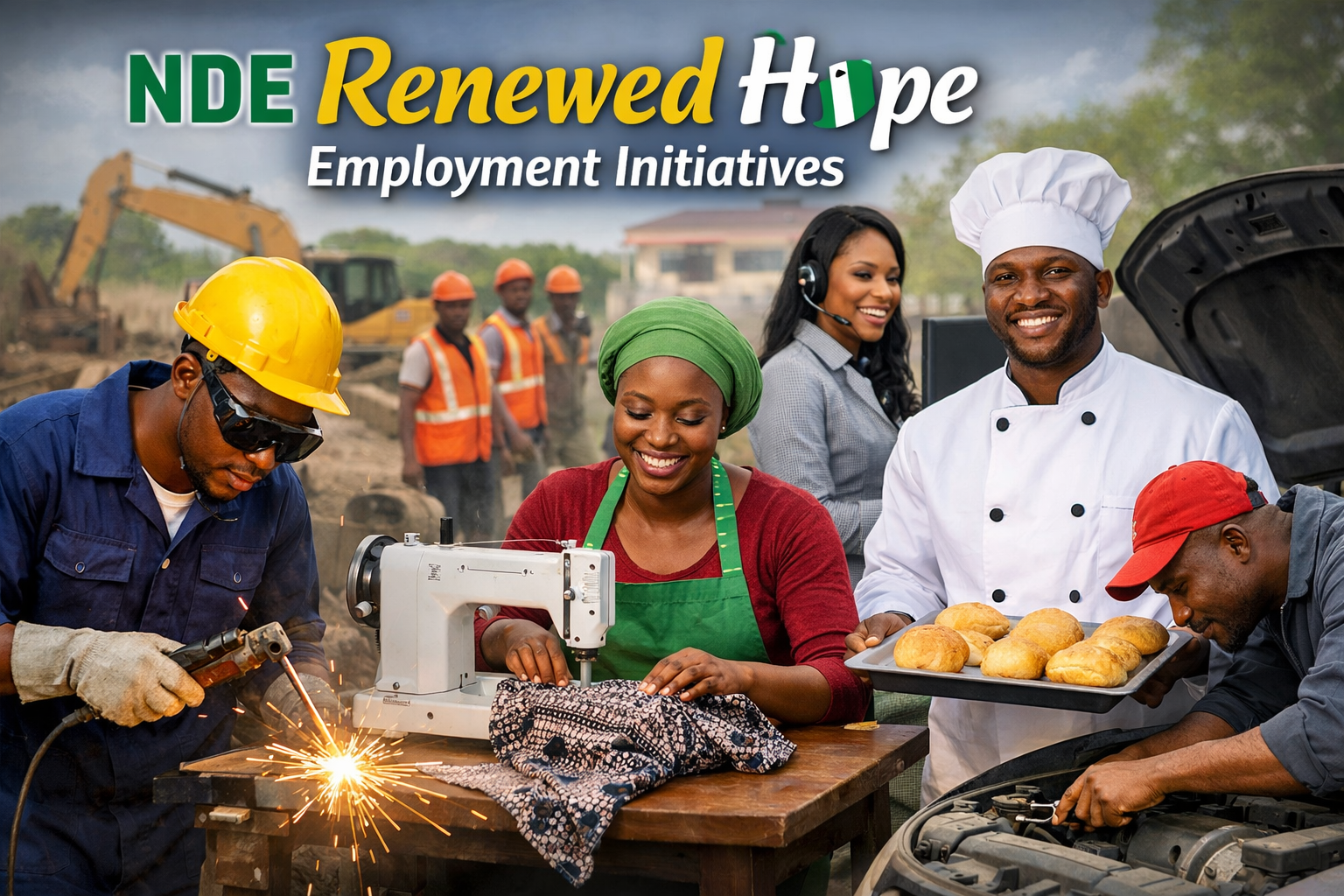
Other VSD skills available include welding, plumbing, carpentry, computer repairs, tailoring, aluminium fabrication, photography, and many more. The list is extensive and reflects the actual skill needs of different communities across Nigeria.
2. Small Scale Enterprises (SSE)
The Small Scale Enterprises programme is designed for Nigerians who want to start or grow their own businesses. Rather than just teaching a trade, SSE focuses on the full entrepreneurship journey, from identifying a business opportunity to setting it up, running it, and scaling it successfully.
The Start Your Own Business (SYOB) scheme is a business training programme specifically designed for unemployed graduates of tertiary institutions. It provides entrepreneurship training skills that prepare graduates for self-employment and sustainability. The age range for SYOB is typically 21 to 35 years.
The Matured People’s Programme (MPP) recognises that entrepreneurship is not just for the young. It is designed for older Nigerians, typically between 35 and 45 years of age, who want to start or formalise a business venture. MPP provides business training and mentorship support tailored to the experience and life stage of mature participants.
The Micro Enterprise Enhancement Scheme (MEES) targets Nigerians who already have a small business running but need support to strengthen and grow it. This is extremely relevant for the millions of Nigerians in the informal economy who are working hard but lack the knowledge, structure, and capital to take their businesses to the next level.
There is also a Women Empowerment branch under SSE, which provides training in food processing, catering, and other income-generating activities that are particularly relevant for Nigerian women in both urban and rural settings.
3. Rural Employment Promotion (REP)
The Rural Employment Promotion department recognises that a large proportion of Nigeria’s unemployed population lives and works in rural areas. Many of these individuals are involved in farming and agriculture but lack the modern knowledge and tools needed to be truly productive and profitable.
The Rural Employment Promotion component includes several agricultural training schemes covering modern farming practices and livestock management. Programmes such as the Sustainable Agricultural Development Scheme, Small Stock Production, and Organic Agriculture provide specialised training in areas like poultry, irrigation, goat farming, and composting.
These training options are designed to help Nigerian farmers move beyond subsistence agriculture into more productive and commercially viable farming operations. By learning modern techniques in areas like irrigation, organic farming, and livestock management, participants can significantly increase their yields and income.
4. Special Public Works (SPW)
The Special Public Works department targets artisans, graduates, and technically inclined Nigerians through a range of specialised programmes.
The Artisans in Collaborative Construction Employment Scheme (ACCES) targets artisans, while the Graduate Coaching Scheme (GCS) engages graduates to teach students preparing for national exams. The Graduate Attachment Programme (GAP) offers internships with companies to provide temporary employment and experience. Environmental and energy-related training schemes include the Environmental Beautification Training Scheme (EBTS) for landscaping and the Solar Energy Training Scheme (SETS) for solar design, installation, and maintenance, specifically geared toward technically inclined graduates.
The Solar Energy Training Scheme is particularly noteworthy because it taps into one of the fastest-growing sectors in Nigeria and globally. As renewable energy adoption increases across the country, trained solar technicians are in very high demand. This scheme gives participants a genuine pathway into a growing industry with real employment prospects.
What Benefits Does NDE RHEI Offer?
Now for the part most people want to know about. What will you actually receive if you are accepted into the NDE Renewed Hope Employment Initiative? The benefits are comprehensive and genuinely useful. Here is a full breakdown.
Fully Funded Training
All training under the NDE RHEI is completely free. All training fees are covered directly by the NDE training fund. You do not pay anything for registration, training materials, or instruction. This removes one of the biggest barriers that often prevents unemployed Nigerians from accessing skills development programmes.
Monthly Stipend of N30,000
The NDE Renewed Hope Employment Initiative offers a N30,000 monthly stipend to help cover your learning expenses. This financial support is provided during the training period to help participants manage their living costs while they are focused on building their skills. It means you do not have to choose between eating and learning.
Nationally Recognised Certificate of Completion
When you complete your training under NDE RHEI, you receive a certificate that is verifiable and recognised nationwide by employers. This certification adds real value to your professional profile. Whether you want to seek employment with a company or market your services as a self-employed professional, the NDE certificate is a credential that employers and clients respect.
Starter Packs and Business Tools
Completing training is just the beginning. NDE goes one step further by equipping graduates with the tools they need to immediately put their skills to work. Starter packs are provided upon training completion to help beneficiaries begin their businesses. Depending on your area of training, this could include physical tools, equipment, materials, or other resources relevant to your trade.
Access to Low-Interest Business Loans
Beneficiaries receive access to low-interest business loans to support their start-up expenses. This is a crucial component because many Nigerians have the skills and the ambition to run a business but cannot access the capital they need. With NDE’s loan support, graduates can borrow what they need to get started without the crushing interest rates associated with commercial lending.
Hands-On Mentorship by Industry Professionals
Training under NDE RHEI is led by industry professionals with real-world experience. This is not classroom theory delivered by people who have never worked in the field. You are being trained by practitioners who understand the actual demands and realities of the industries you are entering. Beyond the formal training period, beneficiaries also receive mentorship support to help them navigate the early stages of building a business or career.
Employment and Internship Linkages
Through the Graduate Attachment Programme and other SPW schemes, NDE actively works to connect qualified graduates with internship positions and employment opportunities in both the public and private sectors. This is especially valuable for young graduates who have the education but lack the work experience that most employers require.
Who is Eligible to Apply for NDE RHEI 2025?
One of the most remarkable things about the NDE Renewed Hope Employment Initiative is how inclusive its eligibility criteria are. The programme truly welcomes a wide range of Nigerians. Here is who can apply.
The programme is open to unemployed youths and school leavers who have completed their secondary or tertiary education but have not yet found stable work. It also welcomes university and polytechnic graduates who are looking to add practical skills to their academic qualifications. Artisans and informal workers who are already working in a trade but want to formalise and upgrade their skills can also apply.
Women are explicitly identified as a target group, with dedicated training programmes and schemes designed specifically around their needs and circumstances. Persons with disabilities are also welcome and the programme has provisions to accommodate their participation. Farmers and rural dwellers who want to modernise their agricultural practices or learn complementary income-generating skills are encouraged to apply.
The programme also reaches middle-aged Nigerians and retirees through the Matured People’s Programme. Interns, apprentices, and small business owners who want to grow their ventures can also participate through relevant scheme options.
In terms of age, most schemes target participants between 18 and 45 years old, with some variation depending on the specific component. For example, SYOB targets ages 21 to 35, while MPP is designed for the 35 to 45 age group. Other schemes generally accept participants between 18 and 40 years of age.
A valid National Identification Number (NIN) is required for all applicants. Registration requires a valid National Identification Number and residency in any Nigerian state, regardless of state of origin. This means you do not need to apply in your home state. You can apply based on where you currently live, which is a practical and inclusive approach that removes another common barrier for applicants.
How to Apply for the NDE Renewed Hope Employment Initiative 2025
The application process for RHEI Phase 2 is fully digital. NDE Director-General Silas Agara explained that the digital platform would power the initiative, emphasising transparency and inclusivity, adding that robust hardware, software, and internet connectivity had been deployed to all 37 states including the FCT to ensure seamless operations. Here is a clear step-by-step guide to walk you through the process.
Step 1: Verify Your NIN
Before you begin your application, make sure your National Identification Number is active and verifiable through the National Identity Management Commission (NIMC) portal. Your NIN is required for identity verification and your application cannot be processed without it. If you have not enrolled for a NIN, visit your nearest NIMC office as soon as possible. If your NIN is registered but you are having issues verifying it, contact NIMC directly to resolve the problem before applying.
Step 2: Visit the Official NDE Registration Portal
Go to the official NDE application platform to begin your registration. Be careful to use only the official government portal. There are fraudulent websites that impersonate government programmes and may attempt to charge you fees or collect your personal information dishonestly. The genuine NDE RHEI application is completely free, and no one should be asking you for money at any point in the process. You can access the official NDE Renewed Hope Employment Initiative registration portal here.
Step 3: Create Your Account
Click on the Register option to create a new account. You will be asked to provide your full name, a valid email address, your phone number, and a password for your account. Make sure you use an email address that you check regularly, as important communications about your application will be sent there. Keep your login details safe and do not share them with anyone.
Step 4: Select the Renewed Hope Employment Initiative Programme
Once you are logged in, look for and select the Renewed Hope Employment Initiative Phase 2 from the list of available programmes. This ensures that your application is directed to the correct initiative and not to an unrelated NDE programme.
Step 5: Complete the Application Form
Fill in all required fields carefully and accurately. You will be asked for your personal details including your full name, date of birth, state of residence, and local government area. You will also provide your educational background, your current employment status, and your preferred area of training or business interest. When selecting your preferred skill or vocational area, choose something that genuinely aligns with your interests, your local market demand, and your long-term career goals. This is an important decision because it will determine what training you receive and what career path the programme prepares you for.
Step 6: Upload Required Documents
You will need to upload clear copies of your documents. These typically include a valid government-issued ID such as your NIN slip, National ID card, or Voter’s card; your academic certificate (at minimum, a secondary school result); and a recent passport photograph. Make sure all documents are readable and not blurry before uploading them.
Step 7: Review and Submit Your Application
Before hitting the submit button, review all the information you have entered carefully. Check that your name is correctly spelled, your NIN is accurate, and your preferred training area reflects your genuine interest. Once you submit, you may not be able to make changes, so accuracy at this stage is very important.
Step 8: Monitor Your Application Status
After submitting, you will receive a confirmation message via email or SMS. Keep checking your email inbox and your application dashboard on the NDE portal for updates about screening, shortlisting, and orientation. If you do not receive a confirmation email, check your spam or junk folder. If you encounter technical difficulties, use the Contact Us section on the portal or visit your nearest NDE state office for assistance.
Ready to get started? Click here to apply for the NDE Renewed Hope Employment Initiative through the official portal.
What Happens After You Apply?
Once you submit your application, the NDE team begins processing and screening submissions. This involves verifying your NIN through NIMC, reviewing your educational qualifications, and assessing your suitability for your chosen training scheme.
Shortlisted applicants are contacted with information about the next steps, which typically include an orientation session where you learn more about the programme, your specific training track, and what is expected of you as a beneficiary.
Selected participants are then enrolled in their chosen training scheme. Depending on the scheme, training may take place at an NDE training centre, a community-based training venue, or through the mobile School-On-Wheels workshop if you are in a rural area. The duration of training varies by scheme. Quick-Fix training can be as short as four weeks, while more technical vocational programmes may run for several months.
During training, your monthly stipend of N30,000 is activated. Upon completion, you receive your certificate and your starter pack. If you applied for loan support, you will also be connected to the relevant NDE loan facility to access the capital you need to begin your business or freelance operations.
Tips to Strengthen Your NDE RHEI Application
With tens of thousands of Nigerians applying for the programme, it is worth taking some time to make your application as strong as possible. Here are some practical tips that can improve your chances of being selected.
Apply as early as possible. The NDE portal can experience high traffic close to the deadline, and early applications are processed without the technical delays that often accompany last-minute submissions. Make sure your NIN is fully verified before you start the form. NIN verification issues are the most common reason applications get stuck or delayed, so resolve any NIN problems in advance.
Be honest and specific about your current situation and your training preference. The more clearly you can articulate what you want to learn and why, the better your application will be matched to the right programme component. Choose a training area that is relevant to your local context. If you live in a farming community, agricultural training may lead to quicker results. If you live in a city, trades like GSM repairs, fashion design, or ICT may be more immediately useful.
Use only the official government portal. Do not pay anyone to help you apply, and do not submit your application through a third-party website. The application is free and you are capable of completing it yourself. If you need help, visit your local NDE office and ask for guidance from the official staff there.
How the NDE RHEI Connects to Nigeria’s Broader Development Goals
The NDE Renewed Hope Employment Initiative sits within a larger national and global policy framework. At the national level, it is a core component of President Tinubu’s Renewed Hope Agenda, which places inclusive economic growth, poverty reduction, and job creation at the heart of government policy. Minister of Labour and Employment Muhammad Maigari Dingyadi noted that the Renewed Hope Agenda prioritises inclusive growth, poverty reduction, and shared prosperity, with employment at its core.
At the global level, the programme aligns with the United Nations Sustainable Development Goals, particularly SDG 1 (No Poverty), SDG 4 (Quality Education), SDG 8 (Decent Work and Economic Growth), and SDG 10 (Reduced Inequalities). By investing in skills development, entrepreneurship, and rural empowerment, NDE RHEI directly contributes to these international development targets.
The programme also plays a role in addressing Nigeria’s skills gap, which is one of the key structural challenges facing the country’s economic development. The initiative aims to bridge the country’s skills gap, empower youth with self-reliance tools, build a skilled workforce, and support national development through vocational empowerment. These are not just programme objectives on paper; they reflect a real and pressing need in the Nigerian economy.
By training participants in areas like solar energy, ICT, and modern agriculture, the programme also helps Nigeria build capacity in future-facing sectors that will be critical to the country’s long-term economic competitiveness. This forward-looking approach sets RHEI apart from poverty alleviation programmes that focus only on immediate survival needs.
Frequently Asked Questions About NDE Renewed Hope Employment Initiative
Is the NDE RHEI application free?
Yes, it is completely free. You do not pay any fees to register, apply, or participate. If anyone asks you to pay money in connection with the RHEI application, that person is running a scam. Report such incidents and apply only through the official government portal.
Do I need a university degree to apply?
No. The programme is open to Nigerians across all educational levels. Whether you are a secondary school leaver, a polytechnic graduate, a university graduate, an artisan, or someone with no formal qualifications, there is a scheme within RHEI that is suitable for you.
How much is the monthly stipend for NDE RHEI?
Selected beneficiaries receive a monthly stipend of N30,000 during their training period to help cover their day-to-day living expenses while they focus on building their skills.
Can I apply from any state in Nigeria?
Yes. The programme accepts applications from residents across all 36 states and the FCT. You do not need to apply in your state of origin; you can apply based on where you currently reside.
What trades and skills are available under NDE RHEI?
The programme covers a very wide range of skills including soap making, perfume making, paint production, bead making, makeup artistry, electrical installation, fashion designing, GSM repairs, beauty therapy, catering, computer operation, plumbing, welding, carpentry, computer repairs, tailoring, aluminium fabrication, photography, solar installation, farming, livestock management, and many more.
How long does NDE training last?
Training duration depends on the specific scheme. Quick-Fix training programmes are as short as four weeks. Community-based and more technical vocational programmes typically run for several months. The Graduate Attachment Programme involves a structured internship period with an organisation.
What is the starter pack and will everyone get one?
The starter pack is a set of tools, equipment, or business materials relevant to your chosen trade that NDE provides to graduates upon completing their training. It is meant to help you immediately start earning with your new skills. Starter packs are provided to qualifying graduates as part of the programme’s resettlement support.
Can persons with disabilities apply?
Yes. The NDE Renewed Hope Employment Initiative explicitly welcomes persons with disabilities and has provisions to accommodate their participation in appropriate training schemes.
What happens if I am not shortlisted?
If you are not selected in the current phase, you can watch for future phases and new cycles of the programme. The NDE continues to run its core programmes throughout the year. You can also visit your local NDE Job Centre to enquire about other training and empowerment options that may be available to you outside of the RHEI specifically.
Related Opportunities for Nigerian Youth in 2025
While the NDE Renewed Hope Employment Initiative is a fantastic opportunity on its own, it works best when combined with other personal development efforts. Here are some related programmes and opportunities that are worth exploring alongside RHEI.
The National Poverty Eradication Programme (NAPEP) offers complementary support for Nigerians including micro-credit facilities, internship grants, and vocational training. Like RHEI, it is free to apply and is backed by the federal government. For those interested in academic progression, the Federal Scholarship Board offers scholarships for Nigerians to study at undergraduate and postgraduate levels both within Nigeria and abroad. The Petroleum Technology Development Fund (PTDF) provides fully funded scholarships for study in engineering, science, and technology fields. State government bursary and scholarship schemes are also available in many states and can provide additional financial support for educational and skills development activities.
For those interested in digital skills specifically, various international organisations and platforms also offer free and subsidised technology training programmes for Nigerian youth. These can be a great complement to the vocational training received through NDE RHEI, especially as the digital economy continues to grow in importance across all sectors.
Our blog covers a wide range of scholarships, grants, and empowerment programmes for Nigerians and Africans. We encourage you to explore our other posts to find additional opportunities that align with your goals.
Final Thoughts: Should You Apply for NDE RHEI?
If you are a Nigerian citizen who is unemployed, underemployed, or simply looking to add valuable skills to your profile, the honest answer is yes, you absolutely should apply for the NDE Renewed Hope Employment Initiative. It is free, it is government-backed, it is nationwide in reach, and it offers real, practical benefits that can genuinely change your economic situation.
The programme has already trained tens of thousands of Nigerians across two phases and has resettled thousands more with the tools and financing they needed to start businesses. These are not imaginary outcomes. They are documented results from a programme that is working.
By equipping youth with skills, fostering entrepreneurship, and promoting inclusive access, the initiative helps transform young people from passive job-seekers into active, productive contributors to society and the economy. That is a transformation worth being part of.
The application is online, it is free, and it is open to an incredibly wide range of Nigerians. There is no reason to sit on the fence about this one. Gather your NIN, prepare your documents, and take the first step toward building a better future for yourself and your family.
To begin your application right now, visit the official NDE registration portal and create your account today. And if this article has been helpful to you, please share it with friends and family members who could also benefit from this opportunity. The more people know about it, the more lives can be changed.