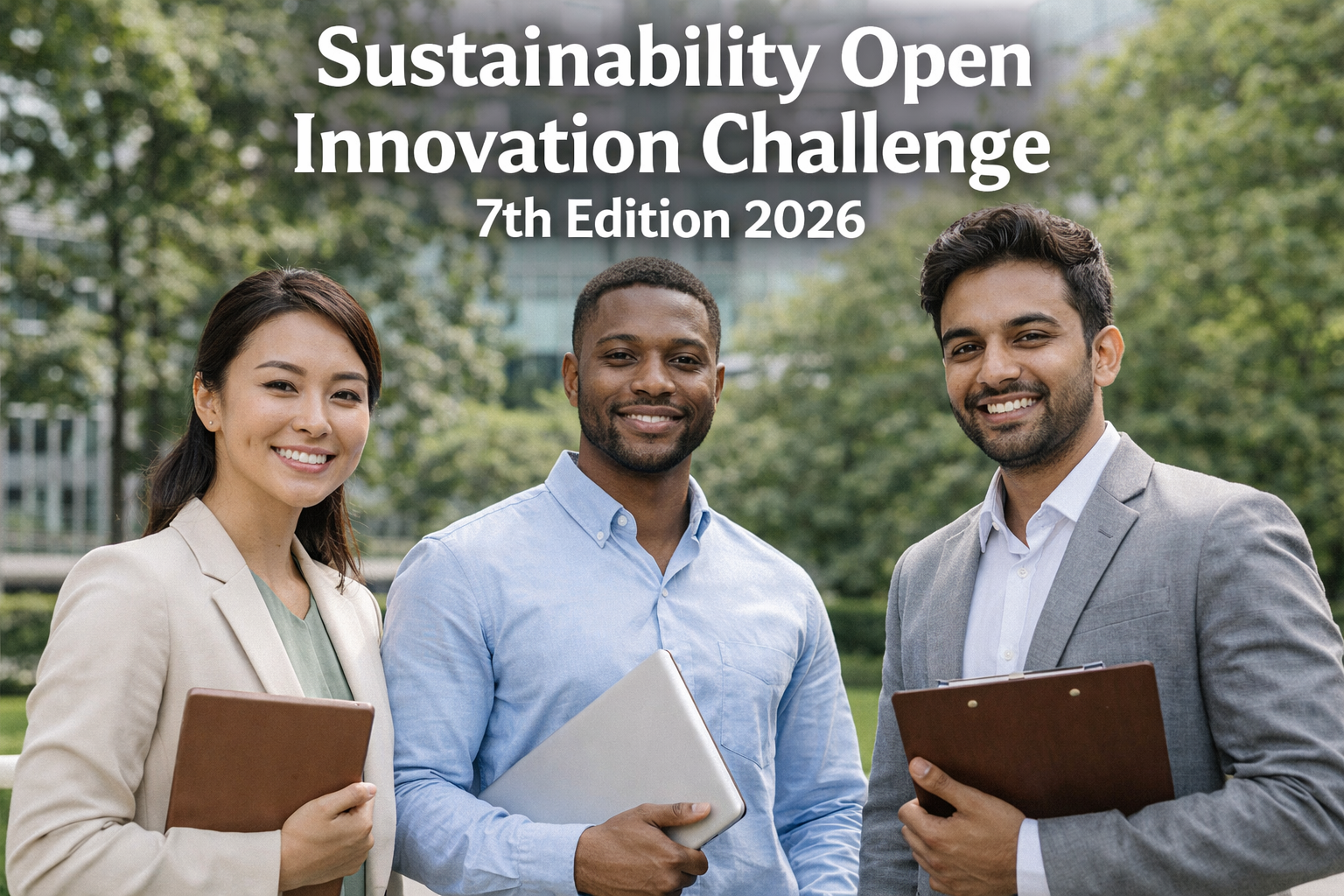
Sustainability Open Innovation Challenge 7th Edition 2026 | Apply Now
If you are a startup founder, an SME leader, a researcher, or an innovator with a technology solution that addresses real-world sustainability problems, there is one global opportunity you need to know about in 2026. The Sustainability Open Innovation Challenge, commonly known as SOIC, is now in its seventh year, and this edition is arguably the most ambitious yet.
Organised by Enterprise Singapore, one of the most respected innovation promotion agencies in Asia, the 7th Edition of SOIC offers over S$3 million in pilot funding and support to innovators from anywhere in the world who are ready to partner with leading corporations to solve sustainability challenges at scale.
This article is a complete guide to the Sustainability Open Innovation Challenge 7th Edition 2026. We will cover what SOIC is, its history and track record, the five key challenge themes, the two application tracks, the corporate partners involved, what winners receive, eligibility requirements, how the judging process works, tips to strengthen your application, and all the details you need to apply. Whether you are hearing about SOIC for the first time or preparing to submit your entry, you will find everything you need right here.
What Is the Sustainability Open Innovation Challenge?
The Sustainability Open Innovation Challenge is a global open innovation program organised by Enterprise Singapore, also known as EnterpriseSG. Enterprise Singapore is the government agency of Singapore that champions enterprise development, supports companies in building capabilities, drives innovation, and helps Singaporean businesses internationalise. As part of its mission to position Singapore as a leading hub for sustainability innovation, EnterpriseSG runs a series of open innovation challenges every year, with the SOIC being its flagship sustainability-focused program.
At its core, SOIC is a partnership-driven initiative that connects innovative startups and SMEs with large, established corporations that have real, specific sustainability problems they want to solve. These corporations, referred to as challenge owners or corporate partners, post detailed challenge statements describing the sustainability problem they face, the kind of solution they are looking for, and the level of technology maturity required. Innovators from around the world then apply by submitting a proposal that explains how their technology or solution addresses one of those challenge statements.
When a startup is matched with a corporate partner through SOIC, the result is a paid pilot, meaning the startup gets funded to test and validate their solution in a real-world business environment. This is fundamentally different from a traditional grant program or startup competition. Rather than simply handing out prize money, SOIC creates actual commercial pathways between innovative solution providers and large corporations with the resources, infrastructure, and market access to help those solutions scale.
Since its launch, SOIC has grown significantly in terms of the number of corporate partners, the size of the prize pool, and the geographic reach of its applicants. The program has facilitated dozens of successful startup-corporate collaborations across Southeast Asia and beyond, and it is now recognized as one of the premier sustainability innovation platforms in the Asia-Pacific region.
About the 7th Edition of SOIC in 2026
The Sustainability Open Innovation Challenge 7th Edition launched its application window on Wednesday, October 29, 2025, with a final submission deadline of Friday, January 30, 2026 at 11:59 pm Singapore Time (GMT+8). The 7th Edition is the biggest SOIC yet in terms of the total value of pilot commitment and funding support available.
With over S$3 million in pilot commitment and funding support available across all tracks, plus an additional S$100,000 cash prize from corporate sponsor Hexagon Group specifically for the Discovery Track, the 7th Edition of SOIC represents a landmark investment in the global sustainability innovation ecosystem. More than 25 leading corporations participated as challenge statement providers in this edition, representing sectors including renewable energy, offshore wind, agrifood, materials, aviation, and healthcare.
The 7th Edition also introduced a more accessible early submission incentive. Applicants who submitted their entries on or before Monday, January 15, 2026, were eligible to receive exclusive feedback on their proposal from the SOIC team ahead of the final deadline, as well as evaluation by SOIC’s venture capital partners for potential investment opportunities. This early submission bonus was designed to help applicants refine their proposals and increase their chances of being matched with a corporate partner.
Note that as of the time of writing this article, the submission window for the 7th Edition has closed. All entries are currently being evaluated and applicants will be notified of their results after Monday, March 9, 2026. However, this guide remains extremely relevant for startups and innovators who want to prepare for the 8th Edition of SOIC, which is expected to open in late 2026, as the program structure, themes, and criteria tend to remain consistent across editions.
The Five Key Challenge Themes of SOIC 7th Edition
The 7th Edition of SOIC organized its challenge statements around five critical sustainability themes. Each theme was chosen to reflect pressing industry priorities identified by the corporate partners participating in the challenge. Here is a detailed look at each theme and why it matters.
Renewable Energy
The Renewable Energy theme focuses on finding new and improved ways to generate, store, distribute, and optimize energy from renewable sources such as solar, wind, hydrogen, and tidal energy. Corporate partners in this track were looking for innovations that can help them decarbonize their operations, reduce reliance on fossil fuels, and improve the efficiency and economics of clean energy systems.
Startups with solutions in areas such as solar panel efficiency improvements, battery energy storage systems, smart grid technology, green hydrogen production, power electronics, and energy management software were particularly well-suited for this theme. Given that Southeast Asia is one of the fastest-growing regions for renewable energy investment, the commercial potential for solutions piloted through SOIC in this space is enormous.
Offshore Wind
Offshore wind is emerging as one of the most important new frontiers in clean energy, particularly in Asia where several countries are making major investments in offshore wind farm development. The Offshore Wind theme in SOIC 7th Edition reflected the urgent need for innovations that can make offshore wind energy more cost-effective, safer, and easier to maintain.
Challenge statements in this theme covered areas including floating offshore wind technology, subsea cable systems, predictive maintenance using artificial intelligence, remote inspection tools, installation vessel optimization, and offshore grid integration. Corporate partners involved in this theme included major players in the energy and marine sectors who have active offshore wind projects in development.
Greener Industries
The Greener Industries theme was one of the broadest in the 7th Edition, covering innovations that help traditional industries such as manufacturing, aviation, maritime, logistics, real estate, and hospitality reduce their environmental footprint. This theme recognized that a large portion of global carbon emissions comes from industrial processes, and that transforming these industries requires practical, scalable innovations that can be deployed at the operational level.
Startups with solutions in industrial decarbonization, low-carbon cooling systems, waste heat recovery, energy efficiency in buildings, sustainable aviation fuel, green shipping, circular economy practices, and carbon capture were highly relevant for this theme. Several of the largest corporate partners in the 7th Edition, including ST Engineering, Electrolux Group, Seatrium, SATS, and Singapore General Hospital, contributed challenge statements under this broad theme.
Sustainable Agrifood
The Sustainable Agrifood theme addressed the urgent need for innovations in food production, supply chain management, and food waste reduction. Globally, the food system accounts for roughly one third of all greenhouse gas emissions, and solving the problem of feeding a growing world population sustainably is one of the defining challenges of our time.
Corporate partners in this track included major agrifood and commodity companies such as Golden Agri-Resources (GARF), Ecom Trading, Cofco International (CCI), Louis Dreyfus Company, Sucafina, Musim Mas, Sumifru, and Thai Wah. These companies were looking for innovations in areas such as precision agriculture, sustainable palm oil sourcing, traceability technology, food waste reduction, alternative proteins, regenerative farming practices, and supply chain transparency tools.
Sustainable Materials
The Sustainable Materials theme brought together corporations looking for innovative alternatives to conventional materials, with a focus on reducing waste, lowering carbon emissions, and creating products that are more durable, recyclable, or biodegradable. This theme was driven by the growing global movement toward a circular economy, in which products and materials are kept in use for as long as possible.
Challenge owners in this track included companies from sectors including consumer goods, travel goods, food and beverage packaging, and industrial manufacturing. Samsonite, Alsco, and Saint-Gobain were among the corporate partners who contributed challenge statements under the Sustainable Materials theme. Startups with solutions in biodegradable packaging, recycled fiber technology, sustainable textiles, bio-based materials, and material recovery systems found strong alignment with this track.
The Two Application Tracks: Main Track and Discovery Track
One of the most distinctive features of SOIC is its dual-track application structure. Understanding the difference between the two tracks is important for deciding how to submit your application.
Main Track
The Main Track is the primary application pathway for most innovators. It features specific challenge statements posted by participating corporate partners, each of which outlines the exact sustainability problem they are trying to solve, the type of solution they are looking for, and the potential for a pilot project if a match is made. When you apply through the Main Track, you select a specific challenge statement and submit a proposal explaining how your solution addresses it.
Successful Main Track applicants are matched with their respective corporate partners and given access to paid pilot opportunities and funding support to test their solutions in real-world settings. The value of individual pilots varies depending on the corporate partner and the scope of the project.
If your solution does not fit neatly into any specific challenge statement, you can still apply through the Main Track by selecting the Open Submission option from the Challenge Statement dropdown menu on the application form. Open Submissions are reviewed across all participating corporate partners and may still result in a match if a partner finds your solution relevant to their needs.
Discovery Track
The Discovery Track was designed for innovators who have novel technologies that may not yet have a direct application to any of the specific Main Track challenge statements but that hold significant potential for the future. Corporate partners in the Discovery Track are interested in uncovering early-stage or emerging technologies that could disrupt their industries in the medium to long term.
Benefits for Discovery Track applicants include access to in-kind support, market access, and the opportunity to co-develop solutions with corporate partners for potential long-term commercial impact. Applications received under the Discovery Track are also channelled to SOIC’s partner programs for additional exposure.
Most importantly for Discovery Track applicants, corporate sponsor Hexagon Group awards S$100,000 in cash prize money to one selected innovator from among all Discovery Track submissions. This makes the Discovery Track a particularly valuable pathway for startups with innovative technologies who want both financial support and a strategic relationship with a major global corporation.
Corporate Partners in SOIC 7th Edition
The 7th Edition of SOIC featured challenge statements from more than 25 major corporations, making it one of the most diverse and well-attended editions in the program’s history. The participating corporate partners spanned multiple industries and represented some of the most recognized names in global business.
Energy partners included ACWA Power, Cyan Renewables, EDP, and JeraNex BP. These are major players in renewable energy generation and distribution with active projects across Asia, the Middle East, and Europe. Agrifood partners included Golden Agri-Resources, Cofco International, Ecom Trading, Louis Dreyfus Company, Musim Mas, Sucafina, Sumifru, and Thai Wah, representing a cross-section of the global agricultural commodity and food processing sectors.
Industrial and engineering partners included ST Engineering, Seatrium, Vopak, OCP Group, and Saint-Gobain. Consumer goods and retail partners included Electrolux Group, Samsonite, and Alsco. Other notable participants included SATS (aviation catering and logistics), Singapore General Hospital (healthcare sustainability), Gardens by the Bay (urban green spaces), ST Telemedia GDC (data centre sustainability), Philips (medical devices and consumer electronics), and Google.
The diversity of these corporate partners across sectors and geographies reflects the breadth of SOIC’s impact and the wide range of sustainability challenges for which solutions are being sought. It also means that startups working across a wide variety of industries can find relevant challenge statements within the program.
What Do Winners Receive?
Winning innovators and shortlisted participants in SOIC receive a comprehensive package of support that goes well beyond a simple cash award. Here is everything that successful SOIC participants can access.
Access to paid pilots: The core benefit of SOIC is the opportunity to conduct a paid pilot with a corporate partner. This means the corporate partner funds you to test and validate your solution in their real-world operating environment. Getting a paid pilot with a large corporation is enormously valuable because it gives you real usage data, a reference customer, and proof of concept that can be used to raise further investment and scale your business.
Funding support: In addition to pilot funding, SOIC provides funding support to help innovators cover the costs of adapting their solution for the pilot environment. The total pool of pilot commitment and funding support available in the 7th Edition exceeded S$3 million across all participating corporate partners.
S$100,000 cash prize from Hexagon Group: One selected Discovery Track innovator receives a S$100,000 cash prize from corporate sponsor Hexagon Group. This is one of the largest single cash prizes available in any innovation challenge program in the Asia-Pacific region.
Mentorship and industry networking: All SOIC participants gain access to mentorship from industry experts and corporate leaders who can help sharpen their value proposition, refine their business model, and open doors to new collaboration opportunities. The SOIC network spans multiple industries and geographies and gives startups access to relationships that would otherwise take years to build independently.
VC evaluation and investment opportunities: Early applicants in the 7th Edition were evaluated by SOIC’s venture capital partners for potential investment. This means SOIC can be a direct pathway to equity funding for startups that impress not just the corporate partners but also the investors connected to the program.
Partner programme exposure: All SOIC applicants are also considered for a range of partner programs connected to the challenge, including The Liveability Challenge (TLC), an annual global initiative that seeks innovative solutions to urban challenges in the tropics. This means submitting one SOIC application can give you access to multiple evaluation pathways and prize pools simultaneously.
Enterprise Development Grant: In some cases, eligible innovators may receive the Enterprise Development Grant from Enterprise Singapore to assist with solution development costs related to the SOIC pilot. This is particularly valuable for early-stage startups that need additional capital to execute the pilot successfully.
Who Is Eligible to Apply for SOIC 7th Edition?
One of the most attractive aspects of SOIC is that it is genuinely open to innovators from anywhere in the world. Here are the detailed eligibility requirements for the 7th Edition.
Geographic eligibility: Startups, SMEs, and solution providers from any country are welcome to apply. SOIC is a fully international program, and participants have come from countries including Singapore, the United States, Israel, the United Kingdom, Germany, the Netherlands, India, Australia, and numerous other nations across Asia, Europe, and the Americas.
Organization type: SOIC is primarily designed for startups and small to medium enterprises. However, institutes of higher learning and research institutes may also participate, but with a specific requirement. They must either register a new spin-off company to license the technology, led by a committed and capable team, or partner with an existing startup or SME that will be responsible for the commercial development of the solution.
Age requirement: All applicants and participants must be above the age of 18 years at the time of submission.
Solution readiness: SOIC is not designed for pure ideas or concept-stage proposals. The program seeks solutions that are at a Technology Readiness Level (TRL) suitable for piloting, which typically means beyond the early ideation phase. You should have a working prototype, proof of concept, or minimum viable product that demonstrates your solution’s technical feasibility. Solutions that have already been deployed in some capacity and are ready for scaling are particularly strong candidates.
Conflict of interest: Employees, representatives, and immediate family members of the joint organisers must declare their relationship when applying. Project proposals that have already received funding from other programs run by government agencies or statutory boards must also declare that funding and provide relevant project details to the organiser.
Solution focus: Your solution must directly and clearly address one of the published challenge statements or, if submitting under the Open Submission or Discovery Track pathways, must demonstrate strong relevance to the overall sustainability themes of the challenge.
How Applications Are Evaluated
SOIC uses a rigorous multi-stage evaluation process to identify the best solutions for each challenge statement. Understanding the evaluation criteria gives you a significant advantage when preparing your application.
The first criterion is technical innovation and novelty. Judges assess whether the solution demonstrates innovative use of technology and whether the technical approach is genuinely unique or substantially better than existing alternatives. A clear and detailed explanation of how the technical aspects of your solution address the sustainability challenge is essential.
The second criterion is scalability and business model. Judges evaluate whether the business model is commercially viable and whether the solution has a realistic path to market acceptance and growth. A solution that works in a laboratory but cannot be produced and deployed at scale will not score well on this criterion.
The third criterion is team capability and track record. The evaluation looks at whether the team has the right mix of skills and relevant expertise, and whether there is a history of successful collaborations or delivery that demonstrates the team’s ability to execute. For early-stage startups, this may mean demonstrating the founders’ domain expertise and any relevant past experience, even from previous employment or academic work.
The fourth criterion is sustainability impact. Each challenge statement highlights the potential sustainability impact that can be achieved through a successful solution. Your proposal should clearly articulate the environmental, social, or economic sustainability benefit that would result from successful implementation of your solution.
The fifth consideration, particularly for the Main Track, is fit with the specific challenge statement. Your proposal must address the stated problem, the required technology specifications, and the deployment context described in the challenge statement you are applying to. A brilliant solution that does not match the challenge statement will not be prioritized over a well-matched but technically comparable proposal.
Step-by-Step Guide to Applying for SOIC
While the 7th Edition application window has closed, the following step-by-step process reflects how the SOIC application works and will apply to future editions. Use this now to prepare for the 8th Edition when it opens in late 2026.
Step 1: Register for an Account. Go to the official SOIC website and register for an account using a valid email address. You will receive a confirmation email once your account has been successfully created. Keep your login credentials safe as you will need them to access your application draft and submit your final proposal.
Step 2: Review the Challenge Statements. Browse through all the published challenge statements under the Main Track and Discovery Track. Take your time to read each statement carefully. Pay attention to the specific problem description, the required technology characteristics, the deployment context, and the sustainability impact target mentioned in each statement. Identify the one or two challenge statements that best align with what your solution can actually deliver.
Step 3: Prepare Your Proposal. Once you have identified your target challenge statement, prepare a comprehensive proposal that addresses all the evaluation criteria. Your proposal should clearly explain what your solution is, how it works technically, why it is innovative and unique, how it directly addresses the challenge statement, what your team’s qualifications and track record are, and how the solution can be scaled commercially. Supporting documents such as technical reports, pilot results, product demos, or case studies should be attached to strengthen your proposal.
Step 4: Submit Early if Possible. In the 7th Edition, submitting before the early submission deadline (January 15, 2026) provided access to feedback from the SOIC team and evaluation by VC partners. Future editions are expected to include a similar early submission incentive. Submitting early also reduces the risk of technical issues on the day of the final deadline and gives you more time to make corrections if needed.
Step 5: Monitor Your Email. After submission, watch your email closely for any communications from the SOIC team. They may request additional information or clarification about your proposal. For the 7th Edition, results were scheduled to be announced after March 9, 2026, and shortlisted applicants were to be contacted directly by the team.
Apply Here (for future editions): https://sustainability.innovation-challenge.sg/
Tips for Writing a Winning SOIC Proposal
The quality of your written proposal is one of the most important factors in determining whether you make it through the evaluation process. Here are practical tips drawn from SOIC’s own published evaluation criteria and the experience of past participants.
Be extremely specific about how your solution addresses the challenge statement. Vague proposals that talk about the importance of sustainability in general terms without clearly connecting to the stated problem will not score well. Read the challenge statement line by line and make sure every part of your proposal responds directly to what the corporate partner is looking for.
Quantify your impact wherever possible. Rather than saying your solution “reduces energy consumption significantly,” say it “reduces energy consumption by 30% compared to the industry baseline, as demonstrated in pilot results with X company.” Specific numbers, benchmarks, and verified results are far more persuasive than general claims.
Show that your solution is ready to pilot, not just conceptually viable. Corporate partners are investing real resources into these pilots, and they want to work with teams whose solutions are already proven to some degree. If you have existing deployments, customers, or pilot results, highlight them prominently.
Invest time in the team section of your proposal. Many startups underestimate how important team credibility is in evaluation. If your team has domain experts, engineers with relevant patents or publications, advisors with industry connections, or previous startup experience, make sure the judges know about it.
Tailor your proposal to each challenge statement separately. If you are applying to multiple challenge statements, resist the temptation to submit the same generic proposal for each. Take the time to customize your language and emphasis for each statement. A tailored proposal shows genuine understanding of the specific problem and increases your chances of being matched.
SOIC Partner Programs and Related Opportunities
One of the unique advantages of applying to SOIC is that your application can also make you eligible for several connected partner programs. These include The Liveability Challenge (TLC), which is an annual global initiative organized alongside SOIC that seeks innovative solutions to urban challenges in the tropics. TLC offers a prize pool of S$2 million and has historically focused on carbon capture, low-carbon energy, urban infrastructure, and sustainable cooling solutions.
SOIC submissions can also be channelled to the Padang and Co accelerator network, which has connections to investors, government innovation bodies, and enterprise development programs across Southeast Asia. For startups looking to enter the Southeast Asian market, this network can be invaluable.
Additionally, SOIC is part of a broader series of innovation challenges organized by Enterprise Singapore that includes the Aerospace Open Innovation Challenge (AOIC) and the Nordic Open Innovation Challenge (NOIC). Startups that participate in one challenge and perform well are often introduced to opportunities in the others.
Why SOIC Matters for Global Sustainability
The world is facing an unprecedented convergence of climate, environmental, and resource challenges. Global temperatures are rising, biodiversity is declining, food systems are under stress, and industrial processes continue to emit massive amounts of greenhouse gases. Solving these problems requires not just policy changes and individual behavior shifts, but practical, scalable technology solutions that can be deployed by the companies and industries that generate the most impact.
This is exactly the gap that SOIC is designed to fill. By creating a structured, incentivized platform where corporations share their actual sustainability problems and innovators compete to solve them, SOIC accelerates the translation of sustainability technology from the lab or pilot stage into real-world commercial deployment. The corporations involved bring resources, infrastructure, distribution networks, and operational expertise. The startups bring agility, creativity, and cutting-edge technology. When the two come together in a well-structured pilot, the result is genuine, measurable sustainability progress at scale.
Over its seven editions, SOIC has helped facilitate dozens of successful startup-corporate partnerships that have resulted in commercially deployed sustainability solutions across Southeast Asia and beyond. The 7th Edition, with its S$3 million funding pool and more than 25 corporate partners, represents the most ambitious effort yet to create these kinds of transformative partnerships.
Frequently Asked Questions About SOIC 7th Edition 2026
Is SOIC open to applicants outside Singapore? Yes. SOIC is fully open to startups, SMEs, and solution providers from any country in the world. The program has had successful participants from Europe, the Americas, the Middle East, South and Southeast Asia, and beyond.
Do I need to have a registered company to apply? Yes. You should be applying as a startup or SME with a registered entity. Research institutes and universities can also apply but must do so through a spin-off or in partnership with an existing startup or SME.
Can I apply to more than one challenge statement? Yes. If your solution is relevant to multiple challenge statements, you may submit separate applications for each. Each application is evaluated independently based on how well it fits the specific challenge statement it is addressing.
What happens after my application is submitted? Your application is reviewed by the SOIC evaluation team and the relevant corporate partner. Shortlisted applicants are typically invited to a meeting or presentation with the corporate partner to further discuss the solution and explore the potential for a pilot. Final announcements are made after all evaluations are completed.
When will the 8th Edition of SOIC open? While Enterprise Singapore has not officially announced the 8th Edition timeline at the time of writing, past editions have consistently launched in the October to November timeframe of each year. Based on this pattern, the 8th Edition of SOIC is expected to open for applications around October or November 2026.
How do I stay informed about SOIC updates? The best way to stay updated is to visit the official SOIC website, follow Enterprise Singapore on their official social media channels, and subscribe to email newsletters from innovation-focused platforms that cover Southeast Asian startup and sustainability news. You can also contact the SOIC organising team directly at info@padang.co for specific inquiries.
Final Thoughts
The Sustainability Open Innovation Challenge 7th Edition 2026 is one of the most significant global open innovation programs in the sustainability space. With over S$3 million in pilot funding, a S$100,000 cash prize from Hexagon Group, more than 25 major corporate partners across five critical sustainability themes, and a genuinely global applicant pool, SOIC represents a world-class opportunity for startups and innovators who are serious about scaling their sustainability solutions.
If you missed the 7th Edition application window, do not be discouraged. The 8th Edition is expected later in 2026, and the best thing you can do right now is use this time to strengthen your solution, build your team, refine your pilot-readiness, and prepare the strongest possible application for the next cycle. The corporate partners in SOIC are not going anywhere, and the demand for practical, scalable sustainability solutions is only growing.
Bookmark the official SOIC website, follow Enterprise Singapore’s innovation channels, and start working on your proposal today. The next edition could be the opportunity that changes everything for your startup.
Official SOIC Website: https://sustainability.innovation-challenge.sg/
Contact the SOIC Team: info@padang.co
Enterprise Singapore Official Website: https://www.enterprisesg.gov.sg/