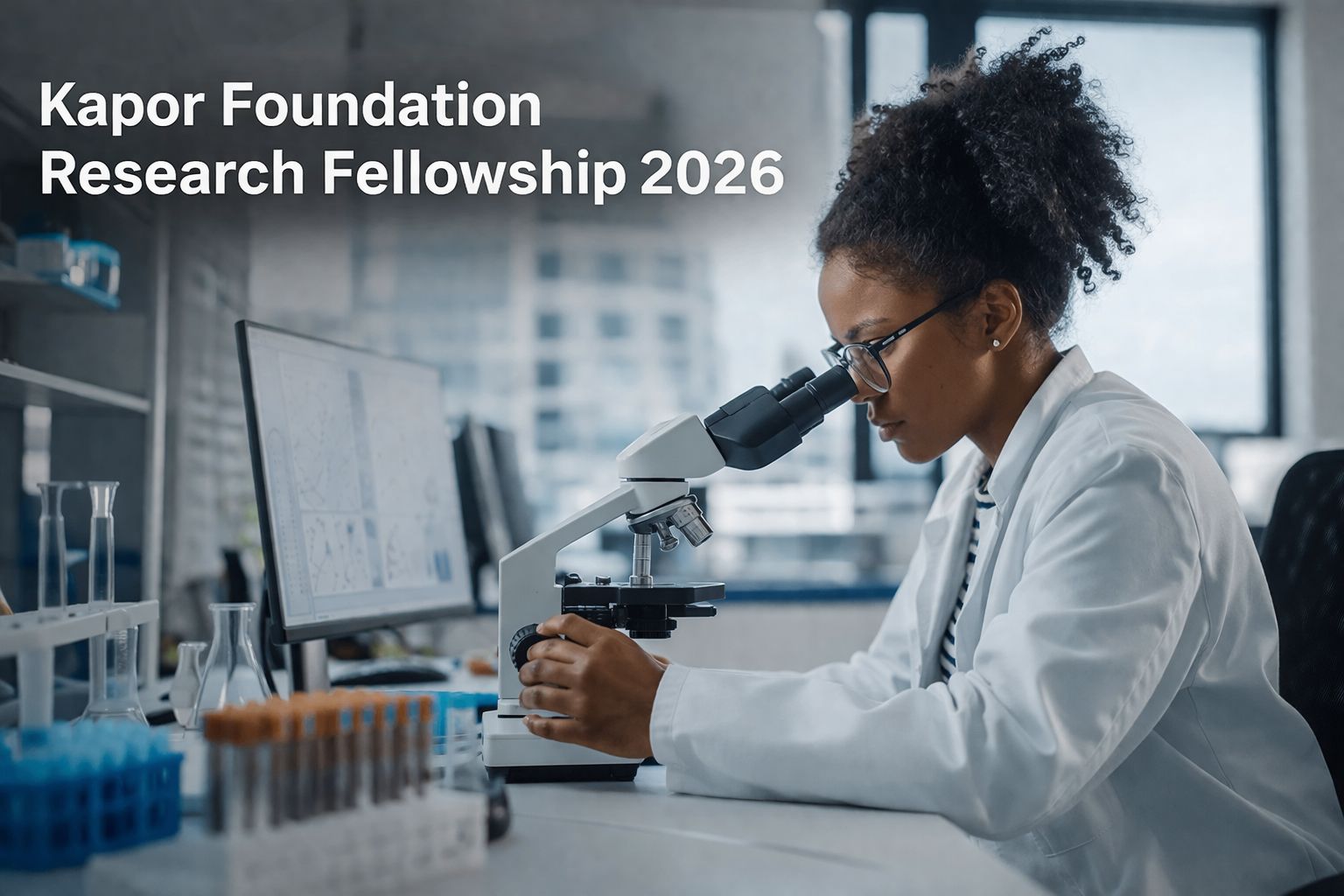
If you are a researcher, academic, or investigative journalist working at the intersection of technology and social equity, the Kapor Foundation Research Fellowship 2026 could be one of the most meaningful opportunities you apply for this year. This fellowship is not just about funding. It is about joining a movement that is working to reshape the technology ecosystem so that it works for everyone, not just a privileged few.

In this article, we will walk you through everything you need to know about this fellowship, from what it is and who it is for, to the research areas it covers, the application process, past fellows who have been selected, and tips to make your application stand out. Whether you found this page through a quick search or someone shared it with you, we want to make sure you leave here fully informed and ready to apply.
What Is the Kapor Foundation Research Fellowship?
The Kapor Foundation Research Fellowship is a program run by the Kapor Foundation, a nonprofit organization that has been working since 1997 at the intersection of racial equity and technology. The foundation’s core belief is simple but powerful: when technology is designed to be inclusive and is used to address real societal challenges, it has the power to transform the entire tech ecosystem for Black, Latine, and Native communities and society as a whole.
The fellowship itself was created to support individuals across academia and investigative journalism who are examining the state of the tech ecosystem, identifying disparities in access, opportunities, and experiences across the tech sector. Research is one of the most powerful tools available for dismantling systemic inequities, and this program exists to fund the people doing that work.
For 2026, the fellowship has been updated to focus specifically on three priority areas, with a strong emphasis on responsible AI and tech ethics. The foundation believes that supporting rigorous, evidence-based research and high-quality journalism in these areas will help drive the systemic change that is so urgently needed right now.
About the Kapor Foundation
Before diving deeper into the fellowship, it helps to understand the organization behind it. The Kapor Foundation was founded by Mitch Kapor and Freada Kapor Klein, two longtime advocates for equity in the technology industry. The foundation operates at the intersection of racial justice and technology, and its work touches four major focus areas: equity in computer science education, inclusive pathways to tech careers, diversifying entrepreneurship and venture capital, and equitable tech policy.
The foundation does not just give money and walk away. It conducts original research, publishes reports, builds the capacity of its partners, invests in tech entrepreneurs, and actively advocates for policy changes that protect and uplift Black, Latine, and Native communities. Its leadership includes Dr. Allison Scott, who serves as CEO and brings a deep research background to the organization’s mission.
In recent years, the Kapor Foundation has also taken a clear stance on artificial intelligence, publishing its Responsible AI Principles and joining Humanity AI, a $500 million commitment to driving a people-centered AI future. This context matters because it shapes what the foundation is looking for in its research fellows.
Why This Fellowship Exists
There is a reason the Kapor Foundation created this fellowship and continues to invest in it. The technology sector still has deep and persistent problems when it comes to access, opportunity, and representation. Black, Latine, and Native communities are underrepresented at every level of the tech industry, from workers to founders to investors. The policies that govern technology are often written without input from the communities most affected by them. And the rise of artificial intelligence has introduced new risks of bias, surveillance, and economic exclusion that require urgent attention.
Research and journalism are essential weapons in the fight for equity. When researchers publish peer-reviewed studies documenting disparities in tech hiring, or when investigative journalists expose the ways algorithmic systems discriminate against marginalized communities, they create the evidence base that advocates, policymakers, and communities need to demand change. The Kapor Foundation Research Fellowship exists to fund that work, at a time when it has never been more important.
Kapor Foundation Research Fellowship 2026: Key Details
Here is a quick overview of what you need to know about the 2026 cycle of this fellowship:
- Program Name: Kapor Foundation Research Fellowship 2026
- Offered by: Kapor Foundation
- Fellowship Type: Research and Investigative Journalism
- Application Mode: Rolling basis
- First Awards Announcement: By June 30, 2026
- Focus Areas: CS/AI Education, Innovation, Governance (with emphasis on responsible AI and tech ethics)
- Eligible Applicants: Academics, doctoral candidates, researchers, and investigative journalists
- Host Organization: Kapor Foundation, Oakland, California
Who Is This Fellowship For?
The Kapor Foundation Research Fellowship is open to two main groups of people. The first group is individuals working in academia, such as doctoral candidates, postdoctoral researchers, and faculty members who are conducting original research on technology disparities, AI governance, computer science education, or related topics. The second group is investigative journalists who are producing long-form, research-informed reporting on the intersection of technology and society.
What ties these two groups together is a shared commitment to producing work that is rigorous, evidence-based, and focused on equity. The foundation is not looking for surface-level or opinion-based work. It wants to support fellows whose projects have the potential to genuinely shift the conversation around technology access, accountability, and fairness.
If you are a graduate student exploring how AI systems reproduce racial bias, a policy researcher analyzing broadband access disparities, a journalist investigating algorithmic discrimination in hiring platforms, or a computer science educator developing inclusive curricula for underserved communities, this fellowship was built for you.
Research Priority Areas for 2026
The 2026 fellowship has three priority research areas. Each of them reflects the Kapor Foundation’s broader mission and its current focus on responsible AI and technology governance.
1. CS and AI Education
This area covers research and journalism focused on how computer science and artificial intelligence education is being delivered, to whom, and with what outcomes. The foundation is particularly interested in work that examines disparities in access to quality CS and AI education across K-12 schools and postsecondary institutions. Research that explores culturally responsive teaching methods, the representation of marginalized students in computing programs, and the effectiveness of different educational interventions is especially relevant here.
As artificial intelligence becomes a core part of how our world works, the question of who gets to learn about it, build with it, and shape its future is becoming more urgent. Fellows working in this area are tackling some of the most important educational equity questions of our time.
2. Innovation
The Innovation priority area focuses on the entrepreneurship and venture capital landscape, particularly as it relates to underrepresented founders and communities. Research in this area might examine the racial wealth gap in startup funding, the experiences of Black and Latine tech entrepreneurs, the role of responsible AI in new product development, or the ways in which technology-driven economic opportunity is being distributed unevenly across society.
The Kapor Foundation has a long history of investing in gap-closing companies and diverse fund managers through its affiliated entity Kapor Capital. The research fellowship in this area is meant to generate the evidence base that informs and strengthens that work, and to hold the broader investment ecosystem accountable to equity standards.
3. Governance
This is perhaps the most timely of the three areas. Technology governance and responsible AI are at the center of some of the most heated policy debates happening right now, from algorithmic accountability and data privacy to facial recognition bans and AI regulation. The Kapor Foundation wants to support researchers and journalists who are digging into these issues with rigor and a commitment to centering the voices of communities that are most affected by technology policy decisions.
Research on how AI systems are regulated at the federal, state, and local levels, how tech companies are held accountable for the harms their products cause, and how civil society organizations are building the capacity to engage in technology policy debates all fall within this priority area.
What the Fellowship Provides
The fellowship provides financial awards to support fellows as they pursue their research or journalism projects. While the exact award amounts for the 2026 cycle are outlined in the official application details document, the program is designed to give fellows the time, resources, and institutional support they need to do their best work.
Beyond the financial support, being a Kapor Foundation Research Fellow comes with significant professional benefits. Fellows are affiliated with one of the most respected organizations working on tech equity in the United States. They gain access to the foundation’s network of researchers, journalists, policymakers, advocates, and technology professionals. Their work is amplified through the foundation’s communications channels, helping it reach the audiences that can act on it.
For doctoral candidates and early-career academics, a Kapor Foundation fellowship is also a meaningful credential that signals your commitment to equity-centered research and your ability to attract competitive external funding. For journalists, it is an opportunity to pursue a story that might otherwise not get greenlit by a traditional newsroom, with the editorial freedom to go deep and get it right.
The 2024-2025 Inaugural Cohort: Past Fellows
The 2024-2025 cohort was the inaugural class of Kapor Foundation Research Fellows, and the caliber of individuals selected gives you a clear picture of what the foundation is looking for. The cohort was divided into two tracks: academic fellows and investigative journalism fellows.
Academic Fellows
The inaugural academic cohort included doctoral candidates and researchers from some of the most prominent universities in the country. Erin Anderson from Georgia State University brought her work on mixed-reality simulation learning experiences for preservice teachers, with a focus on making educational technology accessible for Deaf and Blind educators. Andrea Dean from Georgetown University Law Center combined her background as a software engineer at Amazon with her graduate studies in AI governance and data regulation to explore equitable tech policy. Errika Moore from Georgia Institute of Technology brought decades of experience in STEM education and workforce development to her fellowship research. Deepa Muralidhar, also from Georgia State University, focused on mitigating bias in AI systems through improved explainability and usability. Annabel Rothschild from Georgia Tech explored how data workers’ lived experiences shape the quality and fairness of AI datasets. Kaelyn Sanders from Michigan State University examined digital inequality among Black men and women on parole. Jaemarie Solyst from Carnegie Mellon University researched how to empower marginalized youth as stakeholders in the responsible AI ecosystem. Alicia Tsai from UC Berkeley brought expertise in machine learning theory and AI robustness, with a focus on making AI systems more equitable. Meagan Turner from the University of Louisville combined her engineering background with her work connecting Black tech founders to investors across the United States.
Investigative Journalism Fellows
The journalism track included some impressive reporters and audio journalists as well. Jesse Dukes, a veteran podcast producer, worked on a project about the arrival of generative AI in schools. Tara Garcia Mathewson, who covers the intersection of technology and education for CalMatters and The Markup, brought her decade-long beat on educational equity to her fellowship work. Meghan Sullivan, an investigative journalist focused on technology and Indigenous communities, explored how tech policies affect Native people. Tasmiha Khan, whose bylines span The New York Times, Washington Post, TIME, and Forbes, focused on the intersection of technology with race, health, and civil rights. Ethan Bakuli, a Detroit-based journalist who reports on race and equity in education and the environment, rounded out the journalism cohort.
Looking at this group, a few things stand out. The foundation selected people who were already deep in their fields and producing serious work. It selected people who brought interdisciplinary perspectives, combining technical knowledge with social science, law, journalism, and community organizing. And it selected people whose work was clearly grounded in the real experiences of marginalized communities, not just abstract theory.
How to Apply for the Kapor Foundation Research Fellowship 2026
Applications for the 2026 cycle are being accepted on a rolling basis, which means you do not have to wait for a single hard deadline. However, the foundation has announced that the first awards will be announced by June 30, 2026, so the earlier you apply, the better your chances of being considered in that first round of selections.
To get started, you can download the full application details and then submit your application through the official portal. You can access the application by visiting the Kapor Foundation Research Fellowship page and clicking the Apply Now button. The application is hosted through the Qualtrics platform.
Before you apply, make sure to download the application details document, which is also linked on the fellowship page. This document will give you the specific requirements, guidelines, and criteria that the selection committee uses to evaluate proposals. Reading it carefully before you begin your application is strongly recommended.
Tips for a Strong Application
Based on what we know about the fellowship’s goals and the inaugural cohort that was selected, here are some practical tips to help you put together a competitive application.
Be Specific About Your Research Question
The foundation is looking for projects with clear research questions and a well-defined methodology. Vague proposals about wanting to study AI or tech equity are not going to stand out. Be specific about what you are investigating, why it matters, what methods you will use, and what outcomes you expect. The more clearly you can articulate the problem you are solving and the approach you are taking, the more confident the selection committee will feel in your ability to deliver results.
Connect Your Work to the Foundation’s Priority Areas
Make sure your proposal explicitly connects to one of the three priority research areas: CS/AI education, innovation, or governance. Do not assume the reviewers will make the connection for you. Name the priority area you are addressing and explain how your work contributes to the foundation’s goals in that space.
Center Equity and Community
The Kapor Foundation’s entire mission is built around racial equity and the experiences of Black, Latine, and Native communities in the tech ecosystem. Your proposal should make it clear that equity is not an afterthought in your work but a central organizing principle. If your research involves community members, explain how you are engaging with them and how your findings will be useful to them, not just to academic audiences or policymakers.
Show Your Track Record
Even if you are early in your career, the strongest applications will demonstrate that you already have some relevant experience, publications, reporting credentials, or community engagement. Look at the inaugural fellows and notice that all of them had already been doing meaningful work in their fields before being selected. Use your application to highlight what you have already done and explain how the fellowship will allow you to go further and deeper.
Be Clear About Impact
The foundation wants to fund research and journalism that leads to real-world change, not just papers that get filed away in academic journals or stories that generate a news cycle and fade. Think carefully about who the audience for your work is, how it will reach them, and what you hope they will do with it. Whether your goal is to inform a policy debate, change a hiring practice, shift a curriculum, or hold a tech company accountable, be specific about the impact you are trying to create.
Why You Should Apply
If your work falls anywhere near the areas this fellowship covers, there are real reasons to put the time into applying. First and most obviously, the financial support can make a genuine difference in your ability to pursue your research or reporting project. Doctoral students often have limited funding for original research outside of their dissertation work. Journalists frequently find that the investigative stories that matter most are the hardest to get funded through traditional newsroom budgets. This fellowship can fill that gap.
Second, the Kapor Foundation’s network and platform are genuinely valuable. When your work is amplified through an organization with the reach and credibility of the Kapor Foundation, it gets in front of policymakers, funders, journalists, advocates, and community leaders who can actually use it. That kind of visibility is difficult to manufacture on your own.
Third, the fellowship community itself is a resource. Being part of a cohort of researchers and journalists who are all thinking deeply about technology equity means you will learn from peers who bring different disciplinary backgrounds and methodological approaches to shared problems. Those relationships often outlast the fellowship itself and become part of a lasting professional network.
Finally, there is something meaningful about being formally recognized as someone whose work matters in this fight. Fellowships like this one send a signal to your institution, your peers, and your community that what you are doing is important and worth investing in. That kind of validation can open doors and create momentum in ways that are hard to quantify but very real.
The Bigger Picture: Tech Equity Research in 2026
It is worth stepping back for a moment to think about why this fellowship matters in the context of what is happening in the world right now. Artificial intelligence is reshaping industries, labor markets, education systems, healthcare delivery, and the justice system at a pace that few anticipated even a few years ago. The decisions being made today about how AI is built, deployed, regulated, and governed will shape who benefits and who is harmed for decades to come.
At the same time, many of the civil rights protections, diversity initiatives, and equity-focused programs that were built over decades are facing significant political pressure. Researchers and journalists who are documenting what is happening, who is being left out, and what needs to change are more important than ever. The Kapor Foundation’s investment in this fellowship is a recognition of that reality and a commitment to keeping the equity lens in place even when external forces are pushing against it.
If you are someone who cares about these issues and has the skills and the project to contribute to this work, the Kapor Foundation Research Fellowship 2026 is one of the best opportunities available to you right now. Do not let it pass you by.
Quick Summary
- Program: Kapor Foundation Research Fellowship 2026
- Open to: Academic researchers (including doctoral candidates) and investigative journalists
- Focus: CS/AI Education, Innovation, Governance (emphasis on responsible AI and tech ethics)
- Application: Rolling basis
- First Awards: Announced by June 30, 2026
- Location: U.S.-based fellows (Kapor Foundation is headquartered in Oakland, California)
- Apply: Visit the official Kapor Foundation Research Fellowship application portal to submit your application
Final Thoughts
The Kapor Foundation Research Fellowship 2026 is more than just a funding opportunity. It is an invitation to be part of a community of thinkers, researchers, and storytellers who believe that technology can and should work for everyone. If your research or journalism is focused on how we get there, this fellowship is worth every hour you put into the application.
Take the time to read the application details carefully, craft a proposal that is specific and evidence-based, and make a clear case for why your work matters and what impact it will have. The foundation has already demonstrated through its inaugural cohort that it is serious about selecting fellows whose work can change the conversation. Your work could be part of that next chapter.
Ready to take the next step? Head over to the Kapor Foundation Research Fellowship official page to download the application details and submit your application today.