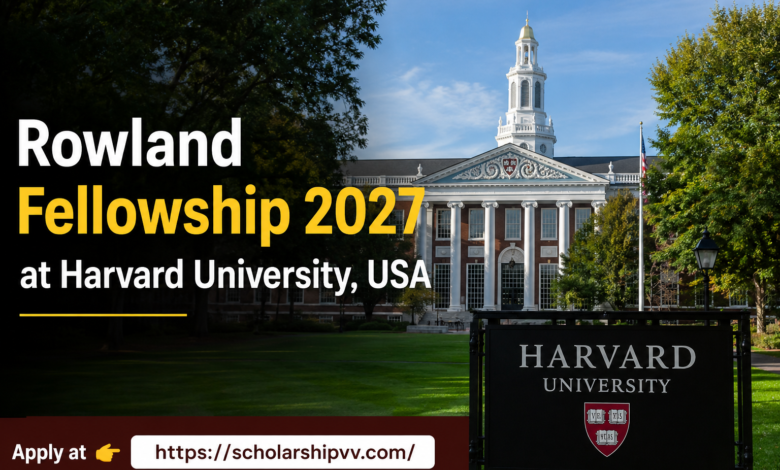
If you are an early-career experimental scientist or engineer looking for an opportunity to launch your own independent research program at one of the most respected universities in the world, the Rowland Fellowship 2027 at Harvard University could be exactly what you have been waiting for. Applications are now open, and this is genuinely one of the most remarkable research fellowships available to scientists anywhere in the world, not because of the prestige of the Harvard name alone, but because of what the fellowship actually offers you in terms of freedom, resources, and long-term career development.

This article covers everything you need to know about the Rowland Fellowship 2027. We will walk you through the history of the Rowland Institute at Harvard, what makes this fellowship so unique, who is eligible, what financial benefits you will receive, what documents you need, how the application process works, tips to help you apply successfully, and how to submit your application before the deadline. Let us get into it.
About the Rowland Fellowship Harvard University
To understand why the Rowland Fellowship is so special, you need to know a little about where it comes from. The Rowland Institute at Harvard was founded in 1980 by Edwin H. Land, the legendary scientist and inventor who founded the Polaroid Corporation and spent fifty years as its Director of Research. Over the course of his career, Land accumulated 533 patents, making him one of the most prolific inventors in American history. His inventions included the first sheet polarizers and the development of instant photography, which completely changed the photography industry.
Land was not just a brilliant inventor; he was a visionary about science and how it should be done. He believed deeply in the importance of giving talented researchers the freedom to pursue bold and ambitious ideas without the constant pressure of grant applications and bureaucratic hurdles. He understood that truly transformative scientific discoveries often come from people who are given the space to work on problems that are, in his own words, “manifestly important and nearly impossible.” That philosophy became the founding principle of the Rowland Institute.
Land established the institute as a privately endowed, nonprofit basic research organization dedicated to experimental science across a wide range of disciplines, with a particular emphasis on interdisciplinary work and the development of new experimental tools and methods. The institute operated independently for over two decades, building a reputation for producing groundbreaking research in physics, chemistry, biology, and biophysics.
In 2002, the Rowland Institute merged with Harvard University, becoming the Rowland Institute at Harvard and joining the Faculty of Arts and Sciences. Harvard President Lawrence H. Summers described the union at the time not as an acquisition but as a genuine merger, and one of the most significant in Harvard’s long history. The move gave the institute access to Harvard’s vast resources while preserving its unique culture of creative, independent science.
Then in 2024, the institute moved from its original building along the Charles River to Harvard’s main campus at 60 Oxford Street, a newly renovated space shared with the Harvard Quantum Initiative. This move was designed to bring Rowland Fellows into even closer proximity with Harvard’s broader academic community and research infrastructure, opening up new possibilities for collaboration across departments and schools.
The Rowland Fellows Program has always been at the heart of the institute. Some of the most distinguished scientists in the world have passed through the program, including Howard Berg, the biophysicist known for his foundational work on bacterial motility and the movement of Escherichia coli; Lene Hau, the physicist who famously slowed light to a standstill using an ultracold atomic system; Donald A. Glaser, a Nobel Prize winner in Physics; and Steven Block, who pioneered the use of optical tweezers to study molecular motors. The institute has a track record of producing scientific leaders, and the current fellowship is designed to continue that tradition.
What Makes the Rowland Fellowship Different from Other Fellowships?
This is a question worth answering directly, because there are many fellowships and postdoctoral programs out there, and on the surface they can all start to sound similar. The Rowland Fellowship is genuinely different in several important ways.
The most important difference is independence. In a traditional postdoctoral position, you work in someone else’s lab, on someone else’s research agenda, and you are building your CV while contributing to a senior researcher’s program. There is nothing wrong with that, and it is an important part of how science works. But the Rowland Fellowship is not that. As a Rowland Fellow, you are the principal investigator. You run your own lab. You set your own research agenda. You hire your own team. You decide what questions to ask and how to answer them. That level of independence is exceptionally rare for early-career scientists, and it is what makes the Rowland Fellowship so transformative for the researchers who receive it.
The second major difference is the scale of the resources provided. The fellowship comes with generous startup funding for capital equipment, a yearly operational budget starting at $225,000 for lab supplies, travel, and the hiring of personnel including postdoctoral researchers, post-baccalaureate students, and undergraduates. That kind of operational budget gives you the ability to actually pursue ambitious, resource-intensive experimental research from day one, rather than spending your first year just trying to set up your lab with limited funds.
The third difference is the breadth of what is funded. The Rowland Institute actively supports high-risk, high-reward research that bridges traditional disciplinary boundaries. The program explicitly welcomes applications from any field of experimental science or engineering, and the institute has a strong preference for research proposals that are bold and interdisciplinary. If your research question does not fit neatly into a traditional department or funding category, the Rowland Fellowship may actually be a better fit for it than many conventional funding mechanisms.
Finally, the mentorship and support infrastructure is exceptional. You are not just handed a budget and left to figure things out on your own. Fellows receive mentoring to help them build a productive lab culture, support for scientific writing and grant applications, career development support throughout the entire fellowship period, and access to leadership training through Harvard’s Core for Mentorship Excellence. That combination of independence and structured support is rare and valuable.
Fellowship Overview and Key Details
Before going into the details, here is a quick overview of the key facts about the Rowland Fellowship 2027:
Host Institution: Rowland Institute at Harvard University, Cambridge, Massachusetts, USA
Department: Faculty of Arts and Sciences, Harvard University
Fellowship Type: Fully funded independent research fellowship
Fellowship Duration: Up to five years
Start Dates for 2027 Fellows: Flexible, between July and December 2027
Research Focus: All fields of experimental science and engineering
Eligible Applicants: International and U.S. applicants; open to all nationalities
Principal Investigator Rights: Full PI rights granted from day one
Application Deadline: Saturday, August 1, 2026 at 11:59 PM EDT
Application Portal: Harvard Careers website only
Financial Benefits: What Does the Rowland Fellowship Cover?
The financial package associated with the Rowland Fellowship is comprehensive and genuinely generous. Here is a detailed breakdown of what you receive as a Rowland Fellow.
Annual Salary
Rowland Fellows receive a competitive annual salary that starts at $89,999 per year. This comes with full Harvard University benefits, which include comprehensive health insurance coverage, retirement plan contributions, and other standard Harvard employee benefits. This salary is not just a stipend; it is a full professional salary at one of the most prestigious institutions in the world.
Annual Operational Research Budget
Perhaps the most striking element of the financial package is the yearly operational budget. Rowland Fellows receive a budget starting at $225,000 per year for general lab operations. This covers lab supplies, reagents, travel to conferences, and most importantly, the hiring of personnel for your research group. You can use this budget to bring on postdoctoral researchers, post-baccalaureate researchers, and undergraduate research assistants. This gives you the ability to build a real research team from the very beginning of your fellowship.
Startup Funding for Capital Equipment
In addition to the annual operating budget, fellows also receive generous startup funding specifically for capital equipment. The exact amount depends on the nature of your research program and what equipment you need to get started. If your research requires specialized instrumentation, custom-built apparatus, or expensive materials, this startup funding is designed to help you acquire those resources without having to wait for external grants.
Dedicated Laboratory Space
Every Rowland Fellow is provided with their own dedicated laboratory space within the Rowland Institute at Harvard’s main campus. Additional ancillary spaces are also available as needed, such as cell culture rooms, magnet rooms, or other specialized environments required by your research program. Having dedicated lab space from day one is a significant advantage that most early-career researchers do not get until much later in their careers.
Access to Shared Research Equipment and Facilities
Beyond your own lab, fellows have access to extensive shared research equipment and facilities both within the Rowland Institute and across Harvard University. This includes the Center for Nanoscale Systems, the Bauer Life Science Core Facility, and many other specialized research infrastructure resources distributed across Harvard’s campus in Cambridge, Massachusetts. The 2024 move to the main campus has made this access even more convenient and immediate.
Staff Scientists and Engineers
One resource that is genuinely rare in academic research settings is direct access to professional staff scientists and engineers who can work with you to design and build custom experimental setups. If your research requires a piece of equipment that does not exist commercially, or if you need to modify existing instruments, the Rowland Institute’s technical staff can help you make that happen. This is an extraordinary resource for experimental researchers.
Mentorship and Career Development
Fellows receive structured mentoring throughout their five-year fellowship period. This includes guidance on developing a productive and healthy lab culture, support for scientific writing and the preparation of manuscripts, help with budgeting and financial management of your lab, leadership training through Harvard’s Core for Mentorship Excellence, and ongoing career development support to help you position yourself for your next career step after the fellowship.
Teaching Opportunities
Rowland Fellows have the opportunity to teach undergraduates during their fellowship, ideally in an active research setting rather than a traditional classroom. This is framed as an opportunity rather than a requirement, and it serves two practical purposes: it gives you experience in teaching and mentorship that will strengthen your academic CV, and it gives you a pipeline for recruiting talented undergraduate students to join your research group.
Visa Support
For international applicants who are not U.S. citizens, the Rowland Institute actively assists with the visa process. This means you do not need to worry about navigating U.S. immigration processes entirely on your own. The institute’s administrative team will support you through the necessary steps to obtain the appropriate visa to work and conduct research at Harvard University.
Eligibility Criteria
The Rowland Fellowship has a focused and relatively straightforward set of eligibility requirements. Here is what you need to qualify for the 2027 cycle.
PhD Requirement
To be eligible for the Rowland Fellowship 2027, you must either currently be in the process of completing your PhD, or you must have received your PhD after May 1, 2025. Importantly, you must have completed your doctoral degree before you actually begin your fellowship term. This means that if you are still finishing your PhD at the time of application, that is perfectly acceptable, but you will need to have your degree in hand before your fellowship start date between July and December 2027.
Experimental Research Focus
Your proposed research must be experimentally focused. The Rowland Fellowship is specifically designed for hands-on, lab-based experimental science and engineering. Purely theoretical, computational, or clinical research proposals are not within the scope of this fellowship. The institute is looking for researchers who will actually be doing experiments in a laboratory setting.
The fellowship accepts applications from an exceptionally broad range of scientific disciplines. Eligible fields include physics, chemistry, biology, engineering, neuroscience, biophysics, materials science, and any other experimental scientific discipline. The institute explicitly states that the research conducted by current and past fellows can be used as a guide to the kinds of work they support, but it should not be considered restrictive. If your experimental science idea is bold, creative, and has the potential to make a significant contribution to your field, the fellowship welcomes it.
There is one important restriction: the program does not support human subjects research or clinical research. If your proposed work involves direct research on human participants, you will need to look at other fellowship opportunities.
Nationality
The Rowland Fellowship is open to applicants from any country. Both U.S. citizens and international applicants are eligible to apply. There are no nationality restrictions, which makes this one of the most accessible prestigious research fellowships in the United States for international scientists.
Institutional Affiliation
Applicants may currently be affiliated with any accredited academic institution, whether in the United States or internationally. Your current university does not need to have any existing relationship with Harvard or the Rowland Institute for you to be eligible to apply.
Required Application Documents
The Rowland Fellowship application requires several specific documents, each of which serves a clear purpose in helping the selection committee evaluate your potential. Here is exactly what you need to prepare.
Elevator Pitch
The elevator pitch is a 250-word summary of your research goals written for a general audience. This is not a technical abstract; it is your chance to explain what you want to do and why it matters in plain language that someone outside your specific field can understand and appreciate. This document tests your ability to communicate science clearly and compellingly, which is an essential skill for any research leader. Do not underestimate how important this piece is.
Statement of Research
The Statement of Research is your detailed research proposal. It has a strict limit of three pages, including all references. Within those three pages, you need to describe your proposed research program, explain the scientific questions you want to answer, outline the experimental approaches you plan to use, and, if relevant, summarize any recent preliminary work that supports the planned experiments. This document should demonstrate the originality, feasibility, and significance of your proposed research.
Vision Statement
The Vision Statement is one page in length, and it is one of the most distinctive elements of the Rowland Fellowship application. In this document, you are asked to describe how your personal values and experiences in academia inform your plan for building a productive, healthy, and supportive culture within your research group. The Rowland Institute takes lab culture seriously, and they want to see that prospective fellows have thought carefully about what kind of research environment they want to create and how they plan to support the people in their group.
Curriculum Vitae
You will need to submit a current and complete curriculum vitae. This should include your educational background, your research experience, any publications or preprints you have authored or co-authored, presentations you have given, any awards or honors you have received, and any other relevant professional experience or activities.
Three to Four Letters of Recommendation
You are required to provide contact information for three to four references. Once you submit your application, automated emails will be sent to your references asking them to submit letters of recommendation, with a deadline of two weeks from when you submit your application. This means you should alert your referees well in advance that they will be receiving these automated requests, so they have enough time to write and submit their letters. Choose people who know your research well and can speak specifically about your potential as an independent research leader.
The Application Process: Step by Step
Here is how to navigate the Rowland Fellowship 2027 application from start to finish.
Step 1: Read All Available Information
Start by visiting the official Rowland Institute at Harvard website to read all the current information about the fellowship, current fellows, and the kinds of research the institute supports. Look at what current and past Rowland Fellows have worked on. This will give you a strong sense of whether your research fits the institute’s culture and mission, and it may also give you ideas for how to frame your own research proposal.