
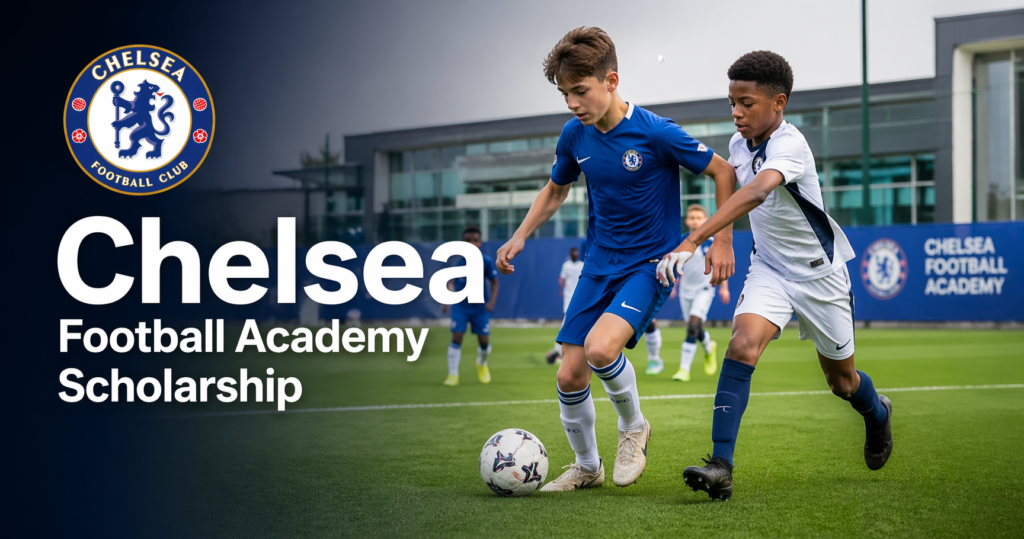
For millions of young footballers around the world, pulling on a Chelsea shirt is the dream. And for a small, gifted group of teenagers each year, that dream takes a very real step forward when they sign a scholarship agreement with one of the most storied academies in English football. But what exactly is the Chelsea Football Academy scholarship, how does it work, who gets it, and what happens to the players who earn one? This guide answers all of those questions in full. Whether you are a parent looking to understand the pathway, a young player hoping to get noticed, or simply someone curious about how elite academy football development works in England, this is everything you need to know.
What Is Chelsea Football Club and Its Academy?

Chelsea Football Club was founded in 1905 by Gus Mears and is based at Stamford Bridge in Fulham, London. The club is one of the most successful in English and European football, having won over 30 major trophies including six Premier League titles and two UEFA Champions League titles. Since Roman Abramovich took over the club in 2003, enormous investment went into both the first team and the academy structure, transforming Chelsea into a powerhouse for producing elite young talent.
The Chelsea Academy operates out of the Cobham Training Centre, located at 64 Stoke Road, Stoke D’Abernon, Cobham, Surrey, KT11 3PT. This world-class facility houses all age groups from the youngest academy players right up to the senior first team, and it is widely considered one of the finest football training complexes in Europe. The Under-21 development squad plays their home games at Kingsmeadow, while the Under-18s primarily train and play at Cobham, with important matches occasionally hosted at Stamford Bridge itself.
Chelsea’s academy is rated as a Category 1 academy under the Premier League’s Elite Player Performance Plan (EPPP), which is the highest possible classification for a youth development programme in England. This status means the academy meets the most rigorous standards in training facilities, coaching quality, education provision, welfare, and player development. There are currently 29 Category 1 academies in England for the 2025/26 season, and Chelsea has consistently ranked among the very best of them.
In terms of competition record, the Chelsea Academy has won the FA Youth Cup nine times, including five consecutive titles between 2014 and 2018, a feat unprecedented in the history of the competition. Chelsea is also the only English club to have reached the final of the UEFA Youth League, having won it twice in four final appearances. These achievements reflect a consistent ability to develop players who compete and win at the very highest youth football level in the world.
What Is the Chelsea Football Academy Scholarship?
The Chelsea Football Academy scholarship is a formal agreement signed between Chelsea Football Club and a young player at the point where they transition from schoolboy registration into full-time professional development. Under the EPPP framework, all players in their Under-17 year must commence the season with a scholarship agreement before they become eligible to sign their first professional football contract. This is the standard pathway used by all Premier League academies in England.
The scholarship agreement, known officially as the PLYD Form 1, is a formal contract focused on an Education Programme. It includes details of the player’s training schedule, educational arrangements, pay, and welfare obligations. At Chelsea, signing the scholarship is a significant milestone. It means the club has formally committed to your development and has identified you as someone with the potential to progress toward a professional career.
Scholars at Chelsea are typically aged 16 to 18, corresponding to the Under-18 age group. Players can be offered a scholarship deal from the 1st of January in their 14th birth year, but the agreement formally begins when they enter their Under-17 season. The most highly rated young players at Category 1 academies like Chelsea are often offered a professional contract at the age of 17, which can be pre-agreed as early as January in their 14th birth year.
For the 2025/26 season, Chelsea confirmed that 16 players had signed as first-year scholars with the club. Signing ceremonies are traditionally held at Stamford Bridge before the pre-season begins, making it a memorable and significant occasion for the players and their families.
How the Chelsea Academy Scholarship Works: The EPPP Development Pathway
To understand the scholarship, you need to understand the broader system it sits within. The Elite Player Performance Plan, commonly called the EPPP, was introduced by the Premier League in 2011 and 2012 with the stated objective of producing more and better homegrown players in English football. The EPPP works across three distinct phases of development.
The Foundation Phase covers Under-9 to Under-11 players. This is the entry point for most players who join the Chelsea Academy, with some players joining as young as Under-8. The Youth Development Phase covers Under-12 to Under-16 players and is where more intensive tactical and technical training begins alongside regular competitive football. The Professional Development Phase covers Under-17 to Under-23 players and is where scholarship agreements are signed and the pathway to professional football begins in earnest.
Under the EPPP, the Premier League is also directly responsible for the formal education programmes of all apprentices aged 16 to 19 who have signed a full-time Scholarship Agreement at a Premier League club. The Premier League’s Education Department delivers programmes to support technical, tactical, physical, mental, lifestyle, and welfare development for all academy players. This education programme has received an Outstanding rating from Ofsted in 2010, 2017, and 2023, reflecting consistently exceptional standards across the system.
What this means practically for a Chelsea scholar is that your education is not just an afterthought to your football training. It is a structured and monitored part of your development. All scholars are required to complete formal qualifications during their time at the academy. These include GCSEs, A-Levels, or BTECs, depending on the player’s stage and academic needs. Chelsea works with partner schools and educational institutions to ensure players maintain their academic progress even while training full time.
What Do Chelsea Academy Scholars Receive?
Being a Chelsea Academy scholar comes with a package of support and benefits that goes well beyond simply getting to train at Cobham. Here is a breakdown of what scholars at the club receive.
Financial Support and Wages
Academy scholars at Premier League clubs including Chelsea receive wages under their scholarship agreements. These wages are set at the apprentice minimum wage level, with average weekly wages across Premier League and Football League clubs sitting at approximately £165 per week for first-year scholars and around £175 per week in the second year. For the most highly rated scholars at a club the size of Chelsea, individual arrangements may differ, and some scholars transition directly onto professional contracts at 17, with wages that can be significantly higher at £1,000 or more per week for young professionals.
Players from the Under-8 through Under-16 age groups do not receive wages, as they are considered youth amateurs at that stage. However, clubs including Chelsea do cover expenses for younger players and their families, including travel and other costs related to training attendance.
World-Class Training Facilities
Chelsea scholars train daily at the Cobham Training Centre, which is widely regarded as one of the most advanced football training complexes in Europe. The facility includes multiple full-size pitches, indoor training areas, a gymnasium, sports science laboratories, medical facilities including a sauna, cold immersion pool, and steam room, a media centre, and dedicated educational spaces. The investment in this facility by the club’s ownership has been substantial, running into tens of millions of pounds, and every scholar has access to all of it.
Coaching from Elite Staff
Chelsea employs some of the best youth development coaches in world football. The Under-18s have a dedicated head coach supported by specialist coaching staff, and scholars receive individualised coaching plans as part of what the EPPP calls the Performance Clock, a player-by-player record of achievement and development. Technical training, tactical education, set-piece preparation, and individual skills development are all part of the daily programme at Chelsea’s academy.
Education and Academic Support
As mentioned, all Chelsea scholars must complete formal academic qualifications alongside their football training. The club works with local schools and educational partners to manage hybrid schedules that accommodate both full-time training and academic study. This means a scholar’s typical week balances morning training sessions with afternoon educational commitments or vice versa, depending on the schedule. The Premier League’s online Learning Management System is used to track each player’s educational attainment data and ensure academic progress is maintained throughout the scholarship.
Pathway to Professional Contracts
The most important benefit of the Chelsea scholarship is what it can lead to. Scholars who continue to develop and impress have the opportunity to sign their first professional contract on or after their 17th birthday. Some of the biggest names in modern English football came through Chelsea’s youth system, including John Terry, Mason Mount, Reece James, Trevoh Chalobah, Levi Colwill, and Conor Gallagher. While not every scholar becomes a Premier League star, the Chelsea scholarship provides a direct pathway toward professional football and opens doors to careers in the game that would otherwise be much harder to access.
University Football Scholarships
For players who do not progress to a professional contract, the Chelsea Academy also provides pathways to university football scholarships in the UK, the USA, and Europe. Scouts from universities and colleges regularly attend Chelsea Academy showcases and tournaments looking for talented players who have the combination of elite football development and academic qualifications to thrive in higher education football programs. This dual-pathway approach means that even players who do not make it to the senior professional game can use their Chelsea Academy background to access funded university education opportunities that combine sport and study.
The 2025/26 Chelsea Academy Scholar Class
For the 2025/26 season, Chelsea confirmed the signing of 16 players as first-year scholars, making it one of the largest scholarship cohorts in recent years. The scholar class reflects the global reach of Chelsea’s scouting network, with players joining from grassroots clubs, other Premier League academies, Championship clubs, and even internationally. Among the 2025/26 scholars is a winger who joined from Glenavon in Northern Ireland and who made history as the youngest-ever senior debutant in United Kingdom football history at just 13 years old.
Several of the 2025/26 scholars had already been playing regularly for the Under-18s in the previous season, even while still in their Under-16 year, which demonstrates the accelerated development pathway available at a Category 1 academy like Chelsea. Some had already represented their countries at international youth level, including players who have featured for England, Morocco, and Ireland in youth competitions. One of the 2025/26 scholars was part of the Morocco Under-17 squad that won the Africa Cup of Nations at Under-17 level, showing the genuinely international composition of the Chelsea academy programme.
How to Get Scouted by Chelsea Football Academy
This is the question that most young players and their parents want answered most honestly. The reality is that there are no open public trials at Chelsea Football Club. The official Chelsea FC website is clear that no open trials exist for either the academy or the senior team. Getting into the Chelsea Academy requires being scouted, and understanding how to put yourself in the best position to be seen is essential.
Join a Chelsea Soccer School
The most accessible route to getting noticed by Chelsea scouts is to join a Chelsea Soccer School. Chelsea runs holiday and term-time soccer school programmes at various venues, and these sessions are regularly attended by scouts who identify promising players and invite them to trial at Chelsea’s development centres. Because these soccer schools are open to any young player, they represent a genuine open-door opportunity that bypasses the need to already be playing at a high level to get noticed.
Participate in the Player Development Programme
Chelsea’s Player Development Programme (PDP) provides after-school weekday training and holiday activities for aspiring young players. This programme offers more sustained exposure to Chelsea’s coaching methods and scouting network than a single soccer school session, and it is an excellent platform for players who want to develop within Chelsea’s system without yet being on a formal registration.
Perform in Grassroots and Schools Football
Many Chelsea academy players have been recruited from grassroots clubs. Players like one of the 2024/25 scholars joined after a successful trial having come from Wimborne Town, a grassroots club in England. Chelsea’s scouting network actively monitors grassroots, schools, district, and county football across the country. Performing consistently well at whatever level you are currently playing at, and ensuring your coaches and clubs are aware of your ambition to be scouted, gives scouts more opportunities to see you at your best.
Submit a Direct Application with Your Player Profile
If you believe you are ready for a Chelsea Academy trial and have not been picked up through passive scouting, you can submit a direct application to the academy. To do this, you need to prepare a player profile that includes your position, age, date of birth, height, weight, contact information, your current club and any previous clubs, details of any trials you have already attended, any representative honours such as schools, district, county, or international appearances, and the fixture list of your current team including locations and kick-off times. Send this to Chelsea FC Academy at the Cobham Training Ground, 64 Stoke Road, Stoke D’Abernon, Cobham, Surrey, KT11 3PT. The academy will assess your application and may send a scout to watch you play.
International applicants are particularly advised to accompany their application with a video showcasing their skills and technical ability. While clubs receive enormous volumes of video submissions, a concise and well-edited highlight reel that demonstrates your technical skills in match situations can help support a written application.
Build Your Skills at a Recognised Development Organisation
Another pathway is to train with a recognised football development organisation that holds partnerships with professional clubs and arranges showcases for scouts. These organisations provide structured training under qualified UEFA coaches, which not only develops your technical ability but also connects you to networks that facilitate scouting exposure at the highest levels. Players who come through these pathways often arrive at club trials demonstrably better prepared than those who have only trained in informal environments.
What Chelsea Academy Scouts Look For
Understanding what scouts at a Category 1 academy like Chelsea are evaluating during a trial or a match observation can help you focus your development. Chelsea’s scouting methodology assesses players across multiple dimensions rather than simply looking at raw talent.
Technical ability is the foundation of every assessment. This means your first touch, passing accuracy, shooting technique, dribbling ability under pressure, and positional awareness on the ball. Chelsea’s coaches are particularly attentive to how a player moves without the ball and how they read the game, because tactical intelligence is just as important as technical skill at this level.
Physical attributes matter too. Speed, strength, stamina, and coordination are all assessed, though at younger age groups scouts understand that physical development varies widely and give more weight to technical and cognitive ability. At the scholarship level, physical readiness to cope with full-time professional training becomes more important.
Mental and character qualities are assessed throughout the process. Scouts and coaches at Chelsea look for players who demonstrate competitiveness, resilience, a willingness to learn, communication skills, and the kind of attitude that will allow them to thrive in a demanding full-time football environment. Players who show leadership, even in small ways, are noted positively. Several scholars in recent cohorts were specifically highlighted for their leadership qualities within their age group teams.
Academic performance is also relevant. Chelsea and all Premier League academies are required to ensure scholar welfare and educational attainment. Players who are struggling academically or who show little engagement with education during the foundation and youth development phases can face challenges when it comes to transitioning into the full-time scholarship programme, where managing both training and study simultaneously becomes essential.
The Chelsea Academy Scholarship from an International Perspective
While the Chelsea Academy scholarship is primarily structured for players within the English football system, Chelsea’s scouting reach is genuinely global. Players have joined the Chelsea Academy from clubs and countries across Europe, Africa, North America, and beyond. Category 1 academies like Chelsea are permitted to recruit nationally since rule changes that removed the previous 90-minute travel restriction that had limited earlier academy recruitment.
For international players, gaining a scholarship at Chelsea requires compliance with FIFA regulations on international transfers of minors, which have strict age and eligibility criteria designed to protect young players. Generally speaking, international players can only be registered at a foreign club’s academy from the age of 16 or older, subject to specific conditions outlined in FIFA regulations. Players and families interested in pursuing this pathway should seek expert legal and sports guidance before attempting international academy moves.
International players who are successful in gaining entry to the Chelsea Academy system may do so through integration recruitment centres that Chelsea operates, through scout identification at international youth tournaments, or through referrals from trusted partner clubs and organisations in other countries.
Notable Chelsea Academy Graduates
One of the most compelling arguments for the quality of the Chelsea Academy scholarship programme is the list of players who have come through it. The academy has produced legends of the game spanning multiple generations. Peter Bonetti, Bobby Tambling, John Hollins, Peter Osgood, Ray Wilkins, and Jimmy Greaves all came through Chelsea’s youth development system in its earlier incarnations. In more recent decades, John Terry, one of the greatest defenders in Premier League history, was a Chelsea academy graduate. Mason Mount, Reece James, Trevoh Chalobah, Levi Colwill, and Conor Gallagher are all products of Chelsea’s modern academy system and have each gone on to represent Chelsea’s senior team and the England national team at the highest level. This track record is one of the most powerful demonstrations of what the Chelsea scholarship pathway can lead to for those with the talent and determination to see it through.

Career Pathways After the Chelsea Academy Scholarship
Not every Chelsea scholar goes on to become a senior professional footballer, and the academy prepares players for this reality. The Chelsea Academy takes a genuinely holistic approach to developing young people, not just young footballers.
Players who do progress to a professional contract at Chelsea can follow a path through the Under-21s and into the senior squad or be loaned out to gain first-team experience at lower league clubs. Those who are released from the professional pathway but have benefited from the scholarship can move to other professional clubs in England or abroad, often at Championship or League One level, using their Chelsea academy background as a significant asset in recruitment.
For those who do not continue in professional football, the qualifications earned during the scholarship open doors to university and further education. As noted earlier, university football scholarships in the UK, USA, and Europe are a genuine outcome for Chelsea academy graduates, and the academic qualifications combined with the discipline and work ethic developed during the scholarship make them strong candidates for any career they choose to pursue. Careers in sports science, physiotherapy, coaching, sports management, media, and performance analysis are all common pathways for academy graduates across the Premier League system.
How to Apply for the Chelsea Football Academy Scholarship
The application process for the Chelsea Football Academy scholarship begins with getting scouted or making contact with the academy as described in the scouting section above. Once a player has been identified and invited for a trial, the formal process involves assessment sessions at Cobham, an interview with academy staff, and if successful, a formal offer of a scholarship agreement.
To begin the formal process of expressing interest in Chelsea Academy, you can visit the Chelsea FC official Academy page for information about the academy’s structure, programmes, and contact details.
Players who are interested in Chelsea Soccer Schools as a route to scouting exposure can find information and booking options through the Chelsea FC Community and Foundation page, where youth development programmes, soccer schools, and community football initiatives are listed. Getting involved in these programmes is one of the most practical and accessible first steps any young player can take toward entering the Chelsea Academy system.
Conclusion
The Chelsea Football Academy scholarship is one of the most coveted opportunities in youth football worldwide. It is not just a chance to train at one of England’s greatest clubs. It is a comprehensive, fully supported development experience that covers coaching, education, welfare, competition, and long-term career planning. For those who earn it, the scholarship is a life-changing opportunity that opens doors whether or not they ultimately reach the senior professional game.
The pathway to earning a Chelsea scholarship begins with talent, but talent alone is not enough. It requires consistent performance over many years, commitment to both football and education, the right attitude, and the ability to be in the right place at the right time when scouts are watching. Joining Chelsea Soccer Schools, training consistently at a high level, competing in district and representative football, and if necessary submitting a direct application to the academy are all concrete steps that put you in the frame.
For the latest information about Chelsea Academy programmes, soccer schools, and how to get involved, visit the Chelsea Football Club Academy page to explore everything the club offers for young aspiring footballers today.
Hello name is Daniel i play the role of a Goalkeeper an i. Seeking for a scholarship
Apply using the link
marialguet62@gmail.com
Hello my name is ISAIAH MARIAL GUET I am playing a role of winger for Real United
Welcome Isaiah, apply using the link. You can also browse through our website for other football scholarship