
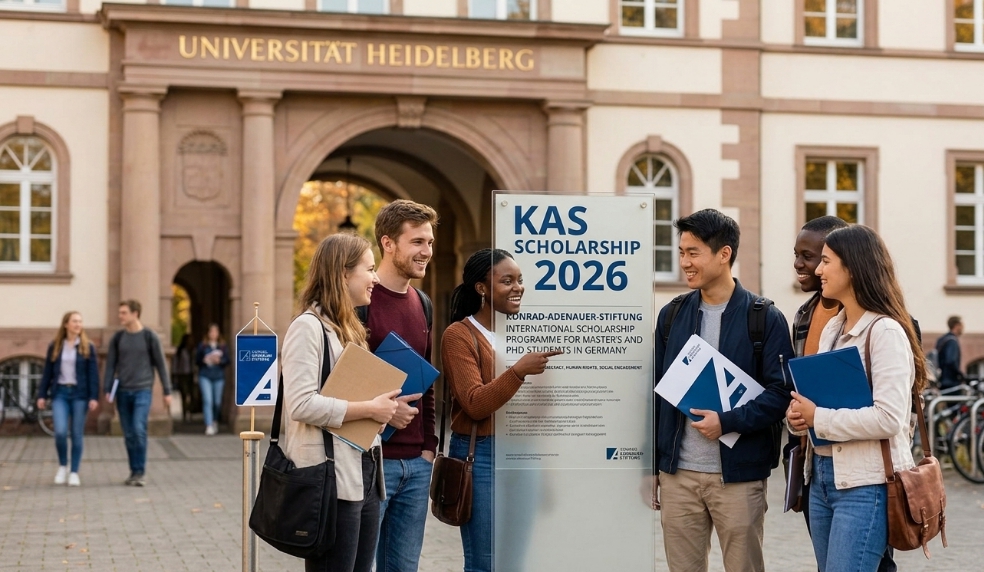
If studying in Germany for free has ever crossed your mind, the KAS Scholarship 2026 is one of the most credible opportunities you will come across this year. Offered by the Konrad-Adenauer-Stiftung, one of Germany’s most respected political foundations, this scholarship gives talented international students and doctoral candidates the chance to pursue a Master’s degree or PhD at a top German university, fully funded, while also developing into future leaders in their home countries.

This guide covers everything you need to know about the KAS Scholarship 2026 in one place. You will find a full breakdown of the scholarship benefits, who can apply, the eligibility requirements in detail, what documents to prepare, the application process, and practical tips to improve your chances of being selected. Whether you are just hearing about it for the first time or you have been researching it for a while, this article will give you a clear and honest picture of what this scholarship involves.
What Is the KAS Scholarship 2026?
The KAS Scholarship is an annual international scholarship programme funded and managed by the Konrad-Adenauer-Stiftung, a German political foundation with a strong Christian democratic identity. The foundation is named after Konrad Adenauer, the first Chancellor of the Federal Republic of Germany, and it has been active in supporting education, political development, and democratic governance both in Germany and across the world for decades.
The KAS International Scholarship Programme is designed specifically for international students and doctoral candidates from non-EU countries who want to pursue a Bachelor’s, Master’s, or PhD programme at a recognized German university or university of applied sciences. The scholarship is not just about financial support. It is about identifying people who combine academic excellence with a genuine commitment to democratic values, community engagement, and social responsibility, and investing in their future so they can go back and create meaningful change in their home countries.
This makes the KAS Scholarship different from many other funding opportunities. It does not simply reward the highest grades. It looks for people who are intellectually strong and at the same time actively engaged in civic, political, or community life. If you are the kind of person who participates in student organizations, volunteer work, or community initiatives while also performing well academically, this scholarship was built for someone like you.
Every year, the foundation receives thousands of applications from talented students across the world, and competition is tough. But for those who meet the profile and take the application process seriously, the rewards are substantial, both financially and professionally.
KAS Scholarship 2026: Quick Facts at a Glance
Scholarship Name: Konrad-Adenauer-Stiftung (KAS) International Scholarship Programme
Offered By: Konrad-Adenauer-Stiftung (KAS), Germany
Study Level: Bachelor’s (ongoing in Germany), Master’s, Postgraduate, and PhD
Target Group: International students and doctoral candidates from non-EU countries
Study Location: Germany (any recognized university or university of applied sciences)
Funding Type: Fully funded
Monthly Stipend (Master’s/Bachelor’s): Up to 992 EUR per month
Monthly Stipend (PhD): Up to 1,400 EUR per month
Funding Duration (Master’s): Up to 2 years (4 semesters standard)
Funding Duration (PhD): Up to 3 years
German Language Requirement: B2 level under the Common European Framework of Reference (CEFR)
Age Limit: Under 30 years at the time of application (general guideline)
General International Deadline: 15 July 2026 at 12:00 noon (CET)
East Africa Deadline (Kenya, Uganda, Tanzania, Ethiopia, South Sudan): 1 March 2026
Application Portal: KAS Campus (campus.kas.de)
Official Website: kas.de
What Does the KAS Scholarship 2026 Cover?
The KAS Scholarship is described as fully funded, and when you look at what it actually includes, that description holds up. Here is a detailed breakdown of every component of the financial and non-financial support you receive.
Monthly Living Stipend
For Master’s, Bachelor’s, and postgraduate students, the scholarship provides a monthly grant of up to 992 EUR. This is meant to cover your day-to-day living expenses, including accommodation, food, transportation, and personal costs while you are studying in Germany. For PhD candidates, the monthly stipend increases to up to 1,400 EUR per month, reflecting the longer and more intensive nature of doctoral research.
These amounts are reviewed and set in line with what the German government and other major German foundations pay, so they are considered realistic for the cost of living in most German cities.
Health and Long-Term Care Insurance Contribution
Germany requires all students to hold health insurance, and the cost can be significant for international students. The KAS Scholarship includes a contribution of up to 120 EUR per month toward your health and long-term care insurance premiums. This takes a meaningful financial burden off scholars and ensures they are properly covered throughout their studies.
Family and Child Allowances
If your spouse or partner relocates to Germany with you for more than three months during your scholarship period, you may apply for a family allowance of 276 EUR per month. Additionally, if you have children, a child allowance of 250 EUR per child per month is available with the proper documentation. These are subject to eligibility and must be applied for separately.
University Tuition Fee Support
While many German public universities charge low or no tuition fees for standard programs, some programs and universities of applied sciences do charge semester fees or program fees. In exceptional cases, KAS scholars may apply for a partial reimbursement of up to 750 EUR per semester for university tuition fees. This is not automatic and applies only where fees exist and are documented.
Research and Travel Grant
PhD scholars who need to conduct research travel abroad as part of their dissertation work can apply for a research travel grant. This excludes travel to conferences but covers genuine research trips that are tied to the academic requirements of the doctoral project. This is particularly useful for scholars whose research involves field work or archival research outside Germany.
Seminar Programme and Professional Development
Beyond the financial benefits, KAS scholars gain access to an interdisciplinary seminar programme organized by the foundation. These seminars bring together scholars from different academic backgrounds and countries to discuss key political, economic, cultural, and social issues. They are not optional extras but are considered a core part of the scholarship experience.
Scholars can also organize their own seminars and events, giving them real leadership and project management experience during their time in Germany. This is a genuinely rare feature among scholarship programs and reflects the foundation’s commitment to developing active, engaged future leaders.
Personal Mentoring and Career Support
Each scholar receives individual guidance from a dedicated advisor at the Konrad-Adenauer-Stiftung and from trusted university advisors. This covers both academic support and career planning, helping scholars navigate the German academic system, explore opportunities, and think strategically about what comes after their degree.
University Group Life
KAS has active university groups across Germany where scholars and locally enrolled KAS students meet regularly for academic discussions, cultural events, theater visits, and networking. These groups are guided by faculty advisors and provide a sense of community that makes the experience of studying far from home significantly easier.
New International Scholars Platform (NIS)
When you are newly admitted as a KAS scholar, you gain access to the New International Scholars (NIS) platform, an online community and support space where you can connect with peers, ask practical questions about settling in Germany, find volunteer opportunities, and explore global issues in a structured, international forum.
Access to a Network of Over 15,000 Alumni
One of the most valuable long-term benefits of the KAS Scholarship is the alumni connection. Once you join the programme, you become part of a global network of over 15,000 current and former KAS scholarship recipients. This network, managed through the alumni association known as ASeV, provides ongoing professional connections, collaboration opportunities, and community even after your scholarship ends.
Who Can Apply? Eligibility Requirements Explained
Understanding the eligibility requirements is the first and most important step before you invest time in an application. The KAS International Scholarship Programme has clear criteria, and meeting all of them is a prerequisite, not just a recommendation.
Citizenship and Country of Origin
The scholarship is open to international students and doctoral candidates from non-EU countries. This means students from Africa, Asia, Latin America, the Middle East, and other parts of the world are eligible, provided they meet the other requirements. EU citizens are not eligible for this specific international programme and must apply through the General Student Support Programme if they are enrolled in Germany.
It is worth noting that for East African countries specifically, including Kenya, Uganda, Tanzania, Ethiopia, and South Sudan, there is a dedicated regional deadline of 1 March 2026 and applications from those countries are sent to the East Africa office of KAS at stipendium-if@kas.de. Applicants from other countries follow the general international process through the KAS Campus portal and the 15 July 2026 deadline.
Academic Qualification
For Master’s scholarship applicants, you must hold or be in the final stages of completing a Bachelor’s degree or equivalent undergraduate qualification. For doctoral scholarship applicants, you must hold a Master’s degree or equivalent and must be enrolled in or formally admitted to a doctoral programme at a recognized German university. The foundation funds degree programmes at both traditional universities and universities of applied sciences (HAW/FH).
Academic Performance
You must demonstrate above-average academic performance. There is no precise GPA cutoff published officially, but competitive applicants typically come from the top tier of their class. Strong grades, consistency throughout your undergraduate career, and evidence of intellectual seriousness are all assessed. If your academic record is mediocre, this is not the right scholarship to invest your effort in. If you are a strong student, this is worth every bit of the effort.
German Language Proficiency
This is one of the most distinctive requirements of the KAS Scholarship compared to other international scholarships. You must demonstrate German language proficiency at level B2 under the Common European Framework of Reference (CEFR). B2 is considered upper-intermediate and means you can understand the main ideas of complex text on both concrete and abstract topics, interact with a degree of fluency, and produce clear, detailed text on a wide range of subjects.
At the time of application, you must have at least B1 level, and you must have B2 by the time you commence your scholarship. Accepted proof of German language proficiency includes certificates from recognized language institutions such as the Goethe-Institut, TestDaF, DSH, or other equivalent recognized examinations. If you are applying and your German is not yet at B1, you will need to invest time in German language learning before submitting your application.
Age Requirement
While the official KAS documentation does not always state a hard age cutoff uniformly across all categories, applicants are generally expected to be under 30 years of age at the time of application for the Master’s scholarship. The spirit of this requirement is that the scholarship is aimed at young, early-career academics who still have a long professional future ahead of them. Doctoral applicants may have slightly more flexibility depending on their circumstances, but youth and early-career stage are important factors in the selection.
Social and Political Engagement
This is where the KAS Scholarship stands apart from most other funding programmes. Academic merit alone is not enough. The foundation is explicitly looking for applicants who are socially or politically engaged in their communities. This means a genuine history of volunteer work, community service, student leadership, civic activism, participation in youth organizations, or any form of structured contribution to society beyond academics.
Your engagement does not need to be in formal politics. It can be community development, environmental activism, youth mentoring, student union leadership, or any other form of organized social contribution. What matters is that it is genuine, consistent, and demonstrable, not something you put on paper just to impress a scholarship committee.
Alignment with Democratic Values
The Konrad-Adenauer-Stiftung is a Christian democratic foundation with a clear commitment to democracy, pluralism, the rule of law, and human rights. Applicants are expected to share these values. This does not mean you need to be a member of any political party or hold any specific ideological position, but it does mean that your personal and professional outlook should reflect respect for democratic principles, freedom of expression, and the dignity of all people.
Enrollment in Germany
You must be enrolled at or plan to enroll at a recognized German higher education institution. The scholarship is specifically for study and research in Germany. It does not cover programs at institutions outside Germany.
Scholarship Duration
The length of the funding period depends on your level of study and academic progress.
For Bachelor’s and Master’s programmes, the standard funding period is two years. This covers the standard length of most Master’s degrees in Germany, which run for four semesters. If your programme requires additional time due to academic reasons, extensions may be possible based on performance and the agreement of your KAS advisor.
For doctoral programmes, the standard funding period is three years. This is designed to cover the core research and writing phase of a typical PhD in Germany. Extensions may also be considered in exceptional cases.