
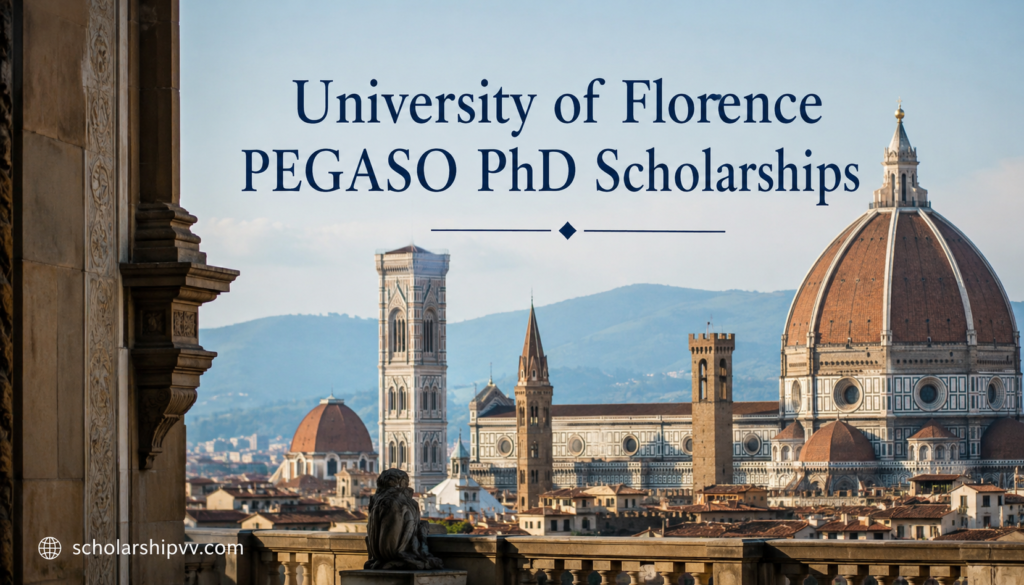
The University of Florence has officially opened applications for its prestigious XLII Cycle PhD Programmes for the 2026/2027 academic year. Hosted in one of Italy’s most renowned academic institutions, these doctoral programmes provide exceptional opportunities for students and researchers from around the world to pursue advanced research across multiple disciplines while benefiting from scholarships, international mobility support, and access to a vibrant academic environment.
The call for applications includes several doctoral programmes headquartered at the University of Florence, with positions available both with and without scholarships. The programmes are scheduled to begin on November 1, 2026, and applications must be submitted before the official deadline of August 06, 2026.
By the end of this article, you will know exactly who qualifies, what documents you need, and the one step almost every rejected applicant skips. Let’s get into it.
Quick Overview Table
| Detail | Information |
|---|---|
| Scholarship Name | PEGASO PhD Scholarships |
| Host University | University of Florence (UniFi) |
| Cycle | 42nd Cycle, Academic Year 2026/2027 |
| Funded By | Regione Toscana, through PR ESF 2021/27 resources under the Giovanisì project |
| Annual Scholarship Value | €16,243.00 |
| Programme Duration | 36 months (3 years), full-time |
| Eligible Applicants | Italian and international applicants holding or nearing a master’s-level qualification |
| Disciplinary Areas | Technological, Biomedical, Agricultural and Veterinary Sciences, Economic and Statistical Sciences, and more |
| Sample Departments Involved | Department of Agriculture, Food, Environment and Forestry (DAGRI), Department of Architecture (DIDA), Department of Experimental and Clinical Biomedical Sciences “Mario Serio” |
| Application Fee | €30, non-refundable |
| Application Deadline | 6 August 2026, 12:00 noon Italian time |
| Application Mode | Online, through the University of Florence portal |
What Is This Opportunity?
Let’s slow down and unpack what PEGASO actually is, because it is not just a generic university scholarship.
PEGASO PhD Scholarships are funded doctoral positions tied to specific PhD programmes at the University of Florence. They are not paid by the university’s regular budget alone. Instead, they are backed by Regione Toscana, the regional government of Tuscany, through a European Social Fund initiative called Giovanisì, a project built specifically to help young people build independent academic and professional futures.
In simple terms, the region is investing directly in young researchers. That funding structure is exactly why the annual scholarship amount sits at a solid €16,243, a figure confirmed in the official University of Florence PhD Programmes page.
Important: This call falls under the university’s 42nd PhD cycle, meaning it is part of a long-running, well-established doctoral system. This is not a brand new experimental program. It is a mature, structured pathway into serious academic research.
Who Is This Actually For?
According to Opportunities Journal’s detailed breakdown of the PEGASO call, this opportunity fits people who want to start a PhD in Italy for the 2026/2027 academic year, already hold or will soon hold a master’s degree, and can commit to a full-time doctoral schedule.
It is not designed for people still searching for bachelor’s or master’s level admission. The PEGASO call is strictly a PhD-level opportunity, so if you are not yet at that stage, this specific scholarship is not your next step, at least not yet.
Key Benefits
Here is why this scholarship is worth your attention, beyond just the headline number.
- €16,243 per year, paid as a scholarship stipend for the full three-year doctoral programme.
- Open to international applicants, not restricted to Italian citizens only.
- Full-time doctoral status, giving you a genuine academic career track instead of a part-time research add-on.
- Access to research mobility, since many PEGASO-linked programmes include periods of applied research activity or mobility components.
- European academic exposure, since Florence sits inside a strong Italian and EU research network.
- Multiple disciplinary areas, covering fields like agricultural sciences, civil engineering, architecture, biomedical sciences, and economics.
- Backed by regional and EU funding, which means the programme is financially structured, not dependent on a single grant that could disappear.
Think about what that last point really means. A scholarship tied to structured regional and EU funding tends to be far more stable year over year than a one-off donor-funded award.
Eligibility Requirements
Before you start drafting your research proposal, check whether you actually meet the baseline requirements.
- You must hold, or be about to obtain, a master’s-level qualification recognized as equivalent to an Italian Laurea Magistrale.
- You must be prepared to begin the PhD programme for the 2026/2027 academic year.
- You must be able to commit to full-time doctoral study for the duration of the programme, normally 36 months.
- You must be willing to complete research mobility or applied research activities where the specific programme requires it.
- You must prepare and submit a serious, well-developed research project proposal aligned with your chosen PhD programme’s disciplinary area.
- Both Italian and foreign applicants are eligible to apply, provided they meet the academic requirements of their chosen programme.
What Most Applicants Don’t Know
Here is something that catches a lot of first-time PhD applicants off guard. A PEGASO scholarship application is not just a form. It is a competitive academic selection process, and the quality of your research proposal often matters more than your grades alone.
According to PhDportal’s overview of doctoral opportunities at the University of Florence, the university runs one of Italy’s largest and most productive public research systems, which means competition for funded seats is real, and admission boards are genuinely evaluating research fit, not just paperwork.
Required Documents
Start gathering these early. A missing document on deadline day can cost you the entire application cycle.
- Valid passport or national identification document
- Master’s degree certificate, or proof that you will obtain it before the programme start date
- Academic transcripts showing your full course history and grades
- A detailed research project proposal matching your chosen PhD programme and disciplinary area
- Curriculum vitae outlining your academic and research background
- Any additional programme-specific documents listed in the official call, such as reference letters or motivation statements
- Proof of payment of the €30 non-refundable application fee
Don’t Miss This: Different PhD programmes under the PEGASO umbrella belong to different departments, such as DAGRI for agriculture and forestry, DIDA for architecture, and the Department of Experimental and Clinical Biomedical Sciences “Mario Serio” for biomedical research. Each one has its own specific fact sheet and requirements, so always check the fact sheet tied to your chosen programme before assuming a generic document list applies.
Step-by-Step Application Process
Let’s turn this into a clear checklist so nothing slips through the cracks.
Step 1: Confirm Your Academic Eligibility
Verify that your master’s degree, or expected degree, is recognized as equivalent to the Italian requirement for PhD entry.
Step 2: Choose Your PhD Programme and Disciplinary Area
Review the available PEGASO-linked programmes and select the one that matches your academic background and research interests.
Step 3: Read the Specific Programme Fact Sheet
Each programme publishes its own fact sheet with exact requirements, evaluation criteria, and available seats. Do not skip this step.
Step 4: Draft Your Research Proposal
This is the heart of your application. Build a proposal that is specific, realistic, and clearly tied to the department’s ongoing research focus.
Step 5: Gather Your Supporting Documents
Collect your transcripts, identification, CV, and any programme-specific paperwork in digital format.
Step 6: Complete the Online Application
Fill in your personal, academic, and programme details through the university’s official online application system.
Step 7: Pay the Application Fee
Submit the €30 non-refundable application fee as part of your submission. Keep proof of payment on hand.
Step 8: Submit Before Noon on the Deadline Day
The online system closes automatically at the stated deadline time, so submit early rather than racing the clock.
Apply Now for the PEGASO PhD Scholarships
Application Deadline
Mark this exact date and time: 6 August 2026, at 12:00 noon Italian time.
That is not a rough estimate. It is a strict cutoff, and the online application system stops automatically once the clock hits noon.
Important: This is not the kind of deadline you want to approach during a “final coffee-fueled hour,” as one detailed report on the scholarship rightly put it. Technical issues, upload delays, and last minute document scrambles have cost genuinely qualified applicants their spot in previous PhD cycles.
Give yourself at least a few days of buffer before the deadline. That buffer is often the difference between a smooth submission and a rejected one.
Important Tips to Increase Your Chances
Anyone can find the deadline online. Very few people know how to actually build a competitive application. Let’s fix that.
1. Treat Your Research Proposal Like a Pitch, Not a Formality
Admission boards are not just checking a box. They want to see a research idea that fits the department’s active work and shows genuine academic thinking.
2. Match Your Background to the Right Disciplinary Area
A strong academic record in the wrong disciplinary area still weakens your application. Pick the programme where your background actually fits.
3. Read Every Fact Sheet Before You Commit
According to Scholarships Guider’s overview of University of Florence PhD offerings, the university runs doctoral programmes across a wide range of fields, from Earth Sciences to Industrial Engineering, each with its own selection process. Do not assume one general set of instructions applies to every programme.
4. Prepare Your CV Like an Academic Document
Your CV should highlight research experience, publications if you have any, and relevant academic projects, not just a generic work history.
5. Do Not Wait Until the Final Week
Programmes with limited seats often see a spike in submissions in the last 48 hours, which increases the risk of technical errors on your end.
6. Cross-Check Details on the Official University Listings
Scholarship terms can shift slightly between cycles. Platforms like WeMakeScholars’ scholarship listings for the University of Florence are useful for discovery, but always confirm final details directly with the university before submitting.
Frequently Asked Questions (FAQ)
What are the University of Florence PEGASO PhD Scholarships?
They are funded doctoral scholarships linked to PhD programmes at the University of Florence, financed by Regione Toscana through the Giovanisì project under PR ESF 2021/27 resources.
How much is the PEGASO PhD Scholarship worth?
The annual scholarship amount is €16,243.00, paid throughout the standard 36-month doctoral programme.
Who can apply for the PEGASO PhD Scholarships?
Both Italian and international applicants who hold, or will soon hold, a master’s-level qualification and can commit to full-time doctoral study.
What is the application deadline?
The application deadline is 6 August 2026, at 12:00 noon Italian time, and the online system closes automatically at that moment.
Is there an application fee?
Yes. Applicants must pay a non-refundable application fee of €30 as part of the submission process.
How long does the PhD programme last?
The standard duration is 36 months, or three years, of full-time doctoral study.
What subject areas are covered under PEGASO?
PEGASO-linked programmes span multiple disciplinary areas, including technological, biomedical, agricultural and veterinary sciences, and economic and statistical sciences.
Do I need a research proposal to apply?
Yes. Applicants must submit a serious, well-developed research project proposal aligned with their chosen PhD programme’s disciplinary focus.
Conclusion: Your Research Career Could Start Here
Let’s bring this full circle.
A funded PhD, backed by regional and EU funding, open to international applicants, paying over 16 thousand euros a year, inside one of Italy’s oldest and most productive research universities. That combination does not come around constantly.
You have two paths from here. Close this article and hope another opportunity shows up later, or start building your research proposal today while the deadline is still weeks away instead of days.
The clock is already running toward 6 August 2026, at noon Italian time. The applicants who win these seats are the ones who started early, picked the right programme, and treated their research proposal like it actually mattered.