
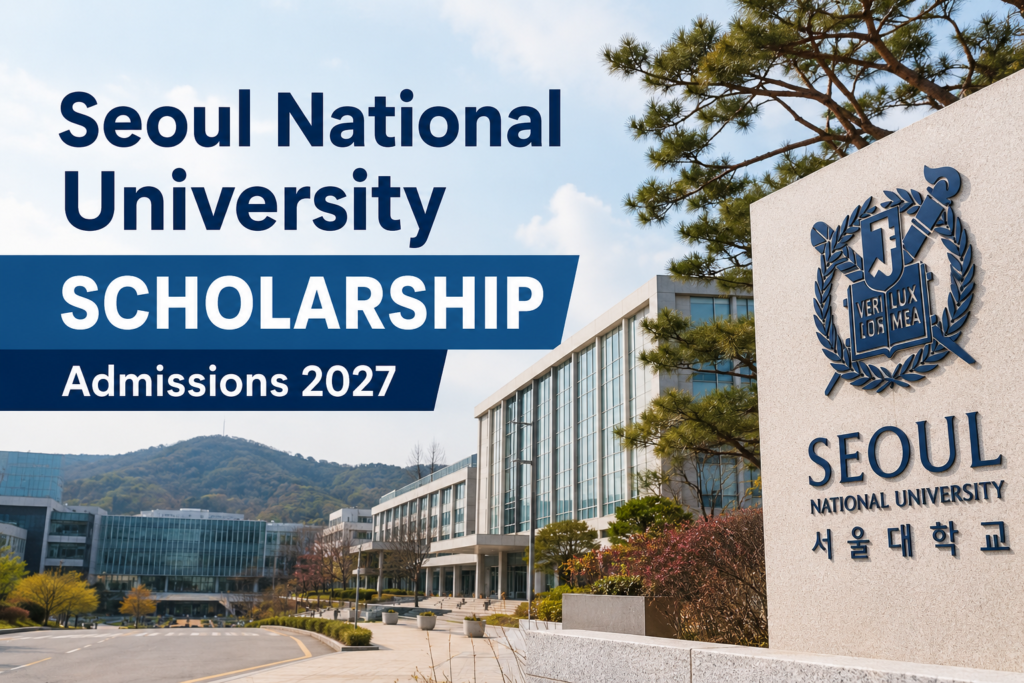
The Seoul National University (SNU) in South Korea has published Guidelines for International students for the Spring 2027 admissions. International Students from around the world are eligible to apply for the Seoul National University Scholarship 2027.
SNU is the most prestigious university in South Korea and a leading institution globally. The Scholarship is available to pursue undergraduate, Graduate, and full-time MBA degree programs. The online Application Window for the SNU Admission is very short.
They will accept applications from 6th July to 9th July 2026. Make sure to prepare each and every document before the application starts.levels.
Here is the part almost every applicant gets wrong: the application window is incredibly short, sometimes just a few days long, and missing it by even one day means waiting for the next cycle entirely.
Stick with this article, because the deadline section below explains exactly where things stand right now, and the eligibility section reveals a detail that quietly disqualifies applicants who assume they qualify when they actually do not.
Quick Overview Table
| Detail | Information |
|---|---|
| University | Seoul National University (SNU) |
| Country | South Korea |
| Degree Levels | Undergraduate, Master’s, Integrated Master’s-PhD, and Doctoral |
| Key Graduate Scholarship | Graduate Scholarship for Foreign Students (GSFS): full tuition exemption for up to 2 years plus living-expense support |
| Key Doctoral Fellowship | SNU President Fellowship Program (SPF): tuition, monthly stipend, airfare, insurance, up to 6 semesters |
| Undergraduate Route | Global Korea Scholarship (GKS), including university and embassy recommendation tracks |
| Spring 2027 Application Window | 6 July 2026 to 9 July 2026 |
| Recommendation Letter Deadline | 10 July 2026 |
| Admission Result Announcement | Expected around November 2026 |
| Eligibility Basis | International Admission I (non-Korean applicant and parents) or International Admission II (entire education completed abroad) |
| Application Mode | Online, through the official SNU admissions portal |
What Is This Opportunity?
Let’s slow down and unpack what the Seoul National University Scholarship actually covers, because it is not a single program. It is a collection of funding pathways under one prestigious roof.
SNU runs separate scholarship structures for undergraduate and graduate applicants, and full details for each level sit on the university’s official Graduate Scholarships page on SNU’s admissions site.
For graduate applicants, the two flagship programs are the Graduate Scholarship for Foreign Students, known as GSFS, and the SNU President Fellowship Program, known as SPF. Undergraduate applicants typically compete through the Global Korea Scholarship, which runs through both university and embassy recommendation routes.
Important: These scholarships are not automatically awarded just because you get admitted. In most cases, you indicate your interest during the same application process, and eligible colleges or the relevant selection committee decide who actually receives funding based on your admission documents.
Why SNU’s Funding Structure Is Different
Unlike scholarships that exist as a separate application layered on top of admission, SNU builds scholarship consideration directly into the same application window. According to DAAD Scholarship’s coverage of the 2027 graduate admissions cycle, SNU’s international admissions process is closely linked with scholarship opportunities designed specifically for foreign students and researchers, rather than treating funding as an afterthought.
That structure is exactly why timing matters so much here. Miss the admission window, and you miss the scholarship opportunity attached to it.
Key Benefits
So what do successful applicants actually receive? Let’s break it down by pathway.
- Full tuition exemption through the GSFS programme, available for up to two years depending on the graduate school and department.
- Comprehensive doctoral funding through the SPF programme, covering tuition, a monthly stipend, airfare, medical insurance, and research support for up to six semesters.
- Monthly living allowances for undergraduate scholars through the Global Korea Scholarship, covering living expenses, textbooks, and insurance premiums.
- Mandatory Korean language training, giving scholars a structured path to functional Korean, which strengthens both academic performance and daily life in Seoul.
- Additional settlement support, including thesis printing costs, research funds, and return travel expenses depending on the specific programme.
- Access to a world-class research environment, since SNU consistently ranks among the top universities in Asia across multiple global rankings.
- A gateway into South Korea’s innovation economy, since SNU graduates often move directly into research networks, government-linked projects, and competitive employment.
Think about the SPF programme specifically for a second. Tuition, stipend, airfare, and insurance combined is a genuinely comprehensive package, not a partial discount you still need to supplement out of pocket.
Eligibility Requirements
Here is where a lot of applicants trip up, so read this section carefully before you get attached to the idea of applying.
- You must apply under one of two categories: International Admission I, where the applicant and both parents hold non-Korean citizenship, or International Admission II, for applicants who completed their entire education abroad, from elementary school through their bachelor’s degree.
- Master’s or combined master’s and doctoral applicants must hold a bachelor’s degree or an equivalent qualification.
- Doctoral applicants must hold a master’s degree or an equivalent qualification.
- Applicants expected to complete their degree requirements by 28 February 2027 are also eligible to apply for the current cycle.
- Applicants who previously held Korean citizenship must formally renounce it before the application deadline.
- Qualifications obtained through degree equivalency exams, homeschooling, or cyber learning are generally not accepted.
- The SNU President Fellowship specifically targets teaching or instructional staff from developing countries, primarily in Asia, Africa, and South America, pursuing doctoral study.
What Most Applicants Don’t Know
Here is the detail that catches people off guard almost every cycle. Graduates of Korean universities can still apply as international students, but only if they genuinely meet the nationality and education criteria for International Admission I or II.
According to Scholarship Roar’s detailed guide to SNU’s 2027 scholarships, applicants must have completed their entire primary and secondary education outside South Korea to qualify under International Admission II, which means partial schooling inside the Korean system generally disqualifies that pathway entirely.
If your academic history is mixed between Korea and abroad, do not assume you automatically qualify. Check the specific category requirements carefully before investing time in your application.
Required Documents
Start gathering these early, since SNU’s admission process is genuinely document-heavy and does not accept late or incomplete submissions.
- Completed online application form through the SNU admissions portal
- Transcripts or degree certificates from your bachelor’s or master’s studies, depending on your target programme
- Proof of degree completion or an expected graduation certificate, if you have not yet finished your current degree
- Personal statement and study plan outlining your academic goals
- Recommendation letters submitted through the official online system within the designated window
- Official documents indicating both parents’ nationality, for International Admission I applicants
- Official documents indicating the parent-child relationship between the applicant and their parents
- Proof of language proficiency, such as TOEFL, IELTS, or TOPIK scores, depending on your programme’s requirements
- A portfolio, for applicants to programmes such as the College of Fine Arts, along with any additional department-specific materials
Don’t Miss This: Recommendation letters must be submitted through the official online system directly by your recommenders. Submissions sent by email, fax, or post are not accepted, so confirm with your recommenders early that they understand the online-only process.
Step-by-Step Application Process
Let’s turn this into a clear, simple sequence so nothing catches you off guard.
Step 1: Confirm Your Eligibility Category
Determine whether you qualify under International Admission I or International Admission II before building the rest of your application.
Step 2: Read the Official Admission Guide in Full
Download and read the current undergraduate or graduate admission guide directly from SNU’s Office of Global Affairs, since requirements shift slightly between cycles.
Step 3: Prepare Your Academic Documents
Gather transcripts, degree certificates, and proof of completion or expected graduation well before the application window opens.
Step 4: Draft Your Personal Statement and Study Plan
Write a focused statement connecting your academic background to your intended programme and research or study goals.
Step 5: Arrange Your Recommendation Letters
Confirm with your recommenders early, since letters must be submitted directly through SNU’s online system within a tight window.
Step 6: Indicate Scholarship Interest During Application
Check the appropriate scholarship interest box during your online admission application, since most SNU scholarships are not a separate application process.
Step 7: Submit All Documents Before the Window Closes
Upload every required document and submit your complete application before the strict deadline. Extensions are not granted.
Step 8: Track Your Application and Await Results
Monitor your application status and prepare for a possible interview stage, particularly for fellowship programmes like SPF.
Start Your SNU Application Now
Application Deadline
Here is the honest, up to date picture. The Spring 2027 online application window ran from 6 July 2026 to 9 July 2026, with recommendation letters due by 10 July 2026.
If you are reading this on or after 10 July 2026, this specific window has closed or is closing within hours. Preliminary admission decisions for this cycle are expected around November 2026.
Important: SNU runs two international admission cycles every year, one for Spring intake and one for Fall intake. Based on the university’s own recurring pattern, the prior Fall 2026 cycle opened its application window in early March 2026, meaning the next opportunity after this Spring 2027 window closes will likely follow a similar early-year timing for a future Fall intake.
Do not treat a missed window as a lost opportunity forever. Treat it as a signal to start preparing now, so you are ready the moment the next application period opens.
Important Tips to Increase Your Chances
Anyone can find the admission dates. Very few applicants know how to actually build a strong SNU application within such a short window. Let’s fix that.
1. Prepare Your Documents Months in Advance
With an application window sometimes lasting only a few days, waiting until it opens to start gathering documents is a losing strategy.
2. Start Language Preparation Early
Whether you need TOPIK for Korean proficiency or TOEFL and IELTS for English-taught programmes, valid scores should be ready well before the window opens, not requested at the last minute.
3. Choose the Right Eligibility Category From the Start
Applying under the wrong international admission category can derail your entire application. Confirm this detail before you invest time anywhere else.
4. Treat Your Recommendation Letters as a Coordination Task
Since letters must go through SNU’s online system directly, confirm your recommenders understand the process and the tight submission window well ahead of time.
5. Research Your Target Department’s Scholarship History
GSFS availability and coverage vary by graduate school and department. According to Opportunities Circle’s overview of SNU’s scholarship programmes, scholarship packages are subject to change depending on the circumstances of the supporting organization, so checking your specific department’s recent scholarship pattern gives you a more realistic picture than assuming uniform funding across the university.
6. Do Not Underestimate the Documentation Standard
According to a detailed practical guide to applying to SNU as a foreign student, the process is document-heavy, deadline-strict, and unforgiving of last-minute mistakes, so build in buffer time for document authentication, translation, or apostille requirements specific to your home country.
Frequently Asked Questions (FAQ)
What is the Seoul National University Scholarship?
It refers to a group of funding programmes at Seoul National University, including the Graduate Scholarship for Foreign Students, the SNU President Fellowship Program, and the Global Korea Scholarship for undergraduate applicants.
Who is eligible to apply as an international student?
Applicants must qualify under International Admission I, meaning the applicant and both parents hold non-Korean citizenship, or International Admission II, meaning the applicant completed their entire education abroad.
What does the Graduate Scholarship for Foreign Students cover?
GSFS may provide full tuition exemption for up to two years, plus living-expense support, though the exact amount varies by graduate school and department.
What does the SNU President Fellowship Program offer?
SPF is aimed at teaching staff from developing countries pursuing a PhD, and it can cover tuition, a monthly stipend, airfare, medical insurance, and research support for up to six semesters.
When did the Spring 2027 application window run?
The online application period ran from 6 July 2026 to 9 July 2026, with recommendation letters due by 10 July 2026.
What if I missed the Spring 2027 application window?
SNU runs two admission cycles per year, Spring and Fall. Based on prior cycles, the next window is expected to open in the following year, so early preparation is the best strategy for the next intake.
Is Korean language proficiency required?
It depends on the programme. Some scholarships require mandatory Korean language training, and failing to reach TOPIK grade 3 within a year can affect continued eligibility for certain undergraduate scholarship tracks.
Can graduates of Korean universities apply?
Yes, but only if they still meet the specific nationality and education requirements of International Admission I or II for their chosen programme.
Conclusion: Prepare Now for the Next SNU Window
Let’s bring this together.
Full tuition coverage, monthly stipends, airfare support, and access to one of Asia’s most respected research universities. That combination is exactly why SNU’s international admissions cycle draws applicants from around the world every single year.
If the Spring 2027 window has already closed by the time you are reading this, do not treat it as a missed chance forever. Treat it as your starting signal to prepare early for the next cycle.
Get your transcripts ready, lock in your language test scores, confirm your recommenders, and choose your eligibility category now, so you are not scrambling during the next short application window.