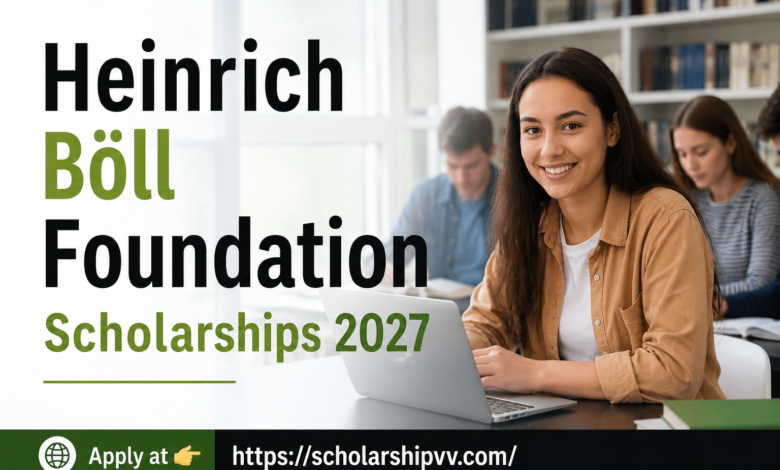
Germany is one of the most popular destinations in the world for international students, and for good reason. It offers world-class universities, a strong research culture, and an open academic environment that welcomes talent from every corner of the globe. Among the many scholarships available to study in Germany, the Heinrich Boll Foundation Scholarship stands out as one of the most prestigious and values-driven opportunities you will find anywhere in Europe.

If you are a graduate or doctoral student with a strong academic record, a genuine commitment to social and political engagement, and a passion for issues like sustainability, democracy, and human rights, the Heinrich Boll Foundation Scholarships 2027 could be exactly the right opportunity for you. Applications open twice a year, and the next major deadline for international applicants is September 1, 2026 for fall intake, followed by March 1, 2027 for spring intake.
In this article, we will cover everything you need to know about this scholarship: the history and values of the Heinrich Boll Foundation, what the scholarship covers financially, who is eligible, what documents you need, how the selection process works, tips to make your application stand out, and how to apply. Let us get started.
About the Heinrich Boll Foundation
The Heinrich Boll Foundation, known in German as the Heinrich-Boll-Stiftung, is one of Germany’s major political foundations. It was established in 1997 and is closely affiliated with the Alliance 90/The Greens, the German Green political party. The foundation is named after Heinrich Boll, the Nobel Prize-winning German author and humanist who was awarded the Nobel Prize in Literature in 1972 and who became one of the most important voices in post-war German culture and society.
Like its namesake, the foundation stands for values that go beyond the purely academic. Its core mission is to promote democracy, human rights, environmental sustainability, gender equality, self-determination, and non-violence. In practical terms, this means the foundation funds research, runs advocacy programs, supports civil society organizations, and awards scholarships to talented and socially engaged students who share these values and are committed to putting them into practice in their academic and professional lives.
The foundation operates internationally, with offices in more than sixty countries across five continents. Its scholarship program, run through the Studienwerk der Heinrich-Boll-Stiftung (the foundation’s scholarship department), is funded by Germany’s Federal Ministry of Education and Research (BMBF) and the Federal Foreign Office (AA). This dual government backing gives the scholarship program both financial stability and significant institutional prestige.
Every year, the Heinrich Boll Foundation supports around 1,450 students and approximately 200 doctoral students from all academic disciplines and types of higher education institutions in Germany and abroad. Up to 250 new scholarship recipients join the program each year, making it a highly competitive but not inaccessible opportunity for qualified applicants.
The Foundation’s Core Values and What They Mean for Applicants
Understanding the foundation’s values is not just background knowledge; it is directly relevant to your application. The Heinrich Boll Foundation is genuinely committed to its principles, and it looks for scholarship recipients who share those principles authentically, not just on paper.
The four core values of the foundation are democracy and human rights, ecology and sustainability, self-determination and justice, and non-violence. These themes run through everything the foundation does, from the research projects it funds to the civic engagement activities it organizes for its scholarship community.
When the foundation’s scholarship committee reviews applications, they are not just looking at your grades or your research proposal. They are trying to understand whether you are genuinely interested in these values, whether you have demonstrated that interest through concrete actions in your academic or community life, and whether the work you want to do in Germany will in some way contribute to these broader goals.
This means that for this particular scholarship, your social and political engagement is as important as your academic record. The foundation describes its ideal scholarship recipients as “tomorrow’s experts and leaders, prepared to take responsibility and advocate the foundation’s green ideals in an international context.” That is a specific kind of person, and the application process is designed to identify them.
Scholarship Overview and Key Details
Here is a quick reference summary of the key details for the Heinrich Boll Foundation Scholarships 2027:
Scholarship Provider: Heinrich Boll Foundation (Studienwerk der Heinrich-Boll-Stiftung), Berlin, Germany
Funding Sources: Federal Ministry of Education and Research (BMBF) and Federal Foreign Office (AA), Germany
Study Level: Master’s degree and PhD (doctoral) programs
Host Institutions: State or state-recognized universities, universities of applied sciences, and universities of the arts in Germany and, in some cases, in Switzerland and other EU member states
Number of Scholarships: Approximately 1,450 to 1,500 per year, with up to 250 new recipients joining annually
Duration: For the full standard study period, with the option to apply for a one-semester extension
Eligible Nationalities: All nationalities (open to German students, EU students, and international students from outside the EU)
Academic Disciplines: All fields of study
Application Mode: Online only; the portal opens approximately six weeks before each deadline
Application Deadlines for 2027: September 1, 2026 (fall intake) and March 1, 2027 (spring intake)
Foundation Address: Schumannstrasse 8, 10117 Berlin, Germany
Contact Email: studienwerk@boell.de
What Does the Heinrich Boll Foundation Scholarship Cover?
The Heinrich Boll Foundation Scholarship is funded, meaning it is designed to cover the main costs of your studies and living expenses in Germany. The exact financial package varies depending on your academic level, your nationality, and where your previous education was completed. Here is a detailed breakdown.
For Master’s Degree (Graduate) Students
Graduate students who were educated in Germany or who are EU nationals and were not educated in Germany receive a monthly living stipend. The amount depends on the student’s own income and, for those under 30 years of age, parental income and assets, as the foundation follows the guidelines set by Germany’s Federal Ministry of Education and Research. The monthly stipend for master’s students is approximately 934 euros, though the exact figure can vary based on individual financial circumstances. In addition to the monthly stipend, students receive a book allowance of around 300 euros per semester to cover study materials and resources.
For international master’s students who completed their first degree outside Germany and are coming to Germany for the first time to study, the scholarship covers the full standard duration of the master’s program. Priority in the international student track is given to applicants from DAC countries (Development Assistance Committee countries, as defined by the OECD) who have not yet taken up residence in Germany at the time of their application. This priority is designed to support students from developing regions who are seeking access to high-quality education in Germany.
For Doctoral (PhD) Students
Doctoral scholarship holders receive a more substantial monthly support package, reflecting the longer duration and the research-intensive nature of doctoral study. Students who were educated in Germany or EU nationals not educated in Germany receive a monthly amount in the range of approximately 1,350 euros, plus an additional monthly research cost allowance of approximately 100 euros to cover expenses related to their research activities.
Non-EU doctoral scholars who were not educated in Germany receive a comparable monthly living support amount, plus a monthly mobility allowance and various individual allowances that can be applied for depending on specific circumstances, such as allowances for accompanying family members, childcare support, or travel costs related to research.
Additional Benefits and Non-Financial Support
Beyond the financial stipend, Heinrich Boll Foundation scholars gain access to a rich ecosystem of non-financial support that many recipients describe as equally valuable to the monetary support.
Scholars become part of the foundation’s extensive academic and political network. This network connects thousands of current and former scholarship holders, researchers, civil society activists, and policymakers who share the foundation’s values. Being part of this network opens doors to collaborations, mentorships, and professional opportunities that extend well beyond the duration of the scholarship itself.
The foundation organizes seminars, workshops, conferences, and cultural events throughout the year that scholarship holders are invited to participate in. These events cover a wide range of topics related to the foundation’s core themes, from climate policy and environmental law to gender studies, digital democracy, and international development. Participation in these events enriches your intellectual experience and broadens your understanding of how your academic work connects to real-world social and political challenges.
Scholars also have access to individual mentoring and career development support, as well as guidance on academic writing, research methodology, and professional networking. For doctoral students in particular, the structured support system around research planning, supervision relationships, and publication can be genuinely helpful in navigating what is often a complex and demanding phase of an academic career.
Eligibility Criteria
The Heinrich Boll Foundation Scholarship has a set of eligibility requirements that differ depending on your nationality, your educational background, and the level of study you are applying for. It is important to read these carefully before applying.
For Master’s Degree Applicants
International students who have completed their first degree outside of Germany are eligible to apply for a master’s scholarship. You can apply before you begin your master’s program in Germany, or you can apply during your program up to the end of the first semester. After the first semester, the window for applying as a new applicant closes.
You must provide proof that you have completed your first degree, either by submitting your degree certificate or, if you are applying before completing your degree, by providing evidence that you are in the final stages of your studies and that your degree will be awarded before you begin your program in Germany.
Priority is given to applicants from DAC countries who are still residing in their home country at the time of application and who have not yet moved to Germany. If you are from a developing country and are planning to come to Germany for master’s study, this priority status gives your application additional weight in the selection process.
For Doctoral (PhD) Applicants
International doctoral students who completed their graduate degree outside of Germany may apply for a doctoral scholarship. Your preliminary research work must be at an advanced enough stage by the time of the application deadline to allow for a meaningful evaluation of your research proposal. A complete research exposé with a realistic timetable is required. Research topics that align with the Heinrich Boll Foundation’s priority areas of ecology, sustainability, democracy, human rights, and social justice will receive preference, though all academic disciplines are in principle eligible.
Academic Excellence
All applicants must demonstrate a very strong academic record. The foundation looks for evidence of outstanding performance in your previous studies, including high grades and any academic distinctions, prizes, or recognitions you have received. For international applicants whose previous institution used a grading system different from the German system, you should provide an explanation of the grading scale used so the selection committee can accurately evaluate your academic standing.
Social Commitment and Political Engagement
This is a genuinely important criterion for the Heinrich Boll Foundation and one that sets this scholarship apart from many others. The foundation expects applicants to have a demonstrated record of social and political engagement. This does not necessarily mean that you need to have been a party political activist, but it does mean that you should be able to point to concrete examples of community involvement, civic engagement, volunteer work, advocacy, or other activities that demonstrate your commitment to contributing to society beyond your academic work.
The foundation’s scholarship committee reviews a two-page summary of your societal involvement as a core part of your application. This summary should describe specific activities, organizations you have been part of, causes you have worked for, and what you have learned or contributed through these experiences.
German Language Proficiency
For international applicants, proof of German language proficiency is required. You must demonstrate at least a B2 level of German under the Common European Framework of Reference for Languages (CEFR), or an equivalent qualification such as the DSH1 (Deutsche Sprachprufung fur den Hochschulzugang). A higher level of proficiency, such as C1 or DSH2, will generally strengthen your application.
This language requirement reflects the fact that scholarship holders are expected to participate in the foundation’s German-language events, seminars, and community activities, as well as to function effectively in a German academic and social environment. If your German is not yet at the required level, this is something to work on well in advance of the application deadline.
Commitment to the Foundation’s Values
Your application must include a convincing explanation of why you are applying to the Heinrich Boll Foundation specifically. The foundation wants to understand your connection to its values of ecology and sustainability, democracy and human rights, self-determination and justice. This is not a bureaucratic requirement; it is a genuine attempt to identify applicants who are aligned with the foundation’s mission and who will actively engage with the scholarship community rather than simply receiving financial support.
Required Documents for Application
Preparing your documents carefully and completely is one of the most important things you can do to give your application the best possible chance. Here is the full list of documents typically required for the Heinrich Boll Foundation Scholarship application.
Online Application Form: The foundation only accepts online applications submitted through its official application portal. The portal opens approximately six weeks before each application deadline. You will fill in all your personal, academic, and motivational information directly in the portal.
Curriculum Vitae: A current, well-organized CV covering your educational background, professional experience, language skills, publications or research outputs if applicable, and any awards or distinctions you have received.
Academic Transcripts and Certificates: Certified copies of all your university degree certificates and transcripts. If your previous institution used a grading system other than the German one, include a brief explanation of the scale so the committee can interpret your grades accurately.
Proof of First Degree (for Master’s Applicants): Your bachelor’s degree certificate or, if you have not yet graduated, official documentation confirming that you are in your final semester and that your degree will be awarded before you begin your master’s program in Germany.