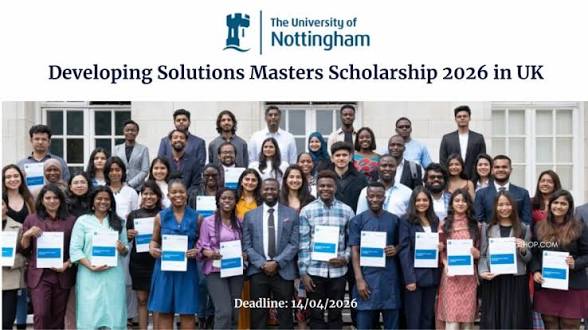
Developing Solutions Masters Scholarship 2026 For Nigerians
If you are an ambitious student from Africa, India, or a Commonwealth nation who dreams of pursuing a fully or partially funded master’s degree at one of the United Kingdom’s most prestigious universities and using that education to genuinely change your home country then the Developing Solutions Masters Scholarship at the University of Nottingham could be the most important opportunity you will ever come across. Established in 2001 as the university’s flagship international scholarship, it has helped hundreds of talented scholars from developing regions earn world-class postgraduate qualifications and return home as changemakers in their fields.
The 2026–2027 application cycle is now open, with a firm deadline of Wednesday, 15 April 2026. In this comprehensive guide, we cover everything — the scholarship’s history and philosophy, full eligibility criteria, the complete list of eligible countries, what faculties and courses qualify, the two levels of award (50% and 100% tuition), the application process through NottinghamHub, the assessment criteria the committee uses, common mistakes to avoid, a step-by-step application walkthrough, and expert tips that will help you write the compelling development vision the selectors are looking for.
1. About the University of Nottingham
The University of Nottingham is a world-leading research-intensive university based in Nottingham, England, United Kingdom. Founded in 1881 and granted its Royal Charter in 1948, it is consistently ranked among the top 100 universities in the world by the QS World University Rankings and the Times Higher Education (THE) World University Rankings. It is a proud member of the Russell Group — the UK’s association of 24 leading research-intensive universities.
As of the most recent data, the University of Nottingham has around 36,180 students at its UK sites — approximately 27,890 undergraduates and 8,290 postgraduates — and over 7,220 academic staff. Its worldwide student body exceeds 47,000, reflecting its global campuses in China (University of Nottingham Ningbo China) and Malaysia (University of Nottingham Malaysia). Nottingham’s UK campus spans three sites: University Park, Jubilee Campus, and Sutton Bonington.
The university has a long tradition of internationalism and social impact — values that are directly and meaningfully reflected in its flagship Developing Solutions scholarship programme. Its graduates are employed by leading organisations across industry, government, academia, and civil society worldwide, making a Nottingham master’s degree a powerful credential on any continent.
2. What Is the Developing Solutions Masters Scholarship?
The Developing Solutions Masters Scholarship is the flagship postgraduate international scholarship of the University of Nottingham. It is specifically designed for students from Africa, South Asia (including India and Pakistan), and other selected Commonwealth countries who wish to pursue a full-time master’s degree at the University of Nottingham’s UK campus and use that education to make a measurable difference in their home countries.
The scholarship is not simply a tuition discount. It is a mission-driven award with a clear social purpose: to support innovative and passionate students who can demonstrate a credible, tangible plan for developing solutions that will positively contribute to key economic, environmental, structural, social, or political challenges in their home countries after graduation. The word “solutions” in the scholarship’s name is intentional — the selection committee is looking for students who are not just strong academically, but genuine problem-solvers with a specific and believable vision for the future of their communities.
Successful applicants receive either a 50% or 100% tuition fee scholarship for their master’s degree, applied directly to their University of Nottingham fee account. The scholarship has been running since 2001 and has supported hundreds of scholars, building an impressive global network of Nottingham-educated development leaders across Africa, Asia, the Caribbean, and the Pacific.
3. Scholarship Overview at a Glance
| Detail | Information |
|---|---|
| Scholarship Name | Developing Solutions Masters Scholarship |
| Host University | University of Nottingham, UK |
| Country of Study | United Kingdom (UK campus only) |
| Founded | 2001 (flagship scholarship — over 25 years running) |
| Scholarship Type | Tuition fee scholarship (50% or 100%) |
| Degree Level | Postgraduate — Full-time Master’s (including MRes) |
| Duration | One academic year |
| Eligible Regions | Africa (all nations), India, Pakistan, and selected Commonwealth countries |
| Eligible Faculties | Engineering; Medicine & Health Sciences; Science; Social Sciences |
| Application Deadline | Wednesday, 15 April 2026 (UK time) |
| Results Notification | By end of May 2026 |
| Programme Start | September 2026 (2026/27 academic year) |
| Application Portal | NottinghamHub |
| Official Website | nottingham.ac.uk/pgstudy/funding/developing-solutions-masters-scholarship |
| Contact Email | scholarship-assistant@nottingham.ac.uk |
4. History and Purpose — Why This Scholarship Exists
The Developing Solutions Masters Scholarship was established by the University of Nottingham in 2001 making it one of the longest-running flagship international postgraduate scholarships at any UK university. At its founding, the university recognised that some of the world’s most urgent development challenges — in public health, food security, climate resilience, education policy, infrastructure, and governance required a new generation of leaders who were both academically equipped and deeply rooted in the communities they aimed to serve.
Rather than simply funding the brightest students from the Global South to study in the UK with no strings attached, Nottingham built the scholarship around a specific philosophy: that the most valuable investment the university could make was in students who already had a plan to return home and change something specific. The scholarship’s name “Developing Solutions” — captures both the development context of the target countries and the active, solutions-focused mindset the university seeks to cultivate.
Over more than two decades, the scholarship has supported students from dozens of countries across Africa, South Asia, and the Commonwealth. Alumni have gone on to lead government health programmes, build social enterprises, publish climate research, reshape education policy, and occupy senior positions in the private, public, and civil society sectors of their home countries. The programme’s legacy is a global network of Nottingham-educated changemakers who are creating measurable impact in some of the world’s most challenging development environments.
5. The Two Award Levels: 50% vs 100% Tuition Coverage
The most frequently asked question about this scholarship is: will I receive 50% or 100% of my tuition fees? The University of Nottingham does not publicly specify a fixed formula for determining which award level a student receives — both are available, and the decision is made as part of the overall assessment of each application. What we know from official guidance is:
- Applicants are assessed on the quality and credibility of their development vision and the overall strength of their application. The most compelling, specific, and impactful applications are the most likely to receive the higher (100%) award.
- Both 50% and 100% scholarships are applied directly to your tuition fee account at the University of Nottingham. The scholarship is not paid to you as cash — it is deducted from your tuition fees at source.
- Both award levels are valid for one academic year only. Two-year master’s students receive funding only for the first year.
- You will be notified of your award level — 50% or 100% — by the end of May 2026.
Do not let uncertainty about which award level you will receive deter you from applying. Put your full effort into crafting the most specific, credible, and impactful development vision statement possible — and let the committee decide. Many scholars who expected 50% received 100% because their application stood out in clarity and impact.
6. What the Scholarship Covers — Full Benefits
The Developing Solutions Masters Scholarship is a tuition fee scholarship. Understanding precisely what it covers and what it does not is essential for financial planning:
Tuition Fee Coverage
Either 50% or 100% of full-time master’s tuition fees for one academic year, applied directly to your university fee account — not paid to you personally.
Flagship Prestige
Scholars join a 25-year legacy programme and gain the distinction of being a University of Nottingham Developing Solutions Scholar — recognised across industry and academia worldwide.
Global Network Access
Connection to a growing international network of Nottingham development alumni across dozens of countries — opening doors to collaboration, employment, and professional partnerships.
Russell Group Education
Access to Nottingham’s world-class teaching, research facilities, careers service, and academic mentorship across four major faculties at one of the UK’s leading universities.
Nottingham Degree Credential
A master’s degree from a top-100 UK university that significantly enhances career prospects and international credibility in any professional or academic field.
Career Development
Access to Nottingham’s renowned careers service, employer networking events, industry insight sessions, and professional development workshops during the degree year.
7. Eligible Countries — Full List
To qualify, applicants must be currently domiciled (living) in one of the following countries. “Domiciled” refers to where you normally reside — not simply where you hold citizenship. This distinction matters: if you are from Nigeria but have been living in the US for several years, your domicile may not be considered Nigeria.
All African nations are eligible — including (but not limited to):
Kenya
Ghana
South Africa
Ethiopia
Tanzania
Uganda
Rwanda
Zimbabwe
Zambia
Cameroon
Senegal
Egypt
Morocco
All 54 African Nations
South Asian and other selected Commonwealth countries:
Pakistan
Bangladesh
Sri Lanka
Nepal
Maldives
Malaysia
Brunei
Fiji
Papua New Guinea
Samoa
Solomon Islands
Tonga
Tuvalu
Vanuatu
Nauru
Kiribati
Jamaica
Barbados
Trinidad and Tobago
Guyana
Belize
Grenada
Dominica
St Kitts and Nevis
St Lucia
St Vincent and the Grenadines
Antigua and Barbuda
Anguilla
Bermuda
British Virgin Islands
Cayman Islands
Montserrat
Turks and Caicos Islands
Falkland Islands
Gibraltar
St Helena
Tristan da Cunha
Pitcairn Islands
8. Eligible Faculties and Subject Areas
The scholarship covers any master’s or MRes programme within the following four faculties at Nottingham’s UK campus. This broad subject coverage is one of the scholarship’s most distinctive and attractive features:
Faculty of Engineering
Civil Engineering, Chemical and Environmental Engineering, Electrical and Electronic Engineering, Mechanical Materials and Manufacturing Engineering, and related disciplines. Particularly relevant for applicants whose development vision involves infrastructure, clean energy, water management, transportation, or technology transfer.
Faculty of Medicine and Health Sciences
Medicine, Nursing, Pharmacy, Public Health, Physiotherapy, Dietetics, Medical Sciences, and related programmes. Scholars focusing on healthcare access, maternal and child health, infectious disease, healthcare workforce development, or health system reform consistently apply through this faculty.
Faculty of Science
Biosciences, Chemistry, Computer Science, Geography, Environmental Science, Food Science, Life Sciences, Mathematics, Physics, and more. Applicants whose development work relates to climate change, food security, biodiversity, digital transformation, or water quality often study here.
Faculty of Social Sciences
Economics, Education, Law, Politics, Business, Sociology, Social Policy, International Development, Psychology, and many others. The broadest faculty and consistently the source of a large proportion of Developing Solutions scholars each year.
The scholarship does not restrict you to a development-related subject specifically. You can apply for an MSc in Computer Science, an MBA, an MSc in Chemistry, or an MA in Politics — as long as you can credibly connect your chosen course to your development vision for your home country.
9. Eligibility Criteria — Who Can Apply
To be considered for the Developing Solutions Masters Scholarship for 2026/27, you must meet all of the following conditions simultaneously:
- Domicile: Currently living in Africa, India, or one of the other listed eligible Commonwealth countries.
- Fee classification: Classified as an overseas (international) student for tuition fee purposes — not UK home fee status.
- Admission offer: Hold a confirmed or conditional offer to start a full-time master’s or MRes programme at the University of Nottingham’s UK campus starting in September 2026. The scholarship application cannot be submitted without this offer.
- Faculty: Your master’s programme must be offered within the Faculty of Engineering, Faculty of Medicine and Health Sciences, Faculty of Science, or Faculty of Social Sciences.
- Development vision: Able to articulate a specific, credible, and impactful plan for addressing a real challenge in your home country, and explain clearly how your chosen Nottingham course will equip you to execute that plan.
10. Who Is NOT Eligible
You are expressly not eligible for the Developing Solutions Masters Scholarship if any of the following apply to you:
- Current or former Nottingham student: If you are enrolled at or have graduated from the University of Nottingham, you cannot apply.
- Previously studied outside your home country: If you have been awarded an undergraduate or postgraduate degree from a university outside your home country, you are generally ineligible. Exception: if that overseas study took place in another Developing Solutions-eligible country, your application may be considered on a case-by-case basis.
- Currently studying in the UK: If you are presently enrolled in any programme at any UK institution, you are ineligible.
- UK/Home fee status: Students classified as home (UK) students for tuition fee purposes cannot apply.
- Part-time students: The scholarship only covers full-time master’s enrolments.
11. How Applications Are Assessed — The Selection Criteria
The Developing Solutions scholarship uses a distinctive assessment methodology that differs significantly from most other UK scholarships. Understanding this is essential for a successful application.
Primary Criterion — Development Vision (Most Critical)
The selection committee assesses applicants first and foremost on the quality, specificity, and credibility of their development vision for their home country. They want to see:
- A specific, named challenge — not a general topic but a precise problem. “Inadequate access to mental health services for adolescents in rural Northern Nigeria” is specific. “Mental health in Africa” is not.
- A tangible proposed solution — What exactly will you do? A named programme, initiative, policy recommendation, technology, or service you intend to build, develop, or implement.
- A credible personal pathway — Why are you the right person to pursue this? What have you already done that demonstrates your commitment and relevant experience?
- A direct and explicit link to your Nottingham course — Which specific modules, research methods, or skills from your chosen programme will equip you to implement your solution? Name them. Be precise.
Secondary Criteria (Traditional Scholarship Factors)
Only after the committee is satisfied that the Developing Solutions ethos has been clearly evidenced do they consider: your reasons for choosing Nottingham specifically, your academic merit, noteworthy personal or professional achievements, and your motivation to drive sustainable change. These matter — but they do not compensate for a weak or vague development vision.
12. Required Documents and Application Materials
The scholarship application is completed entirely through NottinghamHub. Before starting, ensure you have the following prepared:
- A confirmed or conditional Nottingham admission offer for a full-time master’s or MRes starting September 2026 — this is a prerequisite for the scholarship application.
- Written essay responses to the scholarship application questions in NottinghamHub — all must be within the stated word count limits. Responses exceeding limits may not be reviewed.
- Academic transcripts and records — already uploaded to NottinghamHub as part of your course application.
- Personal statement submitted with your original course application — the scholarship committee may cross-reference this.
- MRes applicants only: Email scholarship-assistant@nottingham.ac.uk for separate application instructions before attempting to apply through NottinghamHub.
13. How to Apply — Step-by-Step Guide (NottinghamHub)
The Developing Solutions Masters Scholarship application follows a two-stage process. Stage 1 must be completed before you can access Stage 2.
-
Apply for Your Master’s Programme at Nottingham (Stage 1)
Search for eligible programmes at nottingham.ac.uk/pgstudy/courses. Choose a full-time master’s or MRes within the Faculty of Engineering, Medicine and Health Sciences, Science, or Social Sciences at the UK campus. Submit your course application through the university’s admissions system and pay any required application fee. -
Receive Your Offer of Admission
Wait for a conditional or unconditional admission offer from the University of Nottingham. You cannot submit the scholarship application until you have received this offer. Note: you do not need to accept (confirm) your offer before applying for the scholarship — holding an offer is sufficient. -
MRes Applicants — Contact the Scholarships Team First
If your offer is for an MRes programme, email scholarship-assistant@nottingham.ac.uk for separate application instructions before attempting to use NottinghamHub. MRes applicants follow a different process from standard master’s applicants. -
Log In to NottinghamHub and Navigate to Scholarships (Stage 2)
Log into NottinghamHub at campus.nottingham.ac.uk using your University of Nottingham login credentials. Navigate to the scholarships section of the portal. Find the Developing Solutions Masters Scholarship and open the application form. -
Complete the Scholarship Application Questions
The scholarship application consists of written responses to questions focused on your development vision, your reasons for choosing Nottingham, and your academic background. Each question has a strict word count limit shown at the end of the question. The system does not automatically enforce this limit — you must manually check your word count. Responses exceeding the limit may not be reviewed by the committee. -
Review Thoroughly and Submit Before 15 April 2026
Before clicking submit, review every answer for specificity, clarity, word count compliance, and coherence. Ensure your development vision is clear and directly linked to your Nottingham course. Submit your scholarship application by Wednesday, 15 April 2026 (UK time). -
Await Results — End of May 2026
The scholarship committee reviews all applications after the deadline closes. You will receive an email by the end of May 2026 confirming whether you have been offered a 50% scholarship, a 100% scholarship, or were unsuccessful. Awards are made only to students who accept their offer to study at Nottingham.
14. Application Timeline and Key Dates
| Milestone | Date |
|---|---|
| 2026–2027 Application Cycle Open | Open now (as of March 2026) |
| Scholarship Application Deadline | Wednesday, 15 April 2026 (UK time) |
| Scholarship Results Communicated | By end of May 2026 |
| Programme Start Date | September / October 2026 |
| Academic Year | 2026–2027 |
15. Tips for Writing a Winning Development Vision Statement
The development vision statement is the single most important element of your Developing Solutions scholarship application. Here is detailed, practical guidance on writing one that genuinely stands out:
- Be hyper-specific about the problem. Name the exact challenge, the geographic area, and the affected population. Include data where available. “62% of households in the Volta Region of Ghana lack access to safely managed drinking water services” is infinitely stronger than “water is a problem in Ghana.”
- Describe your solution concretely. What exactly will you build, launch, research, advise on, or implement? Vague aspirations to “help my country” are the most common reason for unsuccessful applications. A specific proposed solution — however modest — is far more compelling.
- Connect your past to your future plan. Have you already done anything relevant to this challenge? Community work, research, professional experience, or even personal lived experience? This context makes your plan credible, not just aspirational.
- Name specific course components at Nottingham. Look at the module list and course content for your chosen programme. Reference one or two specific modules, research methods, or skills by name and explain directly how they will build what you need to implement your solution. This precision impresses the committee.
- Replace every cliché with a specific fact. “I am passionate about development” tells the committee nothing. Replace it with a specific action you have taken, a specific problem you have witnessed, or a specific plan you have formed.
- Respect the word count rigorously. Count your words manually before submitting. The NottinghamHub system does not enforce the limit automatically. Responses over the stated limit may simply not be reviewed. Edit ruthlessly.
- Write the vision statement first. Many applicants write it last, as an afterthought. Give it the most time, the most drafts, and the most attention. Build the rest of your application around it.
- Apply for your Nottingham course as early as possible. You cannot apply for the scholarship without a Nottingham offer. If you apply for your course in late March or early April, you may not receive your offer in time to submit a quality scholarship application before 15 April. Start your course application now.
16. Final Thoughts
The Developing Solutions Masters Scholarship at the University of Nottingham is one of the most impactful postgraduate scholarships available to students from Africa, India, and the wider Commonwealth world. In an era when the cost of UK graduate study has become a genuine barrier for talented students from developing regions, this scholarship — covering up to 100% of tuition fees at a Russell Group university — represents an extraordinary opportunity.
But what distinguishes this scholarship is not merely the financial value. It is the philosophy behind it. Over 25 years since its founding in 2001, the Developing Solutions scholarship has consistently prioritised not the student with the highest grades, but the student with the most credible, specific, and compelling vision for their home country’s future. It invests in plans, not just potential. It backs changemakers, not just candidates. And in doing so, it has built a remarkable global network of alumni who are genuinely transforming the communities they returned to.
If you are an ambitious student from an eligible country with a real challenge you want to solve, a concrete vision for addressing it, and the academic record to back it up this scholarship is built for you. Apply for your Nottingham master’s programme today, secure your offer, and put every effort you have into crafting the most specific and compelling development vision statement possible. The deadline is 15 April 2026 do not wait.