
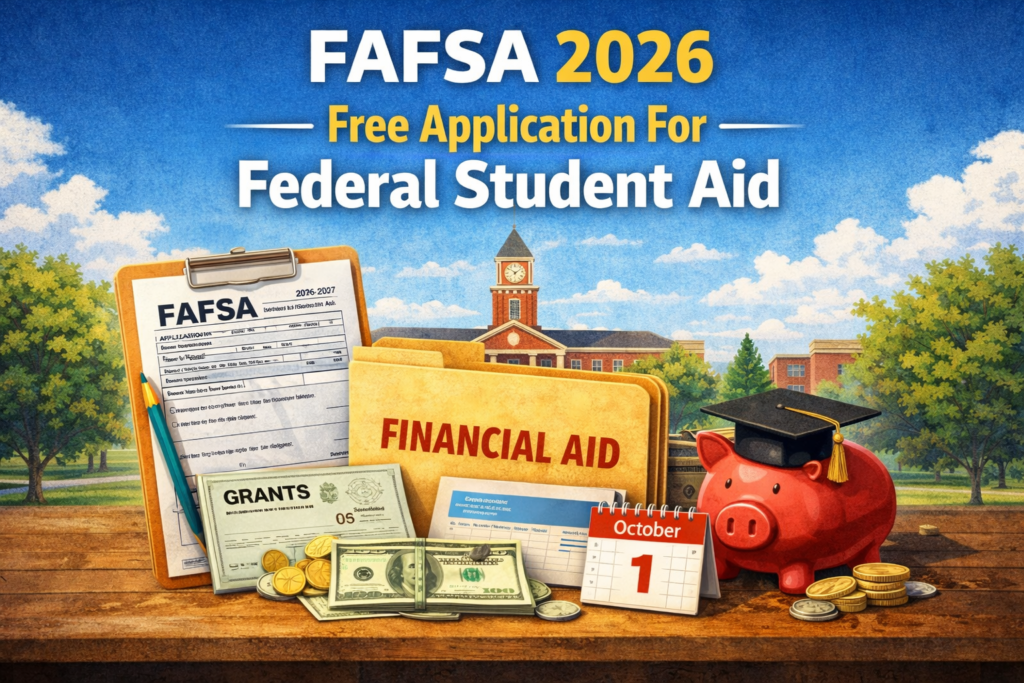
FAFSA 2026: Submit Today, Complete Guide on how to apply
If you are planning to attend college in the United States, or if you are already enrolled and still trying to figure out how to manage the cost, there is one form that matters more than almost anything else in the financial aid process. It is called the FAFSA, and understanding it thoroughly can be the difference between graduating with minimal debt and struggling financially throughout your college years. This guide covers everything you need to know about FAFSA in 2026, including what it is, who qualifies, how to apply, what types of aid it unlocks, the most important deadlines, the latest updates, and practical tips to make sure you get as much aid as possible.
What Is FAFSA?
FAFSA stands for the Free Application for Federal Student Aid. It is a form managed by the United States Department of Education that students and their families complete to determine eligibility for federal financial aid for college. The application is completely free to complete and submit, and it serves as the gateway to billions of dollars in grants, scholarships, work-study programs, and low-interest federal student loans each year.
Around 17 million students complete the FAFSA form every year, and through it, the federal government distributes approximately $120 billion in student financial aid annually. Despite these staggering numbers, millions of eligible students still fail to file FAFSA every year, leaving free money on the table simply because they did not know about it or assumed they would not qualify.
One of the most important things to understand is that FAFSA itself does not give you money. It is an application that determines how much financial aid you are eligible to receive. Once you submit your FAFSA, the US Department of Education and each college you listed on the form will use your information to calculate your financial need and put together a financial aid offer for you. That offer may include grants, scholarships, work-study opportunities, and federal loans depending on your individual circumstances.
Who Should File FAFSA?
The short answer is: almost every student planning to attend or currently attending an accredited college, university, trade school, or vocational program in the United States should file FAFSA. Many students and families skip FAFSA because they assume their household income is too high to qualify for financial aid. This is one of the most common and costly mistakes in the college planning process.
Here is why. FAFSA does not have a strict income cap. Even if your family earns a comfortable income, you may still qualify for unsubsidized federal student loans, work-study programs, and institution-specific scholarships that use FAFSA data to make their awards. Many colleges also use your FAFSA information to award their own grant and scholarship funds, separate from the federal programs. So even if you do not qualify for a Pell Grant, filing FAFSA could still unlock thousands of dollars in aid from the state and from your college directly.
To be eligible to file FAFSA and receive federal student aid, you must meet the following general requirements. You must be a US citizen or an eligible non-citizen such as a US permanent resident, a refugee, an asylum grantee, or someone with an I-94 form showing eligible immigration status. You must have a valid Social Security Number (with limited exceptions for citizens of freely associated states like the Federated States of Micronesia, the Marshall Islands, and Palau). You must be enrolled or accepted for enrollment in an eligible degree or certificate program at an accredited institution. You must be making satisfactory academic progress if you are already enrolled. You must not owe a refund on any federal grants or be in default on a federal student loan.
The FAFSA 2026 Cycles: Which One Applies to You?
One of the most confusing things about FAFSA is understanding which form applies to which academic year. There are currently two relevant FAFSA cycles for students in 2026.
The 2025-2026 FAFSA covers financial aid for students enrolled in college during the 2025-2026 academic year. This form became available on December 1, 2024, after a delayed rollout from the originally planned October 1 date. The federal deadline to submit this form is June 30, 2026, and the deadline for corrections or updates is September 14, 2026.
The 2026-2027 FAFSA covers financial aid for students who will be enrolled in college during the 2026-2027 academic year, meaning students starting college in fall 2026 or spring 2027. This form launched on September 24, 2025, which was actually a week ahead of the anticipated October 1 date and the earliest the FAFSA has ever launched in history. The federal deadline to file this form is June 30, 2027. If you are a high school senior applying to colleges for fall 2026, this is the form you need to complete.
What Is New in FAFSA for 2026?
The 2026-2027 FAFSA cycle brings several significant changes that students and families need to be aware of. These updates were driven in part by the FAFSA Simplification Act, which Congress passed in 2020 to overhaul the financial aid application process, and by the One Big Beautiful Bill Act signed by President Donald Trump on July 4, 2025, which introduced further changes to the student aid formula.
Streamlined Form With Only 36 Questions
One of the most welcome changes in recent FAFSA cycles is the dramatic reduction in the number of questions on the form. The new FAFSA has only 36 questions, compared to the more than 100 questions that were required in previous versions. This simplification makes the application far less intimidating, especially for first-generation college students and families who are completing the form for the first time.
Real-Time Social Security Number Verification
For the 2026-2027 cycle, all users who create a StudentAid.gov account with a Social Security Number will have their accounts verified immediately through the Social Security Administration rather than waiting one to three days as was previously the case. This change significantly speeds up the account creation process and reduces delays at the very first step of the application.
Simplified Contributor Invitation Process
The process for inviting contributors, which is the term FAFSA uses for parents, stepparents, or spouses who need to provide their financial information on the form, has been simplified. You now only need an email address to invite a contributor, making it easier to get the right people involved quickly.
Students Can List Up to 20 Colleges
Previously, students could only list up to ten colleges on their FAFSA form. For the 2026-2027 cycle, this limit has been raised to 20 colleges. This is a meaningful change for students who are applying broadly and want all of their target schools to receive their FAFSA data simultaneously.
New Asset Exclusions Under the One Big Beautiful Bill
Starting with the 2026-2027 award year, families will no longer need to report the net worth of certain family-owned assets, including family-owned businesses with fewer than 100 full-time employees and the net worth of a farm on which the family resides. This change means that more families in rural communities and small business owners may now qualify for more financial aid than in previous years.
Changes to Pell Grant Eligibility
The One Big Beautiful Bill also changed how Pell Grant eligibility is calculated in ways that could reduce access for some students. Students who receive full-ride scholarships that already cover all their educational costs will no longer be eligible to use Pell Grant funds for room, board, and other non-tuition expenses. Additionally, families with a Student Aid Index (SAI) score that is at least twice the maximum Pell Grant award will no longer qualify for a Pell Grant. Foreign earned income, which was previously excluded from the adjusted gross income calculation on the FAFSA, must now be reported in full, which could affect families with income from abroad.
The Grad PLUS Loan Program Is Ending
The One Big Beautiful Bill phases out the Grad PLUS loan program, which will stop accepting new applicants on July 1, 2026. Graduate students who have previously taken out Grad PLUS loans will be grandfathered into the program, and most current students will be able to continue borrowing until their program ends. Graduate students will still be able to apply for Direct Unsubsidized Loans up to the available limit.
What Types of Financial Aid Does FAFSA Unlock?
One of the most important things to understand about FAFSA is what completing it can make you eligible for. There are four main types of financial aid that FAFSA data is used to determine.
Federal Grants
Grants are the best type of financial aid because they are free money that does not need to be repaid. The most important federal grant program is the Federal Pell Grant. For the 2026-2027 award year, the maximum Pell Grant is $7,395. Pell Grants are typically awarded to undergraduate students who demonstrate exceptional financial need and who have not yet earned a bachelor’s degree. Your eligibility is based not just on income but also on your family size, tax filing status, and the federal poverty guidelines.
The Federal Supplemental Educational Opportunity Grant (FSEOG) is another grant program available to students with exceptional financial need. These campus-based grants range from $100 to $4,000 per year and are administered directly by your school’s financial aid office. Not all schools participate, and funds are limited, which is one of the strongest reasons to file FAFSA as early as possible.
Many states also use FAFSA data to award state grants. For example, in North Carolina, submitting the FAFSA is a requirement for receiving the Next NC Scholarship, which covers full tuition and fees for all North Carolina community colleges and more than half the cost at public universities for most families earning $80,000 a year or less. State grant programs vary widely, so it is essential to check your own state’s financial aid programs and deadlines.
Federal Work-Study Programs
Federal Work-Study (FWS) is a program that provides part-time employment opportunities to students who demonstrate financial need, allowing them to earn money to help cover education expenses while attending school. Work-study jobs are typically on campus or with approved off-campus employers, including nonprofit organizations. Earnings from work-study are paid directly to the student by the employer, and the money can be used for any educational expenses including tuition, books, housing, and transportation.
Work-study funding is distributed to schools in fixed allocations, so the funds can run out. Again, this is why filing early matters so much. Students who file FAFSA in October are far more likely to receive work-study funding than those who wait until spring.
Federal Student Loans
Filing FAFSA also makes you eligible for federal student loans, which generally offer lower interest rates and more flexible repayment options than private student loans. There are several types of federal loans available through FAFSA. Direct Subsidized Loans are available to undergraduate students with demonstrated financial need. The federal government pays the interest on subsidized loans while you are in school at least half-time, during the six-month grace period after graduation, and during periods of deferment. Direct Unsubsidized Loans are available to undergraduate and graduate students regardless of financial need. Interest begins accruing immediately on unsubsidized loans. Direct PLUS Loans are available to graduate students and to parents of dependent undergraduate students who want to borrow to help cover educational costs.
Financial advisors consistently recommend exhausting all grant and scholarship options before accepting federal loans, and taking subsidized loans before unsubsidized ones if borrowing is necessary. Private student loans should generally be considered only as a last resort after all federal aid options have been explored.
Institutional and State Scholarships
Beyond federal programs, many colleges and states use FAFSA data to award their own institutional scholarships and grants. Some of these awards are need-based, while others are merit-based awards that simply require FAFSA data as part of the eligibility process. This means filing FAFSA opens doors to scholarship money that is separate from the federal programs and that students might miss entirely if they skip the form.
Understanding the Student Aid Index (SAI)
When you submit your FAFSA, the US Department of Education uses your financial information to calculate a number called the Student Aid Index, or SAI. This number replaced the old Expected Family Contribution (EFC) beginning with the 2024-2025 FAFSA cycle as part of the FAFSA Simplification Act.
The SAI is based on an actual index of the federal poverty level guidelines, and it gives colleges a snapshot of your family’s financial situation relative to the cost of attending a particular institution. A lower SAI means greater financial need and typically results in more aid. An SAI of zero or below indicates that the student may be eligible for the maximum Pell Grant.
The SAI is calculated using several factors, including the student and parent income and assets, household size, the number of family members currently attending college, dependency status, and special circumstances. The formula is applied consistently across all applicants, but the aid package you receive will vary depending on the cost of attendance at each institution you listed on your FAFSA.
Your SAI is not set in stone. If your family’s financial circumstances have changed since you filed your taxes, you can submit a special circumstances appeal to your college’s financial aid office. Schools do have the authority to adjust your financial aid package based on significant changes like job loss, major medical expenses, or divorce.
Documents You Need to Complete FAFSA 2026
Before you sit down to fill out the 2026-2027 FAFSA, it helps to gather everything you need in advance so the process goes smoothly. Here is a list of the documents and information commonly required.
Your Social Security Number, or your Alien Registration Number if you are not a US citizen. Your Federal Student Aid (FSA) ID, which you create at StudentAid.gov and use to log in and sign your FAFSA electronically. Your parents’ Social Security Numbers and FSA IDs if you are a dependent student. Your (and if applicable your parents’) federal income tax returns from the prior-prior year. For the 2026-2027 FAFSA, this means your 2024 federal tax return. Records of any untaxed income, including child support received, interest income, and veterans non-education benefits. Current bank statements and records of investments, savings, and assets. Your FSA ID username and password for signing the completed form electronically.
Because the FAFSA uses data directly from the IRS through a system called the IRS Data Retrieval Tool (DRT), much of your tax information can be imported automatically if you filed a federal tax return. This reduces errors and speeds up processing significantly.
How to Complete FAFSA 2026 Step by Step
Filing FAFSA does not have to be stressful. Here is a straightforward step-by-step guide to completing the 2026-2027 FAFSA.
Step 1: Create Your FSA ID. Go to StudentAid.gov and create your Federal Student Aid ID. Your FSA ID is your username and password for the Federal Student Aid website, and it serves as your legal electronic signature on the FAFSA. Every person who needs to sign the FAFSA must have their own FSA ID. If you are a dependent student, you and at least one parent will each need a separate FSA ID. Thanks to the new real-time SSN verification system in the 2026-2027 cycle, account verification now happens immediately for most users instead of taking one to three days.
Step 2: Log In and Start Your FAFSA. Once your FSA ID is verified, go to StudentAid.gov and log in to access the FAFSA form. If you have filed FAFSA before, you can use the Renewal FAFSA option, which pre-fills some of your information from the previous year and saves time. First-time filers should select the new application option.
Step 3: Invite Your Contributors. If you are a dependent student, you will need to invite your parent or stepparent to contribute their financial information to your FAFSA. In the 2026-2027 cycle, this process requires only an email address to send the invitation. Each contributor will complete their section independently using their own FSA ID. All contributors must provide consent for their federal tax information to be shared with the Department of Education. If any contributor does not provide consent, your FAFSA will be considered incomplete and your SAI cannot be calculated.
Step 4: Fill Out the Student Section. Answer all questions in the student section, including your personal information, housing plans, the schools you want to receive your FAFSA data, and your financial information. The 2026-2027 form has only 36 questions, so this process is much faster than it used to be. Take your time to ensure all answers are accurate and complete.
Step 5: Use the IRS Data Retrieval Tool. When prompted, use the IRS Data Retrieval Tool to automatically import your tax information from your 2024 federal tax return into the FAFSA. This is the fastest and most accurate way to complete the financial section and significantly reduces the chance of errors that could delay your aid processing.
Step 6: Add Your Colleges. List all the colleges you are applying to or currently attending. In the 2026-2027 cycle, you can list up to 20 schools. Your FAFSA data will be sent electronically to each institution you list, and they will use it to build your financial aid offer.
Step 7: Review and Sign. Before submitting, carefully review all the information you have entered. Errors on your FAFSA can delay your aid or result in incorrect award amounts. Once you are confident everything is accurate, sign the form electronically using your FSA ID and submit.
Step 8: Save Your Confirmation. After submitting, you will receive a confirmation screen and a confirmation email. Save or screenshot the confirmation. It is also a good idea to review your FAFSA Submission Summary, formerly called the Student Aid Report, which you will receive within one to three days of submission if you applied online. This document shows your estimated SAI and your Pell Grant eligibility estimate, and it gives you the opportunity to correct any mistakes before they affect your aid.
Apply / Start Your FAFSA Here: https://studentaid.gov/h/apply-for-aid/fafsa
FAFSA 2026 Deadlines You Must Know
Deadlines are one of the most critical aspects of the FAFSA process because many financial aid programs, especially state grants and campus-based aid like FSEOG and work-study, are awarded on a first-come, first-served basis. Waiting too long to file can cost you access to funds that would otherwise have been available to you.
Here are the most important FAFSA deadlines to keep in mind for 2026.
For the 2025-2026 academic year, the federal filing deadline is June 30, 2026 at 11:59 pm Central Time. The deadline for submitting corrections or updates is September 14, 2026.
For the 2026-2027 academic year, the 2026-2027 FAFSA is currently open and was launched on September 24, 2025. The federal deadline is June 30, 2027. However, many state and institutional deadlines fall much earlier, often as soon as October or November of the year before enrollment.
Each state has its own financial aid deadline, and missing the state deadline could mean losing access to state grant programs. Some states award aid only to the first applicants who qualify, so checking your state’s specific deadline is essential. You can find your state’s deadline directly on StudentAid.gov by visiting the FAFSA deadline page and selecting your state from the list.
Individual colleges also set their own priority FAFSA deadlines. For example, Virginia Commonwealth University’s priority FAFSA deadline for 2026 enrollment is February 1, 2026. These institutional priority deadlines are often months before the federal deadline, and submitting by them gives you the best chance of receiving the most generous aid package your school can offer.
The general rule is simple: file as early as possible. Students who complete FAFSA in October are 84% more likely to enroll in college the following fall than those who do not complete the form at all, according to the National College Attainment Network.
FAFSA for Dependent vs. Independent Students
One of the most commonly misunderstood aspects of FAFSA is the distinction between dependent and independent students, and how that status affects what information you need to provide.
If you are considered a dependent student for FAFSA purposes, you are required to report your parents’ financial information in addition to your own. The federal government considers most traditional college-age undergraduates to be dependent on their parents for FAFSA purposes, regardless of whether the parents are actually contributing to the student’s education costs.
You are considered an independent student if you meet at least one of the following criteria: you are 24 years old or older, you are married, you are a graduate or professional student, you are a veteran or active duty military member, you have legal dependents of your own, you are an emancipated minor, you are homeless or at risk of homelessness, or you have been in foster care or a ward of the court since age 13.
Independent students only report their own financial information (and their spouse’s, if applicable) on the FAFSA. This often results in a lower SAI and greater financial need compared to dependent students with the same personal income, because parental assets are not counted.
If your parents are divorced or separated, the FAFSA rules that took effect with the Simplification Act specify that the parent responsible for completing the FAFSA is the parent who provided the most financial support to the student over the past 12 months. This replaced the previous rule that required FAFSA to be completed by the parent with whom the student lived the most. If the contributing parent has remarried, the stepparent’s financial information must also be included.
Common FAFSA Mistakes to Avoid
Even small errors on your FAFSA can delay processing, reduce your aid eligibility, or require time-consuming corrections. Here are the most common mistakes students and families make and how to avoid them.
Not filing at all is the number one mistake. Many students assume they will not qualify for any aid, so they skip the form entirely. As discussed earlier, filing FAFSA opens doors to a wide range of aid beyond just Pell Grants, and there is no income cap for all types of aid. There is truly no downside to filing.
Using incorrect tax year data is another frequent error. The 2026-2027 FAFSA requires 2024 tax information, not 2025. This is the “prior-prior year” rule, meaning the FAFSA always uses tax returns from two years before the academic year the aid will be used for. Using the wrong year’s tax return is a mistake that can take weeks to correct.
Entering the wrong Social Security Number, leaving sections blank, or misreporting income and assets are also common errors that can delay your aid or cause verification issues. The FAFSA Submission Summary you receive after filing is your best tool for catching and correcting mistakes before they become problems.
Missing state and institutional deadlines by waiting until close to the federal deadline is a mistake that costs students real money every year. File early and check the specific deadlines for every state and school you are interested in.
FAFSA and International Students
International students who are not US citizens or eligible non-citizens are generally not eligible to receive federal financial aid through FAFSA. The form is restricted to US citizens, US nationals, US permanent residents, and certain eligible non-citizens with qualifying immigration statuses.
However, international students studying in the US can still pursue institutional scholarships, private scholarships, and state-funded programs that may not require FAFSA. Many American universities have their own financial aid funds for international students that are awarded through separate applications. International students should contact the financial aid office of any US institution they are considering to ask specifically about funding opportunities available to non-US citizens.
For students outside the US entirely, FAFSA is not applicable. If you are looking for scholarship opportunities to study in the United States from another country, explore programs such as the Fulbright Program, the Mastercard Foundation Scholars Program, and university-specific merit scholarships for international students as alternatives to FAFSA-based aid.
After You File: What to Expect
Once you submit your FAFSA, here is what happens next. Within one to three business days for online submissions, you will receive your FAFSA Submission Summary by email. This document shows your SAI, lists the schools that will receive your data, and tells you if you are potentially eligible for a Pell Grant. Review it carefully and correct any errors as soon as possible.
Within a few weeks of your FAFSA being processed, the colleges you listed will begin receiving your data and working on your financial aid offer. Processing times vary, but federal FAFSA processing typically takes 10 to 13 business days. Schools then take additional time, ranging from a few weeks to a few months, to review your information and package your aid.
Once a school sends you a financial aid offer letter, review it carefully to understand exactly what you are being offered and the terms of each component. Grants and scholarships are free money that does not need to be repaid. Work-study funds are earned through employment. Loans must be repaid with interest. You do not have to accept all parts of the aid package, and you can decline loans you do not need.
If you feel your financial aid offer does not accurately reflect your family’s current situation, especially if circumstances have changed since you filed your taxes, contact the financial aid office and ask about a Special Circumstances Review or Professional Judgment process. Schools have the authority to adjust aid packages in cases of genuine financial hardship.
FAFSA Tips to Maximize Your Aid in 2026
File as early as possible. State and campus-based aid programs run out fast, and early filers consistently receive more aid than those who wait. Create your FSA ID before the FAFSA opens so you are ready to submit immediately when the form goes live.
Do not assume you earn too much. The FAFSA has no income cutoff for all types of aid. Even families with higher incomes can access unsubsidized loans and institutional scholarships. File regardless of your income level.
Use the IRS Data Retrieval Tool. This feature pulls your tax information directly from the IRS and reduces the risk of errors. It also speeds up processing. Using it is almost always the right choice if you filed a federal tax return.
Renew your FAFSA every year. FAFSA is not a one-time application. You must submit a new form every year you plan to receive financial aid. Use the renewal option to save time by pre-filling your information from the prior year.
Check your email regularly after submitting. Colleges and the Department of Education may request additional documentation as part of the verification process. Responding promptly to any requests will help ensure your aid is processed without delays.
which typically require a credit check.
Do I need to file FAFSA every year? Yes. FAFSA is not a one-time application. You must submit a new FAFSA for every academic year you want to receive financial aid. Your financial situation, family size, and enrollment status can all change from year to year, so your aid package is recalculated each time you file.
Final Thoughts
FAFSA is the single most important financial aid form in the United States, and completing it is one of the smartest things any student or family can do when planning for college. The 2026 FAFSA cycle brings real improvements in the form of a simplified 36-question application, faster account verification, a streamlined contributor process, and the ability to list up to 20 colleges at once. At the same time, the changes brought by the One Big Beautiful Bill mean that some students will need to take a closer look at how the updated rules affect their Pell Grant eligibility and loan options.
Whatever your income level, whatever your family situation, and whatever type of school you plan to attend, filing FAFSA is worth doing. The process has never been simpler, the potential rewards are significant, and there is genuinely no downside to submitting the form. Start your FSA ID today, gather your documents, and file as early as you possibly can.
Your future self will thank you for it.
File Your FAFSA Now: https://studentaid.gov/h/apply-for-aid/fafsa
Estimate Your Aid with the Federal Student Aid Estimator: https://studentaid.gov/aid-estimator/
Find Your State FAFSA Deadline: https://studentaid.gov/apply-for-aid/fafsa/fafsa-deadlines
Create Your FSA ID: https://studentaid.gov/fsa-id/create-account