Call For Application: Ford Global Fellowship
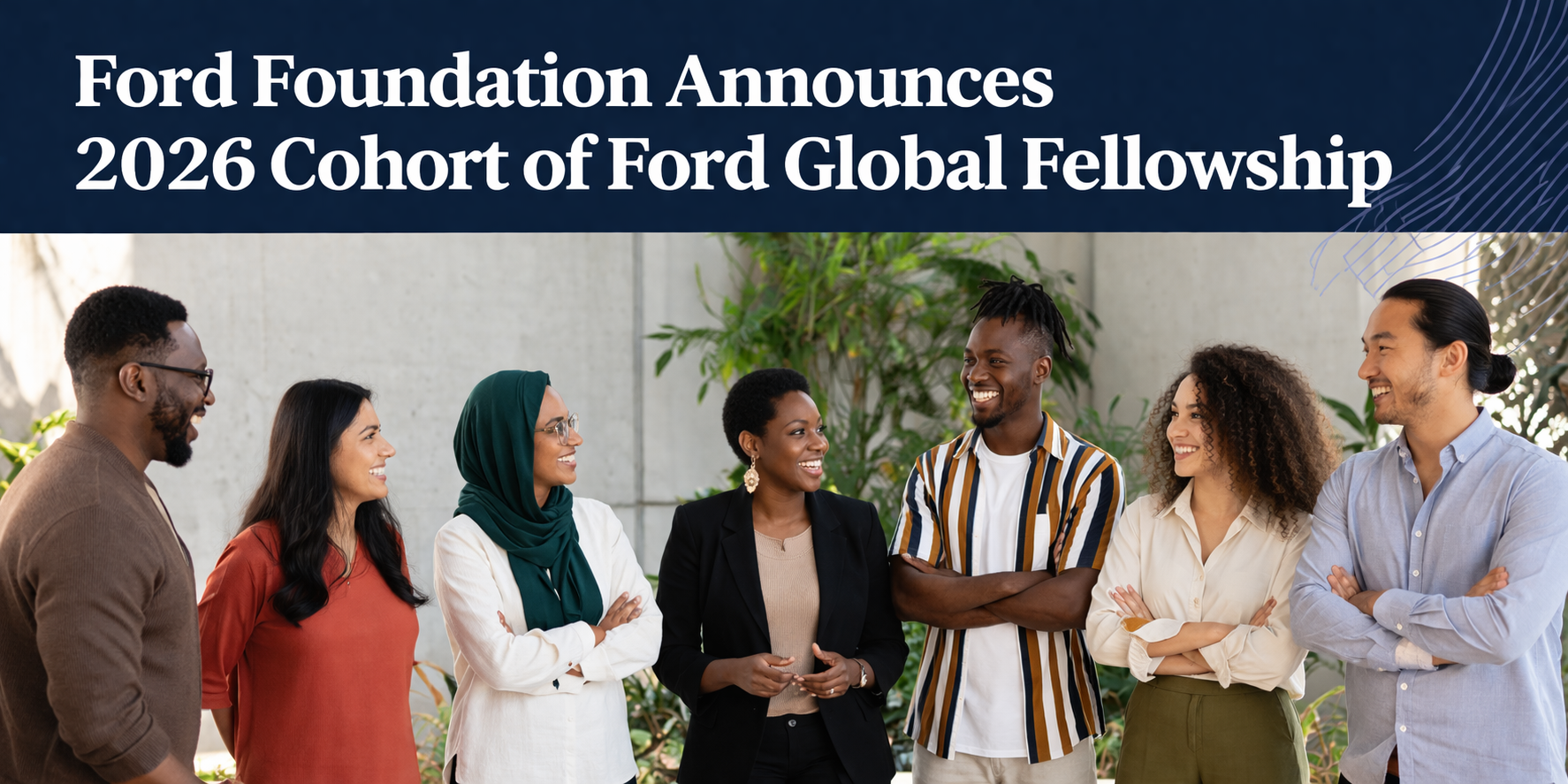
On April 7, 2026, the Ford Foundation officially announced the newest group of leaders selected for the Ford Global Fellowship, welcoming 32 remarkable individuals into a growing international network dedicated to tackling inequality from the ground up. This announcement marks another significant milestone in what has become one of the most respected and ambitious social justice fellowship programs in the world.
With this latest cohort, the Ford Global Fellowship community now exceeds 150 active fellows working across Africa, Asia, the Americas, and the Middle East. Each of these individuals was chosen not just for their academic credentials or professional achievements, but for something much harder to quantify: a proven, lived commitment to making the world more equitable, democratic, and just.
If you have been following leadership development programs, international fellowships, or social justice philanthropy, this is a story worth paying close attention to. In this article, we will walk you through everything you need to know about the Ford Global Fellowship 2026 cohort, including who the new fellows are, what the program offers, how fellows are selected, which regions are represented, and what the fellowship means for the future of global social change work.
What Is the Ford Global Fellowship?
The Ford Global Fellowship is a flagship international program launched by the Ford Foundation in 2020. It was introduced as a bold, 10-year commitment with an initial investment of $50 million, and its purpose is straightforward: to identify, connect, and support the next generation of social justice leaders from around the world who are already doing transformative work in their communities but need the resources, networks, and support to go further and deeper.
The program is not a traditional scholarship that pays for a university degree. Instead, it is a leadership fellowship built around the idea that the most powerful change agents in the world often already exist in the communities most affected by inequality. What they frequently lack is not talent or vision but access to funding, global connections, and the kind of sustained institutional support that can take their work from local impact to systemic change.
Each fellow receives a no-strings-attached stipend of $25,000, individualized leadership coaching, access to a vibrant global community of practice, and participation in multi-day in-person gatherings held in different regions across the world. These convenings are designed to spark cross-border learning, build genuine relationships among fellows, and generate fresh thinking about how to address inequality across vastly different cultural and political contexts.
Importantly, the Ford Global Fellowship is not a passive experience where fellows simply receive support. Fellows are co-creators of the program itself. The design, learning agenda, culture, and activities of the fellowship are shaped in real time by the fellows themselves, making the program truly collaborative and responsive to the realities on the ground.
A Brief History of the Ford Foundation’s Commitment to Fellows
To understand why the Ford Global Fellowship matters so much, it helps to know the history behind it. The Ford Foundation has been investing in individuals for over 90 years. Over the decades, the foundation has supported leaders as varied as Kofi Annan, Muhammad Yunus, and Condoleezza Rice, as well as writers like James Baldwin and Saul Bellow, constitutional lawyers in South Africa, and doctoral students of color in the United States.
The Ford Global Fellowship builds directly on the legacy of the Ford Foundation’s International Fellowships Program (IFP), which ran from 2001 to 2013 and represented a $280 million commitment to advancing the education of social justice leaders across the globe. Over those 12 years, more than 4,300 fellows from 22 countries completed graduate or postgraduate programs. Many of those alumni went on to hold public office, lead international organizations, and build civil society institutions that continue to serve millions of people today.
While the IFP focused on formal academic study and tuition support, the Ford Global Fellowship takes a different approach. It recognizes that some of today’s most impactful leaders are not primarily academics but practitioners, artists, lawyers, activists, engineers, and entrepreneurs who are doing the hard work of systemic change every single day. The fellowship is designed to support them in that ongoing work, not to redirect them into a classroom.
The 2026 Announcement: What We Know
The Ford Foundation announced the 2026 cohort of the Ford Global Fellowship from New York on April 7, 2026. This year’s group consists of 32 new leaders drawn from 11 regions across the globe where the Ford Foundation has an established presence and deep network of partners. Their addition brings the total fellowship community to over 150 fellows.
Adria Goodson, the director of the Ford Global Fellowship, spoke about the significance of this cohort at the time of the announcement. She described the fellowship as a reflection of an evolution of Ford’s historical mission to invest in visionaries who are reimagining a more just future. She emphasized that by connecting leaders across regions, the fellowship is helping to fortify the global civic architecture needed to accelerate efforts to disrupt the drivers of inequality in an increasingly complex world.
Noorain Khan, the chief innovation officer at the Ford Foundation, also shared her perspective on the announcement. She highlighted that for nine decades, the foundation has operated on the conviction that individuals with lived experience are the most effective architects of social change. The 2026 cohort, she noted, reflects the foundation’s continued commitment to keeping its resources focused on those who are actively building more inclusive and democratic societies from the ground up.
The 2026 cohort represents a genuinely wide spectrum of work. Fellows include filmmakers and biomedical engineers, environmental justice advocates and disability rights leaders, digital security specialists and Indigenous rights lawyers, grassroots organizers and impact investors. What unites them is not their field or geography but their shared commitment to dismantling the systems that produce and perpetuate inequality.
Meet the 2026 Ford Global Fellows
Here is an overview of the 32 leaders welcomed into the 2026 cohort of the Ford Global Fellowship. Reading through their work is a powerful reminder of the sheer breadth and depth of the global movement for equity and justice.
Beinerth Chitiva Mosquera, Colombia
General Director of the English Learning Center, Beinerth Chitiva Mosquera runs a nonprofit that provides academic enrichment and leadership development for young people in Chocó, one of Colombia’s most underserved regions. He believes that equal access to quality education is a core pillar of a just and free society.
Chinenye Uwanaka, Nigeria
Founder and managing partner of the Firma Advisory, a pan-African law and policy advisory firm, Chinenye Uwanaka provides strategic guidance on technology, infrastructure, investment, intellectual property, and public policy across the continent. She believes that truly representative systems can create wealth and dignity for citizens.
Dr. Darshana Joshi, India
Cofounder and CEO of VigyanShaala International, Dr. Darshana Joshi works to dismantle systemic barriers in STEM education for underserved youth in India, particularly girls and students from rural and low-income communities. She believes that those most affected by global challenges must be part of designing the solutions.
Diri Diepriye Ibim, Nigeria
A filmmaker and cofounder of FEMBUD, a feminist creative collective, Diri Diepriye Ibim also oversees programs and advocacy at the Dorothy Njemanze Foundation, a survivor-run nonprofit focused on sexual and gender-based violence response and prevention. She believes that art and creativity are essential to structural change.
Enrique Salanic, Guatemala
A K’iche’ and queer actor, cultural practitioner, and spiritual guide, Enrique Salanic works through film, performance, and Mayan fire ceremonies to challenge the idea that only certain bodies, beliefs, and stories deserve protection and visibility.
Erika Moore, United States
A biomedical engineer and professor at the University of Maryland, Erika Moore works to dismantle inequity in the study of human health. She believes in teaching equity as a core research design principle, arguing that this approach can create a healthier, stronger world for everyone.
Febriana Firdaus, Indonesia
An award-winning journalist and documentary filmmaker, Febriana Firdaus has reported extensively on human rights violations, government accountability, and environmental issues across Southeast Asia. She is a champion of digital storytelling as a tool for inspiring future generations to address global inequality.
Gabriela Carrera, Guatemala
A professor and community organizer at Universidad Rafael Landívar, Gabriela Carrera works as director of public action, an initiative focused on community transformation through dialogue and mutual education.
Gerald Sikazwe, Zambia
A social movement builder who uses poetry, performance, and digital storytelling, Gerald Sikazwe amplifies the voices of underrepresented communities in Southern Africa through his work with the Word Smash Poetry Movement and the Centre for Young Leaders in Africa.
Gervas Evodius, Tanzania
A priest, gender activist, and cofounder of Hakizetu Organization, Gervas Evodius promotes gender equality and advances women’s economic rights across Tanzania. He believes that economic independence creates pathways to dignity and safety.
Guadalupe García Prado, Guatemala
An anthropologist and founder of the Observatory of Extractive Industries in Guatemala, Guadalupe García Prado grounds research and advocacy in a deep connection to land, forests, waters, and living territories to protect communities from extractive industry harms.
Hashem Hashem, Lebanon
A playwright, theatermaker, poet, and performer based in Beirut, Hashem Hashem also runs an Arabic creative writing platform on Instagram. He believes that theater and storytelling are powerful tools for exposing injustice and building communities of care and solidarity.
Hassana Maina, Nigeria
Founder and executive director of ASVIOL Support Initiative, a feminist organization that advances survivor-centered legal support and policy reform, Hassana Maina believes that addressing the structural inequality behind gender-based violence is essential to building a world where equality is lived rather than negotiated.
Hind Hamdan, Lebanon
A gender and workers’ rights specialist, Hind Hamdan advances gender-transformative approaches within trade unions, grassroots movements, and labor governance systems. She is committed to making invisible labor visible and shifting power structures through storytelling and mentorship.
Kari Guajajara, Brazil
A Guajajara-Tenetehára lawyer with the Indian Law Resource Center, Kari Guajajara believes that protecting Indigenous lands is indispensable to climate justice and human rights. She is committed to upholding the constitutional rights of Indigenous communities to their ancestral lands.
Karina Penha, Brazil
Co-executive director and founder of the Amazônia de Pé Movement, a prominent movement dedicated to protecting the Amazon and its people, Karina Penha confronts land, racial, and territorial inequality as root causes of the climate crisis in Brazil.
Kartik Sawhney, India
A tech entrepreneur, disability advocate, and cofounder of I-Stem, a nonprofit that builds digital infrastructure to ensure all people can independently access public services, Kartik Sawhney believes that accessibility is essential to dismantling inequality and fostering economic mobility.
Letícia Leobet, Brazil
A Black feminist advocate and deputy coordinator at Geledés, the Black Women’s Institute, Letícia Leobet leads efforts to translate community demands into effective policy at the United Nations system. She believes that reparative approaches, not technocratic solutions, are needed to truly transform systems of inequality.
Luis Sevillano, Colombia
A university professor who has spent 25 years working with USAID and local governments to promote the rights and cultural heritage of Afro-Colombian and Indigenous communities, Luis Sevillano believes that culturally inclusive public policy can build a future where opportunity is not defined by race or place of birth.
Makomborero Carl Muropa, Zimbabwe
A human rights lawyer, education strategist, and cofounder of African Montessori Hub, Makomborero Carl Muropa provides underserved communities with culturally responsive, child-centered learning while also working on housing justice issues.
Naomi Mwaura, Kenya
Founder and executive director of Flone Initiative Trust, Naomi Mwaura improves safety and inclusion for historically excluded commuters in Kenya. Her work centers on building transportation systems that prioritize safety and dignity as core infrastructure.
Paknam Kima Pai, Colombia
A lawyer, researcher, and advocate for the rights of the Inkal Awa Indigenous people, Paknam Kima Pai challenges systemic inequality and believes that territorial autonomy and self-governance are essential to the future of Indigenous communities.
Parasurama Pamungkas, Indonesia
A researcher and advocate working on AI governance, spyware accountability, platform regulation, and data protection in the Global South, Parasurama Pamungkas believes that technology should benefit society by aiding vulnerable individuals and ensuring lives full of dignity.
Pravin Nikam, India
A lawyer and educator who founded SAMAVESH, an organization working to transform conditions that exclude communities from education and economic opportunity, Pravin Nikam believes that addressing inequality requires redesigning social systems so that basic rights are guaranteed by design.
Reem Almasri, Jordan
A digital security strategist who advises social justice organizations in Southwest Asia and North Africa, Reem Almasri helps civil society organizations take ownership of their communications and data, building more resilient and secure operations.
Roishetta Sibley Ozane, United States
An environmental justice leader and founder of the Vessel Project, which provides critical support to vulnerable populations in Louisiana, particularly Black and Indigenous communities, Roishetta Sibley Ozane believes in the deep interconnectedness of environmental and social struggles.
Siphiwe Ngwenya, South Africa
An artist, creative economist, and executive director of the Maboneng Township Arts Experience, Siphiwe Ngwenya transforms township and rural homes into gallery, cinema, and heritage spaces. He is committed to a world where art sustains households and communities own the means of cultural production.
Staicy Naanyu Letoluo, Kenya
Founder and CEO of Indigenous Friends of the Mau Forest, the first Indigenous Maasai Lady youth-led organization in Narok, Kenya, Staicy Naanyu Letoluo believes that Indigenous women and girls must be at the center of decisions about their land, education, and conservation strategies.
Yaw Owusu-Boahen, United States
A mission-driven impact investor and vice president at ConnCORP, Yaw Owusu-Boahen is dedicated to closing the racial wealth gap through investments in people, places, and platforms. He believes that everyone deserves reliable pathways to wealth and a brighter future.
Yazmany Arboleda, United States
Founder and artistic director of the People’s Creative Institute and New York City’s inaugural People’s Artist for the Civic Engagement Commission, Yazmany Arboleda uses public art to transform civic spaces and advance social change. He sees democracy as a reflection of what we collectively choose to value and resource.
Ying Xin, United States
Program manager for the Global LGBTQI+ Human Rights Program at Harvard Kennedy School’s Carr-Ryan Center for Human Rights, Ying Xin designs leadership initiatives for LGBTQI+ leaders in under-resourced regions. She believes in bridging frontline community advocacy and high-level systemic change.
Zhen Ni, United States
A project manager at the University of Chicago and advocate for the disabled community in China, Zhen Ni works to dismantle systemic exclusions in education, care, and social services. He envisions a society where disability is honored as a profound source of knowledge about justice and interdependence.
What the Ford Global Fellowship Offers Its Fellows
One of the most important things to understand about the Ford Global Fellowship is what it actually provides to the people selected. Here is a detailed look at the support fellows receive:
A $25,000 No-Strings-Attached Stipend
Every Ford Global Fellow receives a personal stipend of $25,000. This funding comes with no restrictions on how it is used. Fellows can invest it in their organizations, use it for personal development, apply it to research, or allocate it in whatever way best supports their work and mission. The unrestricted nature of this funding is intentional and reflects the foundation’s deep trust in its fellows and their judgment.
Leadership Coaching and Individual Development
Each fellow has access to individualized coaching designed to strengthen their leadership skills. This is not generic corporate training but personalized support tailored to each fellow’s specific context, challenges, and goals. The coaching is designed to help fellows reach new audiences, navigate complex systems, and build the kind of resilient, sustainable leadership that can weather the long arc of social change work.
Multi-Day In-Person Convenings
A cornerstone of the fellowship experience is a series of multi-day in-person gatherings held in different regions across the world. These convenings are designed to foster deep connection and cross-cultural learning among fellows. Participants engage in site visits, hear from guest speakers, and participate in experiences unique to the local setting. The gatherings are more than networking events; they are spaces where real intellectual collaboration and personal transformation take place.
Regular Virtual Cohort Connection Activities
Between in-person gatherings, fellows participate in monthly virtual cohort connection activities. These ongoing touchpoints help maintain the sense of community and shared purpose that is central to the fellowship’s design. Fellows are expected to engage fully in these virtual activities as part of their commitment to the program.
A Vibrant Community of Practice
Perhaps the most enduring benefit of the Ford Global Fellowship is membership in a growing community of practice that spans past, present, and future cohorts. This community is described as an infrastructure of belonging, a space where diverse leaders from disparate fields and regions can build genuine relationships, share knowledge, and support each other’s work for years and even decades after their fellowship period ends. The fellowship is designed to have a multiplier effect: as the community grows, the collective impact of its members amplifies across borders and issues.
An Individual Learning Plan
Fellows work with the foundation to develop an Individual Learning Plan that supports their personal leadership development over the course of the fellowship. This plan is tailored to each fellow’s unique goals and helps ensure that the fellowship experience is genuinely responsive to what each individual needs to grow and do their best work.
How Are Fellows Selected?
This is a question many people ask, and the answer is important. The Ford Global Fellowship does not accept open applications or self-nominations. This is not a scholarship where you fill out an online form and submit your documents by a deadline. Instead, candidates are identified through a formal nomination-based selection process, and invitations to apply are extended only to those who come through this official channel.
The selection process is designed to identify leaders who are already doing meaningful work in their communities but have not yet had access to the resources and networks needed to fully realize their potential. The foundation and its extensive network of regional partners actively seek out people who may not have the visibility or connections that come with traditional elite institutions but who are driving real, ground-level change in their communities.
Selection criteria focus on demonstrated impact, leadership potential, commitment to addressing the root causes of inequality, ethical integrity, and a genuine curiosity to expand perspectives beyond their current sphere. The foundation is intentionally seeking diversity, not just in terms of geography and demographics but in terms of approaches, disciplines, and ways of thinking about disrupting inequality.
There is no single archetype of an ideal Ford Global Fellow. The program is specifically designed to bring together people with vastly different backgrounds and methodologies, because the foundation believes that this diversity of thought and approach creates the most fertile conditions for innovation and transformative change.
Which Regions Does the Fellowship Cover?
The Ford Global Fellowship covers the 11 regions where the Ford Foundation has an established presence and deep networks. These regions are the United States, Brazil, the Andean Region, Mexico and Central America, India, Sri Lanka and Nepal, Eastern Africa, West Africa, Southern Africa, the Middle East and North Africa, Indonesia, and China.
This geographic scope reflects the foundation’s belief that it can most effectively engage with leaders in regions where it has existing relationships, contextual knowledge, and a long history of working across sectors and issues. Each cohort is designed to include fellows from all 11 regions, ensuring a genuinely global perspective within the community of practice.
The 10-Year Vision and Long-Term Goals
The Ford Global Fellowship is designed as a 10-year program with a goal of supporting approximately 200 fellows over that period. With the 2026 cohort now announced, the fellowship community has passed the 150-fellow milestone, demonstrating real momentum toward this target.
The long-term vision of the program goes beyond individual impact. The foundation is building what it describes as a global civic architecture, a robust, interconnected infrastructure of leaders, ideas, and relationships that can collectively accelerate the dismantling of systems of inequality. This is not about any single leader or any single issue but about creating the conditions for sustained, compounding, cross-border impact over decades.
The fellowship also represents a deliberate shift in how philanthropy thinks about its role. Rather than positioning funders as the primary architects of social change, the Ford Global Fellowship is built on the conviction that the most effective solutions come from the people and communities closest to the problems. The program is designed to transfer power, not just resources.
Why the Ford Global Fellowship Matters in 2026
In a world where democratic institutions are under pressure, climate change is accelerating inequality, and the rights of marginalized communities are being contested in countries across every region, the work that Ford Global Fellows are doing has never been more urgent or more important.
The 2026 cohort includes leaders working on issues as varied as digital rights and AI governance in Southeast Asia, environmental justice and Indigenous land rights in Latin America, gender-based violence prevention in West Africa, disability rights in China and India, and LGBTQI+ human rights in under-resourced communities around the world. Together, they represent the full complexity of the global inequality crisis and the remarkable diversity of people working to address it.
What makes the Ford Global Fellowship different from most leadership programs is its insistence on genuine co-creation. Fellows are not passive recipients of a pre-designed program. They are active participants in shaping the fellowship’s culture, learning agenda, and activities. This means the program evolves with each new cohort, constantly learning from the leaders it supports and becoming more responsive to the realities of social change work in the present moment.
How to Learn More and Get Involved
Since the Ford Global Fellowship does not accept open applications, the best way to engage with the program is to follow it closely, build your network and profile within the social justice sector in your region, and connect with Ford Foundation partners and grantees who may be involved in the nomination process.
If you are a social change leader in one of the 11 regions covered by the fellowship, the most important thing you can do is focus on doing impactful, visible work in your community. The foundation is actively looking for leaders who have already demonstrated meaningful impact but whose full potential has not yet been realized due to a lack of resources or a global network.
You can learn more about the fellowship, read about all past and current fellows, and stay updated on future cohort announcements by visiting the official Ford Global Fellowship page on the Ford Foundation website.
You can also read the full official announcement of the 2026 cohort and the complete profiles of all 32 new fellows by visiting the Ford Foundation’s 2026 Ford Global Fellowship announcement page.
Frequently Asked Questions
Is the Ford Global Fellowship an open scholarship program?
No. The Ford Global Fellowship is not an open scholarship in the traditional sense. It does not accept direct applications or self-nominations from the public. Candidates are identified through a formal nomination-based process, and only those who receive official invitations through this channel are able to apply. This is an important distinction from most scholarship and fellowship programs.
Does the Ford Global Fellowship cover university tuition?
No. Unlike the Ford Foundation’s previous International Fellowships Program, the Ford Global Fellowship does not provide tuition support for formal academic study. Instead, it offers a $25,000 no-strings-attached stipend, leadership coaching, access to a global community of practice, and participation in in-person and virtual convenings. The program is designed to support leaders in their ongoing work, not to redirect them into academic study.
How long does the fellowship last?
The fellowship period for each cohort runs for approximately 18 months. During this time, fellows are expected to participate fully in three week-long in-person gatherings and regular monthly virtual cohort connection activities. Fellows also have the opportunity to engage in optional community-building and co-created learning experiences.
Who is eligible for the Ford Global Fellowship?
The fellowship is open to leaders from the 11 regions where the Ford Foundation has a presence: the United States, Brazil, the Andean Region, Mexico and Central America, India, Sri Lanka and Nepal, Eastern Africa, West Africa, Southern Africa, the Middle East and North Africa, Indonesia, and China. Beyond geography, candidates should be emerging social change leaders who have demonstrated meaningful impact in their communities and whose potential has not yet been fully realized due to a lack of resources or access to a global network.
How many fellows are selected each year?
The number of fellows selected per cohort varies. The inaugural 2020 cohort included 24 fellows. Subsequent cohorts have been larger. The 2026 cohort includes 32 new fellows. The overall program aims to support approximately 200 fellows over the course of its 10-year lifespan through to 2030.
Is the Ford Global Fellowship related to the Ford Foundation International Fellowships Program?
They are related in spirit but different in design and scope. The International Fellowships Program ran from 2001 to 2013 and focused on supporting formal graduate and postgraduate academic study for social justice leaders. The Ford Global Fellowship, launched in 2020, does not provide academic tuition support but instead focuses on peer learning, network building, leadership development, and co-creating a global community of practice. Both programs share the core value of investing in individuals who are committed to addressing inequality.
What is the Ford Foundation’s overall endowment and scale?
The Ford Foundation is one of the largest private foundations in the world, with an endowment of $16 billion. It has its headquarters in New York and 10 regional offices across Africa, Asia, Latin America, and the Middle East. The foundation has been operating for 90 years, and the Ford Global Fellowship is among its most visible current investments in individual leadership development.
Conclusion
The announcement of the 2026 cohort of the Ford Global Fellowship is genuinely exciting news for anyone who cares about social justice, global leadership development, and the future of civil society. With 32 new fellows joining a community that now numbers over 150 extraordinary leaders from every corner of the globe, the fellowship is proving to be exactly what it was designed to be: a catalytic investment in the people who are building a more equitable world from the inside out.
From Indigenous rights lawyers in Colombia and Brazil to digital security advocates in Jordan and Indonesia, from environmental justice leaders in Louisiana to STEM education pioneers in India, the 2026 cohort reflects the true breadth and depth of the global movement against inequality. These are not distant, abstract figures. They are practitioners, organizers, artists, and entrepreneurs doing real, daily work in their communities, and the Ford Global Fellowship is giving them the tools, resources, and connections to do that work even better.
Whether you are a young social change leader hoping to one day be part of this network, a philanthropy professional tracking global trends in leadership development, or simply someone who wants to understand what serious investment in human capital looks like, the Ford Global Fellowship is worth watching closely.
To stay updated on future cohorts, learn more about the program’s philosophy, and read the full profiles of all 2026 fellows, visit the Ford Global Fellowship official program page.