
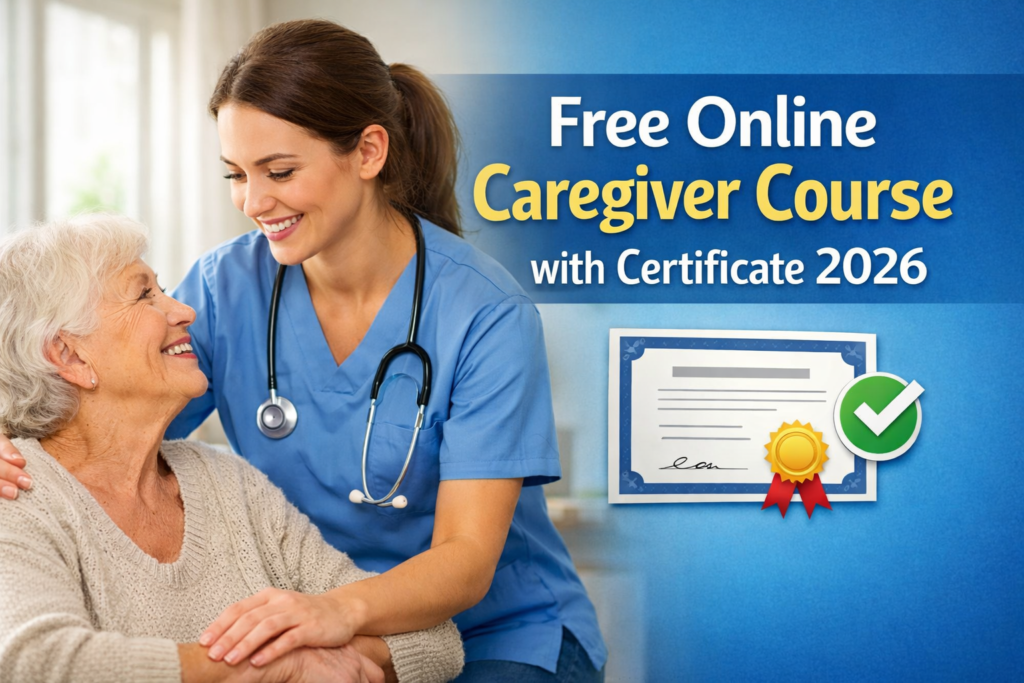
If you are looking for a way to become a qualified caregiver without spending money on expensive training programs, you are in the right place. In 2026, there are more free online caregivers course with certificate available than ever before, and many of them are offered by reputable organizations and universities that are recognized globally. Whether you want to care for an elderly parent at home, start a professional career in healthcare, or simply upgrade your skills as a practicing caregiver, this guide will walk you through everything you need to know.
Caregiving is one of the most in-demand professions in the world right now. The global population is aging rapidly, and there is a growing need for trained, compassionate individuals who can provide quality care to older adults, people with disabilities, children, and those living with chronic illnesses or conditions like dementia and Alzheimer’s disease. The good news is that you do not have to enroll in a full-time nursing school or spend thousands of dollars to get the training and certification you need. Many of the best caregiver courses in the world are available online, completely free, and they come with a recognized certificate upon completion.
This article is a full breakdown of the best free online caregiver courses with certificates in 2026, what each one covers, who it is best for, and how you can sign up today. We will also cover what skills you will gain, what kind of jobs these certifications can help you get, and answers to the most common questions people have about free caregiver training.
Why Caregiver Training Matters in 2026
Before we get into the specific courses, it is worth understanding why caregiver training is so important. Many people assume that caring for someone is something you can do naturally without any formal training, especially if you are looking after a family member. While love and compassion are absolutely important, effective caregiving also requires real knowledge and practical skills.
A trained caregiver knows how to safely assist a person with limited mobility without causing injury to either themselves or the person in their care. They know how to manage medications properly, recognize warning signs of health deterioration, respond to emergencies, provide nutritional support, and communicate effectively with both the person they are caring for and the wider healthcare team. Without this knowledge, even the most well-intentioned caregiver can make mistakes that have serious consequences.
Professional caregivers who have completed certified training are also viewed far more favorably by employers. Online certifications from platforms like Coursera, edX, and Alison demonstrate commitment to self-improvement and signal that the applicant has acquired core competencies expected on the job. Courses from well-known platforms are designed by experienced medical and healthcare professionals to teach exactly the skills that employers and care facilities look for. This is why getting certified, even through a free online course, can make a real difference to your career prospects.
What to Look for in a Free Online Caregivers Course with Certificate
Not all free caregiver courses are created equal. Before you enroll in any program, there are a few things worth checking to make sure you are spending your time wisely. First, look at who created the course. Courses developed by accredited universities, global health organizations, or well-established nonprofits carry more weight than those built by unknown providers. Second, check what topics the course covers. A good caregiver course should address the basics of personal care, communication skills, safety and emergency response, nutrition, and the emotional aspects of caregiving. Third, find out what type of certificate you will receive at the end and whether it is widely recognized by employers in your country or region.
You should also think about the format of the course. Some courses are self-paced, meaning you can study whenever it suits you, while others are structured with weekly lessons and deadlines. If you are juggling a job, family responsibilities, or other commitments, a self-paced format may work better for you. Finally, make sure the platform itself is reputable and that the certificate is accessible online so you can share it on your resume or LinkedIn profile.
Best Free Online Caregiver Courses with Certificates in 2026
Here is a detailed look at the most trusted and widely used free caregiver courses with certificates available in 2026. Each one has something different to offer, so read through all of them and find the one that best matches your goals.
1. Alison: Introduction to Caregiving
Alison is one of the world’s most popular free online learning platforms, with over 50 million registered learners. Their Introduction to Caregiving course is one of the most straightforward and accessible entry points into the field. The course takes approximately three hours to complete, making it ideal for beginners who want a solid foundation without a huge time commitment.
The course covers legal and ethical responsibilities in caregiving, communication styles including verbal and nonverbal communication, how to handle common impairments such as vision loss, hearing difficulties, and cognitive changes, time management and task prioritization, how to set professional boundaries, and recognizing and managing caregiver stress. To earn a certificate, you need to score 80 percent or higher on the course assessments. The course itself is entirely free to enroll in and complete. The digital certificate is available for a small fee if you choose to purchase it, but you can also share your Learner Record or Learner Achievement Verification for free if you prefer not to purchase the printed certificate.
Alison also offers a Diploma in Caregiving, which is a longer and more comprehensive program that covers the practical, legal, and ethical issues around providing care for the sick and elderly. If you are serious about building a career in caregiving, the diploma is worth considering after completing the introductory certificate course.
You can browse and enroll in Alison’s free caregiving courses directly through their website. All courses are available on the Alison mobile app as well, which means you can study offline if you have poor internet access.
2. Coursera: Caregiving Courses from Top Universities
Coursera partners with some of the world’s leading universities and institutions to offer high-quality online courses, and caregiving is one of the areas where they have a strong selection. You can access a range of caregiving courses on Coursera for free by auditing them, which means you get access to video lessons, readings, and assignments without paying anything. If you want a verified certificate, you will need to pay a fee or apply for financial aid, which Coursera offers to learners who qualify.
One of the standout courses on the platform is Supporting Families and Caregivers, offered by Stanford University as part of the Palliative Care Always Specialization. This course is designed for healthcare providers, social workers, family friends, and caregivers who want to support individuals with serious illness. It covers topics such as caregiver burden, how to screen for it, emotional support strategies, and how to empower families to get the help they need. The course is accredited by the Accreditation Council for Continuing Medical Education (ACCME) and the American Nurses Credentialing Center (ANCC), which makes it particularly valuable for healthcare professionals seeking continuing education credits.
Coursera also offers courses on home health care, geriatrics, dementia care, nutrition, dignity in care, patient communication, and mental and behavioral health in caregiving contexts. Many of these are developed by institutions such as Johns Hopkins University, Yale University, and the University of California. If you are looking to move into professional caregiving or upgrade skills you already have, the depth and quality of courses on this platform is hard to beat.
Visit the Coursera caregiving courses page to explore all available programs and find one that fits your level and goals.
3. edX: Understanding Dementia and Caregiving for Older Adults
edX is another major platform for free online education, partnering with universities around the world to deliver high-quality academic content. For caregivers, two courses stand out in particular.
The first is Understanding Dementia, a beginner-friendly course that introduces learners to common types of dementia including Alzheimer’s disease. Over six weeks, you will learn communication strategies for interacting with people living with dementia, how to interpret behaviors, and the ethical dimensions of dementia care. The course is delivered through video lectures and interactive quizzes, and participants who complete it receive a certificate of completion from edX. This course is particularly well suited to family caregivers and those who are new to aged care and want foundational knowledge before moving into more specialized training.
The second notable option on edX is a course from the Karolinska Institutet titled CARE: Introduction to Caregiving for Older Adults. This four-part, self-paced interactive course provides an introduction to the knowledge and skills needed to care for older adults and is designed to complement other courses in a broader caregiving learning pathway. It is an excellent starting point for anyone interested in working with elderly populations.
Browse available caregiving courses by visiting the edX online learning platform and searching for caregiving or aged care topics.
4. American Red Cross: First Aid, CPR, and Child Caregiver Training
The American Red Cross is one of the most trusted training organizations in the world, and it offers several courses that are directly relevant to caregivers. Their Advanced Child Care Training course is a fully online program that teaches lifesaving skills alongside practical caregiving skills such as bottle feeding, holding infants, child behavior and discipline, professionalism, and safety. The course includes videos, interactive activities, and quizzes to keep learners engaged.
The Red Cross also offers a free online course titled First Aid Fundamentals, which takes approximately two hours to complete. It covers essential topics including scene safety, adult CPR, choking relief, wound care, and how to respond to common emergencies. Upon completion, learners receive a Red Cross e-Certificate, which is widely recognized by employers in the healthcare and childcare sectors. Many care facilities and home health agencies require caregivers to hold a current first aid and CPR certification, so this is a genuinely practical certificate to have.
The Red Cross has also developed a free Child Care app that equips caregivers with detailed information on topics like diapering, feeding, and emergency first aid for children, along with interactive lessons and quizzes. For anyone providing childcare, this app is a valuable free resource to have on your phone.
You can find all available Red Cross caregiver training options on the Red Cross official training and class registration page.
5. Family Caregiver Alliance (FCA): Free Webinars and CareNav Resources
The Family Caregiver Alliance, also known as FCA, is a nonprofit organization that has been supporting family caregivers for over 40 years. Through its National Center on Caregiving, the FCA offers access to more than 40 free recorded webinars covering a huge variety of caregiving topics. These webinars are particularly well suited to unpaid family caregivers who are looking after a loved one with conditions such as Parkinson’s disease, stroke, Alzheimer’s disease, or other forms of dementia.
Topics covered in the FCA’s webinar library include how to move an elderly person with limited mobility, planning for care transitions, recognizing the early warning signs of age-related diseases, financial and legal considerations in caregiving, and how to practice self-care to avoid caregiver burnout. Resources are also available in multiple languages including Spanish, Chinese, Tagalog, and Vietnamese, making the FCA’s training accessible to a wide global audience.
The FCA’s CareNav platform brings all services and resources together in a personalized dashboard, making it easy for caregivers to find the specific training and support they need. The FCA also offers a course called Improving Practice: Working with Diverse Family Caregivers, which is free and designed for professionals who work with and support family caregivers in diverse communities.
Register for free to access FCA’s training resources and webinars through the Family Caregiver Alliance Learning Center.
6. MindEdge: Mental Health and Resiliency for Caregivers
One aspect of caregiving that often gets overlooked is the emotional and psychological toll it takes on the caregiver. Caregiver burnout is a real and serious problem that can affect both the quality of care being given and the health of the caregiver themselves. MindEdge offers a free course called Mental Health and Resiliency specifically designed to address this challenge.
Delivered across six self-paced modules, the course teaches strategies for self-care, stress management, building resilience, and advocacy. It uses case studies and reflective exercises to reinforce learning, making it a practical and engaging experience. Upon passing the final exam, learners receive a certificate of completion. This course is ideal both for family caregivers who are starting to feel overwhelmed and for professional caregivers who want to develop better tools for managing the emotional demands of their work.
7. OpenWHO: World Health Organization Free Caregiving Courses
OpenWHO is the World Health Organization’s open online learning platform, and it offers free courses on topics related to public health, emergency response, and healthcare. While not exclusively focused on caregiving, several courses on the platform are directly relevant to caregivers, particularly those working in healthcare settings or in communities affected by disease outbreaks or public health crises.
Courses on OpenWHO are developed by WHO experts and cover areas such as infection control, pandemic response, disease prevention, and safe patient care practices. These are especially useful for caregivers who want to understand how to protect both themselves and the people they care for from infectious diseases. All courses on OpenWHO are free, and certificates of completion are issued to learners who pass the assessments.
Explore free caregiver-relevant health courses by visiting the OpenWHO online learning platform and searching for topics related to patient care and infection control.
8. SC Training (formerly SafetyCulture): Caregiver Training Courses
SC Training offers a collection of free online caregiver courses with certificates that are particularly popular with care agencies and healthcare organizations that want to train their staff. However, individual caregivers can also access many of these courses for free.
One of their standout offerings is Mental Health and Resiliency in Aged Care Facilities, a free microlearning course that helps caregivers enhance their mental health and emotional resilience using the 3Rs model, which covers resistance, resiliency, and recovery. The platform also offers a course on dementia care that teaches practical skills for supporting people with dementia, including communication techniques, appropriate activities and exercises, and how to respond to behavioral changes at different stages of the condition.
SC Training uses gamification techniques such as points, challenges, and interactive elements to make learning more engaging. Shorter lesson formats also make it easier for caregivers with busy schedules to fit training into their day. Certificates are issued upon course completion and can be shared digitally.
9. mmLearn.org: Free Video Library for Senior Caregivers
mmLearn.org started as a professional caregiver training resource but has since opened its library to anyone who wants to learn. The platform hosts over 300 training videos covering practical topics related to caring for seniors. These include nutrition, household safety for elderly individuals, recognizing and responding to depression in older adults, managing memory loss, understanding common medical conditions in the elderly, and much more.
While mmLearn.org is more of a video library than a structured course platform, it is an excellent supplemental resource for caregivers at any level. The content is practical, easy to understand, and delivered by experienced healthcare professionals. It is particularly useful for family caregivers who want quick, accessible guidance on specific topics without having to sit through an entire structured course.
10. AARP: Prepare to Care Training
AARP is one of the most well-known organizations supporting older adults and their caregivers in the United States, but many of their resources are accessible to caregivers anywhere in the world. The AARP Prepare to Care series offers training modules at no cost that are specifically designed for unpaid family caregivers. The series covers how to start difficult conversations about care needs, how to create a care plan, how to coordinate with healthcare providers, and how to manage the practical and emotional demands of becoming a caregiver.
AARP also offers a broader collection of caregiving resources, guides, and expert advice through their online caregiving hub, covering topics from home safety and financial planning to legal considerations and finding respite care. This makes AARP one of the most comprehensive free resources for family caregivers, even if you are not based in the United States.
Access AARP’s free caregiving training and resources through the AARP caregiving resource center.
What Topics Do Free Caregiver Courses Typically Cover?
If you are wondering what you will actually learn from these free caregiver courses, here is a broad overview of the most common topics covered across the programs listed above. Not every course covers all of these areas, but between the options available, you can build a comprehensive knowledge base in caregiving without spending a single dollar.
The core areas typically covered include basic personal care skills such as bathing, dressing, grooming, and toileting assistance. Courses also address nutrition and meal planning for older adults and people with special dietary needs, safe patient handling and mobility assistance to prevent falls and injuries, medication management and understanding common medications used in elder care, infection control and hygiene practices to prevent the spread of illness, first aid and CPR for emergency response situations, dementia and Alzheimer’s care including communication strategies and behavioral management, mental health support and recognizing signs of depression and anxiety in care recipients, legal and ethical issues in caregiving including privacy, consent, and reporting abuse, communication skills for working with care recipients, families, and healthcare teams, and caregiver self-care strategies to prevent burnout and maintain personal wellbeing.
Together, these topics give a comprehensive picture of what it takes to be an effective, compassionate, and professional caregiver. Even if you already have some caregiving experience, working through courses on these topics can help you fill gaps in your knowledge and feel more confident in difficult situations.
Are Free Caregiver Certificates Recognized by Employers?
This is one of the most common questions people ask when considering free online caregiver training, and the answer is generally yes, with some important context. Online certificates from well-known platforms like Coursera, edX, and Alison are viewed favorably by many healthcare employers today. They demonstrate that the candidate is committed to self-education, willing to take initiative, and has acquired documented competencies in caregiving.
Courses developed by prestigious institutions such as Stanford University, Johns Hopkins, and the Karolinska Institutet carry significant credibility because they are associated with universities that are globally recognized for academic excellence. Similarly, first aid and CPR certifications from the American Red Cross are widely accepted by home care agencies, residential care facilities, and childcare providers as legitimate credentials that demonstrate workplace readiness.
That said, it is important to understand that free online certificates are typically most useful as a starting point or supplement to more formal training. If you are pursuing a career as a professional Home Health Aide, Certified Nursing Assistant (CNA), or similar regulated role, you will likely need to complete state or country-specific licensing requirements that go beyond what a free online course can provide. However, having free certifications on your resume absolutely makes you a stronger candidate and shows employers that you take your professional development seriously.
How to Choose the Right Free Caregiver Course for You
With so many options available, it can feel overwhelming to decide where to start. Here are a few simple questions you can ask yourself to narrow it down: