
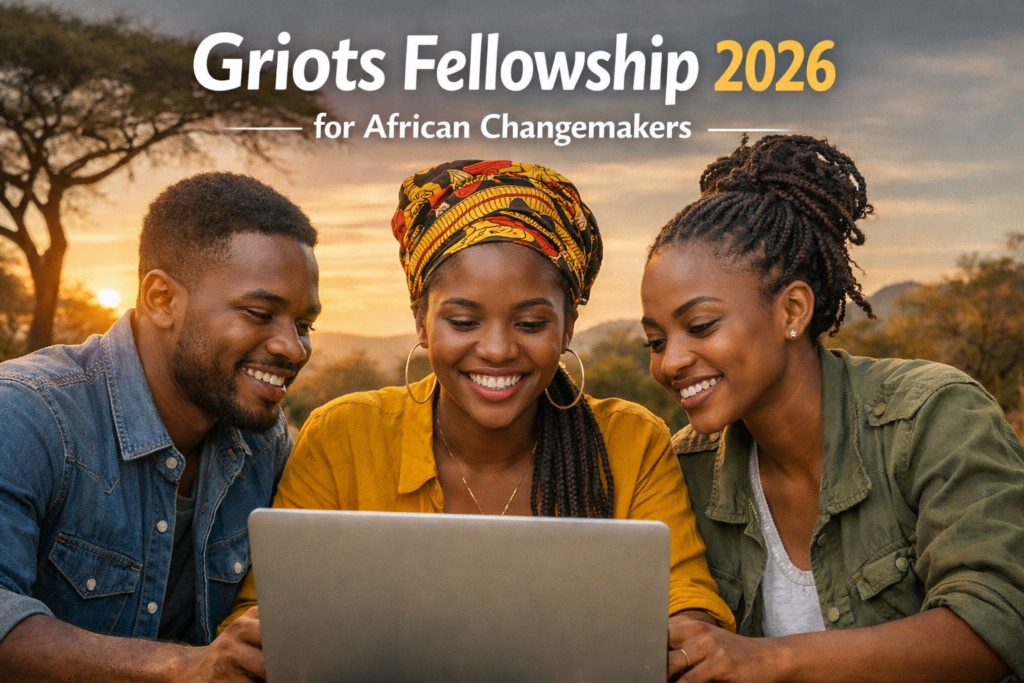
If you are a journalist, writer, filmmaker, artist, or cultural practitioner in Africa who is passionate about shaping authentic African stories, then this fellowship was created for someone exactly like you. The Griots Fellowship 2026 is now officially open for applications, and it is one of the most culturally significant fellowship programs on the continent right now. Run by the LéO Africa Institute, this program brings together Africa’s storytelling voices and gives them the tools, networks, and platforms to reclaim and reshape how the African narrative is told to the world.

In this article, we will walk you through everything you need to know about the Griots Fellowship 2026. We will cover what the fellowship is about, who runs it, the 2026 theme, the three program tracks, who is eligible to apply, what you gain from participating, and exactly how to submit your application. Read every section carefully because the details matter.
What is the Griots Fellowship?
The Griots Fellowship is a leadership and storytelling program dedicated to equipping African changemakers with the skills, platforms, and professional networks they need to shape and reclaim their continent’s narrative. The fellowship is organized and run by the LéO Africa Institute, a respected leadership and development organization based in Uganda that works across the African continent.
The fellowship draws its name and inspiration from the griot tradition of West Africa. A griot is a West African historian, storyteller, praise singer, poet, and musician. Griots have been the keepers of oral history across generations in West African societies. They are the ones who remembered the stories, preserved the culture, and passed knowledge from one generation to the next. In communities where written records were not the primary method of preserving history, the griot was the living library of the people.
By naming this fellowship after the griot, the LéO Africa Institute is making a powerful statement. It is saying that storytelling is not a trivial skill. It is a form of leadership. It is an act of cultural preservation. And in a modern world where African stories are often filtered through outside voices and perspectives, it is also an act of resistance and reclamation.
The Griots Fellowship takes this ancient tradition and brings it into the 21st century. It supports modern-day narrators working in journalism, film, creative writing, oral history, digital media, and cultural heritage, and equips them with the skills and networks they need to tell Africa’s stories authentically, confidently, and on their own terms.
The program is also inspired by the TED Talks model, which values concise, powerful, idea-driven communication. This combination of the ancient griot tradition and the modern TED platform creates a fellowship that is uniquely positioned to bridge Africa’s past and future through the power of story.
About the LéO Africa Institute
To understand the Griots Fellowship fully, it helps to know a little about the organization behind it. The LéO Africa Institute is a leadership development organization that works to cultivate the next generation of African thought leaders grounded in values, ethics, and a deep understanding of the continent. The institute runs several flagship programs across the continent, including the Young and Emerging Leaders Project (YELP), the Huduma Fellowship for public servants in Uganda, and the Griots Fellowship for storytellers and cultural practitioners.
The LéO Africa Institute believes that Africa’s development must be led by Africans who are not just technically skilled but who also lead with integrity, vision, and a strong sense of identity. The Griots Fellowship is an expression of this belief in the cultural and narrative dimension. For the institute, the stories a continent tells about itself shape how it is perceived both from within and by the outside world. Getting those stories right matters enormously.
Griots Fellows who have gone through the program have gone on to produce award-winning documentaries, published investigative journalism, created cultural preservation projects, and led digital media innovation. The fellowship’s alumni community is a testament to the kind of impact the program aims to create across the continent.
The 2026 Theme: “Stories that will Define our Future”
Each year, the Griots Fellowship centers its programming around a specific theme that reflects a pressing question or opportunity for African storytelling. For 2026, the theme is “Stories that will Define our Future.”
This theme is both a challenge and an invitation. It is asking African storytellers to look forward, not just backward. It is asking: what are the stories that will shape Africa’s identity, direction, and legacy for the next generation? What narratives need to be told now to make sure that Africa’s future is built on truth, complexity, and authentic experience rather than on stereotypes, misrepresentation, or incomplete pictures?
This theme touches on everything from climate change to political governance, from technology and digital transformation to cultural identity and diaspora experiences. It encompasses the stories being told in languages that are disappearing, in communities that are being overlooked, and in corners of the continent that rarely make international headlines. The 2026 Griots Fellows will be working on projects that speak directly to this theme and will be challenged to think about the long-term significance of the stories they choose to tell.
If you have been working on a project or a body of work that speaks to Africa’s future and the stories that will define it, this fellowship was designed with exactly that kind of work in mind.
The Three Core Fellowship Tracks
One of the most important things to understand about the Griots Fellowship is that it is not a one-size-fits-all program. It is structured around three distinct tracks, each designed for a different type of storyteller and cultural practitioner. Before you apply, you need to identify which track is most aligned with your work and professional background.
Track 1: Journalism and Media
This track is designed for journalists, editors, and media professionals who are telling Africa’s stories through traditional and digital media. It covers a wide range of journalistic practice including investigative journalism, multimedia storytelling, and data journalism. If you are someone who works in print, broadcast, online media, podcasting, or any other media format to report on African realities, this is your track.
Fellows in this track develop skills in narrative strategy, media production, and story packaging. They learn how to investigate and report with depth and integrity on complex African issues, and they gain access to networks of media professionals across the continent and beyond. The emphasis is on producing journalism that is rigorous, contextual, and genuinely African in its framing and perspective.
Track 2: Creative Arts
This track is for filmmakers, writers, poets, and artists who craft narratives through creative expression. It covers film production, creative writing, visual storytelling, and digital content creation. If you are a documentary filmmaker, a fiction writer, a visual artist, a poet, or a digital content creator whose work engages with African identity, culture, and experience, this track is built for you.
Fellows in this track engage deeply with the craft of creative storytelling. They work on independent creative projects, receive mentorship from experienced practitioners, and participate in workshops that sharpen both their technical skills and their artistic vision. The goal is to support storytellers who are not just skilled craftspeople but who are also using their art to say something meaningful about Africa’s present and future.
Track 3: Cultural Heritage
This track is for cultural practitioners who are working to preserve and promote African heritage, traditions, and languages. It covers oral history documentation, indigenous knowledge systems, and language revitalization. If your work involves archiving traditional stories, preserving endangered languages, documenting indigenous knowledge, or promoting African cultural practices in the modern world, this is the track for you.
Fellows in this track are treated as cultural custodians. They work on projects that document and preserve knowledge that might otherwise be lost, and they are given the tools and frameworks to make this work sustainable and impactful. This track recognizes that cultural preservation is itself a form of storytelling and a critical act of identity maintenance in a rapidly changing world.
Who is Eligible for the Griots Fellowship 2026?
The Griots Fellowship has clear eligibility requirements. Before investing time in your application, make sure you meet all of the following criteria.
Age: Applicants must be between 25 and 45 years old. This range makes the fellowship accessible to both emerging practitioners and more established mid-career professionals.
Experience: You must have at least 3 years of professional experience as a journalist, writer, filmmaker, or cultural practitioner. This is not a fellowship designed for complete beginners. The program is built for people who already have a foundation in their craft and are looking to deepen their skills and expand their impact.
Portfolio: You must be able to demonstrate your storytelling abilities through published work, completed films, documented cultural projects, or other tangible evidence of your creative or professional output. A strong portfolio is a central part of what makes an application competitive.
Geography: The fellowship is open to African citizens and to persons of African descent from the diaspora. You do not have to be based on the continent to apply, but your work must be focused on shaping authentic African narratives.
Commitment: Applicants must demonstrate a genuine and sustained commitment to shaping authentic African narratives. This goes beyond having worked in media or the arts. The fellowship is looking for people whose work is driven by a clear purpose and a dedication to telling African stories with honesty and depth.
Project Proposal: You must have a clear concept for a storytelling project that you intend to develop during the fellowship. This is an important element of the application. The Griots Fellowship is not just a training program you attend. It is a program you bring your own work into. Your project proposal should reflect the 2026 theme and align with the track you are applying to.
What You Will Gain as a Griots Fellow
If you are accepted into the Griots Fellowship 2026, here is what you can expect from the experience.
Intensive Training and Skill Development
Fellows go through intensive training designed to sharpen their craft and expand their professional capabilities. Depending on your track, this includes workshops on investigative journalism, multimedia production, film production, creative writing, oral history documentation, and narrative strategy. The training is delivered through in-person residencies, online workshops, and self-directed learning. You will leave the fellowship as a more skilled and more confident storyteller than you were when you entered.
In-Person Residencies and Online Workshops
The fellowship uses a blended learning model that combines in-person residencies with online workshops. The in-person residencies are immersive experiences where fellows gather together to learn, collaborate, and build community. These residencies are among the most valuable parts of the program because they create space for the kind of deep relationship-building and peer learning that is difficult to replicate online. The online workshops extend the learning beyond the residency periods and allow fellows to continue developing their skills from wherever they are based.
Independent Creative Projects
Each fellow works on an independent creative project during the fellowship period. This project is the practical heart of the program. Everything you learn in the workshops and residencies feeds directly into your project. By the end of the fellowship, you will have a completed or significantly advanced piece of work that reflects both the growth you have experienced and the 2026 theme of “Stories that will Define our Future.” This project becomes a tangible output of your fellowship experience and a significant addition to your professional portfolio.
Collaborative Learning and Peer Exchange
One of the unique aspects of the Griots Fellowship is its emphasis on collaborative learning. You will not just be learning from facilitators and mentors. You will also be learning from your fellow cohort members. The program intentionally brings together storytellers from different disciplines, countries, and backgrounds, creating a cohort that is rich in diverse perspectives and experiences. This cross-disciplinary, cross-continental peer exchange is one of the most valuable dimensions of the fellowship.
Networks and Platforms
The Griots Fellowship provides access to professional networks and platforms that extend well beyond the fellowship period. As a Griots Fellow, you become part of a growing community of African storytellers and cultural leaders who are shaping the continent’s narratives. This network includes journalists, filmmakers, writers, artists, cultural practitioners, media organizations, and development institutions across Africa and internationally. The connections you make during the fellowship can open doors to publication, distribution, collaboration, and funding opportunities long after the program has ended.
Cultural Leadership Development
Perhaps the most distinctive aspect of the Griots Fellowship is its framing of storytelling as cultural leadership. The program does not just help you become a better journalist or filmmaker. It helps you understand your role as a cultural leader. It challenges you to think about the responsibility that comes with telling stories, the power of narrative to shape public consciousness, and the ethical dimensions of representing communities and experiences that are not always your own. This leadership dimension is what distinguishes the Griots Fellowship from a standard professional training program.
Why the Griots Fellowship Matters for Africa Right Now
To appreciate why this fellowship is so significant, it is worth thinking about the broader context in which it operates. African stories have historically been told through the lens of outsiders. Colonial powers, foreign journalists, international NGOs, and Western media organizations have long played a dominant role in shaping how Africa is represented globally. The result has been a heavily distorted picture that emphasizes poverty, conflict, and crisis while ignoring the complexity, creativity, resilience, and diversity of life across the continent’s 54 countries and over a billion people.
This has consequences that go beyond media representation. The stories told about a continent shape how international institutions, investors, policymakers, and even ordinary people around the world engage with and make decisions about that continent. It shapes how young Africans see themselves and what they believe is possible for their own lives and communities.
The Griots Fellowship is a direct response to this reality. It is an investment in African storytellers who are already working to challenge these distorted narratives and replace them with stories that are more honest, more complex, and more truly representative of African life and experience. Every journalist who investigates corruption in a way that also holds up examples of good governance. Every filmmaker who tells a story of love, grief, or joy in a specific African community. Every cultural practitioner who records an elder’s knowledge before it disappears. These are acts of narrative reclamation, and the Griots Fellowship exists to support and amplify them.
At a time when digital media has given African storytellers more distribution tools than ever before, and when global audiences are increasingly hungry for authentic content from the continent, the Griots Fellowship is exactly the kind of program that Africa needs. It is training the storytellers who will use those tools wisely and with purpose.
Tips for Submitting a Strong Griots Fellowship Application
Competition for the Griots Fellowship is real, and only a limited number of fellows are selected each cohort. If you want to maximize your chances of being accepted, here are some practical tips.
Be clear about your track. Choose the track that most closely reflects your professional background and your project. Do not try to span multiple tracks or be vague about your area of practice. The selection panel wants to see clarity and focus.
Develop a strong project proposal. Your project idea is central to your application. It should be specific, not general. Instead of saying you want to tell African stories, describe the particular story you want to tell, why it matters, who it is for, and how you plan to tell it. Tie it clearly to the 2026 theme of “Stories that will Define our Future.”
Show your portfolio confidently. Your published work, films, or documented projects are your evidence. Present your portfolio in a way that makes your experience and your voice clear. Quality matters more than quantity, so choose examples that best represent who you are as a storyteller.
Articulate your commitment to authentic African narratives. The fellowship is not just looking for skilled practitioners. It is looking for people with a purpose. Be honest and specific about why telling authentic African stories matters to you personally and professionally. What drives you? What do you believe is at stake?
Highlight your leadership potential. Remember that this is a leadership fellowship as much as it is a storytelling program. Think about ways in which your work already demonstrates leadership in your community or field, and articulate that in your application.
Apply as early as possible. The fellowship does not currently have a publicly stated deadline, but that does not mean you should delay. Fellowship programs of this caliber often fill their cohorts or change their timelines without much advance notice. The safest approach is to apply as soon as you are ready.
Quick Summary: Griots Fellowship 2026 at a Glance
For easy reference, here are the key details of the Griots Fellowship 2026:
- Program Name: Griots Fellowship 2026
- Organizer: LéO Africa Institute
- 2026 Theme: “Stories that will Define our Future”
- Who Can Apply: African citizens and persons of African descent aged 25 to 45 with at least 3 years of experience as a journalist, writer, filmmaker, or cultural practitioner
- Three Tracks: Journalism and Media, Creative Arts, Cultural Heritage
- Program Format: In-person residencies, online workshops, and independent creative projects
- What You Need: Portfolio of published work or completed projects, and a clear storytelling project proposal
- Application Deadline: Unspecified (apply as early as possible)
- Application Fee: Free
- Inspiration: West African Griot tradition and TED Talks
How to Apply for the Griots Fellowship 2026
Applying for the Griots Fellowship is free of charge. The application is submitted online through the official LéO Africa Institute platform. Here is a step-by-step guide to help you prepare:
Step 1: Confirm that you are between 25 and 45 years old and have at least 3 years of professional experience in journalism, writing, filmmaking, or cultural practice.