Last Updated: 19 May 2026 at 11:30 PM
Updated By: Uwandu Chinwe
- What Is the American Council of Learned Societies (ACLS)?
- The 2026 ACLS Fellowships: What Was Just Announced
- Fellowship Benefits and Stipend Details
- Core Stipend
- Additional Supplements for Non-Traditional Scholars
- Residential Fellowship Option at the New York Public Library
- Fellowship Tenure and Portability
- Who Is Eligible for ACLS Fellowships?
- Citizenship and Residency
- Academic Degree
- Tenure-Track Faculty Requirements
- What Projects Are Supported?
- What Disciplines Qualify?
- How Does the Selection Process Work?
- What Does the Application Include?
- Other ACLS Fellowship Programs to Know About
- ACLS HBCU Faculty Fellowship and Grant Program
- Luce/ACLS Dissertation Fellowships in American Art
- ACLS Leading Edge Fellowships
- Tips for Applying to the Next ACLS Fellowship Cycle
- Why This Fellowship Matters for the Humanities
- ACLS at 100: A Century of Supporting Scholarship
- How to Apply for the ACLS Fellowship
- Final Thoughts
If you are a humanities scholar looking for serious funding to push your research forward, the 2026 ACLS Fellowships might just be the most important opportunity you come across this year. The American Council of Learned Societies (ACLS) has officially announced the 2026 awardees of its flagship fellowship program, and the numbers this cycle are genuinely impressive. But more importantly, if you missed this round, understanding how the program works puts you in a much stronger position for the next competition cycle.
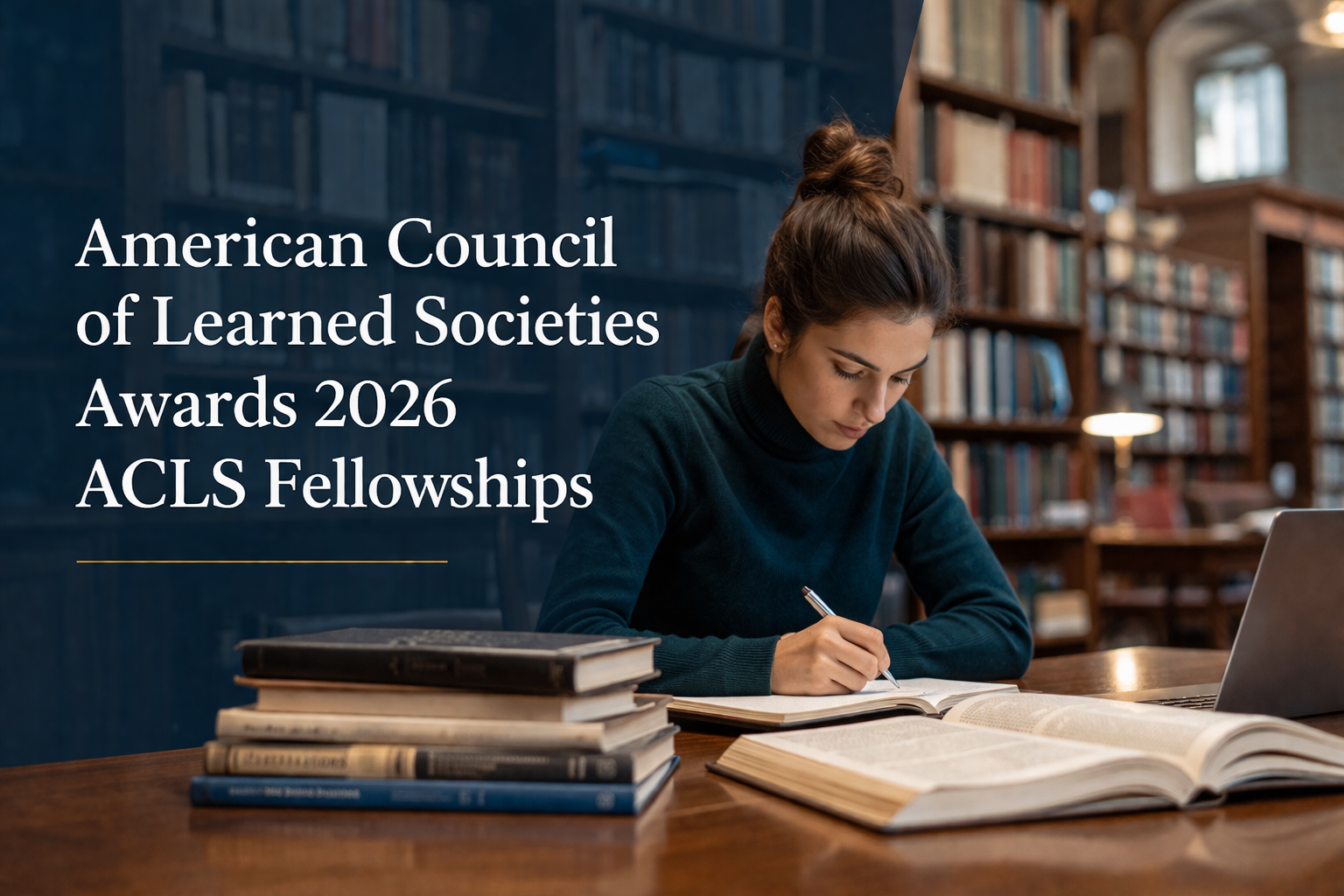
In this guide, we are going to walk you through everything related to the American Council of Learned Societies Awards 2026 ACLS Fellowships. We will cover what ACLS is, what the fellowship offers, who is eligible, what the selection process looks like, what disciplines are supported, and how you can position yourself as a strong applicant the next time applications open. Let us get into it.
What Is the American Council of Learned Societies (ACLS)?
Before diving into the fellowship itself, it helps to understand the organization behind it. The American Council of Learned Societies is a nonprofit federation of 81 scholarly organizations. It has been around for over a century and stands as the leading representative of American scholarship in the humanities and social sciences. ACLS operates on the core belief that knowledge is a public good, and it channels that belief into practical support for scholars at all stages of their careers.
In 2026, ACLS is celebrating 100 years of grantmaking, which makes this particular fellowship cycle a historic one. The ACLS Fellowship Program is the organization’s longest-running program, and it has consistently supported some of the most significant scholarly work produced in the United States over the past century.
ACLS is not a government body. It is funded through its endowment, institutional members, and a range of generous donors and foundations. This independence gives it the flexibility to support scholarship across a wide spectrum of disciplines without being tied to narrow policy priorities.
The 2026 ACLS Fellowships: What Was Just Announced
On April 16, 2026, ACLS officially announced the 2026 ACLS Fellows. This is a big deal for the humanities community. Here are the key highlights from this year’s announcement:
This year’s program awarded more than $3.5 million to 63 scholars across a range of fields. These scholars were selected from a pool of over 2,000 applicants through a competitive, multi-stage peer review process. The 2026 fellows come from public and private research universities, liberal arts colleges, community colleges, and even a museum, which reflects just how broad the fellowship’s reach really is.
More than half of the 2026 ACLS Fellows are either early-career scholars or scholars who do not hold tenure-track faculty appointments. That is an important detail. It signals that ACLS is intentionally investing in scholars who are often overlooked by traditional academic funding structures, including adjunct faculty, independent scholars, and those in teaching-intensive roles.
ACLS President Joy Connolly captured the spirit of the program in her remarks about this year’s fellows. She pointed out that deep understanding of humanity does not come out of nowhere. It rests on the work of generations of scholars who simply need time to do research and develop their arguments. The fellowship exists to create that time.
Fellowship Benefits and Stipend Details
Now let us talk about what the fellowship actually provides, because the financial support here is substantial.
Core Stipend
The fellowship stipend is set at $60,000 for a 12-month fellowship. If you take the fellowship for a shorter period, the award is prorated at $5,000 per month, with a minimum award of $30,000. So even a six-month fellowship comes with $30,000 in support, which gives you serious runway to focus entirely on your research without financial pressure.
Additional Supplements for Non-Traditional Scholars
This is one of the things that makes the ACLS Fellowship genuinely different from many other academic grants. ACLS provides award supplements of between $3,000 and $6,000 specifically for independent scholars, adjunct faculty, and faculty in teaching-intensive roles. This extra money can go toward research support, attendance at scholarly conferences, manuscript development workshops, health insurance, or even child and elder care costs during the fellowship term. That kind of practical support matters enormously for scholars who are already stretched thin.
Residential Fellowship Option at the New York Public Library
There is also a special residential fellowship track available through a partnership with the New York Public Library’s Dorothy and Lewis B. Cullman Center for Scholars and Writers. Fellows accepted into this track receive a stipend of $90,000 and are required to be in residence from September 2026 through May 2027. They get individual office space within the Stephen A. Schwarzman Building and access to one of the world’s great research library collections. This is a separate application with its own deadline, so scholars interested in this track need to plan ahead carefully.
Fellowship Tenure and Portability
The fellowship tenure can begin no earlier than July 1, 2026, and must conclude no later than December 31, 2027. Fellowships can run anywhere from six to twelve months. The awards are portable, meaning you are not required to be at a specific institution or location to carry out your research. You can work at any site that is appropriate for your project. Six consecutive months of the fellowship must be taken together, but any remaining time within the award window can be taken separately.
Who Is Eligible for ACLS Fellowships?
Eligibility for the ACLS Fellowship is specific, so it is worth going through the requirements carefully to make sure you qualify before investing time in an application.
Citizenship and Residency
You must be a US citizen, a permanent resident, or fall into one of several other protected categories. This includes Indigenous individuals residing in the United States through rights associated with the Jay Treaty of 1794, DACA recipients, asylees, refugees, and individuals with Temporary Protected Status. Foreign nationals who have been living in the United States or US territories for three or more years before the application deadline are also eligible, as long as they do not establish permanent residence outside the US during the fellowship period.
Academic Degree
You need to have earned a PhD in the humanities or interpretive social sciences by the application deadline. If you are an established scholar without a PhD but can demonstrate an equivalent level of scholarly achievement through publications and professional experience, you may still qualify. The ACLS FAQ provides more detail on this alternative pathway.
Tenure-Track Faculty Requirements
If you hold a tenure-track position at the time of application, whether tenured or untenured, there is an additional requirement. You must have had a gap of at least two years between the end of your last supported research leave of a semester or more and September 1, 2026. A “supported research leave” is defined as the equivalent of one semester or more of time away from teaching or administrative work, supported by sabbatical pay, institutional funding, fellowships, or grants.
What Projects Are Supported?
The ultimate goal of your project must be a major piece of scholarly work. This can take the form of a monograph, peer-reviewed articles, a publicly engaged humanities project, a digital research project, a critical edition, or other scholarly resources. Projects at any stage of development are welcome. ACLS does not fund works of fiction, textbooks, straightforward translation without significant scholarly apparatus, or projects that are primarily pedagogical in focus.
What Disciplines Qualify?
The ACLS Fellowship covers a genuinely wide range of humanistic and interpretive social science disciplines. Here is a look at the fields that are eligible:
American studies, anthropology, archaeology, art and architectural history, classics, economics, ethnic studies, film studies, gender studies, geography, history, languages and literatures, legal studies, linguistics, musicology, philosophy, political science, religious studies, rhetoric and communication, media studies, sociology, and theater, dance, and performance studies are all eligible. Interdisciplinary and cross-disciplinary humanistic work is also welcome. Psychology PhDs are eligible only if the degree focuses on the history of psychology or environmental psychology.
ACLS actively invites applications from scholars working on topics grounded in any time period, any world region, and any humanistic methodology. The organization aims to fund fellows who represent the full variety of humanistic scholarship, and it is committed to inclusive excellence, which it defines as academic excellence enriched by a plurality of backgrounds, experiences, and perspectives.
How Does the Selection Process Work?
The selection process is rigorous and multi-stage, which is part of what makes an ACLS Fellowship so meaningful on a CV. Here is how it works.
Applications first go through a disciplinary review, where scholars working in your specific field read and score your proposal. Top-scoring applications then move to a multi-disciplinary panel of scholars who evaluate finalists across career stages and across a range of humanistic disciplines. This means your proposal has to be compelling not just to specialists in your area but to scholars from across the humanities.
Reviewers evaluate proposals on five key criteria: the potential of the project to advance the field and make an original and significant contribution to knowledge, the quality of the research design, the applicant’s record of scholarly achievement, the clarity and quality of the proposal itself, and the feasibility of the proposed work plan. All eligible applications are evaluated on these criteria without regard to race, ethnicity, gender, or any other protected characteristic.
What Does the Application Include?
For the 2025-26 competition cycle, which produced the 2026 fellows, the application required the following components:
A completed application form submitted through the ACLS online fellowship and grant administration system. A research proposal of no more than five pages, double spaced, in Arial or Helvetica 11-point font, including any footnotes or endnotes. Optional supporting materials of up to two additional pages, which could include images, musical scores, or similar non-text materials. A work plan of no more than one page that clearly outlines the work to be done during the fellowship term and how it fits into the broader trajectory of the project. A bibliography. A writing sample. Letters of reference.
The work plan is particularly important. Reviewers want to see which aspects of the project you will tackle during the fellowship period and in what order. A vague plan will not serve you as well as a concrete, realistic timeline that shows you have thought through the logistics of your research.
Other ACLS Fellowship Programs to Know About
The flagship ACLS Fellowship is not the only program ACLS runs. There are several related programs that scholars in different situations should be aware of.
ACLS HBCU Faculty Fellowship and Grant Program
In April 2026, ACLS also announced 20 awards through its HBCU Faculty Fellowship and Grant Program, which supports exceptional research by faculty at Historically Black Colleges and Universities. Eight fellows received up to $50,000 each to support long-term research projects, while twelve grantees received up to $10,000 each for project development and smaller-scale research. This year’s awards went to faculty at 18 different HBCUs across the country. The program also provides a $2,500 grant to each awardee’s home institution to support humanities programming or infrastructure.
Luce/ACLS Dissertation Fellowships in American Art
Supported by the Henry Luce Foundation, this program has been running since 1992 and has funded more than 300 scholars. The 2026 Luce/ACLS Dissertation Fellows each received $43,500 to support one year of research and writing as well as fellowship-related travel between July 2026 and May 2027. This fellowship is specifically for dissertation research on the history of visual arts of the United States, including Native American art.
ACLS Leading Edge Fellowships
The Leading Edge Fellowship is designed for recent humanities PhDs who want to apply their scholarly skills in the nonprofit sector. In 2026, the program offered 14 two-year fellowship opportunities with mission-driven nonprofit organizations. For remote positions, fellows earn $70,000 in year one and $72,000 in year two. For in-person positions, the stipend is $72,000 in year one and $74,000 in year two. Fellows also have access to health insurance, professional development funding, and up to $5,000 in relocation support for in-person placements. This program is made possible through the support of the Mellon Foundation.
Tips for Applying to the Next ACLS Fellowship Cycle
If you are reading this after the 2025-26 competition has closed, do not be discouraged. The next competition cycle will open again, and you have time to prepare a genuinely strong application. Here are some practical things to keep in mind.
Start thinking about your proposal early. Five pages is not a lot of space to convey the significance of your research, the methodology you are using, and why your particular approach advances the field. Scholars who are used to writing long academic papers sometimes underestimate how much work it takes to make a concise, compelling proposal.
Pay close attention to the work plan requirement. ACLS wants to see that you have thought realistically about what you can accomplish in six to twelve months. A work plan that promises too much will raise red flags with reviewers. A work plan that is concrete, staged, and realistic signals that you are a serious and organized scholar.
Ask colleagues who have received ACLS Fellowships or similar grants to look at your proposal before you submit. Peer feedback at this stage is invaluable. You can also request reviewer feedback after the competition if your application was not selected. This can give you specific, actionable information to improve your next submission.
Make sure your citizenship or residency status clearly meets the eligibility criteria. If you are a foreign national who has been residing in the US for several years, double-check that you meet the three-year residency requirement and that your living situation during the fellowship period will not disqualify you.
If you are on a tenure track, track your research leaves carefully. The two-year gap requirement between your last supported research leave and the fellowship start date is a hard rule. If you have questions about how it applies to your situation, reach out to ACLS directly before investing time in a full application.
Why This Fellowship Matters for the Humanities
It is worth stepping back for a moment to think about why programs like the ACLS Fellowship are so important in the current academic climate. Humanities scholars face real structural challenges. Tenure-track positions have become increasingly scarce. Teaching loads at many institutions leave little room for sustained research. Funding for humanistic work is consistently harder to secure than funding in STEM fields.
The ACLS Fellowship pushes back against those pressures in a meaningful way. By providing scholars with six to twelve months of protected time and a substantial stipend, it makes it possible to do the kind of deep, sustained intellectual work that the humanities require. It also signals, to institutions and to society more broadly, that humanistic scholarship deserves serious investment.
The fact that more than half of the 2026 fellows are early-career scholars or scholars outside the tenure track is especially significant. These are the people who most need this kind of support, and ACLS is clearly prioritizing them.
ACLS at 100: A Century of Supporting Scholarship
The 2026 fellowship cycle is a milestone because ACLS is celebrating 100 years of grantmaking this year. Since its founding in 1919, ACLS has grown into a federation of 81 scholarly organizations representing virtually every corner of the humanities and interpretive social sciences. Over that century, it has funded thousands of scholars whose work has shaped how we understand history, language, culture, philosophy, religion, art, and so much more.
Reaching 100 years of grantmaking is not just a symbolic achievement. It is a reflection of sustained institutional commitment to the idea that deep humanistic scholarship is worth funding, year after year, regardless of shifting trends in higher education policy or public discourse. For scholars working in the humanities today, that kind of long-term institutional backing is genuinely rare, and it is part of what makes an ACLS Fellowship so significant.
How to Apply for the ACLS Fellowship
Applications for the ACLS Fellowship are submitted through the ACLS online system. The competition cycle for 2025-26 closed in September 2025, with notifications going out in April 2026. For the next cycle, applications are expected to open again in summer 2026, with a deadline likely in late September 2026. You should check the official ACLS website regularly for updates on the next competition cycle.
To apply or get full details about the program, visit the official ACLS Fellowship page using the link below.
Apply for the ACLS Fellowship on the Official ACLS Website
Final Thoughts
The American Council of Learned Societies Awards 2026 ACLS Fellowships represent one of the most competitive and prestigious funding opportunities available to humanities scholars in the United States. More than $3.5 million is going to 63 scholars this cycle, selected from over 2,000 applicants. If you are in the humanities or interpretive social sciences and you are looking for time and support to do serious scholarly work, this program should absolutely be on your radar.
Whether you are an early-career researcher just starting to build your scholarly profile, a mid-career scholar with a major book project in progress, or an independent scholar working outside the traditional academic structure, the ACLS Fellowship program has been designed with you in mind. The additional supplements for adjunct faculty and independent scholars, the portability of the award, and the flexibility of the tenure window all reflect an organization that genuinely understands the realities of scholarly life today.
Keep an eye on the official ACLS website for updates on the next competition cycle. When applications open, use the guidance in this article to prepare a strong, competitive proposal. And if you want to explore other global scholarship and fellowship opportunities, browse the rest of our blog where we regularly cover funding programs for scholars, students, and researchers around the world.