
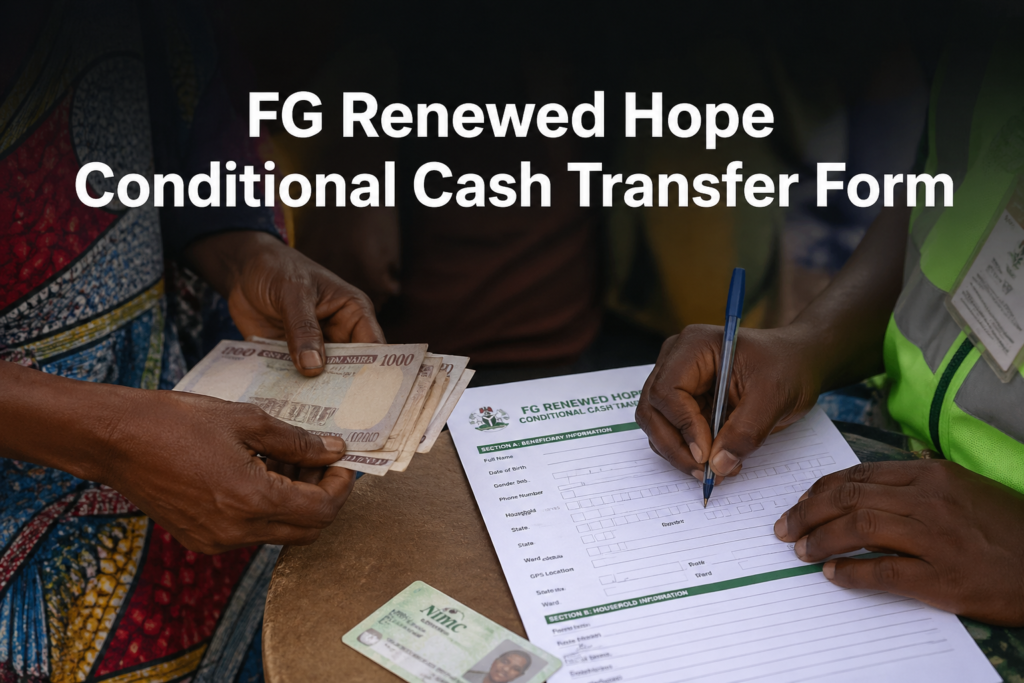
If you are a Nigerian living in a low-income household and you have been hearing about the Federal Government’s Renewed Hope Conditional Cash Transfer (RH-CCT) program, you are in the right place. This article will walk you through everything you need to know about the FG Renewed Hope Conditional Cash Transfer Form, how the registration process works, who qualifies, how much money is involved, and what steps to take right now if you want to benefit from this initiative.

The Federal Government of Nigeria, under President Bola Ahmed Tinubu’s Renewed Hope Agenda, launched this program to provide direct financial relief to the most vulnerable households across all 36 states and the Federal Capital Territory. Whether you live in a rural village, a semi-urban settlement, or a struggling urban area, this program was designed with you in mind.
Let us break everything down so you clearly understand how the program works and what you need to do.
What Is the FG Renewed Hope Conditional Cash Transfer Program?
The Renewed Hope Conditional Cash Transfer, commonly referred to as RH-CCT, is a social welfare initiative launched by the Federal Government of Nigeria as part of President Tinubu’s broader Renewed Hope Agenda. The program is designed to cushion the economic hardship facing poor and vulnerable Nigerian households, especially following the removal of the fuel subsidy and the resulting rise in the cost of living.
The program is managed and implemented through the National Social Investment Programme Agency (NSIPA), specifically through its National Cash Transfer Office (NCTO). It works in coordination with the National Social Safety Nets Coordinating Office (NASSCO), which is responsible for maintaining the National Social Register (NSR), the official database of poor and vulnerable households in Nigeria.
According to official government releases, the Renewed Hope CCT program targets approximately 15 million vulnerable households across the country, reaching an estimated 62 million Nigerians in total. Eligible beneficiaries receive a monthly payment of N25,000, with payments typically made over a three-month period, giving each household a total of N75,000.
The payments are made directly into beneficiaries’ bank accounts or through government-issued ATM cards, making the disbursement process more transparent and reducing the risk of leakages or fraud that plagued earlier versions of the program.
Background: Why Was This Program Created?
Nigeria has faced serious economic challenges in recent years. The removal of the fuel subsidy in 2023 led to a sharp increase in transportation costs, food prices, and the general cost of living. Low-income families were hit hardest, and the government recognized the urgent need to provide a cushion for the most vulnerable segments of the population.
President Tinubu announced this initiative as part of his Renewed Hope Agenda, which was introduced during his Independence Day speech on October 1, 2023. The Renewed Hope CCT program officially launched on October 17, 2023, as a direct response to the economic pressures that followed the subsidy removal.
The program is not entirely new. Nigeria has had a Conditional Cash Transfer scheme since 2016, when the National Social Safety Nets Coordinating Office (NASSCO) was established in partnership with the World Bank to improve Nigeria’s social protection system. That partnership involved a $500 million credit from the World Bank, later followed by an $800 million scale-up. The current Renewed Hope CCT builds on that foundation but with stronger transparency measures, including the mandatory use of National Identification Numbers (NIN) and Bank Verification Numbers (BVN) to verify beneficiaries.
Who Is Behind the Program? Key Agencies to Know
Understanding who runs the program will help you know where to go if you have questions or need assistance. Here are the key agencies involved:
National Social Investment Programme Agency (NSIPA)
NSIPA is the umbrella agency that oversees all social investment programs in Nigeria. It was established in 2015 and given formal legal backing through the NSIPA Act of 2022. NSIPA manages six core programs, including the Conditional Cash Transfer, N-Power, the National Home-Grown School Feeding Programme (NHGSFP), the Government Enterprise and Empowerment Programme (GEEP), the Vulnerable Group Fund (GVG), and NASSCO.
National Cash Transfer Office (NCTO)
The NCTO is the department within NSIPA responsible specifically for the implementation of the Conditional Cash Transfer program. It handles the selection, enrollment, payment processing, and monitoring of CCT beneficiaries.
National Social Safety Nets Coordinating Office (NASSCO)
NASSCO is responsible for building and maintaining the National Social Register (NSR), which is the master database of poor and vulnerable households in Nigeria. NASSCO was established in 2016 with World Bank support and currently has data on over 68 million poor and vulnerable individuals, covering approximately 19 million households across the 36 states and FCT.
State Cash Transfer Units (SCTUs)
Each state has its own State Cash Transfer Unit that works with the federal agencies to coordinate registration, enumeration, and disbursement activities at the local level. If you want to find out about the program in your state, the SCTU in your State Ministry of Economic Planning or Social Welfare is the right place to start.
Who Qualifies for the Renewed Hope Conditional Cash Transfer?
One of the most common questions people ask is about eligibility. Not every Nigerian household qualifies automatically. The program specifically targets households that meet certain criteria. Here is what you need to know about who qualifies:
1. Households Listed in the National Social Register (NSR)
The primary requirement for receiving the RH-CCT is that your household must be listed in the National Social Register. This register was built through a process called Community-Based Targeting (CBT), where state officials, local government authorities, and community leaders worked together to identify and document poor and vulnerable households in each community.
If your household is already on the NSR, you have a higher chance of being selected for the CCT program. If you are not on the register, you will need to contact your Local Government Area (LGA) social protection office to find out if enrollment is open in your area.
2. Poor and Vulnerable Households
The program specifically targets households living in extreme poverty or those that are vulnerable due to factors such as unemployment, disability, old age, illness, or being headed by a single parent or widow. Families with young children, especially those not currently accessing education or healthcare, are also prioritized.
3. Valid NIN and Active Bank Account
A major requirement introduced under the Renewed Hope Agenda is that all beneficiaries must have a valid National Identification Number (NIN) and a Bank Verification Number (BVN). The Federal Government made this mandatory to ensure transparency and to prevent fraud. If you do not have a NIN, you should visit a NIMC enrollment center to get one before applying.
4. Households Not Yet Receiving Other Major Government Benefits
The program is designed to reach those who are not already receiving significant support from other government social protection programs. However, in some cases, households may benefit from multiple programs depending on their situation.
5. Rapid Response Register (RRR) Beneficiaries
In addition to the main National Social Register, the Federal Government introduced the Rapid Response Register (RRR) in more recent phases of the program. The RRR targets individuals in urban and semi-urban areas who have been affected by economic shocks, emergencies, or displacement. If you live in a city and have been economically displaced, you may qualify through the RRR pathway.
How Much Money Do Beneficiaries Receive?
Each qualifying household receives N25,000 per month under the Renewed Hope CCT program. This payment is typically made over three months, meaning a total disbursement of N75,000 per household per cycle.
Payments are made directly into the beneficiary’s bank account or through a government-issued ATM card linked to their account. The Federal Government has confirmed that no cash is distributed by hand, and all transactions are digital to maintain accountability and reduce the chances of corruption.
As of late 2024, the Federal Government released over N10.2 billion to 411,292 households across all 36 states and the FCT in a single tranche. In a subsequent disbursement, the total amount grew to N24.78 billion, reaching 991,261 households nationwide. These figures show that the program is being scaled up rapidly and that more Nigerians are being added to the beneficiary list with each new cycle.
Understanding the FG Renewed Hope Conditional Cash Transfer Form
There is a lot of confusion online about the FG Renewed Hope Conditional Cash Transfer Form. Many people are searching for a downloadable PDF form or an online portal where they can fill out their application. Here is what you actually need to know.
Unlike some other government programs, the Renewed Hope CCT does not operate through a standard online application portal where you simply log in and submit your details. The enrollment process is done through community-based enumeration and registration, which means officials come to your community, ward, or local government area to collect your data and register your household.
However, some states and implementing agencies do publish registration forms and portal links through official government websites. Here is how the process generally works:
Step 1: Check If Your State Is Running an Active Enrollment
The first thing you should do is find out if your state is currently running an active CCT registration or update exercise. You can do this by visiting the official NSIPA website, your state’s Ministry of Economic Planning, or checking for announcements from the NASSCO office.
Step 2: Visit Your LGA Social Protection Office
Go to your Local Government Area office and ask for the department that handles social welfare or the National Social Investment Program. They will tell you if there is ongoing enrollment in your ward and whether your household can be added to the National Social Register.
Step 3: Connect With Enumerators in Your Community
Enumerators are government-authorized field officers who visit communities to register eligible households. You can reach them through local authorities, your traditional ruler’s palace, ward development committees, or your LGA office. When enumerators visit your area, they will collect your personal information, household composition, income level, and living conditions.
Step 4: Provide Required Documents
During the registration exercise, you will need to provide the following documents:
- National Identification Number (NIN)
- Bank Verification Number (BVN)
- Active bank account details
- Registered phone number
- Voters card or other valid ID (as supporting identification)
Step 5: Wait for Verification and Approval
After registering, your information will be verified by officials to confirm your eligibility. This process can take several weeks. If approved, your name will be added to the National Social Register and you will eventually receive a payment notification via SMS or a bank credit alert.
Step 6: Collect Your ATM Card (If Applicable)
In some states, beneficiaries are issued government ATM cards linked to their accounts instead of having funds credited directly to an existing bank account. If you receive an SMS alert to come and collect an ATM card, visit the designated distribution center in your state with your NIN, BVN, and registered phone number for verification and card activation.
How to Apply Online (For States With Online Portal Access)
For states or phases of the program that do support online registration through government portals, the general process works as follows. Start by visiting the official NSIPA website or your state’s social protection portal. Look for any active registration links under the Renewed Hope or Conditional Cash Transfer sections. Fill in the online form with your personal details, including your NIN, BVN, phone number, and household information. Upload any required documents as specified on the portal. Submit your application and note the reference number or tracking ID provided after submission. Log back in periodically to check the status of your application.
You can also check the official NSIPA portal for registration updates by visiting the NSIPA official website. For the National Cash Transfer Office specifically, you can access enrollment and payment information at the NCTO official website.
What to Do If You Are Not Already on the National Social Register
If your household is not already captured in the National Social Register, do not panic. The government is continuously expanding the register to include more households, especially as new enrollment exercises are rolled out in states across the country.
Here are the steps you can take to get your household included in the NSR:
First, visit your nearest LGA office and ask specifically for the social protection or NASSCO desk. Explain that you want your household to be included in the National Social Register. They will guide you on the next steps and let you know if there is an ongoing or upcoming community enumeration exercise in your area.
Second, get your NIN sorted out as soon as possible. The Federal Government has made it clear that no household can be added to or retained on the National Social Register without a valid NIN. Visit a National Identity Management Commission (NIMC) enrollment center in your LGA to get your NIN if you do not already have one. It is free to enroll.
Third, make sure you have an active bank account in your name, linked to your BVN. If you do not have a bank account, you can open a basic savings account at any commercial bank or microfinance bank with your NIN and a passport photograph. Some government programs also work with mobile money operators.
Fourth, stay connected to your community. Many registration exercises are announced at the ward level through community leaders, traditional rulers, and religious institutions. Make sure local leaders know you are interested in being included so they can inform you when enumerators visit.
How Payments Are Made
One of the biggest improvements under the Renewed Hope CCT compared to earlier programs is the use of digital payment channels. Here is how payments reach beneficiaries:
Direct Bank Transfer
If you have an active bank account registered with your BVN and linked to your profile on the National Social Register, payments will be credited directly to your account. Beneficiaries have confirmed receiving bank alerts with the description “National Social Investment / Renewed Hope CCT” along with the credit of N25,000.
Government-Issued ATM Cards
In some states and distribution cycles, the NCTO distributes government-issued ATM cards to beneficiaries who may not have existing bank accounts or who need a dedicated card for receiving payments. These cards are activated at distribution centers after identity verification with NIN and BVN.
Financial Service Providers
The Federal Government works with designated Financial Service Providers (FSPs) to process payments. These include licensed banks and mobile money operators. When a payment cycle is initiated, the FSP routes the N25,000 payment to each verified beneficiary’s designated account.
Common Scams to Watch Out For
As with many government benefit programs, the Renewed Hope CCT has attracted its share of fraudulent actors. You need to protect yourself from scammers. Here are some red flags to watch out for:
No one should ever ask you to pay a fee to register for the CCT program. Registration is completely free. If anyone online, in person, or via SMS asks you to pay any amount, whether it is N500, N1,000, N3,500, or more, to register or collect your payment, it is a scam.
Do not trust websites that claim to have a special “portal” for N75,000 or higher cash transfer amounts that are not officially announced by the government. Many fake websites copy the government’s branding and logos to look legitimate.