
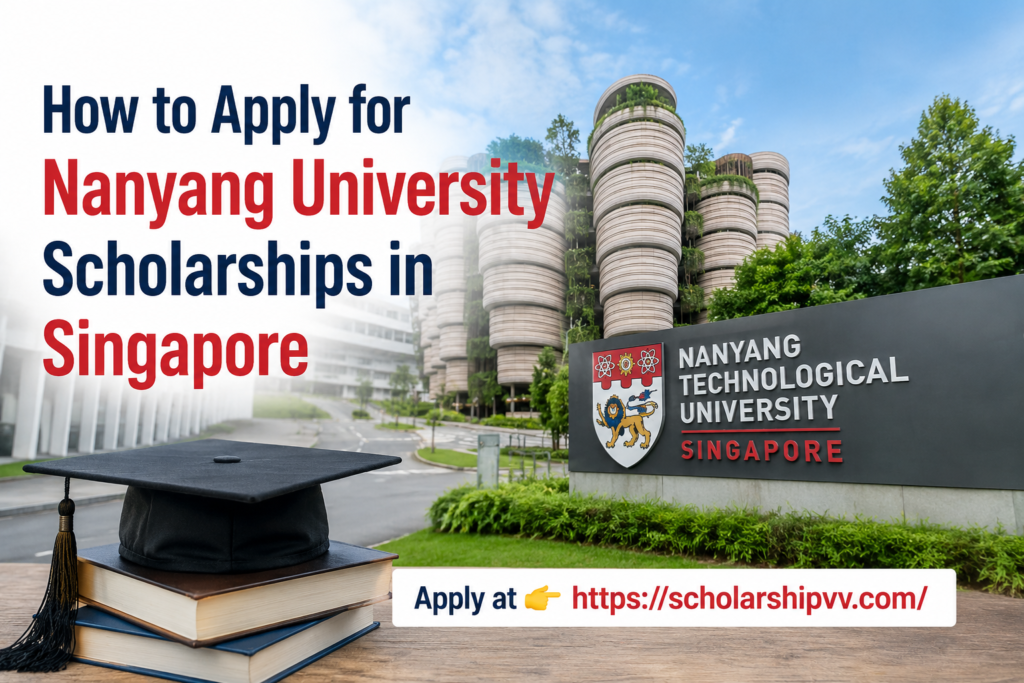
Singapore has become one of the most desirable study destinations in Asia, and if you are planning to pursue your undergraduate, master’s, or PhD degree there, Nanyang Technological University is a name you simply cannot ignore. Popularly known as NTU, this world-class institution consistently ranks among the top 20 universities globally in the QS World University Rankings and is recognized as one of the best research universities in Asia. The good news for international students is that NTU offers a wide range of generous, fully funded scholarships that cover tuition fees, living expenses, housing, and more. If you have been wondering how to go about applying for NTU scholarships in Singapore for 2026, this article breaks down everything you need to know, from the available scholarship types to the step-by-step application process.
About Nanyang Technological University (NTU), Singapore

Nanyang Technological University was founded in 1981 and is located in the western part of Singapore on a lush green campus that spans over 200 hectares. It is a publicly funded research university and one of only two universities in Singapore to consistently place in the global top 20. NTU is home to more than 33,000 students from over 100 countries, making it a genuinely multicultural academic community.
The university is organized into several colleges and schools covering engineering, science, business, humanities, arts and social sciences, education, and medicine. Its research output is internationally recognized, and it has strong partnerships with industry leaders, government agencies, and universities around the world. For international students, NTU offers a supportive and well-resourced environment, with state-of-the-art laboratories, an extensive library network, on-campus housing, and a vibrant student life.
Singapore itself is a significant draw. It is one of the safest countries in the world, with a highly efficient public transport system, a strong economy, low taxes, and a strategic location at the heart of Southeast Asia. Many scholarship recipients cite the combination of NTU’s academic quality and Singapore’s quality of life as the key reasons they chose to apply.
Overview of NTU Scholarships for 2026
NTU offers scholarships at three academic levels: undergraduate (bachelor’s degree), graduate (master’s and PhD by research), and doctoral. For international students, the most prominent and well-funded scholarships are the Nanyang Scholarship for undergraduates, the Nanyang President’s Graduate Scholarship (NPGS) for PhD candidates, the NTU Research Scholarship for graduate research students, and the Singapore International Graduate Award (SINGA) for PhD students funded by the Singapore government through the Agency for Science, Technology and Research (A*STAR).
Each of these scholarships has its own eligibility requirements, financial package, and application process. Understanding the differences will help you identify which scholarship is the right fit for your academic level and goals. Below is a summary table covering the key scholarships available at NTU for 2026.
| Scholarship Name | Level | Open to International Students | Key Financial Benefits | Application Deadline (2026) |
|---|---|---|---|---|
| Nanyang Scholarship | Undergraduate (Bachelor’s) | Yes | Full tuition, S$6,500/year living allowance, S$2,000 accommodation, S$8,000 travel grant, S$2,000 computer allowance | January 15, 2026 (closes March 19, 2026 for some qualifications) |
| Nanyang President’s Graduate Scholarship (NPGS) | PhD (Doctoral) | Yes (all nationalities) | Full tuition, monthly stipend of S$3,000, conference allowance up to S$4,000/year, IT allowance, campus accommodation priority | November 1 to December 31, 2025 (Aug 2026 intake); June 1 to July 31, 2026 (Jan 2027 intake) |
| NTU Research Scholarship (RSS) | Master’s and PhD by Research | Yes | Full tuition, monthly stipend of S$2,000 (international), up to S$2,500 after qualifying exam | Apply with admission application (rolling basis) |
| Singapore International Graduate Award (SINGA) | PhD by Research | Yes (international students only) | Full tuition, monthly stipend of S$2,000 (rising after qualifying exam), settling-in allowance, airfare grant | December 1, 2025 (for August 2026 intake) |
| Nanyang Business School (NBS) MBA Scholarship | MBA (Postgraduate) | Yes (admitted students) | Partial to full tuition fee coverage; merit and financial need-based | Varies by MBA application round |
| Renaissance Engineering Programme Scholarship (REPS) | Undergraduate (Engineering) | Yes | Full funding; leadership and professional development components | Concurrent with NTU undergraduate admission |
Scholarship 1: The Nanyang Scholarship (Undergraduate)
The Nanyang Scholarship is NTU’s flagship award for undergraduate students and is arguably one of the most generous undergraduate scholarships in Asia. It is open to both Singaporean and international students who are applying for a full-time undergraduate degree program at NTU for the 2026/2027 academic year.
What the Nanyang Scholarship Covers
The financial package for the Nanyang Scholarship is comprehensive. Successful recipients receive full coverage of subsidized tuition fees for the entire normal duration of their undergraduate program. On top of that, they receive a living allowance of S$6,500 per academic year. Students who reside in NTU hostels also receive an accommodation allowance of up to S$2,000 per academic year. There is a one-time travel grant of up to S$8,000 for participation in an overseas program, subject to the terms and conditions in the Travel Grant Form. A one-time computer allowance of S$2,000 is also provided.
There is no bond attached to the Nanyang Scholarship itself, aside from the standard three-year bond applicable to all Singapore permanent residents and international students under the Ministry of Education (MOE) Tuition Grant Scheme. This means that after graduating, international scholarship holders are required to work for a Singapore-registered company for three years.
Eligibility for the Nanyang Scholarship
To be considered for the Nanyang Scholarship, applicants must possess excellent results in qualifications such as the Singapore-Cambridge GCE A-level, International Baccalaureate (IB) Diploma, NUS High School Diploma, Polytechnic Diploma from a Singapore polytechnic, or Year 12 equivalent qualifications from their home country. Beyond academic achievement, the scholarship places significant emphasis on co-curricular activities, leadership qualities, and community involvement. Students must apply for a full-time undergraduate degree program at NTU and be either Singaporean or an international student applying for the 2026/2027 intake.
Note that the scholarship is awarded on a competitive basis among shortlisted candidates. Simply meeting the minimum academic requirements does not guarantee a scholarship offer. The review process considers the whole student, including their extracurricular record and demonstrated leadership potential.
Important Conditions
Scholarship holders are required to take on the role of student ambassador or a similar representative role, participating in publicity talks or hosting guests on behalf of the university. The scholarship may be withdrawn if a holder’s academic progress or behavior is deemed unsatisfactory. If a scholarship holder decides to terminate the scholarship before completion, they will be required to repay the benefits received.
Scholarship 2: Nanyang President’s Graduate Scholarship (NPGS)
The Nanyang President’s Graduate Scholarship, commonly referred to as the NPGS, is NTU’s most prestigious scholarship for doctoral candidates. It is designed specifically for final-year undergraduate students or recent graduates who aspire to build a career in research by pursuing a full-time PhD at NTU. The scholarship is named after and awarded by the President of NTU, which gives you a sense of how selective and distinguished it is.
What the NPGS Covers
The NPGS provides a comprehensive financial package. Recipients receive full coverage of annual tuition fees. In addition, they receive a monthly stipend of S$3,000 throughout the scholarship period. A conference allowance of up to S$4,000 per financial year is available for scholars to present their research at international conferences. There is also an IT allowance, and priority is given for campus accommodation. Singaporean citizens who hold the NPGS also receive Central Provident Fund (CPF) contributions from the university on top of the monthly stipend.
International NPGS holders are required to perform teaching and laboratory supervision duties as part of the Graduate Assistantship Programme (GAP). This is not a punitive requirement but rather a structured opportunity for doctoral candidates to develop their skills in academic instruction and laboratory management, which is valuable for those who wish to pursue careers in academia.
Eligibility for the NPGS
The NPGS is open to applicants of all nationalities, although preference may be given to Singapore citizens and permanent residents. Academically, applicants must hold, or be on track to receive, a First Class Honours degree, or equivalent, at the bachelor’s level. If you have not yet completed your undergraduate degree, you will need to provide documentation from your university confirming that you are expected to graduate with the highest academic distinction.
Beyond academic excellence, the NPGS selection process looks for demonstrated research potential and leadership qualities. The scholarship is highly competitive, and simply having a First Class Honours degree is the minimum bar rather than a guarantee of success. Shortlisted candidates are invited for interviews and may be asked to present their research interests or submit additional assessment materials.
Duration and Renewal
The NPGS is initially awarded for one year and is renewable annually, subject to satisfactory academic progress and research performance. The maximum duration of the award is four years for PhD candidates. This annual renewal structure means that staying on top of your research output and maintaining a strong working relationship with your supervisor is essential throughout the fellowship period.
Application Windows for the NPGS (2026)
For the August 2026 intake, applications opened from November 1, 2025, to December 31, 2025. For the January 2027 intake, the application window runs from June 1, 2026, to July 31, 2026. For applicants to the National Institute of Education (NIE), different application periods apply, so it is important to check the specific NIE deadlines separately.
Scholarship 3: NTU Research Scholarship (RSS)
The NTU Research Scholarship, known as the RSS, is a graduate-level scholarship available to both master’s and PhD students pursuing research degrees at NTU. Unlike the NPGS, which is a highly selective presidential award for doctoral candidates only, the RSS is a broader scholarship that is widely offered across NTU’s schools and research programs.
What the RSS Covers
The NTU Research Scholarship covers annual tuition fees and provides a monthly stipend. For international students, the initial monthly stipend is S$2,000, which can be increased by up to S$500 per month after the scholar passes the PhD Qualifying Examination or Confirmation. The scholarship is tenable for up to two years for master’s students and up to four years for PhD candidates, subject to satisfactory academic progress and the availability of research funding within the relevant school.
International students holding the RSS are also required to fulfill the Graduate Assistantship Programme duties, which include teaching and laboratory supervision. Singaporean citizens receive CPF contributions on top of the monthly stipend.
How to Apply for the RSS
To be considered for the NTU Research Scholarship, applicants must indicate their interest in the scholarship when completing their application for admission to a graduate research program at NTU. There is no separate scholarship application form for the RSS. Successful candidates are informed of their scholarship offer together with their admission offer. The application process is rolling, meaning there is no single fixed annual deadline, though most graduate admissions take place in two main intakes: August (semester one) and January (semester two).
Scholarship 4: Singapore International Graduate Award (SINGA)
The Singapore International Graduate Award, commonly known as SINGA, is a government-funded scholarship jointly administered by the Agency for Science, Technology and Research (A*STAR), Nanyang Technological University (NTU), the National University of Singapore (NUS), and Singapore University of Technology and Design (SUTD). It is funded by the Singapore government specifically for international students and is only open to those who are not Singaporean citizens or permanent residents.
SINGA is designed to attract outstanding international students to pursue PhD research in Singapore’s top research institutions and universities. It is one of the most globally recognized graduate scholarships offered by any university in Asia.
What SINGA Covers
The SINGA scholarship covers full tuition fees for the duration of the PhD program. International scholars receive an initial monthly stipend of S$2,000, which can increase after passing the PhD qualifying examinations. In addition to the monthly stipend, SINGA provides a one-time settling-in allowance to help scholars cover the costs of relocating to Singapore, as well as a one-time airfare grant to help cover the cost of the flight to Singapore.
Eligibility for SINGA
SINGA is exclusively for international students seeking admission as a full-time student for a PhD by research at a participating university, including NTU. Applicants must have completed, or be about to complete, a Bachelor’s or Master’s degree in Science or Engineering. A strong academic record is essential. Applicants who hold undergraduate degrees can apply directly for a PhD under the SINGA program without needing a prior master’s degree. Language proficiency tests such as GRE, IELTS, TOEFL, SAT, or GATE scores are generally not required at the time of application, which lowers one common barrier for international applicants from countries where access to these tests is limited.
SINGA Application Deadline
The application deadline for the August 2026 intake was December 1, 2025. Future intakes follow a similar timeline, so international students targeting the 2027 intake should begin monitoring the official SINGA and NTU admissions pages from around August or September 2026 to stay informed of the next application cycle opening.
Eligibility Requirements Across NTU Scholarships
While each scholarship has its own specific criteria, there are several general eligibility requirements that apply across most NTU scholarships for international students in 2026.
- For undergraduate scholarships: Completion of secondary education equivalent to 12 years of schooling, with outstanding academic results in qualifications such as A-levels, IB Diploma, or Year 12 equivalent. Evidence of leadership, co-curricular involvement, and community engagement is important.
- For master’s scholarships: A completed bachelor’s degree with honors, or equivalent, from a recognized university. A strong academic record is expected, and a minimum cumulative GPA of 3.5 or above is generally expected of scholarship holders throughout their studies.
- For PhD scholarships (NPGS, RSS, SINGA): A bachelor’s or master’s degree with excellent academic standing. For the NPGS specifically, a First Class Honours degree or equivalent is required. Demonstrated research aptitude, such as publications, research experience, or a strong research proposal, is a significant advantage.
- English proficiency is required for all programs. Non-native English speakers may need to provide IELTS or TOEFL scores, depending on the scholarship and program.
- All nationalities are eligible to apply unless otherwise specified (SINGA is open to international students only).
- Scholarship holders are not permitted to hold any other scholarship or financial award simultaneously without the university’s explicit permission.
Documents Required for NTU Scholarship Applications
The exact documents required may vary slightly depending on the scholarship and program level, but here is a comprehensive checklist of what most applicants will need to prepare:
- For undergraduate applicants: Copy of secondary school leaving certificate or equivalent (A-levels, IB Diploma, Year 12 results, or polytechnic diploma). Academic transcripts from all institutions attended. Proof of co-curricular activities and leadership roles. A passport-sized photograph. Valid passport copy.
- For master’s and PhD applicants: Academic transcripts of all completed degrees. Copy of your bachelor’s degree certificate (and master’s degree if applicable). For the NPGS specifically, documentation from your current university confirming you are on track to graduate with First Class Honours if you have not yet graduated. A detailed curriculum vitae or resume, generally no longer than two pages in PDF format. A statement of purpose or personal statement outlining your academic and research interests, career goals, and reasons for applying.
- Two to three letters of recommendation from academic supervisors or professors who can speak to your research ability and academic character.
- English language proficiency test results (IELTS or TOEFL), if applicable.
- A research proposal, for PhD applicants, describing the research problem you intend to investigate, the methodology you plan to use, and the expected contribution to your field.
- For SINGA applicants: Evidence that you have identified a potential supervisor at NTU who is willing to supervise your research. This is not always mandatory but strongly recommended, as it significantly strengthens your application.
How to Apply for NTU Scholarships in Singapore: Step-by-Step Guide
The application process for NTU scholarships is closely tied to the general university admissions process. Here is a practical, step-by-step walkthrough of how to apply.
Step 1: Choose Your Program and Scholarship
Before anything else, decide on the academic level (undergraduate, master’s, or PhD) and the specific program or field of study you want to pursue at NTU. Research the available programs on the NTU website and identify which scholarship you are eligible for and wish to apply for. If you are a final-year undergraduate applying for a PhD, you will want to look at the NPGS or SINGA. If you are an international student applying for an undergraduate degree, the Nanyang Scholarship is your primary target.
Step 2: Identify a Potential Research Supervisor (For Graduate Applicants)
For master’s and PhD applicants, it is highly recommended to reach out to a potential faculty supervisor at NTU before submitting your formal application. Browse the faculty profiles in your area of interest on the NTU school or department website, read their recent publications, and send a concise, professional email introducing yourself, briefly describing your research interests, and asking if they are accepting new students. Having a supervisor who has already expressed interest in your application is not always mandatory, but it can meaningfully strengthen your candidacy, especially for the NPGS and SINGA scholarships.
Step 3: Apply for NTU Admission Online
All applications to NTU, whether for undergraduate or graduate programs, are submitted online through NTU’s official admissions portal. You must apply for admission to your chosen program first. For undergraduate applicants, you will apply through the NTU undergraduate admissions system. For graduate applicants, you will apply through the NTU graduate admissions portal. During the admission application, there is a designated section where you indicate your interest in being considered for scholarship funding. For most NTU scholarships, the scholarship consideration is embedded within the admission application rather than being a completely separate process.
To begin your application, visit the NTU Admissions official page and select the appropriate application pathway based on your level of study.
Step 4: Indicate Your Scholarship Interest
Within the NTU admission application form, clearly indicate your interest in being considered for the relevant scholarship. For the Nanyang Scholarship (undergraduate), tick the scholarship interest box and upload all required supporting documents, including your academic transcripts, co-curricular records, and any other materials requested in the form.
For the NPGS, you apply for the scholarship at the same time as you apply for PhD admission. There is an online NPGS scholarship application form within the graduate admissions system. Make sure you complete this correctly and submit all required documents within the specified scholarship application window.
For the SINGA scholarship, there is a dedicated SINGA application portal managed by A*STAR, though applications are processed in coordination with NTU’s admissions system. Visit the official SINGA scholarship page on the A*STAR website for direct access to the SINGA application portal.
Step 5: Submit a Teacher or Academic Appraisal
For undergraduate scholarship applicants, after receiving your NTU application number, you are required to provide a link to a school teacher (who must not be a relative) who will complete an online appraisal form on your behalf. The teacher generally has up to seven days to submit this form, with a maximum extension of three weeks if necessary. Plan ahead and inform your referee well in advance so they have enough time to complete this step.
For graduate applicants, letters of recommendation from academic supervisors or professors are required. These are typically uploaded directly by the referee through the online application system after you provide their contact details.
Step 6: Shortlisting and Interview
Once applications are reviewed, shortlisted candidates are notified by email and invited to participate in a scholarship selection interview. For the Nanyang Scholarship, selection interviews typically take place between March and May. Only applicants shortlisted for an interview will be informed via email, usually by late May. Applicants who are not shortlisted do not receive individual notification emails.
For the NPGS, shortlisted candidates are invited for an interview and may be required to undergo additional assessment by the relevant school. Prepare to speak clearly and confidently about your research interests, your motivation for applying to NTU, and your long-term academic and professional goals.
Step 7: Await the Official Offer
Scholarship results for graduate programs are communicated together with the admission offer via email. For undergraduate scholarships, offer letters are sent after the interview stage. If you receive a scholarship offer from another institution before hearing back from NTU, it is good practice to contact the NTU scholarships office to inform them of your situation and ask about your timeline.
For any NTU scholarship inquiries, you can also contact NTU’s financial matters and scholarships office through the contact details available on the NTU Graduate Financial Matters and Scholarships page.
Why Choose NTU and Singapore for Your Studies?
Beyond the scholarship benefits, there are strong academic and practical reasons why NTU is worth pursuing. NTU is consistently ranked in the top 20 universities in the world according to QS World University Rankings, and it sits firmly in the top five in Asia. Its research output is internationally competitive, particularly in engineering, materials science, environmental science, artificial intelligence, and biomedical research.
Singapore is a city-state that punches far above its weight in terms of technology, innovation, and global connectivity. It is home to the Asia-Pacific headquarters of many of the world’s largest multinational companies, giving students and researchers unparalleled access to industry partnerships, internship opportunities, and post-graduation employment prospects. The government’s Smart Nation initiative has channeled significant investment into higher education, especially in STEM, sustainability, and digital innovation, which directly benefits NTU students through well-funded research programs and cutting-edge facilities.
From a practical standpoint, Singapore is one of the safest countries in the world to live in. The cost of living, while not cheap by regional standards, is offset for scholarship holders who receive generous living allowances and accommodation support. The country is also extremely well-connected internationally, with Changi Airport serving as one of the busiest and most awarded airports in the world.
Tips for a Strong NTU Scholarship Application
Given how competitive these scholarships are, especially the NPGS and SINGA, here are some honest and practical tips to help you put your best application forward.
- Start early. Scholarship application windows often close several months before the program start date. Missing a deadline by even a day means waiting an entire year for the next intake. Set calendar reminders and track deadlines carefully.
- Contact a potential supervisor before applying, especially for graduate scholarships. Supervisors who know your work and are expecting your application can advocate for you during the internal review process. A cold application with no prior supervisor contact is significantly weaker than one where a faculty member is already championing your candidacy.
- Write a specific, focused statement of purpose. Explain clearly what research problem you want to work on, why it matters, and why NTU is the right place to do it. Mention specific faculty members, research groups, or facilities that make NTU uniquely suited to your work. Generic statements that could have been sent to any university are easy for reviewers to spot and dismiss.
- Highlight research experience and output. If you have published papers, presented at conferences, completed a research thesis, or worked as a research assistant, make this visible and prominent in your application. For the NPGS especially, demonstrated research ability is the primary differentiator among academically strong candidates.
- Prepare thoroughly for the scholarship interview. Research NTU’s faculty, ongoing research projects, and recent achievements in your field. Be ready to discuss your proposed research in detail, explain your methodology, and articulate why you are the right person for the scholarship.
- Be honest and consistent. Make sure the information in your application form, CV, statement of purpose, and recommendation letters all align and present a coherent picture of who you are as a scholar. Inconsistencies are red flags for reviewers.
Frequently Asked Questions
Can I apply for more than one NTU scholarship at the same time?
In most cases, scholarship consideration for NTU-administered scholarships such as the Nanyang Scholarship, NPGS, and RSS is integrated into the admission application. However, you should not hold more than one scholarship simultaneously unless you have explicit permission from the university. If you are considering the SINGA in addition to other NTU scholarships, check the specific terms of each award carefully.