
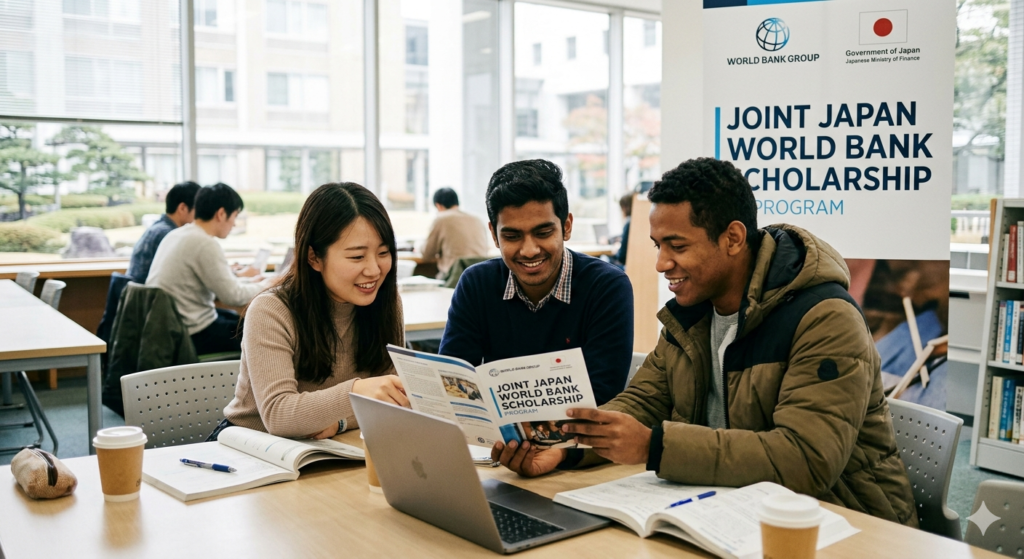
Joint Japan World Bank Scholarship: If you are a mid-career professional from a developing country who wants to pursue a fully funded master’s degree at one of the world’s best universities, the Joint Japan/World Bank Graduate Scholarship Program (JJ/WBGSP) could be the most important opportunity you apply for this year.

Jointly funded by the Government of Japan and the World Bank Group, this scholarship has been transforming careers and building development leadership in developing nations for nearly four decades. In 2026, the program continues to offer full financial support to qualified professionals who are committed to returning home after graduation and contributing to their country’s social and economic development.
This guide covers everything you need to know about the JJ/WBGSP in 2026. We will explain what the program is, its history, what it fully covers, the eligibility requirements, the participating universities, the fields of study supported, both application windows with their exact dates, how the selection process works, and practical tips to help you submit a competitive application. By the end of this article, you will have a clear picture of whether you qualify and exactly what steps to take to apply.
What Is the Joint Japan World Bank Graduate Scholarship Program?
The Joint Japan/World Bank Graduate Scholarship Program, commonly referred to as JJ/WBGSP, is a highly competitive, fully funded scholarship program designed specifically for mid-career professionals from eligible World Bank member developing countries. The program supports these professionals in pursuing a master’s degree in a development-related field at one of the program’s designated participating universities located in the United States, Europe, Africa, Oceania, and Japan.
The scholarship was established in 1987 as a joint initiative between the Government of Japan and the World Bank. Since its inception, the Government of Japan has contributed over US$204.7 million to fund the program. Over the past four decades, JJ/WBGSP has supported more than 7,000 mid-career professionals from approximately 160 developing countries, building a global alumni network of development practitioners who have gone on to hold senior positions in governments, international organizations, civil society, and the private sector across the developing world.
The program is administered by the World Bank’s Development Economics Vice Presidency (DEC) and is guided by a Steering Committee composed of members of the World Bank Board of Directors and World Bank management. This institutional backing gives the program a level of credibility and prestige that very few scholarship programs in the world can match.
The core philosophy behind JJ/WBGSP is straightforward. The program identifies talented, experienced development professionals from the developing world, funds their graduate education at world-class institutions, and expects them to return home after graduation to apply their new knowledge and skills toward solving real development challenges in their countries. It is not just a scholarship. It is an investment in the next generation of development leaders.
Why the JJ/WBGSP Stands Out Among Global Scholarships
There are thousands of scholarship programs available globally, but few combine the prestige, financial comprehension, institutional backing, and real-world development focus that JJ/WBGSP offers. Here is why this scholarship deserves special attention from any development-focused professional.
First, the scholarship is fully funded. It does not just pay for your tuition. It covers your return economy airfare, a monthly living stipend, medical insurance, and a travel allowance. The full benefits package means you can focus entirely on your studies without having to worry about finances during your program.
Second, the program places scholars at some of the most prestigious universities in the world. The list of 44 participating master’s programs in 24 universities spans institutions across the United States, Europe, Africa, Oceania, and Japan. These are not second-tier institutions. They include schools like Johns Hopkins University, Australian National University, Erasmus University Rotterdam, and many others that are globally ranked and deeply respected in their respective fields.
Third, JJ/WBGSP is designed specifically for people who already have professional experience and a track record of contributing to development. This means you are in a cohort of peers who are similarly experienced, motivated, and mission-driven. The collective intelligence and professional network you build during your scholarship is an asset that scholars consistently describe as one of the most valuable parts of the program, lasting well beyond the years of study.
Fourth, the program’s return obligation, while it may seem like a restriction, is actually one of its greatest features for serious development professionals. Knowing that your peers, classmates, and fellow alumni are all committed to going back and making a difference creates a culture of accountability and purpose that is genuinely rare in graduate school settings.
JJ/WBGSP 2026: Key Program Details at a Glance
Before diving into the full details, here is a quick snapshot of the most important facts about the JJ/WBGSP for the 2026 academic year.
The scholarship is funded by the Government of Japan and administered by the World Bank Group. It supports master’s degree programs only. No undergraduate, doctoral, or short course programs are included. The scholarship is available for 44 participating master’s programs at 24 universities across the US, Europe, Africa, Oceania, and Japan. It is open to nationals of eligible World Bank member developing countries. Two application windows are available depending on the start date of your chosen program. Application Window 1 ran from January 15 to February 27, 2026. Application Window 2 runs from March 30 to May 29, 2026. The scholarship covers tuition, a monthly living stipend, round-trip economy airfare, health insurance, and a travel allowance. Scholars are required to return to their home country immediately after completing their program and apply their knowledge toward national development priorities.
What the JJ/WBGSP Scholarship Covers in 2026
One of the most important questions any prospective scholarship applicant asks is: what exactly does this scholarship pay for? For JJ/WBGSP, the answer is comprehensive. Here is a detailed breakdown of every component of the scholarship package.
Round-Trip Economy Airfare
If you are not already attending your graduate program at the time of the scholarship award, JJ/WBGSP pays for one economy class air ticket from your home country to your host university at the start of the program. It also pays for one economy class air ticket from the host university back to your home country immediately following the end of the scholarship period. If you are already enrolled in your program when you receive the scholarship, the outbound airfare is not provided, but the return ticket is still covered.
In addition to the two-way economy class air travel, scholars receive a US$600 travel allowance for each trip, meaning you receive up to US$1,200 in total travel allowances across both journeys. This allowance is meant to cover incidental travel expenses such as ground transportation, baggage fees, and airport costs.
Tuition Fees
The scholarship covers the full tuition for your graduate program at the participating university to which you have been admitted and where you have been awarded the scholarship. The scholarship covers the duration of the graduate program or two years, whichever is less. If your program lasts longer than two years, you will need to fund the remaining period yourself or through other sources.
It is important to understand that the scholarship covers only tuition as defined by the university, which typically includes core course fees. Expenses related to research, supplementary educational materials, field trips, workshops, seminars, and internships are not covered. Educational equipment such as computers is also not part of the scholarship package.
Medical Insurance
The JJ/WBGSP pays the cost of basic medical insurance obtained through the host university. This is an important benefit because health coverage abroad can be extremely expensive, and having it built into the scholarship package removes a significant financial burden from scholars.
Monthly Living Stipend
Scholars receive a monthly living stipend for the duration of their scholarship period to cover day-to-day living expenses such as food, local transportation, and personal costs. The amount of the stipend varies depending on the cost of living in the host country and city where the university is located. While the specific stipend amounts are not published as a flat global rate, they are calibrated by the World Bank to be sufficient for a modest but comfortable standard of living in the host city.
What the Scholarship Does Not Cover
Being clear about what JJ/WBGSP does not cover is just as important as knowing what it does. The scholarship does not cover the cost of applying to the program, dependents or family members accompanying the scholar, research expenses, field trips, internships, workshops, supplementary courses outside the core curriculum, laptop or computer purchases, or any living expenses beyond the standard monthly stipend.
The scholarship also does not duplicate other sources of financial support. If you are awarded another scholarship or fellowship simultaneously, you must inform the JJ/WBGSP Secretariat and provide documentation of the other funding. The JJ/WBGSP scholarship may supplement but does not duplicate other awards.
Who Is Eligible for the JJ/WBGSP in 2026?
Eligibility for JJ/WBGSP is one of the most carefully defined aspects of the program. All eligibility criteria are strictly adhered to, and no exceptions are made. Here is a complete breakdown of the requirements for developing country nationals applying in 2026.
Nationality and Citizenship
You must be a national of a World Bank member developing country that is included on the JJ/WBGSP’s list of eligible countries. For 2026, the eligible country list includes 96 developing nations across Africa, Asia, Latin America, the Middle East, and Oceania. Some of the countries on the eligible list include Nigeria, Ghana, Kenya, Ethiopia, Tanzania, Uganda, Bangladesh, India, Pakistan, Indonesia, the Philippines, Vietnam, Cambodia, Bolivia, Honduras, and many others. You must check the official eligible country list published in the current year’s Application Guidelines to confirm whether your country qualifies, as this list can change between cycles.
You must not hold dual citizenship with any developed country. If you hold citizenship in both a developing and a developed country, you are not eligible to apply under the developing country nationals track.
Academic Qualification
You must hold a bachelor’s degree or its equivalent. This degree must have been earned at least three years before the application deadline date for the window you are applying under. Degrees earned less than three years before the application deadline do not meet this requirement, regardless of how strong the academic record is.
Professional Experience
This is the criterion that most distinguishes JJ/WBGSP from other scholarship programs. You must be currently employed in a development-related role in a paid, full-time position at the time you submit your scholarship application. You must also have at least three years of paid, development-related employment experience acquired since earning your bachelor’s degree, and that experience must have been acquired within the past six years from the application deadline date.
Part-time work may count toward the three-year requirement, but specific conditions apply. The Application Guidelines and FAQs for each window explain exactly how part-time experience is calculated. For nationals of countries classified as Fragile and Conflict States, the program acknowledges limited employment opportunities and adjusts the employment requirement accordingly. The list of Fragile and Conflict States eligible for this exception is published in Annex 3 of the Application Guidelines.
Development-related work is broadly defined. The Application Guidelines include a suggested list of development-related topics in an annex. This covers areas such as economic policy, public administration, health policy, education, infrastructure, agriculture, environmental management, social development, urban planning, and many others. If your work falls within any field that directly contributes to a country’s economic or social development, it is likely to be considered development-related.
University Admission Requirement
This is the single most important practical requirement to understand before doing anything else. You cannot apply for the JJ/WBGSP scholarship until you have already been unconditionally admitted to at least one of the program’s designated participating master’s programs. The link to the JJ/WBGSP scholarship application form is only shared with candidates who have already been admitted to a participating program and shortlisted as eligible by that university. If you have not secured admission to a participating program, you cannot apply for this scholarship, full stop.
This means the very first step in your JJ/WBGSP journey is identifying a participating program you want to apply to and securing admission to it. The master’s program must be located outside your country of citizenship and outside your country of residence as listed at the time the application window opens.
Other Eligibility Restrictions
You must not be a current employee of the World Bank Group in any capacity, including as an Executive Director, an alternate, or any type of staff. Close relatives of World Bank Group staff, defined as parents, siblings, children, aunts, uncles, nieces, and nephews, are also not eligible.
If you have previously been offered a JJ/WBGSP scholarship and declined it, or if you previously received a JJ/WBGSP scholarship but did not graduate from the program, you are permanently ineligible to apply again. This is a lifetime restriction with no exceptions.
You may only submit one application per scholarship cycle. Individuals who submit more than one application within the same cycle are automatically disqualified from consideration.
Participating Universities and Programs in JJ/WBGSP 2026
For the 2026 academic year, JJ/WBGSP supports 44 participating master’s programs at 24 universities in the US, Europe, Africa, Oceania, and Japan. The key areas of study include economic policy management, tax policy, infrastructure management, public policy, development studies, urban management and development, water and sustainable development, public health, and agribusiness.
Some of the notable universities and programs participating in the 2026 cycle include the following. Australian National University’s Crawford School of Public Policy offers programs in public policy and economic policy. Erasmus University Rotterdam in the Netherlands participates through two institutes: the Institute for Housing and Urban Development Studies (IHS Rotterdam), which offers an MSc in Urban Management and Development with tracks covering urban digital transformation, urban housing and land justice, urban environment and sustainability, and strategic urban planning; and the International Institute of Social Studies (ISS, The Hague), which offers an MA in Development Studies. IHE Delft Institute for Water Education in the Netherlands offers an MSc in Water and Sustainable Development with multiple specialization tracks including Water, Food and Energy; Water Hazards, Risks and Climate; Water and Health; and Water Resources and Ecosystem Health. Johns Hopkins University’s Bloomberg School of Public Health in the United States offers programs in public health. Yokohama National University’s Institute of Urban Innovation in Japan offers the Infrastructure Management Program (IMP) under the Graduate School of Urban Innovation.
Other participating institutions are located across the United States, the United Kingdom, continental Europe, Sub-Saharan Africa, and the Asia-Pacific region. The full and current list of all 44 participating programs, divided by application window, is published on the World Bank’s official JJ/WBGSP scholarships page and is updated annually. Always refer to the current year’s official list to confirm which programs are participating in the cycle you are applying for, as the list can change from year to year.
View the Full List of Participating Programs: JJ/WBGSP Participating Programs on the World Bank Website
The Two Application Windows for 2026
To accommodate the varying academic calendars of participating universities, JJ/WBGSP organizes its 2026 application process into two separate windows. Each window corresponds to participating programs that start at different times of the year. You apply under the window that corresponds to the program you have been admitted to.
Application Window 1
Application Window 1 for developing country nationals ran from January 15, 2026 to February 27, 2026 at 12:00 noon Eastern Standard Time (EST). This window has now closed. Finalists notified through Window 1 were informed of their status in March 2026.
Application Window 2
Application Window 2 for developing country nationals runs from March 30, 2026 to May 29, 2026 at 12:00 noon Eastern Standard Time (EST). If you have been admitted to a participating program that falls under Window 2, this is your active opportunity to apply. The scholarship application link for Window 2 is communicated only to candidates who have been unconditionally admitted to a Window 2 participating program and shortlisted as eligible by that university.
Application Window for Japanese Nationals
A separate application window exists specifically for Japanese nationals. The 2026 window for Japanese nationals runs from February 16 to April 17, 2026 at 12:00 noon EST. Japanese nationals applying through this track must meet different eligibility criteria, including not being employed by the Government of Japan or its related agencies at the time of application.
Official JJ/WBGSP Scholarship Page: Joint Japan/World Bank Graduate Scholarship Program on the World Bank Website
How the Selection Process Works
Understanding how JJ/WBGSP selects its scholars gives you a significant advantage when preparing your application because you can tailor your materials to align with what the assessors are actually looking for.
After you submit your application, it goes through a multi-step selection process. First, the JJ/WBGSP Secretariat confirms that you meet all the basic eligibility criteria. Any application that does not meet all eligibility requirements is automatically disqualified at this stage. No exceptions are made and no partial eligibility is considered.
Applications that pass the eligibility check are then assessed by two qualified and independent assessors. Each assessor reviews your application independently and scores it on a scale of 1 to 10, taking into account four main evaluation factors and the degree of cohesion among them. These four factors are your academic performance, your professional experience and career trajectory, your demonstrated commitment to development, and the strength and clarity of your professional and academic goals as expressed in your application essays and supporting materials.
The JJ/WBGSP Secretariat then uses the average score from the two independent assessors as the primary ranking tool. However, the final selection is not determined by score alone. The Secretariat also applies four additional selection criteria to ensure that the overall pool of scholars is diverse and fair. These criteria include maintaining a reasonably wide geographical distribution of awards across eligible countries, maintaining a reasonable distribution of awards across gender, giving additional consideration to unusual circumstances or hardships when assessing employment experience and other aspects of an application, and giving preference to applicants who, all else being equal, have more limited access to financial resources for graduate studies abroad.
After the Secretariat has identified its list of finalists, the list is presented to the JJ/WBGSP Steering Committee, which is composed of members of the World Bank Board of Directors and World Bank management. The Steering Committee reviews and approves the final list of scholarship recipients. Winners are then notified as soon as the Steering Committee approval process is complete, typically by mid-July for Window 1 finalists and on a similar timeline for Window 2 finalists.
After being notified as a finalist and before the scholarship offer is formally made, you will be required to submit two additional documents. The first is a Letter of Admission from your participating university confirming that your admission is unconditional except for financing. The second is a Medical Certificate issued by a licensed medical doctor, dated less than three months before the start date of your master’s program, confirming that you are in good health to travel and study. Failure to provide either of these documents on time will result in disqualification, even at the finalist stage.