
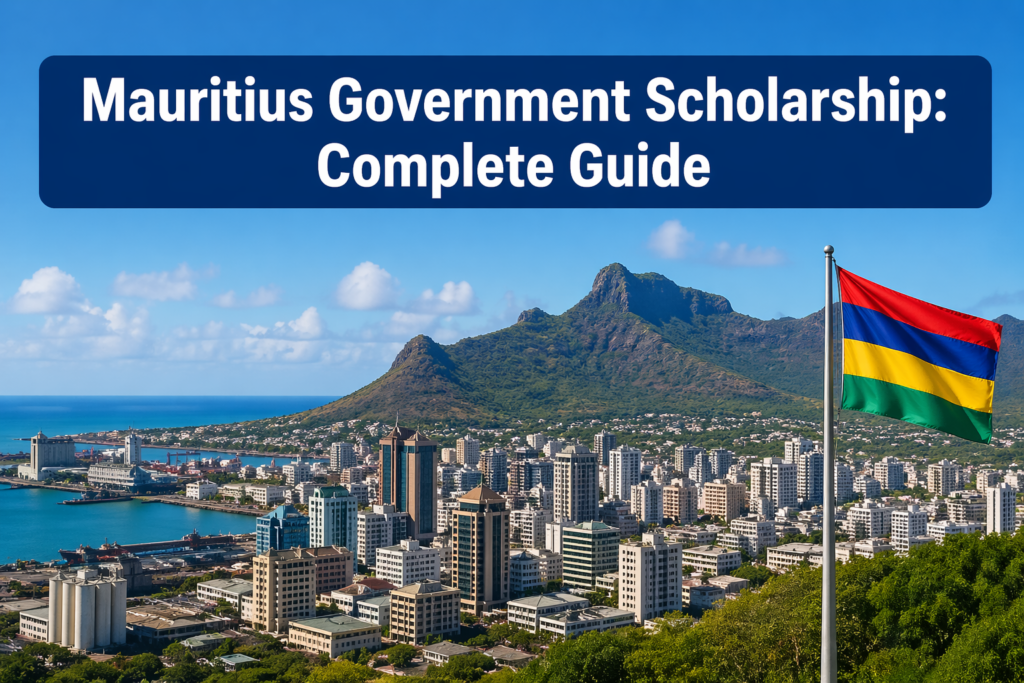
When most people think about studying abroad on a fully funded government scholarship, their minds go straight to Europe, North America, or East Asia. Very few think of Mauritius. And that is exactly why this opportunity is so underrated and so worth talking about. The Mauritius Government Scholarship, officially known as the Mauritius Africa Scholarship Scheme (MASS), is a fully funded programme offered by the Government of the Republic of Mauritius to deserving students from African nations. It covers tuition, living expenses, and return airfare, all at no cost to the student.

This guide is going to walk you through everything you need to know about the Mauritius Government Scholarship. We will cover what it is, why Mauritius is an excellent destination for higher education, what the scholarship covers, who is eligible, which universities participate, what documents you need, how to apply step by step, and some practical tips to help your application succeed. Whether you are applying for an undergraduate diploma, a bachelor’s degree, a master’s programme, or a PhD, this article covers it all.
What Is the Mauritius Government Scholarship (MASS)?
The Mauritius Africa Scholarship Scheme, commonly referred to as MASS, is a bilateral scholarship programme established by the Government of the Republic of Mauritius. It is offered to students who are resident citizens of member states of the African Union or African Commonwealth countries. The programme is supervised by the Ministry of Tertiary Education, Science and Research of Mauritius and is coordinated at the national level by the Higher Education Commission (HEC) of Mauritius.
The scholarship was created as part of Mauritius’s broader commitment to promoting capacity building across the African continent. Mauritius recognises that one of the greatest barriers to development in Africa is access to quality higher education. By offering fully funded places at its public universities, Mauritius aims to strengthen academic and professional ties with its African partners while giving talented young people a world-class education in a supportive and internationally connected environment.
The programme is aligned with Goal 4 of the United Nations Sustainable Development Goals (SDGs), which calls for inclusive and equitable quality education and the promotion of lifelong learning opportunities. It reflects Mauritius’s investment in Africa’s human capital at the regional and continental level.
Each year, the Government of Mauritius issues a Call for Applications, which is then distributed to Nominating Agencies in eligible countries. These agencies, which are typically part of each country’s Ministry of Education, manage the national selection process before forwarding nominated candidates to Mauritius for final selection.
Why Study in Mauritius?
Mauritius is one of Africa’s most stable and well-developed economies, with a gross national income per capita of approximately USD 12,850. It consistently ranks among the top countries in Africa for governance, ease of doing business, and human development. But what makes it an excellent destination for higher education specifically?
First and foremost, the higher education system in Mauritius is modeled on the British university system. This means that academic programmes at Mauritian public universities follow international standards, and degrees earned there are recognised across the Commonwealth and in many countries worldwide. Courses at public institutions are primarily taught in English, which makes the transition easier for students from English-speaking African countries. French and Mauritian Creole are also widely spoken in everyday life, giving students an immersive multilingual experience.
Second, Mauritius offers a uniquely multicultural and peaceful environment. The island is known for its cultural diversity, blending African, Indian, European, and Chinese influences into a society that is welcoming, tolerant, and vibrant. For students arriving from various parts of Africa, this creates a comfortable and stimulating environment in which to grow personally and academically.
Third, Mauritius is strategically positioned in the Indian Ocean, making it a growing hub for regional business, finance, technology, and tourism. Studying there gives students exposure to an internationally oriented economy with strong links to both Africa and Asia, which can be a powerful career advantage after graduation.
And of course, the natural environment of Mauritius is breathtaking. Living on an island with beautiful beaches, lush mountains, and a warm climate while pursuing your university degree is an experience very few students anywhere in the world get to have.
What Does the Mauritius Government Scholarship Cover?
The Mauritius Africa Scholarship Scheme is a fully funded scholarship. Here is a detailed breakdown of what it provides to successful candidates:
Tuition Fees
The scholarship covers all tuition fees at the chosen public Higher Education Institution (HEI) in Mauritius for the full duration of the programme. This means you will not be required to pay anything directly to the university for your academic instruction.
Historically, the scholarship has made financial provision for tuition in the range of MUR 100,000 per annum for students from SADC countries and up to MUR 160,000 per annum for students from non-SADC countries, allocated directly to the host institution. These figures may be updated with each new call for applications, so always verify the current amounts on the official Mauritius government scholarship page.
Monthly Living Allowance
In addition to tuition, the scholarship contributes to living expenses during your studies in Mauritius. This allowance is designed to help cover basic day-to-day costs such as food, local transportation, and personal necessities while you are studying on the island. The exact amount varies and may be adjusted depending on your country of origin and the year of the scholarship round.
Return Airfare
The scholarship covers a return airfare by the most economical route. This means that your travel costs from your home country to Mauritius at the beginning of your studies and back to your home country upon successful completion of your programme are covered. This is a significant benefit that removes one of the largest practical barriers for students coming from mainland Africa.
Medical Insurance
Successful scholarship candidates are covered by medical insurance for the full duration of their studies in Mauritius. This ensures that you have access to healthcare services while living abroad without having to worry about the cost of medical treatment.
Duration of the Award
The scholarship is awarded for the minimum course duration of the selected programme or for the maximum period allowed under the scheme, whichever is shorter. This ensures that funding is aligned with the realistic time needed to complete your degree. No extension of the scholarship period is provided beyond the agreed duration, so it is important to plan your studies carefully and progress consistently.
Levels of Study Available
The Mauritius Africa Scholarship Scheme supports multiple levels of higher education. Here is what is available:
Diploma Programmes
These are foundational-level programmes that typically last one to two years. They are suitable for students who want to gain a professional qualification in a specific technical or vocational field before potentially continuing to a full degree programme.
Bachelor’s Degree (Undergraduate)
Full undergraduate degree programmes at Mauritius public universities are available under MASS. These typically last three to four years depending on the field of study. This is the most popular level of the scholarship and attracts the largest number of applicants from across Africa.
MPhil (Master of Philosophy)
The MPhil is a research-based postgraduate qualification. Students enrolled in MPhil programmes conduct supervised research and produce a thesis. The duration is typically one to two years depending on the institution and the nature of the research.
MPhil Leading to PhD
Some candidates are enrolled in a combined MPhil/PhD track, where they begin with MPhil-level research and then upgrade to doctoral studies upon demonstrating sufficient academic progress. This track is particularly suited to students who are early in their research careers and want a structured pathway to a full doctorate.
PhD (Doctorate)
Doctoral scholarships are available for candidates who already hold a master’s degree or a first-class undergraduate degree and who are ready to conduct independent, supervised research at the highest academic level. PhD programmes in Mauritius typically span three to four years. Applicants who already hold a PhD are not eligible to apply.
Participating Universities and Institutions
The scholarship is tenable only at public Higher Education Institutions (HEIs) in Mauritius. Private institutions are not included. Here is a list of the main participating public institutions:
University of Mauritius (UoM)
The University of Mauritius is the largest and most established public university on the island. It offers a wide range of programmes across faculties including engineering, science, social sciences and humanities, law and management, agriculture and natural resources, and information and communication technology. The UoM is the most popular destination for MASS scholarship holders and has a large and active international student community.
University of Technology, Mauritius (UTM)
UTM is a technology-focused institution that offers programmes in areas such as computer science, engineering, business, and applied sciences. It is particularly well suited for students interested in technical and innovation-driven fields. UTM has strong industry partnerships and a growing research reputation.
Université des Mascareignes (UdM)
UdM is a relatively newer institution that offers undergraduate and postgraduate programmes primarily in French and English. It caters to students interested in business, management, education, and social sciences. UdM provides a bilingual academic environment that reflects Mauritius’s French-influenced cultural heritage.
Open University of Mauritius (OU)
The Open University of Mauritius offers a range of flexible academic programmes. While it is primarily known for distance and part-time learning, it also participates in the MASS programme for full-time, on-campus enrolments.
Mauritius Institute of Education (MIE)
MIE is a specialised institution focused on teacher training and education studies. It is the right choice for MASS applicants who want to pursue a career in teaching, curriculum development, educational leadership, or pedagogy.
Mahatma Gandhi Institute (MGI) and Rabindranath Tagore Institute (RTI)
These two institutions specialise in arts, culture, language, and related disciplines. They offer unique academic environments for students interested in cultural studies, fine arts, music, and language education.
Academy of Design and Innovation and Mauritius Institute of Health (MIH)
These specialised institutions cater to students interested in design-related fields and health sciences respectively. MASS applicants pursuing creative or health-related programmes may find these institutions particularly relevant.
When applying for the scholarship, you must have already applied for a full-time, on-campus programme at one or more of these institutions. You cannot apply for the scholarship without first initiating a university application in Mauritius.
Fields of Study Available
Across the participating public universities, MASS scholarship holders can pursue studies in a broad range of fields. Some of the most popular and widely available subject areas include:
Engineering (civil, mechanical, electrical, electronic, chemical, computer, and environmental). Computer Science and Information Technology. Business and Management. Accounting and Finance. Economics. Law and Public Policy. Social Sciences. Education and Teacher Training. Agriculture, Forestry, and Fisheries. Food Technology and Nutrition. Natural Sciences (biology, chemistry, physics, mathematics, and statistics). Actuarial Science. Tourism and Hospitality Management. Health Sciences. Environmental Sciences. Communication and Media. Architecture. Design and Innovation.
The specific programmes available vary by institution and may differ from one year to the next. Always check the current listings on the websites of the participating universities and cross-reference with your country’s eligible fields as indicated by your national Nominating Agency.
Eligibility Requirements
To be considered for the Mauritius Africa Scholarship Scheme, applicants must meet the following criteria:
Citizenship and Residency
You must be a resident citizen of a member state of the African Union or an African Commonwealth country. Mauritian nationals are not eligible to apply for MASS. Self-financing African students who are already studying in Mauritius at the same level they wish to apply for are also not eligible.
Age Requirements
For undergraduate (diploma and degree) programmes, applicants must be at least 18 years old and must not have reached their 26th birthday by 1 January of the year in which the scholarship is offered. For MPhil, MPhil/PhD, and PhD programmes, applicants must not have reached their 40th birthday by 1 January of the scholarship year. Some sending countries, such as Kenya, apply their own national age limits (for example, not more than 25 years for undergraduate applicants), so always confirm the requirements with your Nominating Agency.
Academic Qualifications
For diploma and undergraduate degree programmes, applicants must have completed their secondary education with satisfactory results. The specific grade requirements vary by country and institution. For example, Kenyan applicants are typically expected to have a minimum KCSE Mean Grade of B (plain) for undergraduate entry. For MPhil/PhD programmes, applicants must hold a recognised undergraduate degree with at least an upper second class result (equivalent to a GPA or CPA greater than 60%), and preferably a master’s degree as well. For PhD-only applications, a first-class undergraduate degree or an MPhil from a recognised university is required. Applicants who already hold a PhD degree are not eligible to apply for MASS scholarship support.
Programme Admission
Before applying for the scholarship, you must have already applied for a full-time, on-campus programme at a public HEI in Mauritius. This is one of the most important requirements. Either a conditional offer letter from the Mauritian HEI or proof of application (such as a receipt of payment of the application fee) must be submitted along with your scholarship application. You cannot submit a scholarship application without showing that you have already initiated a university application in Mauritius.
PhD Supervisor
For PhD-level applicants, you must provide the name and written acceptance of a proposed supervisor from a Mauritian university. Without a confirmed supervisor, your application cannot proceed. Make contact with potential supervisors at your chosen institution early in the process, as identifying a willing and available supervisor can take time.
Language of Instruction
Most programmes at Mauritius public universities are taught in English. Applicants must demonstrate sufficient proficiency in the language of their chosen programme. If your academic documents are not in English or French, they must be accompanied by a certified translation into one of these two languages.
Required Documents
When submitting your application for the Mauritius Government Scholarship, you will need to gather and prepare the following documents:
A fully completed application form, with all sections (Sections 1 to 6) filled in correctly. Section 5 must be endorsed and completed by your country’s Nominating Agency. A certified copy of your birth certificate. If you do not have a birth certificate, you may need to provide an affidavit stating this. A copy of the biodata page of your valid passport (if available). Certified copies of all academic certificates and mark sheets from secondary school and any tertiary institutions previously attended. If these documents are not in English or French, certified translations must be submitted along with the originals. A copy of a conditional offer letter from a Mauritian public HEI, or a receipt of payment of the application fee as proof that you have applied for admission. A medical certificate, duly filled in and signed by a registered medical practitioner. This should be signed in the designated section of the application form (Section 6) and appropriately stamped. For MPhil and PhD applicants, an abridged research proposal is required. This should include a brief description of the research problem, aims and objectives, methodology, a tentative timeframe with an emphasis on data collection, and a list of any equipment, laboratory facilities, or software that will be required. It should also include the name and contact details of the identified supervisor in Mauritius. For PhD applicants, a supporting statement from a named supervisor at the chosen Mauritian university. Recommendation letters as required by the institution or sending country. A National Endorsement Form, which can be downloaded from the official MASS page on the Ministry of Tertiary Education website. For some sending countries, additional country-specific documents may be required. Always check with your Nominating Agency for the full national requirements.
How to Apply: Step-by-Step
The application process for the Mauritius Government Scholarship involves several stages. Here is a clear and detailed walkthrough:
Step 1: Download the Official Application Form and Guidelines. The first thing you need to do is download the correct application form and guidelines for your level of study. There are separate forms for undergraduate and postgraduate programmes. These can be downloaded from the official MASS page managed by the Ministry of Tertiary Education, Science and Research of Mauritius, or from the Higher Education Commission of Mauritius website. Make sure you are using the form for the correct academic year.
Step 2: Apply to a Public University in Mauritius. Before completing your scholarship application, you must apply for admission to at least one full-time, on-campus programme at a public HEI in Mauritius. Visit the websites of the participating institutions and apply during their open application windows. Once you have applied, obtain either a conditional offer letter or a receipt of payment of the application fee. University application fees are payable, though some sending agencies offer support for the first applicants to submit complete documentation.
Step 3: For PhD Applicants, Identify a Supervisor. If you are applying for a PhD or MPhil programme, you must identify and contact a potential supervisor at your chosen Mauritian university. Get a written statement of acceptance from your proposed supervisor and include it with your application. This step takes time, so start early.