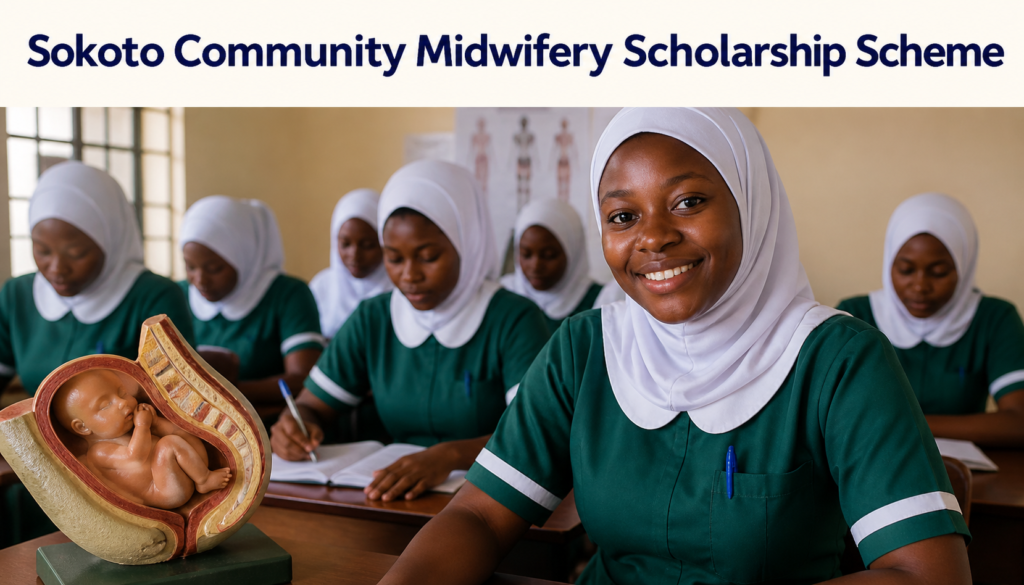
If you are a young woman from a rural community in Sokoto State, Nigeria, and you have ever wanted a career in healthcare but felt that the financial barriers were simply too high, then 2026 has brought a very real and significant opportunity for you. The Sokoto State Government, in partnership with the United Nations Population Fund (UNFPA), has officially launched the Community Midwifery Scholarship and Bonding Scheme. This programme is offering full scholarships to 500 young women from underserved communities in Sokoto State to train as community midwives and return to serve those same communities after graduation.

This is not a speculative announcement or a promise that has not yet been acted on. The scheme was officially unveiled at the 8th Sokoto State Council on Health, a high-level meeting held in April 2026 and attended by the Sokoto State Governor, Ahmad Aliyu Sokoto, the State Commissioner for Health, Dr Faruk Umar Abubakar, UNFPA representatives, and a range of development partners. The commitment is real, the funding is confirmed, and the implementation plan is already in motion.
In this guide, we cover everything you need to know about the Sokoto Community Midwifery Scholarship Scheme 2026. We explain what it is, why it exists, who is eligible, what community midwifery training involves, what the bonding requirement means for your future, how to apply when the portal opens, and what to expect after graduation. We also look at the broader health reform efforts of the Sokoto State Government so you can understand how this scholarship fits into a much larger, longer-term vision for healthcare in northwestern Nigeria.
What Is the Sokoto Community Midwifery Scholarship and Bonding Scheme?
The Sokoto Community Midwifery Scholarship and Bonding Scheme is a government-backed, UNFPA-supported programme designed to train 500 young women from rural communities across Sokoto State as community midwives. The training is fully funded, meaning selected candidates will not be required to pay tuition or related academic fees. After completing their training, graduates are expected to be deployed back to underserved communities across the state to provide essential maternal and child healthcare services at the grassroots level.
The programme is being implemented in two carefully planned phases. The first phase will enrol 250 candidates in 2026. The second phase will enrol another 250 in 2027. This phased approach allows the state to manage training capacity, ensure quality, and plan the deployment of graduates in an organised and effective way.
The word “bonding” in the scheme’s title has a specific meaning that every potential applicant needs to understand from the beginning. A bonding scheme is an arrangement in which a government or organisation funds a person’s education in exchange for a commitment from that person to work in a designated area or role for a set period after graduation. In this case, the Sokoto State Government and UNFPA are funding your community midwifery training, and in return, you agree to serve in a designated underserved community in Sokoto State after you qualify. This is a globally recognised and respected model for building healthcare capacity in hard-to-reach areas. It is not a penalty or a restriction. It is a partnership between you and your community.
Why Was This Scholarship Created? Understanding the Problem It Is Solving
To appreciate the significance of this scheme, you need to understand the healthcare reality that it is responding to. Sokoto State has some of the most challenging maternal and child health statistics in Nigeria, and Nigeria itself is among the countries with the highest rates of maternal mortality in the world. A major driver of these statistics is a persistent shortage of skilled birth attendants in rural areas.
When a woman in a remote village goes into labour without a trained midwife or healthcare worker nearby, the risks to her life and that of her baby increase dramatically. Many complications that are entirely manageable with skilled care become fatal when there is no one qualified to help. This has been a known and documented problem in northern Nigeria for decades, and it is particularly acute in Sokoto State.
Governor Ahmad Aliyu Sokoto has been addressing this problem with a deliberate and multi-layered approach since taking office in 2023. His administration’s 9-Point SMART Innovative Agenda specifically targets healthcare delivery as a priority area. One of the concrete steps taken under this agenda has been the introduction of a two-year mandatory rural service policy for newly recruited health workers. Under this policy, over 1,500 nurses and midwives have already been recruited and deployed to underserved rural communities, with incentives including a 10 per cent rural allowance provided to encourage retention.
The state is also in the process of recruiting 2,400 additional community health workers to strengthen primary healthcare coverage across all local government areas. On top of all this, 270 medical students from Sokoto State are currently on the state government’s payroll, earning civil service Level 07 salaries while studying, with a requirement to serve the state for a period after graduation. The Community Midwifery Scholarship and Bonding Scheme is the latest and one of the most ambitious additions to this already active healthcare reform agenda.
The involvement of UNFPA adds further weight and resources to the initiative. UNFPA has identified Sokoto State as one of its highest-funded states in Nigeria, with more than N4.6 billion allocated for health interventions in 2026 alone. This level of international investment reflects the United Nations’ recognition of both the scale of the challenge in Sokoto and the genuine commitment of the state government to addressing it. The family planning support component alone involved the state government investing N30 million in child-spacing commodities, which UNFPA then matched with an additional N50 million worth of supplies, collectively benefiting thousands of women of reproductive age across the state.
The Commissioner for Health, Dr Faruk Umar Abubakar, is particularly well-placed to drive this agenda. Before his appointment by Governor Ahmad Aliyu, he served as the Secretary General, Registrar, and Chief Executive Officer of the Nursing and Midwifery Council of Nigeria (NMCN) from 2016 to 2024, a tenure during which the total number of nurses and midwives produced annually in Nigeria rose from 9,000 to 29,000. His deep understanding of midwifery education, regulation, and workforce development makes him an unusually effective leader for a programme of exactly this kind.
What Is Community Midwifery? A Guide for Prospective Applicants
If you are considering applying for this scholarship, you need to have a clear understanding of what community midwifery is and what your training and career will involve.
Community midwifery is a specialised branch of midwifery practice focused on delivering maternal and newborn healthcare services within community settings, particularly in rural and remote areas that cannot easily access hospital-based care. Unlike midwives who work primarily in hospital labour wards, a community midwife is trained and equipped to bring skilled care directly to women in their homes and villages.
A trained community midwife is capable of providing antenatal care to pregnant women, conducting safe deliveries, providing postnatal support to mothers and newborns, identifying warning signs and high-risk pregnancies that require referral to higher-level facilities, offering family planning counselling and support, and educating communities about maternal health, nutrition, hygiene, and child welfare. These are not minor tasks. They are life-saving responsibilities that directly reduce the risk of maternal and neonatal deaths in the communities where you serve.
The Community Midwifery Programme in Nigeria is regulated and accredited by the Nursing and Midwifery Council of Nigeria (NMCN). The programme is designed to be shorter and more focused than the standard three-year Basic Midwifery Programme, with a curriculum specifically tailored to community-level practice. It equips graduates with the practical skills needed to function effectively in primary healthcare settings, even in environments with limited equipment and infrastructure.
In Sokoto State, the College of Nursing Sciences Sokoto (CONSSOKOTO) is a key institution for nursing and midwifery education. Run by the state government, it offers both Basic General Nursing and Basic Midwifery programmes and has historically provided affordable training for Sokoto indigenes. The college also runs a dedicated Community Midwifery Programme designed to train midwives specifically for rural and underserved communities. Other state-accredited institutions may also be involved in delivering training for scholarship recipients under this new scheme.
When you complete your community midwifery training and are deployed to a rural community, your role goes beyond clinical care. Midwives in community settings also serve as health educators, community mobilisers, and trusted advocates for women’s reproductive rights and child welfare. The work is demanding, but it is also profoundly meaningful. In communities where women have never had access to a skilled birth attendant, the arrival of a qualified midwife changes the entire landscape of maternal health, sometimes within months.
Programme Key Facts at a Glance
Programme Name: Sokoto Community Midwifery Scholarship and Bonding Scheme
State: Sokoto State, Nigeria (North West geopolitical zone)
Sponsoring Organisations: Sokoto State Government and United Nations Population Fund (UNFPA)
Key Government Officials: Governor Ahmad Aliyu Sokoto; Commissioner for Health, Dr Faruk Umar Abubakar
Target Beneficiaries: Young women from rural and underserved communities across Sokoto State
Total Number of Scholarships: 500 (250 to be enrolled in 2026 and 250 in 2027)
Course of Study: Community Midwifery
Scholarship Type: Full Scholarship (tuition and related academic costs covered)
Post-Graduation Obligation: Deployment to underserved communities in Sokoto State (bonding requirement)
Regulatory Body: Nursing and Midwifery Council of Nigeria (NMCN)
Announced At: 8th Sokoto State Council on Health meeting, April 2026
Who Is Eligible to Apply for the Sokoto Community Midwifery Scholarship Scheme?
Based on official announcements and the nature of the programme, here is a summary of who the scheme is designed for and what the eligibility requirements are expected to be. As the programme is newly announced and the full application portal has not yet been published at the time of writing, some details may be clarified in subsequent official communications. Always check official government and UNFPA channels for the most up-to-date eligibility requirements before applying.
Gender: The scholarship is specifically for young women. This reflects the realities of maternal healthcare delivery in northern Nigeria, where many women and families in conservative communities strongly prefer to be attended to by female health workers. Training female midwives from within those communities is one of the most effective ways to ensure that women will actually use the maternal health services available to them.
Origin: You must be an indigene of Sokoto State. The programme is designed to train women who have roots in the communities they will eventually return to serve. A midwife who comes from the same community she serves is far more likely to be trusted, accepted, and effective in her role.
Community Background: Priority is expected to be given to women from rural and underserved communities. The whole purpose of the bonding component is to direct trained midwives to the areas where they are most needed, which are typically the rural communities furthest from urban health facilities. Women who already live in or have strong ties to these areas are the most natural candidates for this programme.
Academic Qualifications: Admission into any NMCN-accredited Community Midwifery Programme in Nigeria typically requires a minimum of five O-Level credit passes in relevant subjects. These generally include English Language, Mathematics, Biology, Chemistry, and Physics, obtained in not more than two sittings from WAEC or NECO, or a combination of both. Confirming that you meet these requirements before applying is essential.
Commitment to the Bonding Requirement: You must be willing to accept deployment to an underserved community in Sokoto State for a set period after completing your training. The specific duration of the bonding period has not been officially published yet, but programmes of this type in Nigeria and globally typically require between two and five years of service. This is a genuine commitment and should be treated as such when you consider whether to apply.
Age: While no specific age limit has been officially stated, most community midwifery training programmes in Nigeria target candidates broadly between the ages of 17 and 35. Official guidelines released during the application period will clarify this.
Benefits of the Sokoto Community Midwifery Scholarship
The scholarship is described in official communications as a full scholarship. Based on the structure of the programme and the information available, here is what recipients can expect:
Full Tuition Coverage: All tuition fees and academic costs for the community midwifery training programme will be covered by the scholarship. You will not need to pay for your education out of your own pocket or from your family’s resources.
Structured Clinical Training: As part of your training, you will receive structured clinical and practical education that prepares you for real-world practice in community health settings. This includes training in antenatal care, safe delivery, postnatal care, neonatal health, and emergency obstetric referrals.
Post-Training Employment and Deployment: After graduation, you will be deployed to a designated underserved community in Sokoto State as part of the healthcare workforce. This means that you will have a job waiting for you immediately after you qualify. In a country where graduate unemployment is a serious concern, this guaranteed employment pathway is one of the most valuable aspects of the whole scheme.
Integration into the State Health Workforce: Graduates deployed under this scheme are expected to become part of the Sokoto State government health workforce. This brings access to government employment structures, which may include salary, pension contributions, health insurance, and opportunities for career progression. Existing health workers recruited under the governor’s broader reform programme are already receiving a 10 per cent rural allowance as an incentive for rural service, and similar provisions may apply to community midwifery graduates.
Professional Recognition: Upon completing an NMCN-accredited programme, you will be eligible for registration with the Nursing and Midwifery Council of Nigeria, giving you professional standing as a certified midwife in Nigeria with the potential to build a long-term healthcare career.
How to Apply for the Sokoto Community Midwifery Scholarship 2026
At the time of writing, the official application portal for the Sokoto Community Midwifery Scholarship and Bonding Scheme has not yet been publicly published. The scheme was announced at the April 2026 Council on Health meeting, and the enrolment of the first 250 candidates is scheduled within 2026. This means the application window could open in the coming weeks or months. Here is how you should prepare now so that you are ready to move quickly when it does.
Step 1: Confirm your academic qualifications. Verify that you have the required O-Level credit passes in the relevant science subjects. If you have sat for your WAEC or NECO examinations but are awaiting results, monitor the official announcements for guidance on whether awaiting-results candidates are eligible to apply.
Step 2: Gather your key documents. The documents you are likely to need include your WAEC or NECO result slip, a birth certificate or sworn age declaration, a letter of indigeneship from your local government area in Sokoto State confirming your state of origin, a recent passport photograph, and a valid means of identification such as a national ID card, voter’s card, or NIN slip.
Step 3: Monitor official channels for announcements. The most reliable way to know when the application opens is to follow the Sokoto State Government’s official website and the Sokoto State Ministry of Health for news and updates. You should also follow the official UNFPA Nigeria channels, which regularly publish information about health programmes they support across Nigeria.
Step 4: Apply immediately when the portal opens. Government scholarship programmes receive large volumes of applications, and selection processes for competitive schemes like this one can move quickly once the window opens. Do not wait until the deadline approaches. As soon as the portal is announced and goes live, submit your application with all the required documents.
Step 5: Never pay anyone to apply. This scholarship is entirely free of charge to apply for. No government scholarship programme requires payment of any form of processing fee, registration fee, or application charge. If anyone contacts you claiming they can secure a place in this programme in exchange for money, that is a scam. Report such contacts to the appropriate authorities.
When the application portal becomes available, you can access it through the official Sokoto State Government website. To check for the latest updates and apply when the portal goes live, visit the official Sokoto State Government website. You can also monitor the UNFPA Nigeria official website for updates related to this scholarship and other health programmes in Sokoto State.
The Bonding Commitment: What You Are Really Agreeing To
The bonding requirement deserves its own discussion because it is a significant part of what makes this scholarship different from a conventional educational grant. When you accept this scholarship, you are not just accepting money for your education. You are entering into a formal agreement with the Sokoto State Government and UNFPA to return to serve your community after graduation.