
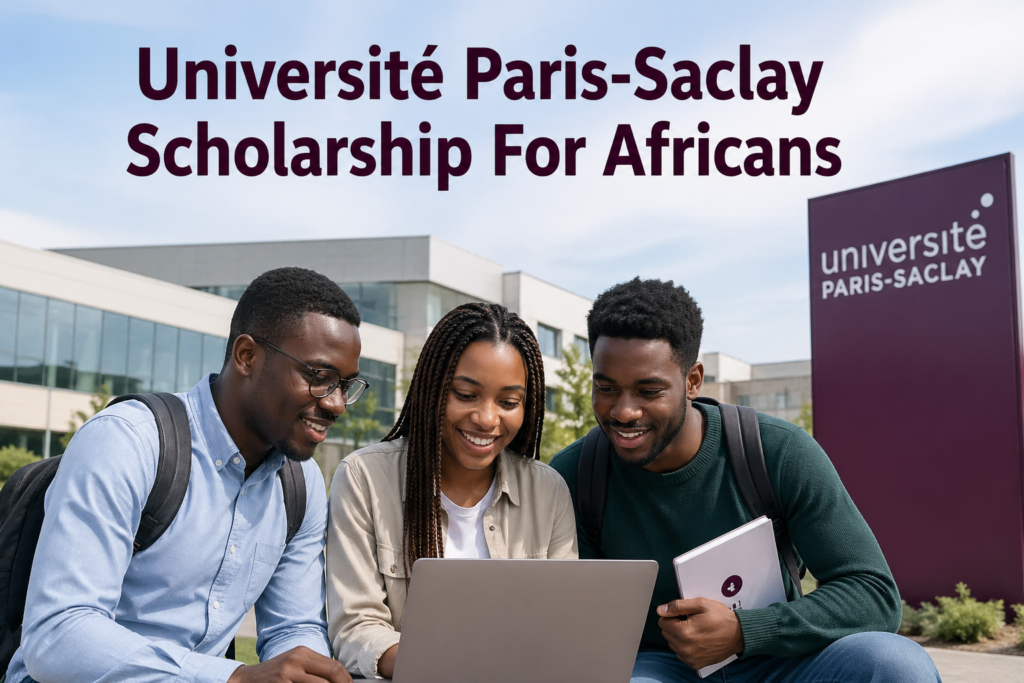
If studying in France at one of Europe’s most research-intensive universities has ever crossed your mind, now is the right time to pay attention. Université Paris-Saclay has opened its International Master’s Scholarships programme for the 2026 academic cycle, and it is one of the most accessible and genuinely rewarding scholarship opportunities available to international students seeking a Master’s degree in France today.

This scholarship is not some small consolation award. It comes with a €10,000 annual grant paid over ten months, a potential top-up of up to €1,000 for travel and visa costs, automatic renewal for a second year if you start in the first year of your Master’s programme, and access to a university that currently ranks among the top 70 institutions in the world according to QS World University Rankings 2026. It is open to all academic fields, and students from every country are eligible to apply.
If that sounds like something worth reading about, this guide covers everything you need to know: what the scholarship is, who runs it, who qualifies, which courses and institutions are eligible, how the application works, the key deadlines, and how to get started today.
About Université Paris-Saclay Scholarship
Before getting into the scholarship itself, it is worth understanding where you would actually be studying if you receive this award, because Université Paris-Saclay is not your ordinary French university.
Université Paris-Saclay was formally established in 2019 following the merger of four technical grandes écoles and several technological institutes, engineering schools, and research facilities. The result was a vast, interconnected research and academic institution located south of Paris, on the Plateau de Saclay, stretching from Paris to Orsay and through Evry and Versailles. The campus spans over 1,345 hectares and is home to more than 48,000 students from 127 different countries.
What makes Paris-Saclay genuinely special is its research infrastructure. The university operates over 275 laboratories in fields ranging from particle physics and nuclear physics to astrophysics, condensed matter physics, nanoscience, nanotechnology, and electronics. It shares laboratories with some of the most respected research organisations in the world, including the CEA (Commissariat à l’énergie atomique), CNRS (Centre national de la recherche scientifique), INRAE, INRIA, INSERM, and ONERA.
The university’s rankings reflect this research strength. According to QS World University Rankings 2026, Université Paris-Saclay is ranked equal 70th in the world and 12th in Europe. The Academic Ranking of World Universities (Shanghai Rankings) places it 13th globally, making it one of France’s most internationally recognised institutions. In specific fields like mathematics and physics, it consistently ranks within the top 10 to 15 universities worldwide.
Its history also stretches back further than 2019. Université Paris-Saclay traces its roots to the University of Paris, which was established as far back as 1150. One of its predecessor institutions, the University of Paris-Sud in Orsay, produced or hosted multiple Nobel Prize winners, including Alain Aspect (Nobel in Physics, 2022), Albert Fert (Nobel in Physics, 2007), and Pierre-Gilles de Gennes (Nobel in Physics, 1991).
When the French government created Université Paris-Saclay, their stated aim was to create an institution capable of competing with the top American technological research universities, including MIT. That ambition explains both the scale of the institution and the generous scholarship programme it runs to attract outstanding international talent.
What Is the International Master’s Scholarship at Université Paris-Saclay?
The International Master’s Scholarship programme at Université Paris-Saclay is officially known as the International Master’s Scholarships Program IDEX. The IDEX designation refers to the programme’s funding base: it was established with funding from the IDEX (Initiative d’Excellence) programme, which is part of the third Investissements d’Avenir (Investments for the Future) initiative of the French government, designed to support world-class higher education and research ecosystems in France.
In practical terms, this means the scholarship is backed by the French state and delivered through the university itself. It is a serious, well-funded initiative, not a symbolic gesture.
The core purpose of the scholarship is to promote access for highly qualified international students to Master’s programmes at Université Paris-Saclay, particularly for those who want to develop an academic project that leads through to doctoral-level research. In other words, if you are an international student with real academic ambitions and the potential to go on to a PhD, this scholarship was designed with you in mind.
That said, you do not have to be pursuing a PhD pathway to apply. The scholarship is open to any eligible international student admitted to an eligible Master’s programme, regardless of whether or not they plan to continue to doctoral study. However, students admitted to the second year of a Master’s programme (M2) will need to demonstrate a well-argued motivation to pursue a PhD in a laboratory of Paris-Saclay University as part of their application.
How Much Is the Scholarship Worth?
The financial value of the Université Paris-Saclay International Master’s Scholarship is straightforward and substantial.
Annual Scholarship Amount
Each scholarship is worth €10,000 per year. This amount is paid monthly by Université Paris-Saclay for the full duration of the academic year, from September through to June, covering a period of ten consecutive months. That works out to €1,000 per month, every month, for your entire academic year.
Travel and Visa Expense Support
In addition to the annual grant, successful applicants may also receive up to €1,000 towards travel and visa expenses, depending on their country of origin. This contribution is designed to help cover the real costs that international students face when relocating to France from abroad. It is worth noting that laureates (scholarship winners) receive both the scholarship and any travel expense support only upon arrival in France and after completing formal enrolment in their programme. No advance payments are made before the student physically arrives and registers.
Duration: One or Two Years
The scholarship duration depends on which year of the Master’s programme you are entering when you apply. If you are admitted to the first year of your Master’s (M1), the scholarship is awarded for one year initially and will automatically renew for a second year, provided you complete all required credits and gain admission to a second-year Master’s programme (M2) at Université Paris-Saclay. If you are admitted directly to the second year of a Master’s (M2), the scholarship covers that single year only.
This means that a student admitted at M1 level could receive a total of €20,000 in scholarship support across two years of Master’s study, before even factoring in travel and visa assistance.
Which Institutions Are Part of the Programme?
Université Paris-Saclay is not a single-campus institution in the traditional sense. It is a federation of member institutions, and the scholarship is available to students admitted to Master’s programmes delivered by any of the following member institutions:
- AgroParisTech (leading institution for life sciences, agronomy, and environmental sciences)
- CentraleSupélec (one of France’s top grandes écoles for engineering and technology)
- ENS Paris-Saclay (École Normale Supérieure Paris-Saclay, a leading institution for science, technology, and humanities)
- INSTN-CEA (Institut National des Sciences et Techniques Nucléaires, affiliated with the French Atomic Energy Commission)
- IOGS (Institut d’Optique Graduate School, a specialist optics and photonics institution)
- Université Évry Paris-Saclay (UEVE, a comprehensive university covering sciences, humanities, law, and economics)
- Université Paris-Saclay (the main university itself)
- UVSQ (Université de Versailles-Saint-Quentin-en-Yvelines, covering law, economics, sciences, and health)
The administrative institution of your enrolment must be one of these eight institutions for your Master’s programme to be eligible under the scholarship scheme.
Which Courses Are Eligible?
The good news here is that the scholarship is open to all academic fields. There is no restriction on subject area. Whether you are studying physics, computer science, biology, mathematics, agronomy, economics, engineering, law, social sciences, humanities, or any other discipline offered through Université Paris-Saclay’s accredited Master’s programmes, you are eligible.
The only exclusion is vocational programmes, known in French as formations en apprentissage. These work-study programmes that combine academic study with professional apprenticeship contracts are not eligible for the scholarship. All other nationally accredited Master’s programmes delivered by the eligible institutions are included.
Both M1 (first year of Master’s) and M2 (second year of Master’s) are eligible entry points. Students may apply from either year of their programme, subject to meeting the other eligibility requirements.
Who Is Eligible to Apply?
Eligibility for the International Master’s Scholarship is clearly defined by the university. The following criteria are cumulative, meaning you must meet all of them to qualify.
Primary Eligibility Criteria
First, you must be admitted to a Master’s degree programme at Université Paris-Saclay delivered by one of the eight member institutions listed above. Being admitted to the university’s programme does not automatically mean you qualify for the scholarship; you must meet all the eligibility conditions as well.
Second, you must be studying in France for the first time. This means you should never have been registered in a French higher education institution before, with some important exceptions covered below. Prior exchange programmes, Erasmus Mundus joint Master’s degrees that did not result in a French degree, non-degree internships, and language programmes do not disqualify you from the first-enrolment requirement.
Third, you must be under 30 years of age during the year in which you are applying. This age limit applies to the selection year, not necessarily the year in which your studies begin.
Exceptions and Special Cases
The university also recognises that some students may have had limited prior contact with France that should not disqualify them. The following groups remain eligible even if they have been in France briefly:
Students of foreign nationality who are living on French soil for less than one year, who were previously or are currently enrolled in a non-degree training course or internship. Students of foreign nationality living in France for less than one year who are attending language classes of the FFL (French as a Foreign Language) type. Students who previously lived in France as part of a mobility programme during earlier studies, such as an Erasmus Mundus Joint Master’s Degree or a standard exchange programme, where the outcome was not a French degree.
Additionally, refugee students or those with subsidiary protection status may benefit from a bonus system under the IDEX scholarship scale, reflecting the university’s commitment to inclusivity and access for students in vulnerable situations.
Who Is Not Eligible
Students who are already enrolled in a French higher education institution and who do not fall into one of the exception categories above are not eligible. Students who have had a study interruption of more than three years are also excluded. And importantly, students who are receiving other funding above €600 per month are declared ineligible, as the International Master’s Scholarship cannot be combined with other major scholarships. Specifically, it cannot be cumulated with France Excellence Eiffel scholarships, France Excellence Europa scholarships, or Erasmus Mundus scholarships.
How Does the Application Process Work?
The application process for the Université Paris-Saclay International Master’s Scholarship is slightly different from many other scholarship programmes because it operates in two stages: programme application first, then scholarship application by invitation only.
Stage One: Apply to Your Master’s Programme
The very first thing you need to do is apply to and be admitted to a Master’s programme at Université Paris-Saclay or one of its member institutions. You cannot apply for the scholarship without being selected for a programme first. This stage involves applying through the university’s admission portals or the specific admissions process of the institution delivering your chosen programme.
For the 2026 cycle, the deadline for master’s programme coordinators to select candidates for the scholarship is Wednesday 25 March 2026, at 11:59pm Paris time. This means that the master’s programme you are applying to must complete its selection of scholarship-nominated students by this date.
Stage Two: Scholarship Application by Invitation Only
This is a critical point that many students miss: there is no open or unsolicited scholarship application. Only students who receive an email from Université Paris-Saclay inviting them to apply for the IDEX scholarship will be able to submit an application. If you are selected by your Master’s programme coordinator as a scholarship candidate, you will receive a link to the online scholarship application form by email.
Once you receive that email and decide to apply, you must complete the online application form and provide the names and contact details of two referees. These referees can be a director of studies, a professor, an internship coordinator, or any professional who can speak meaningfully to your academic ability and potential. Each referee named by you will be sent a link to an online recommendation form by email and must complete and submit their recommendation before the deadline.
Your application is only considered complete when both referees have submitted their recommendation forms. You will be automatically notified each time a referee submits their form. However, you will not receive a separate confirmation that your overall application is complete, so it is entirely your responsibility to ensure both referees submit on time.
Any application that is incomplete or submitted after the deadline is automatically rejected, with no exceptions.
Selection and Notification
After the application deadline closes, a jury of academic professionals reviews all complete applications. The jury’s selection process is discretionary and its decisions are confidential. No appeals are possible once the jury has made its decisions. All applicants, whether successful or not, are informed of the jury’s decision by email.
Key Deadlines for the 2026 Application Cycle
Getting your dates right is essential because missing any deadline automatically disqualifies your application. Here are the key dates for the current cycle, all listed in Paris time (GMT+1):
The candidate selection deadline by Master’s programme coordinators is Wednesday 25 March 2026, at 11:59pm Paris time. After being selected, the deadline to complete your scholarship application and for the reception of both recommendation forms from your referees is Tuesday 31 March 2026, at 11:59pm Paris time. Successful applicants will then be expected to arrive in France and enrol in their programme from September 2026 onwards, when scholarship payments begin.
These are tight dates with almost no buffer between them, so if you are serious about this scholarship, you need to be well advanced in your Master’s programme application long before the end of March.
What Makes a Strong Application?
Since the scholarship selection is competitive and the process is merit-based, understanding what the jury looks for is important. Here are the factors that matter most.
Academic Excellence
The scholarship is fundamentally based on academic achievement. Your transcript, grades, and the quality of your prior academic record will be central to the jury’s assessment. Make sure your application clearly presents your academic background and any distinctions, awards, or honours you have received.
Research Orientation and PhD Motivation (for M2 applicants)
For students applying at the M2 level, demonstrating a clear, well-argued motivation to pursue a PhD at a laboratory of Université Paris-Saclay is specifically required. If you want to go on to a doctorate, be explicit about which research area interests you, which laboratories at Paris-Saclay you are attracted to, and why your academic background makes you a strong candidate for that research path.
Quality of Recommendation Letters
The two referees you choose play a significant role. Choose people who know your academic work well and can speak specifically to your ability, potential, and character. Generic letters that say little more than that you attended a class and performed adequately are unlikely to impress a rigorous jury. Referees who can speak to research experience, independent thinking, and intellectual curiosity will serve your application much better.
First Enrolment in France
One factor the jury will verify is your status as a first-time enrollee in France. Make sure your application accurately and honestly reflects your prior academic history, including any time spent in France on exchange, language courses, or internships, so that your eligibility can be confirmed without any confusion.
Living and Studying at Université Paris-Saclay
Understanding what life actually looks like as a student at Université Paris-Saclay helps you make a more informed decision about whether this is the right opportunity for you.
Location
The university is located south of Paris, primarily on and around the Plateau de Saclay. The main campus is in Gif-sur-Yvette and Orsay, with facilities also in Evry, Versailles, and other nearby towns. The area is well connected to central Paris by public transport and is surrounded by the Vallée de Chevreuse natural park, making it a genuinely pleasant environment to live and study in.