
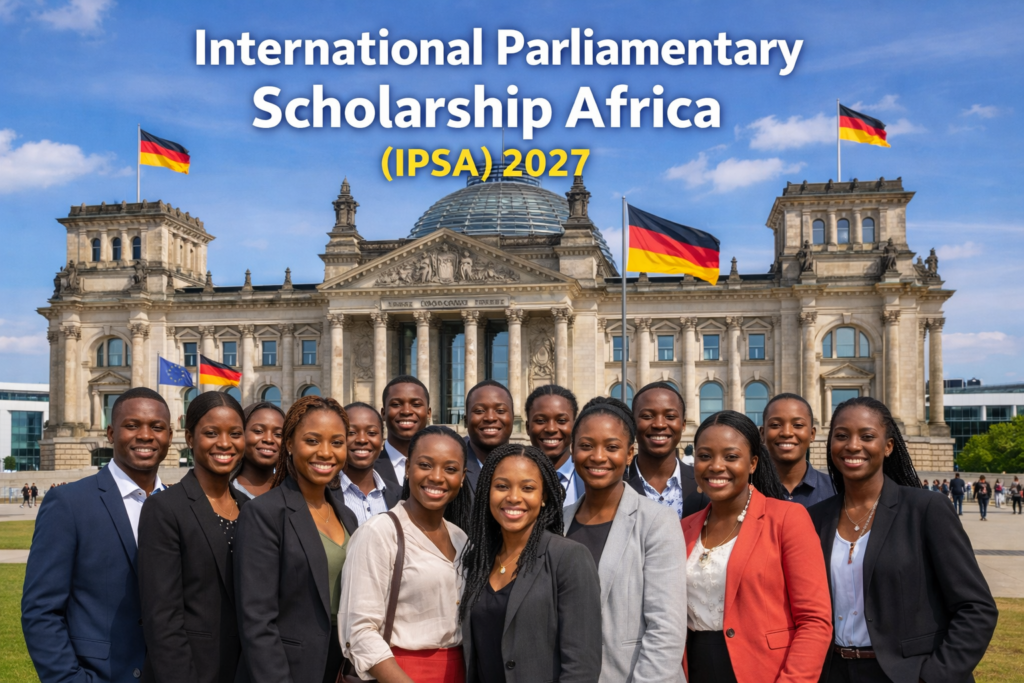
If you are a young university graduate from Africa with a genuine passion for democracy, governance, and public service, then the International Parliamentary Scholarship Africa 2027 is one opportunity you absolutely need to know about. Offered by the German Bundestag, this is a fully funded, four-week programme that brings up to 24 selected participants from nine African countries to Berlin, Germany, to experience parliamentary democracy from the inside. And when we say “from the inside,” we mean it literally: participants spend one full week working directly in the office of a sitting Member of the German Parliament.

This is not the kind of programme where you sit in a lecture hall and watch presentations about democracy. This is a hands-on, immersive fellowship where you observe legislative debates, contribute to parliamentary office work, attend workshops on governance and anti-corruption, and leave Berlin with a civic project plan you are expected to implement at home. For young Africans who are serious about shaping the future of their countries, this is as close to a real parliamentary education as you can get.
In this article, we cover everything you need to know about the International Parliamentary Scholarship Africa (IPSA) 2027: what it is, who it is for, what it offers, the nine eligible countries, how to apply, what documents you need, and tips to strengthen your application before the 15 May 2026 deadline.
What Is the International Parliamentary Scholarship Africa (IPSA)?
The International Parliamentary Scholarship, commonly known as IPS or IPSA when referring specifically to the African programme, is one of the German Bundestag’s most important international exchange initiatives. The broader IPS programme has been running since 1986 and invites young graduates from about 50 countries around the world to experience Germany’s parliamentary system firsthand. It is one of the longest-running parliamentary fellowship programmes in Europe.
The African edition of the programme, specifically targeting sub-Saharan African countries, was launched in 2020 under the patronage of the President of the German Bundestag. This version was created in recognition that Africa’s democratic landscape needs sustained investment, and that the best way to strengthen democratic institutions across the continent is to equip the next generation of African leaders with practical knowledge of how strong parliamentary systems actually work.
The IPSA programme is organized directly by the administration of the German Bundestag and runs in partnership with Berlin’s leading universities, including Freie Universitat Berlin, Humboldt-Universitat Berlin, and Technische Universitat Berlin. This academic partnership gives the programme both practical depth and intellectual rigour, making it stand out from other short-term fellowships.
For the 2027 edition, applications opened on 1 April 2026 and close on 15 May 2026. The programme itself runs from 4 January to 2 February 2027 in Berlin, Germany. Up to 24 participants will be selected from nine African countries across three regional groupings.
IPSA 2027 Programme Overview
Here is a quick-reference summary of the most important facts about the International Parliamentary Scholarship Africa 2027:
- Programme Name: International Parliamentary Scholarship Africa (IPSA / IPS Africa)
- Organized by: German Bundestag (German Federal Parliament)
- Programme Year: 2027
- Location: Berlin, Germany
- Programme Duration: 4 January 2027 to 2 February 2027 (four weeks)
- Number of Participants: Up to 24 fellows
- Funding: Fully funded
- Eligible Countries: Botswana, Namibia, South Africa, Kenya, Tanzania, Uganda, Ghana, Nigeria, Senegal
- Application Period: 1 April 2026 to 15 May 2026
- Application Language: German (all documents must be submitted in German)
- Age Requirement: Under 30 years old as of 1 January 2027
About the German Bundestag
Understanding the institution behind this scholarship gives you a much clearer picture of why it is so valuable. The German Bundestag is the federal parliament of Germany and one of the most respected legislative bodies in the world. It is based in the iconic Reichstag building in Berlin and consists of hundreds of elected Members of Parliament who represent constituencies across Germany.
Germany is widely regarded as one of the world’s most stable and transparent democracies. Its parliamentary system, the separation of powers, its strong civil society traditions, and its anti-corruption frameworks are all areas from which young leaders from developing democracies can learn a great deal. The Bundestag has been running international exchange programmes since 1986, and over the decades, IPS alumni have gone on to hold important positions in government, civil society, academia, and international organizations in their home countries.
The fact that this programme is organized directly by the Bundestag itself, not just a foundation or a subsidiary organization, makes it particularly prestigious. When you participate in the IPSA, you are not visiting Germany as a tourist or even as an academic observer. You are working inside one of Europe’s most important democratic institutions, building relationships with sitting parliamentarians and their staff, and gaining the kind of experience that simply cannot be replicated in a classroom.
The Nine Eligible African Countries
The IPSA 2027 is open to young graduates from nine specific sub-Saharan African countries, grouped into three regional clusters. This regional structure ensures that the programme has representation from different parts of Africa and that the perspectives brought to Berlin reflect the diversity of democratic experiences across the continent.
Southern Africa
The three countries in the Southern Africa cluster are Botswana, Namibia, and South Africa. These countries have some of the most established democratic traditions in sub-Saharan Africa and have navigated significant political transitions over the past few decades. Participants from this region bring experiences with constitutional democracy, land reform debates, economic inequality, and regional governance challenges.
East Africa
The East African cluster includes Kenya, Tanzania, and Uganda. This region has seen significant democratic growth as well as persistent governance challenges, particularly around electoral integrity, press freedom, and the relationship between central government and civil society. East African participants often have deep experience with grassroots activism and community-led governance initiatives.
West Africa
The West African cluster consists of Ghana, Nigeria, and Senegal. West Africa is home to some of the continent’s most vibrant and contested democracies. Ghana is frequently held up as a model of peaceful electoral transitions in Africa. Nigeria is the continent’s most populous country with a complex multi-party federal system. Senegal has a long tradition of civil society engagement. Participants from West Africa often bring dynamic perspectives on federalism, youth political participation, and democratic accountability.
If your country is not on this list, unfortunately the IPSA 2027 would not be available to you. However, the broader IPS programme by the German Bundestag also runs separate cohorts for countries in other regions of the world, so it is worth checking whether your country is part of one of those editions.
What Does the IPSA 2027 Scholarship Cover?
The IPSA 2027 is fully funded, meaning all major costs associated with your participation are covered. Here is a breakdown of what the scholarship provides:
Monthly Stipend
Each fellow receives a monthly stipend of 700 euros. For a four-week programme, this covers your day-to-day expenses in Berlin including food, local transport, and personal costs. Berlin is one of the more affordable capital cities in Western Europe, so this stipend is genuinely comfortable for daily living during the programme.
Accommodation in Berlin
The Bundestag arranges and fully covers accommodation for all participants throughout the duration of the programme. You do not need to search for housing or pay rent out of your own pocket. This is a significant relief for participants traveling from Africa, as Berlin accommodation costs can be high for short-term stays.
Travel Costs
Round-trip travel expenses from your home country to Berlin and back are fully covered. This removes one of the biggest financial barriers for international participants, as flights between Africa and Germany can be expensive depending on the time of year and departure point.
Health, Accident, and Personal Liability Insurance
Participants are covered by comprehensive health insurance, accident insurance, and personal liability insurance for the entire duration of the programme. This means you are protected against unexpected medical costs or accidents during your stay in Germany, which is particularly important for international visitors unfamiliar with the German healthcare system.
In total, this comprehensive funding package ensures that selected participants can fully concentrate on the learning experience without being distracted by financial pressures. The Bundestag has designed the scholarship to be genuinely accessible, not just nominally free.
What Will You Do During the Programme?
The four-week IPSA 2027 programme is packed with structured activities, and the schedule is designed to give participants both breadth and depth of democratic knowledge. Here is what to expect:
One-Week Parliamentary Placement
The centerpiece of the entire programme is a one-week placement in the office of a sitting Member of the German Bundestag. This is genuinely extraordinary access. During this week, you will sit alongside parliamentary staff, observe legislative debates and committee sessions, contribute to research and office tasks, and get a real feel for how democratic decision-making happens at the highest level of government.
This placement is what sets the IPSA apart from most other international fellowships. While other programmes offer lectures about parliament, this one gives you a desk inside it. Alumni consistently describe this week as one of the most transformative experiences of their professional lives.
Workshops on Democracy and Governance
Throughout the programme, participants attend structured workshops covering a wide range of governance topics. These include sessions on Germany’s parliamentary system, the principles of pluralism and minority protection, the rule of law, and how Germany’s federal structure distributes power between the national and state governments. These sessions are led by Bundestag staff, academics from Berlin’s universities, and guest practitioners from German political life.
Anti-Corruption Training
Anti-corruption is one of the most pressing issues facing African democracies, and the IPSA takes it seriously. Dedicated sessions focus on Germany’s anti-corruption frameworks, transparency mechanisms, and the role of civil society in holding government accountable. For participants from countries where corruption is a daily reality, these sessions often spark important conversations and practical insights.
Intercultural Competence and Project Management
The programme also includes practical skills training in intercultural communication and project management. The intercultural component prepares participants to work effectively in diverse international environments, while the project management training directly feeds into the post-programme requirement.
Erinnerungskultur: Germany’s Culture of Memory
One distinctive element of the IPSA is its engagement with Erinnerungskultur, which translates roughly as Germany’s culture of remembrance. This involves exploring how Germany has processed its own dark history, particularly the Nazi era and the Holocaust, and how that process of public memory and accountability has shaped modern German democratic identity. For participants from countries dealing with their own legacies of political violence, colonialism, or authoritarian rule, these sessions offer a sobering and thought-provoking perspective on national reconciliation.
The Post-Programme Civic Project
Before leaving Berlin, every participant is expected to have developed a concrete outline for a civic project they intend to implement in their home country after the programme ends. This requirement is one of the things that most clearly distinguishes the IPSA from observational fellowships. The Bundestag is not just inviting you to learn. It is investing in what you plan to do when you go back home. This expectation should shape how you think about your application and how you frame your goals from the very beginning.
Eligibility Criteria for IPSA 2027
Before you begin your application, make sure you meet all of the following requirements. Missing even one of them could disqualify your application.
Nationality
You must be a citizen of one of the nine eligible countries: Botswana, Namibia, South Africa, Kenya, Tanzania, Uganda, Ghana, Nigeria, or Senegal. Dual citizenship is permitted, meaning if you hold citizenship of one of these countries alongside another nationality, you may still be eligible. Confirm your eligibility based on your passport.
Age Requirement
You must be under 30 years of age as of 1 January 2027. This means you must have been born on or after 2 January 1997. There is no flexibility on this age limit, so double-check your date of birth against this requirement before applying.
University Degree
You must hold a completed university degree. The degree can be in any field, as the programme is not restricted to political science or governance-related disciplines. What matters is that you have demonstrated academic achievement and that you can show how your educational background connects to your interest in politics and democratic development.
German Language Proficiency
This is one of the most important and often most challenging eligibility requirements. You must demonstrate German language proficiency at a minimum B2 level on the Common European Framework of Reference (CEFR). B2 is classified as an upper-intermediate level, meaning you can communicate fluently and spontaneously in German, understand complex texts, and express yourself clearly on a wide range of topics.
Your German proficiency must be backed by a recent official language certificate. Accepted certifications typically include TestDaF, DSH, Goethe-Zertifikat B2, or equivalent recognized qualifications. If you are not yet at B2 level, this is the single most important thing to work on before the application deadline.
It is also worth noting that all application documents must be submitted in German, including your motivation letter. This reinforces how central German language ability is to the entire programme.
Political and Social Engagement
Beyond the formal qualifications, the Bundestag is looking for candidates who are already politically and socially active in their communities. This does not mean you need to be a politician or a government employee. You could be a civil society activist, a community organizer, a journalist, a student leader, an NGO worker, or someone involved in any form of civic engagement. What the selection committee wants to see is that you are already contributing to democratic life in your country and that you have a clear, credible vision for how this programme will amplify that contribution.
Required Application Documents
All documents must be submitted in German through the official IPS digital application platform. Here is the full list of what you need to prepare:
- Recent passport-sized photograph
- Passport or national identity card copy
- University degree certificate (original or certified copy, in English or German)
- Official German language certificate proving at least B2 level proficiency
- Motivation letter in German, maximum two pages, signed
- Letter of recommendation from a professor, teacher, or employer (in German or English)
Preparing these documents takes time, particularly the language certificate and the motivation letter. Start gathering everything well before the 15 May 2026 deadline. If you need to sit a language exam, check the exam schedule now and book a date that gives you enough time to submit your certificate before the application window closes.
How to Apply for the IPSA 2027
The application process for the International Parliamentary Scholarship Africa 2027 has been fully digitized. Paper applications are no longer accepted, and email submissions are explicitly not permitted by the Bundestag. Here is how the process works:
Step 1: Prepare All Your Documents in German
Before you open the application portal, have every required document ready. Your motivation letter needs to be carefully written in German and should not exceed two pages. Make sure it is signed. Your university degree certificate must be either an original or a certified copy, and it must be in English or German. If your degree certificate is in another language, you will need a certified translation.
Step 2: Submit Through the Official IPS Digital Application Platform
All applications must be submitted through the Bundestag’s dedicated online portal for the IPS programme. You will need to create an account, fill in your personal details, upload all required documents, and submit before the deadline. Make sure you receive a confirmation of submission. You can access the official application portal and full programme details by visiting the IPSA 2027 official page on the German Bundestag website.
Step 3: Application Routed Through Your German Embassy
In addition to the online submission, your application may need to be routed through the German embassy or consulate in your home country. The exact procedure can vary slightly by country, so it is important to contact the German diplomatic mission in your country to confirm the local requirements. Some embassies conduct pre-selection interviews before forwarding shortlisted applications to Berlin.
Step 4: Interview Stage
Shortlisted applicants are invited for interviews at the German diplomatic missions in their respective countries. These interviews are conducted as part of the selection process and assess your German language ability, your understanding of democratic governance, your civic commitment, and the credibility of your post-programme project plan. Prepare thoroughly for this stage.
Step 5: Final Selection by the Bundestag
Final selection is conducted by an independent panel appointed by the German Bundestag. The panel evaluates applicants based on their professional credentials, social and political engagement, language proficiency, intercultural skills, and overall potential as emerging democratic leaders. Successful candidates are notified directly.
Tips to Write a Winning IPSA 2027 Application
With up to 24 spots available across nine countries, competition for the IPSA is genuinely strong. Here are some concrete tips to help your application stand out:
Start Learning German Now If You Have Not Already
This cannot be overstated. If you are not yet at B2 level, everything else in your application becomes irrelevant because you will not pass the language requirement. German B2 is not a level you can reach in a few weeks. If you are at A2 or B1 right now, dedicate serious time and resources to reaching B2 before the deadline. Use language learning apps, enrol in a German course, find language exchange partners, and consume German-language media every day.
Make Your Civic Project Idea Concrete
One of the strongest signals you can send in your motivation letter is a clear, specific, and realistic idea for the civic project you plan to implement after the programme. Vague intentions like “I want to promote democracy in my community” are much weaker than a specific project concept with a defined target group, a realistic scope, and a clear connection to your existing work. Think about this carefully before you write a single word of your application.