
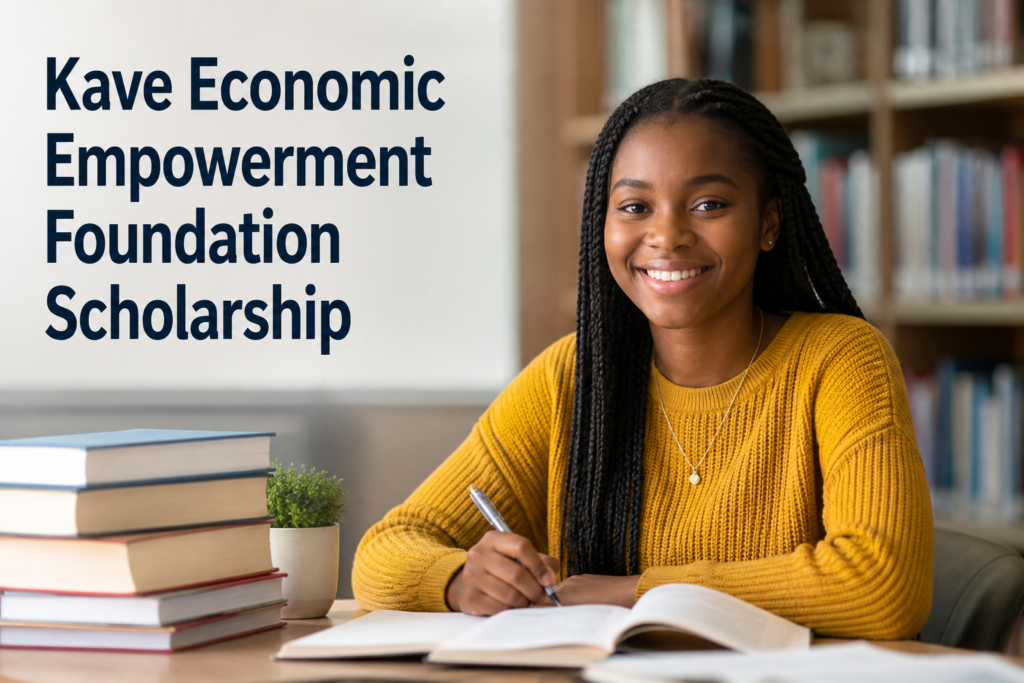
If you are a student from Benue State, Nigeria, struggling to cover the cost of your tertiary education, the Kave Economic Empowerment Foundation Scholarship (KEEF) is one opportunity you need to know about in 2026. This programme was created by Dr Godwin Kave, a Benue-born entrepreneur, philanthropist, and United Nations Peace Ambassador, to provide direct financial support to indigent students enrolled in tertiary institutions across all 23 Local Government Areas (LGAs) of Benue State.

The KEEF Scholarship is relatively new as a formally structured programme, but it has already made a meaningful impact. In April 2026, more than 100 students received scholarship awards worth a total of N5 million, distributed at a public event held at Gboko Polytechnic in Gboko LGA. Each of the 100 beneficiaries received N50,000 to support their ongoing academic journey. For many of these students, who come from backgrounds of genuine financial hardship, this was not just money. It was a lifeline that made the difference between continuing school and dropping out.
In this article, we explain everything you need to know about the KEEF Scholarship. We cover who Dr Godwin Kave is and why he created this foundation, what the scholarship offers, who is eligible, how the selection process works, how to apply, what students who have received the award are saying, and what to do to prepare for the next application cycle. If you are a Benue State student in a tertiary institution and you are facing financial challenges, read this article from beginning to end.
Who Is Dr Godwin Kave and What Is the Kave Economic Empowerment Foundation?
To understand the KEEF Scholarship properly, you need to understand the man behind it. Dr Godwin Kave is a Benue State-born entrepreneur, business mogul, and humanitarian. He holds the title of United Nations Peace Ambassador, a recognition of his sustained commitment to community development and peaceful coexistence. He is also based in Calabar and has built a career that has given him both the means and the motivation to invest in the communities he came from.
The Kave Economic Empowerment Foundation, commonly referred to as KEEF, is the institutional vehicle through which Dr Kave channels his philanthropic activities. The foundation was formally unveiled during the week-long activities that marked Dr Kave’s 50th birthday celebration in April 2026. Although he had been quietly offering humanitarian assistance for years before that, his 50th birthday provided what he described as an opportunity to institutionalise these interventions and give them a permanent structure through KEEF.
The motivation behind KEEF is deeply personal. Dr Kave has spoken openly about coming from a humble background and experiencing financial hardship while trying to pursue his own education. In his own words at the scholarship event: “My motivation for this initiative is that I was once in your shoes and I have come from a humble background, so I know how difficult it is to acquire education from a poor background.” This is not a foundation created from a distance by someone who has never faced the challenges that the beneficiaries face. It was built by someone who lived through those challenges and refused to forget where he came from after achieving success.
The foundation’s activities during the birthday week were deliberately broad and community-focused. The week began with a free medical outreach in Buruku LGA, where over 1,000 residents received free healthcare services including medical consultations, blood pressure checks, malaria testing and treatment, deworming for children, and distribution of basic hygiene and health materials. This was followed by a youth skills acquisition programme in Makurdi. Then came the scholarship awards at Gboko Polytechnic. Dr Kave also visited an Internally Displaced Persons (IDP) camp in Makurdi, where he donated relief materials to victims of the Yelewata attack. He also facilitated an Artificial Intelligence and ICT training programme for 150 Benue youths at Government Model Secondary School, Makurdi.
Each of these activities reflects a different dimension of what KEEF is trying to achieve. The foundation is not narrowly focused on scholarships alone. It is about economic empowerment in the broadest sense, addressing health, technology skills, livelihood support, and access to education all at once. The scholarship component is one important arm of a much larger mission.
Kave Economic Empowerment Foundation Scholarship 2026: What It Is and What It Offers
The formal name of this programme is the Kave Economic Empowerment Foundation Scholarship. It targets indigent students currently enrolled in tertiary institutions across Benue State. In the 2026 edition, a total of 100 students were selected as beneficiaries, each receiving N50,000 in financial support. The combined total disbursed during this single event was N5 million.
The scholarship is not structured as a monthly stipend or a fee payment made directly to an institution. It is a direct financial support award given to selected students to help them manage the cost of their education, whether that is paying outstanding fees, purchasing academic materials, covering transportation to school, or managing other education-related expenses. The award is paid in cash or through bank transfer, which gives students the flexibility to apply it where they need it most.
For students who were not able to attend the award ceremony in person, Dr Elijah Ikpanor, the Coordinator of the KEEF Scholarship and Colloquium, confirmed that shortlisted candidates who could not make it would receive their funds through bank transfers. This is an important detail because it shows that the logistics of the programme are designed to be inclusive rather than exclusionary.
The programme covered students drawn from across all 23 Local Government Areas of Benue State, not just from the LGA where the event was held or where Dr Kave is from. This geographic breadth is significant. It means that students from both the urban centres of the state and from rural, less accessible communities were considered and included in the programme. A student from Ushongo LGA had the same opportunity as a student from Makurdi, and a student from Gwer-West had the same chance as one from Gboko.
The students who benefited represented a variety of institutions and fields of study. Among the recipients reported were students from the University of Mkar, Moses Orshio Adasu University Makurdi (MOAUM, formerly known as Benue State University Makurdi), and Nasarawa State University, Keffi. Fields represented included English, Medical Laboratory Science, Data Science and Technology, and Medicine. This diversity of institutions and disciplines shows that the scholarship is not limited to any one type of course or any single university.
Who Is Eligible for the KEEF Scholarship?
Based on the information released during the 2026 edition of the scholarship, the eligibility criteria for the KEEF Scholarship are focused and specific. Here is what is required to qualify:
You must be an indigene of Benue State, Nigeria. The scholarship is specifically designed for young people who originate from Benue State. This is a community-focused programme, and the founder’s intention is to give back directly to the state he comes from. Students from other states who happen to be studying at Benue institutions are not the target of this scholarship.
You must currently be enrolled in a tertiary institution. The KEEF Scholarship is for students who are already studying at a university, polytechnic, college of education, or another accredited tertiary institution. It is not designed for secondary school students or for those who have not yet gained admission into a tertiary programme. You must be an active, enrolled student at the time of application.
You must demonstrate genuine financial need. The core purpose of this scholarship is to support indigent students, meaning students from low-income backgrounds who face real financial barriers to completing their education. Demonstrating financial need is a central requirement. The selection committee evaluates this carefully as part of the application review process.
You must be a resident or indigene from one of the 23 LGAs of Benue State. The programme is designed to reach students from all across Benue State, not just from specific towns or districts. The 23 Local Government Areas of Benue State include Ado, Agatu, Apa, Buruku, Gboko, Guma, Gwer, Gwer-West, Katsina-Ala, Konshisha, Kwande, Logo, Makurdi, Obi, Ogbadibo, Ohimini, Oju, Okpokwu, Otukpo, Tarka, Ukum, Ushongo, and Vandekya. Students from each of these areas are eligible to apply.
The KEEF Scholarship Coordinator, Dr Elijah Ikpanor, has publicly stated that applicants are expected to serve as ambassadors of the scheme after receiving their awards. This suggests that the foundation is looking for students who are not just in need but who are also serious about their studies, their character, and their potential contribution to their communities. While this is not a rigid additional criterion, it is worth keeping in mind when preparing your application.
How the KEEF Scholarship Selection Process Works
One of the most reassuring aspects of the KEEF Scholarship is the transparency of its selection process. Dr Elijah Ikpanor, who serves as Scholarship Coordinator as well as Director of Culture for Advancement and Linkages at Moses Orshio Adasu University, Makurdi, explained the process clearly at the 2026 award event.
The scholarship is publicly advertised across media platforms. This is not a closed or privately circulated opportunity. When a new application cycle opens, information about it is shared online and through media channels so that eligible students from across all 23 LGAs can become aware of it and apply. This approach is deliberate and intended to ensure fairness. A student in Vandekya or Ukum should have the same awareness of the opportunity as one in Makurdi or Gboko.
Applications are submitted online. The use of an online application system is specifically designed to eliminate geographic bias and ensure fairness. When applications come in digitally, the selection process is not influenced by who physically walked into an office or who someone knows at the venue. Each application stands on its own merits.
Selection is merit-based and transparent. Dr Ikpanor confirmed at the 2026 event that Dr Kave himself did not interfere with the selection process at any stage. “I did not have any interference from our founder or any committee member. They gave me the opportunity to assess you independently,” he said. This is a strong assurance for applicants who are concerned about whether the process is genuine. In a country where many scholarship programmes are questioned for transparency, KEEF’s insistence on independent, merit-based selection is a notable and commendable feature.
One of the 2026 beneficiaries, Iorkyaa Grace, a 400-level Medical Laboratory Science student at MOAUM, spoke candidly about this. She noted that her previous attempts to secure scholarships from other sponsors had not been successful, describing some of those programmes as “non-existent” and “questionable.” She commended Dr Kave for the genuine intervention. This kind of testimonial from a real student carries significant weight and speaks to the credibility of the KEEF process.
How to Apply for the KEEF Scholarship
The 2026 cycle of the KEEF Scholarship has already been completed. The call for applications was announced in April 2026, applications were reviewed, and 100 beneficiaries were selected and awarded at a ceremony at Gboko Polytechnic. If you missed this cycle, the next thing to do is prepare for the 2027 cycle.
Here is how to position yourself to apply successfully when the next round opens:
Step 1: Monitor official announcements closely. The 2026 scholarship was publicly announced on social media platforms before applications closed. Keep an eye on Dr Godwin Kave’s social media pages and the KEEF Foundation’s official channels for announcements about the next application window. The call for applications for 2026 was circulated on Facebook and other platforms, so following KEEF-related pages and accounts is one of the most practical ways to stay informed.
Step 2: Prepare your proof of indigeneship and financial need. Since the scholarship targets indigent Benue indigenes, you will likely need to provide documents that confirm your state of origin. A letter of indigeneship or local government certificate from your LGA is typically what is required in Nigerian scholarship applications of this type. In addition, you should be prepared to document your financial situation. This might include a letter from your parent or guardian describing your household income level, or any other documentation that demonstrates genuine financial hardship.
Step 3: Have your academic documents ready. As a student in a tertiary institution, you will need to confirm your enrolment. This typically involves having your student ID, your institutional admission letter, or your most recent academic results or transcript available to submit as part of your application.
Step 4: Write a sincere personal statement. While the specific application requirements for the KEEF Scholarship have not been published in full detail, most scholarship programmes of this type include a personal statement or essay component where applicants explain their circumstances, their academic goals, and why they deserve support. Write this honestly and from the heart. The Foundation’s founder has spoken about empathy and personal experience as the foundation of this programme. A genuine personal story is more compelling than a polished but hollow essay.
Step 5: Apply early when the portal opens. Online scholarship applications can receive heavy traffic when deadlines approach. Submit your application as early as possible once the window opens. Do not wait until the final days. Late applications are unlikely to be considered.
To stay updated on when the next KEEF Scholarship application opens and to access the official application portal when it becomes available, follow the Kave Economic Empowerment Foundation on Facebook for official announcements and updates. You can also follow updates through Nigerian scholarship platforms and news outlets covering Benue State developments. Remember, this scholarship is entirely free to apply for. Do not pay any individual or agent who claims to be processing applications on your behalf.
Voices of 2026 Beneficiaries: What Students Are Saying
The most meaningful way to understand the impact of the KEEF Scholarship is to hear from the students who received it. At the 2026 award ceremony, several beneficiaries spoke about what the award meant to them.
Nenger Mbanengen, a 300-level English student at the University of Mkar, expressed heartfelt gratitude to Dr Kave for the support. For a student in a humanities programme at a Benue-based private university, even a relatively modest sum can make the difference between clearing outstanding fees and facing deregistration.
Iorkyaa Grace, a 400-level Medical Laboratory Science student at Moses Orshio Adasu University, Makurdi, pointed out that she had applied for scholarships through other channels in the past without success. She described those experiences as discouraging and even questioned the legitimacy of some programmes. Her testimony about the KEEF process being real and transparent carries weight for any student who has become cynical after pursuing ghost opportunities.
Awua Bemdoo, studying Data Science and Technology at Nasarawa State University, Keffi, and Benjamin Saaondo, a medical student at MOAUM, both expressed appreciation and pledged to use the funds responsibly and with academic purpose.
These are real students from real programmes at real institutions. The variety of their backgrounds, schools, and fields of study confirms that the KEEF Scholarship is not a narrow, tokenistic programme but one that genuinely reaches across the breadth of Benue State’s student population.
What Distinguished Guests Said About the KEEF Scholarship
The 2026 scholarship ceremony at Gboko Polytechnic attracted a range of respected guests whose remarks added perspective to the significance of what KEEF is doing.
The Ter Gboko, HRH Gabriel Ishosum, was represented at the event by the District Head of Gboko South, HRH Akpam Abeke. He commended Dr Kave for choosing to mark his milestone birthday not through lavish celebrations abroad but through impactful humanitarian service at home. He advised the beneficiaries to use the funds wisely and encouraged them to carry the spirit of giving forward in their own lives. His remarks reflected a traditional value deeply embedded in Tiv and Benue culture: that a person of substance gives back to the community.
Prof Benjamin Odey Omang of the Department of Geology at the University of Calabar offered a line that captured the philosophy of the entire initiative simply and powerfully: “It’s not rich people that give, it’s good people that give. So, Kave is a good man.” This observation resonates beyond the event itself. KEEF was not built on unlimited wealth. It was built on a decision by one person to prioritise other people’s needs over personal celebration.
Dr Henry Effiom, the Chief Executive Officer of Henroy Enterprise in Calabar, used the occasion to urge prayers for Dr Kave to sustain and grow his philanthropic efforts. Dr Amon Terpase Emmanuel, Head of Station at the National Cereals Research Institute in Yandev, encouraged the students with a message about multiplication: “Make that token you are benefitting today speak. Let the little beginning multiply in thousand folds.”
The presence of the Benue State Commissioner for ICT and Digital Economy, Mr Kwaghgba Amande, at the AI training event connected to KEEF also demonstrated that the foundation’s work aligns with the broader development agenda of the state government under Governor Rev Fr Hyacinth Alia. This kind of institutional recognition helps ensure that the foundation’s efforts are not isolated acts of charity but are embedded within a wider ecosystem of support for Benue State’s youth.
Beyond the Scholarship: What Else KEEF Does
It is worth emphasising that the scholarship programme is just one part of what the Kave Economic Empowerment Foundation does. Understanding the full scope of KEEF’s work helps potential applicants and community members appreciate the long-term vision behind it.
The foundation’s AI and ICT training programme, which trained over 150 Benue youths in 2026, reflects Dr Kave’s recognition that the economy of the future runs on digital skills. Many Benue youths have access to smartphones and social media but are using these tools passively rather than productively. The training programme at Government Model Secondary School, Makurdi, was designed to redirect that energy toward income-generating digital work.
The medical outreach in Buruku LGA, which served over 1,000 residents, demonstrates that KEEF sees health as a pillar of community empowerment. When families are trapped in cycles of preventable illness, their children cannot focus on education. Addressing health at the grassroots level creates conditions in which academic investment becomes more possible.
The skills acquisition programme for youth in Makurdi, along with the provision of materials to women for small-scale enterprises, shows that KEEF is thinking about livelihoods across multiple age groups and demographics. Young women with small businesses are as much a part of Dr Kave’s vision of community empowerment as university students seeking scholarship support.
The fact that all of these activities were structured, announced in advance, and executed across multiple LGAs and venues within a single week indicates that KEEF is not an ad hoc or disorganised effort. It is a foundation with genuine institutional capacity and a plan for growing its impact over time.
Why the KEEF Scholarship Matters for Benue State Students
Benue State is one of Nigeria’s North Central states and is home to a large and ethnically diverse population. It faces considerable development challenges including poverty, conflict between farming communities and herders, and significant internal displacement of residents from rural areas. Despite these challenges, Benue State has a strong cultural value around education. Families across the state make enormous sacrifices to send their children to school, and many students are determined to complete their degrees despite financial hardships that would cause others to give up.
For students from Benue, the gap between ambition and access is often bridged by nothing more than a timely financial intervention. An N50,000 scholarship may not seem like a large sum in absolute terms, but for a student whose family earns from subsistence farming or petty trade, it can clear an outstanding balance that has been threatening their academic continuation. It can buy textbooks they have been reading photocopies of. It can cover a semester’s worth of accommodation rent. It can fund transportation to and from a distant institution for months.