
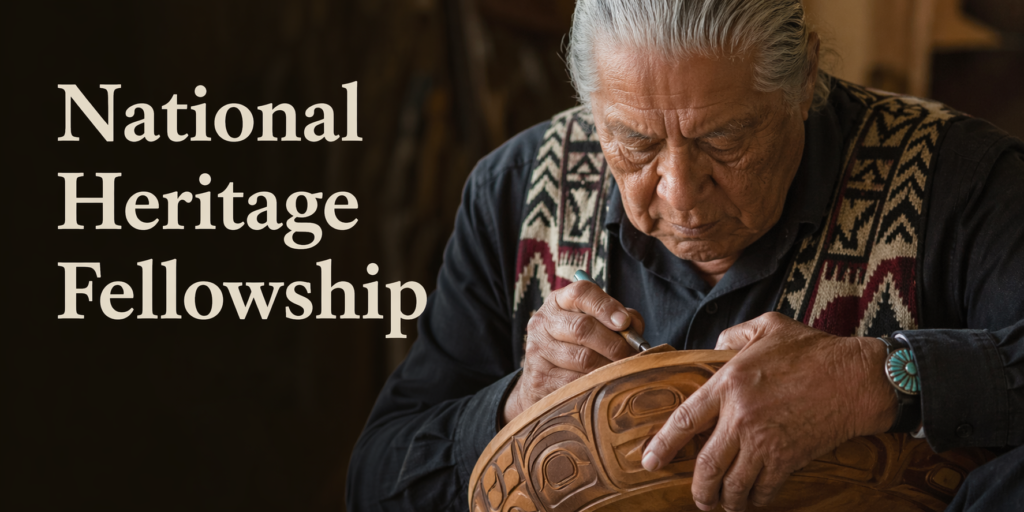
The National Endowment for the Arts (NEA) has officially announced the recipients of the 2026 NEA National Heritage Fellowships. This is the nation’s highest honor in the folk and traditional arts, and each year it brings a new spotlight to the master artists who are quietly keeping America’s most diverse and deep-rooted cultural traditions alive. The 2026 class includes musicians, dancers, craftspeople, a folklorist, and a basketry duo, representing communities across the United States and its territories.

If you have never heard of the NEA National Heritage Fellowship before, this article is a good place to start. And if you already know the program and want the full breakdown of who was recognized in 2026 and how the nomination process works for 2027, you will find everything you need here. This is a significant cultural moment, and it is worth understanding in full.
What Is the NEA National Heritage Fellowship?
The NEA National Heritage Fellowship is a lifetime honor awarded annually by the National Endowment for the Arts to master folk and traditional artists in the United States. It is widely considered the most prestigious recognition available in the field of folk and traditional arts, and it comes with a one-time cash award of $25,000.
The program was officially founded in 1982 by Bess Lomax Hawes, who served as the first director of the Folk and Traditional Arts Program at the NEA. The concept had been in development for roughly five years before the first fellowships were awarded. When the program launched, the monetary award was $5,000. That amount was raised to $10,000 in 1993, and since 2009 the award has been set at $25,000, which program administrators have described as enough to make a real difference without overshadowing the artistic recognition itself.
Since 1982, the NEA has awarded more than 500 of these fellowships. Including the 2026 class, the total number of recipients has reached 502. These artists span an extraordinary range of disciplines, from musicians and dancers to weavers, carvers, instrument makers, quiltmakers, storytellers, and cultural documentarians. What they all share is a lifetime of commitment to an art form rooted in community and passed down through generations.
Each year, the NEA honors between nine and thirteen artists with this fellowship. Recipients are sometimes described informally as national living treasures, a term that captures both the rarity of the recognition and the irreplaceable nature of the cultural knowledge these artists carry.
Who Are the 2026 NEA National Heritage Fellows?
The 2026 class of NEA National Heritage Fellows represents a rich cross-section of American cultural life, drawing from Latin music traditions, Indigenous Pacific Islander culture, Appalachian heritage, Irish instrument making, Western craftsmanship, and Hawaiian textile arts. Here is a look at each of the honorees.
Juan Díes and Victor G. Pichardo, Mexican Folk Musicians (Chicago, Illinois)
Juan Díes and Victor G. Pichardo are co-founders of Sones de México Ensemble, and together they have spent decades working to sustain Mexican son, a genre of regional folk music that draws from across different parts of Mexico. Their work spans performance, teaching, and community organizing. Through the ensemble they founded, they have brought Mexican son to national stages while simultaneously training new generations of musicians who might otherwise never have had access to this tradition. Their recognition as 2026 NEA National Heritage Fellows honors both the artistic excellence they have demonstrated and the deep community investment that has made their work sustainable over time.
Belen Escobedo, Conjunto Tejano Fiddler (San Antonio, Texas)
Belen Escobedo is a fiddler rooted in the musical traditions of the Texas-Mexico borderlands. The early Mexican and Tejano fiddle tunes she performs were once common across South Texas but have become increasingly rare over time. Through decades of both performance and teaching, Escobedo has helped preserve a style of playing that might otherwise have faded entirely from living practice. Her work represents exactly the kind of cultural stewardship the National Heritage Fellowship was designed to honor. She is based in San Antonio and continues to be an active presence in the Conjunto Tejano tradition.
Giovanni Hidalgo, Latin Percussionist (Ocoee, Florida)
Giovanni Hidalgo is one of the most celebrated Latin percussionists of his generation. Known for his extraordinary speed, technical precision, and deeply expressive playing style, he has been a transformative presence in the world of Latin percussion for decades. Beyond his performing career, Hidalgo has been a dedicated educator, influencing and training generations of musicians who have carried his approach into their own careers. His fellowship recognizes both his global artistic impact and his commitment to passing on the knowledge he has accumulated throughout a lifetime of serious musical practice.
Gerry Milnes, Folklorist and Documentarian (Elkins, West Virginia)
Gerry Milnes holds a special place among the 2026 class of fellows because he is the recipient of the Bess Lomax Hawes National Heritage Fellowship, a distinct honor within the fellowship program that recognizes an individual who has made a significant contribution to the preservation and awareness of cultural heritage rather than being a practicing artist themselves. Milnes was born in 1946 and has spent more than 50 years documenting the traditional arts and culture of Appalachia through recordings, films, and public programs. A West Virginia folklorist, author, filmmaker, musician, and educator, he was nominated by the West Virginia Humanities Council. His lifelong work has brought serious and sustained attention to the artists and cultural practices of his home region in ways that will outlast any single performance or exhibit.
The Bess Lomax Hawes National Heritage Fellowship, the award Milnes is receiving, was established in 2000 and is named after the same woman who founded the broader fellowship program in 1982. It is awarded annually to someone whose contributions to folk and traditional arts have been primarily through teaching, advocacy, and organizing rather than through personal artistic practice.
Lloyd Harold Kumulā’au Sing, Jr. and May Haunani Balino-Sing, Hawaiian Twined Basketry Artists (Wahiawa, Hawaii)
Lloyd Harold Kumulā’au Sing, Jr. and May Haunani Balino-Sing are Hawaiian twined basketry artists based in Wahiawa, Hawaii. Their work sits at the intersection of traditional craft and cultural continuity, representing practices with deep roots in Native Hawaiian culture. Twined basketry is a technically demanding art form, and their mastery of it, combined with their commitment to teaching and community engagement, exemplifies the kind of living cultural transmission that the National Heritage Fellowship exists to celebrate.
Patrick Olwell, Flutemaker (Athens, Georgia and Nellysford, Virginia)
Patrick Olwell is a flutemaker who has dedicated his career to reviving and redefining the wooden flute at the heart of Irish traditional music. Drawing on historical instrument designs and decades of meticulous study and craftsmanship, Olwell’s flutes have set the standard for instrument makers and players working in this tradition today. His work represents a rare form of cultural contribution, operating at the intersection of artistic excellence, historical scholarship, and practical craft. Olwell is based between Athens, Georgia and Nellysford, Virginia.
Frank Rabon, CHamoru Dancer and Choreographer (Hagåtña, Guam)
Frank Rabon is a Native Pacific Islander who has spent more than four decades leading efforts to restore and sustain CHamoru dance, an Indigenous tradition of Guam and the greater Mariana Islands. The CHamoru people’s dance tradition carries with it the history, language, and cultural knowledge of an entire community, and Rabon’s work has been central to ensuring that this knowledge continues to be transmitted to younger generations. His recognition as a 2026 National Heritage Fellow brings well-deserved national attention to cultural preservation work that has been happening in Guam for decades largely outside the mainstream spotlight.
Cary Schwarz, Saddlemaker and Leather Artist (Salmon, Idaho)
Cary Schwarz is a saddlemaker and leather artist based in Salmon, Idaho, whose work operates at the intersection of function and design. He creates custom saddles known for their structural strength, balance, and exceptional craftsmanship. Saddlemaking is a tradition with deep roots in the ranching and cowboy culture of the American West, and Schwarz represents the kind of master craftsperson whose knowledge of materials, form, and technique goes far beyond what can be learned from a manual or a classroom. His fellowship honors a lifetime of work that keeps a distinctly American craft tradition alive in its most skilled and authentic form.
What Does the NEA National Heritage Fellowship Include?
Each 2026 NEA National Heritage Fellowship includes a one-time monetary award of $25,000. In addition to the financial award, each recipient receives a certificate of honor and a congratulatory letter from the President of the United States. Recipients are also honored at a formal recognition ceremony in Washington, D.C., which is held in the fall each year.
The annual recognition events traditionally include an awards ceremony, a banquet, and a public concert or presentation featuring the honorees. Since the COVID-19 pandemic interrupted the in-person format starting in 2020, the events have evolved, with documentary films produced on each fellow by the National Council for the Traditional Arts (NCTA) in association with Hypothetical. In 2024, these films were screened at the John F. Kennedy Center for the Performing Arts. The 2026 fellows will be honored in Washington, D.C. in fall 2026, with more details expected to be announced later in the summer.
The NEA has confirmed that the fellowship is a lifetime honor, meaning it is awarded once to each recipient and is not a recurring or renewable grant. The program is one-time-only by design, which reflects its nature as a recognition of a lifetime of achievement rather than support for a specific project or period of work.
How Does the National Heritage Fellowship Selection Process Work?
The selection process for the NEA National Heritage Fellowship is community-driven and expert-reviewed, which makes it genuinely distinctive among arts honors of this scale. Here is how the process works from start to finish.
Public Nominations
The process begins with nominations submitted by the general public. Anyone can nominate a deserving folk or traditional artist for the fellowship, and in practice many nominees are put forward by members of their own communities, people who have witnessed their work firsthand and understand its depth and significance. The program receives an average of more than 200 nominations each year, which gives some sense of the breadth of traditional artistic talent that exists across the United States.
Expert Panel Review
From the pool of public nominations, a rotating panel of specialists reviews the candidates and makes recommendations. The panel includes folklorists, cultural experts with a variety of forms of specialized knowledge, and at least one layperson. This combination of professional expertise and community perspective is intentional, ensuring that the evaluation process is both rigorous and grounded.
National Council on the Arts Review
The expert panel’s recommendations are then reviewed by the National Council on the Arts, which is the advisory body for the NEA. The Council reviews the panel’s recommendations and sends its own recommendations forward to the NEA chairman.
Final Decision by the NEA Chairman
The final selection decisions are made by the chairman of the National Endowment for the Arts. For the 2026 class, that is Mary Anne Carter, who in announcing this year’s fellows noted that the honorees reflect the richness of America and carry forward cultural practices that have been passed down over generations.
The Bess Lomax Hawes National Heritage Fellowship: A Special Honor Within the Program
One fellow each year receives the Bess Lomax Hawes National Heritage Fellowship, which is a distinct recognition within the broader fellowship program. It was established in 2000 to honor Bess Lomax Hawes herself, the woman who created the fellowship program in 1982 and directed the NEA’s Folk and Traditional Arts Program during the years the program was developed.
The Hawes Fellowship is specifically awarded to individuals who have made significant contributions to the preservation and awareness of cultural heritage through teaching, advocacy, and organizing rather than through personal artistic practice. It recognizes the people behind the scenes who make it possible for traditional arts to survive and thrive, the folklorists, educators, documentarians, and community organizers whose work often goes unrecognized in award programs that focus only on performers and makers.
In 2026, that honor goes to Gerry Milnes, the West Virginia folklorist and documentarian whose more than 50 years of work recording, filming, and sharing the traditional culture of Appalachia has made him one of the most important figures in American regional folk arts documentation.
A Brief History of the NEA National Heritage Fellowship Program
Understanding where the National Heritage Fellowship came from helps explain why it matters as much as it does today. The program grew out of a recognition in the 1970s that the United States had no formal national mechanism for honoring its master traditional artists. In countries like Japan, such artists are officially designated as Living National Treasures and receive ongoing government recognition and support. The United States had no equivalent.
Bess Lomax Hawes and her colleagues at the NEA spent roughly five years developing the concept before the first fellowships were awarded in 1982. From the beginning, the program was designed to be community-rooted, with nominations coming from the public rather than being generated by institutional processes. That democratic foundation has remained central to the program’s identity ever since.
Over the decades, the program has recognized artists working in an extraordinary range of traditions, from Delta blues and Appalachian ballad singing to Carolinian stick dancing, Wildfowl decoy carving, Afghan rubab playing, and Tejano accordion. The full list of nearly 500 past recipients reads as a remarkable document of American cultural diversity and artistic excellence, and it continues to grow each year.
The National Council for the Traditional Arts (NCTA) has organized the annual recognition events in Washington, D.C. since 1983, producing the concerts, ceremonies, and documentary films that bring the fellows’ stories to broader public audiences. The Library of Congress’s American Folklife Center also holds extensive archival collections related to many past fellows, preserving recordings, photographs, and documentation of their work for future generations.
About the National Endowment for the Arts
The National Endowment for the Arts is an independent federal agency of the United States government, established by Congress to fund, promote, and strengthen the creative capacity of American communities. It is the largest funder of the arts and arts education in communities nationwide, and it operates as a catalyst for both public and private support for the arts across the country.
Beyond the National Heritage Fellowship, the NEA administers numerous other grant programs and honors, including the NEA Jazz Masters Fellowships, the National Medal of Arts, Grants for Arts Projects, the Our Town program for creative placemaking, and the NEA Big Read literacy initiative. The National Heritage Fellowship sits within the NEA’s honors portfolio alongside the Jazz Masters as one of the most prestigious recognitions the agency bestows.
The NEA is headed by a chairman appointed by the President of the United States. Mary Anne Carter currently serves in that role and has spoken about the importance of the National Heritage Fellowship as a way of recognizing artists whose contributions to American cultural life are often overlooked by mainstream arts institutions.
How to Nominate Someone for the 2027 NEA National Heritage Fellowship
One of the most important things to know about the NEA National Heritage Fellowship is that the nominations come from the public. This is not a program where insiders nominate each other or where recognition flows downward from institutional gatekeepers. If you know a master folk or traditional artist whose work deserves national recognition, you can nominate them, and your nomination could be the one that changes their life.
The NEA is currently accepting nominations for the 2027 class of NEA National Heritage Fellows, and the deadlines are coming up quickly.
2027 Nomination Deadlines
- Part 1, Online Nomination Form: Monday, May 11, 2026, by 11:59 p.m. Eastern Time
- Part 2, Additional Materials via Applicant Portal: Friday, May 22, 2026, by 11:59 p.m. Eastern Time
These are hard deadlines. Late, ineligible, and incomplete nominations will not be reviewed, and exceptions are only considered in cases of documented NEA systems failures.
The Two-Part Nomination Process
The nomination process has two distinct steps, and both must be completed to submit a valid nomination.
Step 1 requires you to complete and submit an online nomination form through the NEA website. This form captures basic information about both the nominee and the person making the nomination. You will need to have your information organized before you start, as the online form does not have full word processing features. The NEA recommends drafting your answers in a word processing program first, then copying and pasting the text into the form fields.
Step 2 requires you to submit additional materials through the NEA Applicant Portal. These materials include a nomination statement, an artist biography, letters of support, and work samples. Access credentials for the Applicant Portal are emailed to nominators after their Part 1 submission is received. All Part 2 materials must be submitted by May 22, 2026.
Starting in 2026, there is also an important change to how nominations are handled: nominations are now active for one year only. This means that any nominations submitted in previous years must be resubmitted to remain active in the current cycle. If you nominated someone in a prior year and they were not selected, you will need to resubmit your nomination to keep them in consideration for the 2027 class.
Who Is Eligible to Be Nominated?
To be eligible for nomination, a candidate must be a living U.S. citizen or permanent resident of the United States. Nominees must be actively participating in their art form, whether as practitioners, mentors, instructors, or scholars, and must be worthy of national recognition. All nominations must be submitted in English.
The program welcomes nominations across a wide range of folk and traditional arts disciplines. Past recipients have included visual and textile artists, dancers and choreographers, musicians, woodworkers, choral singers, community activists, filmmakers, archivists, documentarians, and radio producers. There is no narrow definition of what counts as a folk or traditional art form for the purposes of this program.
What Makes a Strong Nomination?
A strong nomination is specific, personal, and evidence-based. The expert panel reviewing nominations is looking for nominees who demonstrate a lifetime of artistic excellence, an active role in transmitting their tradition to others, and a meaningful connection to the community from which their art form comes. Generic praise is less useful than concrete examples of the artist’s work, their teaching, their community engagement, and the depth of their knowledge.
The American Folklore Society, in partnership with the NEA and the National Assembly of State Arts Agencies, has hosted workshops for people interested in submitting nominations, and recordings of those sessions are available for those who want a deeper understanding of what makes a nomination compelling. The Folk Arts Partnership Professional Development Institute is a good resource if you are preparing a nomination for the first time and want guidance on where to focus your effort.
To begin the nomination process, visit the NEA National Heritage Fellowship Nominations page on the official NEA website, where you will find the nomination guidelines, downloadable instructions, and the link to the online nomination form.
Why the NEA National Heritage Fellowship Matters
In a cultural landscape dominated by commercial entertainment and mass media, the art forms recognized by the NEA National Heritage Fellowship often exist at the edges of public visibility. A CHamoru dancer in Guam, a Tejano fiddler in San Antonio, a flutemaker in Virginia, a saddlemaker in Idaho: these are not people whose work generates headlines or streaming revenue. But the cultural knowledge they carry is irreplaceable, rooted in communities and histories that cannot be reconstructed once they are lost.
The $25,000 award is meaningful for artists who have often spent their lives prioritizing cultural commitment over financial gain. But the recognition itself may matter even more. Being named a National Heritage Fellow places an artist’s work in a national conversation, connects them with peers across the country, and creates documentary records, films, archival collections, and public programs that ensure their knowledge is preserved and accessible to future generations.
For communities whose traditions are being recognized, the fellowship can also function as a form of validation. It signals that the broader American public and its federal cultural institutions regard their heritage as worthy of the nation’s highest honor. That is not a small thing.