
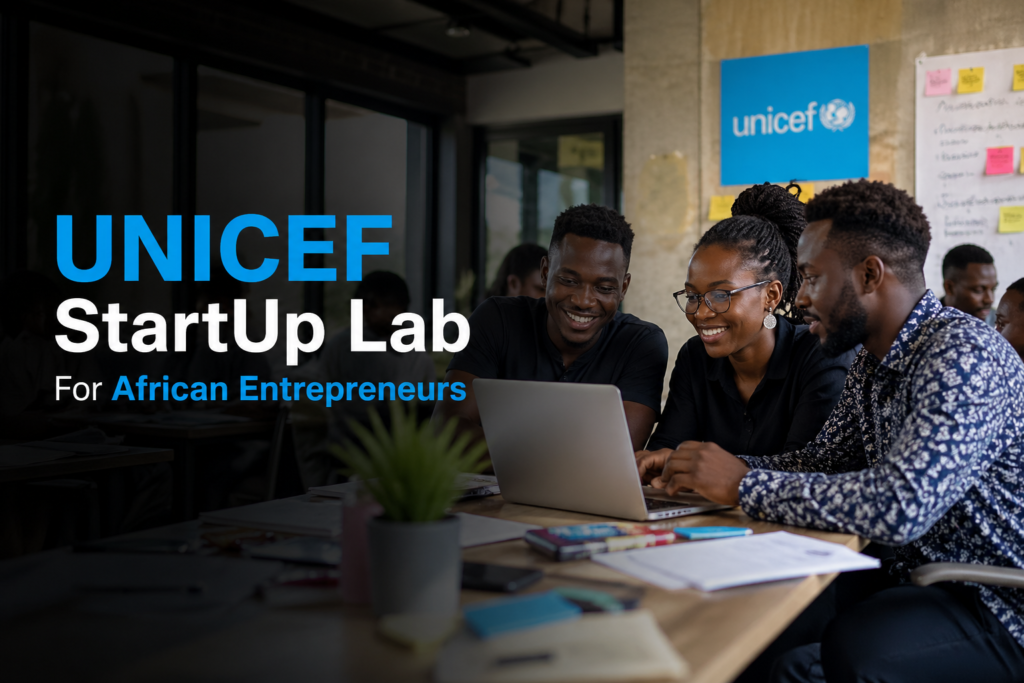
The UNICEF StartUp Lab has officially opened applications for its 2026 cohort, which is the sixth edition of one of West Africa’s most respected tech-focused social impact accelerator programs. If you are building a technology-driven startup in Ghana that is working to improve the lives of children, young people, or vulnerable communities, this is one opportunity you should not let pass without a serious look.

This is not just another accelerator program with a well-designed logo and a list of generic promises. The UNICEF StartUp Lab is backed by the full institutional weight of UNICEF Ghana, funded by the Korea International Cooperation Agency (KOICA), and implemented by MEST Africa, one of the continent’s most respected technology entrepreneurship institutions. It sits at the intersection of innovation, development policy, and global systems, and that combination creates something genuinely rare for African entrepreneurs: a non-dilutive pathway to funding, mentorship, and global visibility with one of the world’s most recognized and trusted organizations.
This article covers everything you need to know about the UNICEF StartUp Lab 2026, including how the program works, what it offers selected startups, which sectors it covers, how the application process works, what makes a strong application, and why the program’s focus on Digital Public Goods sets it apart from every other accelerator on the continent.
What Is the UNICEF StartUp Lab?
The UNICEF StartUp Lab is a six-month tech accelerator program designed specifically to support impact-driven startups and businesses that are building innovative, technology-enabled solutions addressing challenges faced by children and young people. It was launched in October 2019, when UNICEF Ghana partnered with the African Health Innovation Center (AHIC) and the Meltwater Entrepreneurial School of Technology (MEST) to welcome the first ever cohort of 13 young entrepreneurs at UNICEF’s offices in Accra.
Since that founding moment, the program has grown significantly in both scale and ambition. Through its first five cohorts, the UNICEF StartUp Lab has supported more than 103 startups, helping them collectively reach over 250,000 children and young people across Ghana. In 2026, the sixth cohort is now underway, with 20 carefully selected, growth-stage, tech-enabled social impact startups admitted to this year’s program.
The program is led by UNICEF Ghana, supported by KOICA under its partnership with UNICEF titled “Accelerating Entrepreneurship and Innovation in Ghana,” and implemented on the ground by MEST Africa. This three-way partnership between a global development organization, a government development cooperation agency, and a leading African technology school creates a depth of support that most accelerator programs simply cannot match.
Why the UNICEF StartUp Lab Stands Out in Africa’s Accelerator Landscape
Ghana and West Africa are home to a growing number of accelerator programs, and it is fair to ask what makes the UNICEF StartUp Lab worth the additional effort of a competitive application process. The answer lies in a few things that are genuinely different about how this program works.
First, it is entirely non-dilutive. Unlike venture capital-backed accelerators that take equity in your company in exchange for funding, the UNICEF StartUp Lab provides prototype grants and scale-up funding without taking any ownership stake in your business. That matters enormously for early-stage founders who are still figuring out the right ownership structure and do not want to give away equity before they have established real value.
Second, it operates at the intersection of innovation and global development policy. Most accelerators are purely business-focused. The UNICEF StartUp Lab actively connects startups to UNICEF’s programmatic work across Education, Health and Nutrition, Social Policy and Protection, Water, Sanitation and Hygiene (WASH), and Child Protection. This means selected founders are not just getting business coaching; they are engaging directly with domain experts who have decades of experience working on the specific problems their startups are trying to solve.
Third, it has a clear pathway to international recognition through the Digital Public Goods (DPG) framework, which we will cover in detail below. This pathway can significantly raise a startup’s profile and attractiveness to global partners and investors in ways that a standard accelerator demo day simply cannot replicate.
Fourth, the program’s track record is measurable and growing. Over five cohorts since 2019, it has moved from 13 startups in the first cohort to supporting over 100 ventures total, reaching a quarter of a million children. The Government of Korea through KOICA has invested $2.2 million over five years in this initiative, which is a serious financial commitment that reflects genuine confidence in the program’s impact.
The 2026 Cohort: What Has Been Announced
The sixth cohort of the UNICEF StartUp Lab has now been officially welcomed. Twenty growth-stage, tech-enabled social impact startups have been admitted to the 2026 program. These ventures are developing innovative solutions to address critical challenges facing children and adolescents across education, health, nutrition, climate action, and financial inclusion.
The 2026 cohort reflects interesting shifts in Ghana’s startup ecosystem. EdTech ventures make up 40 percent of the cohort, reflecting the growing maturity and market traction of education technology in Ghana. Alongside EdTech, the 2026 cohort also features strong representation from FinTech, Agriculture, and Climate Action sectors, which signals a broadening of the startup ecosystem’s focus beyond traditional health and WASH-focused ventures.
Geographically, while 50 percent of the 2026 cohort is based in Greater Accra, the program has maintained its commitment to regional inclusion, with representation from the Western, Northern, and Upper East regions of Ghana. This matters because the challenges facing children in rural and northern Ghana are often quite different from those in Accra, and regionally diverse cohorts produce more varied and complete solutions.
Christin Lucille McConnell, Chief of Education at UNICEF Ghana, spoke about the significance of this cohort on its launch: the startups demonstrate the creativity and commitment needed to tackle some of the most pressing challenges facing children today, and UNICEF will work closely with them to connect them to technical experts and investors so they can scale their impact for children in Ghana and beyond.
Over the next six months, the admitted startups will undergo a rigorous venture-building curriculum, working alongside UNICEF programme specialists and industry experts to refine their products, strengthen their business models, and build pathways toward international investment, including the UNICEF Innovation Fund and the Digital Public Goods ecosystem.
What Participants Receive: The Full Package
One of the things that makes the UNICEF StartUp Lab genuinely competitive among African accelerator programs is the breadth of what selected startups receive. It is not just a mentorship program with monthly check-in calls. The support is intensive, hands-on, and connected to real resources.
Equity-Free Prototype Grants
Every startup admitted to the 2026 cohort is eligible for a prototype grant of GHS 65,000 (approximately $6,000 USD at current exchange rates). This funding is designed to help startups iterate on and improve their core product or service, run user tests, build out technical infrastructure, or address any other product development bottleneck that is limiting their growth. Critically, this funding comes with no equity requirement, meaning you keep full ownership of your company while receiving financial support to move faster.
Scale-Up Fund for Top Performers
Beyond the standard prototype grant, three standout ventures from each cohort are selected to receive an additional GHS 165,000 (approximately $15,000 USD) through the Scale-up Fund. This larger award is reserved for startups that demonstrate exceptional progress during the program and have a clear, credible plan for scaling their impact beyond their current market. In previous cohort descriptions, this was framed as $15,000 in additional scale-up funding per selected startup, making the total potential funding for top performers significantly higher than the baseline grant.
Direct Engagement with UNICEF Programme Specialists
This is perhaps the most distinctive benefit of the entire program. Selected startups work directly with UNICEF’s sector specialists in Education, Health and Nutrition, Social Policy and Protection, WASH, and Child Protection. These are professionals who have spent careers understanding the specific challenges that startups in the UNICEF StartUp Lab are trying to solve. Having direct access to their knowledge, networks, and feedback is something that no amount of generic business coaching can replicate.
Access to the UNICEF Innovation Ecosystem
Participants gain access to UNICEF’s broader innovation ecosystem, including potential linkages to the UNICEF Venture Fund (also known as the UNICEF Innovation Fund), which has funded early-stage technology ventures around the world with equity-free funding of up to $100,000 USD. Being a UNICEF StartUp Lab graduate significantly raises a startup’s profile within the UNICEF system and can open doors to this additional funding tier.
KOICA and Development Partner Networks
Through the program’s partnership with KOICA, startups also gain linkages and engagement opportunities with Korean development partners, international investors, and the broader KOICA-affiliated development ecosystem. This is a meaningful differentiator because it opens doors to international markets and investor networks that most African startup founders would not otherwise have easy access to.
Tech Perks Including AWS Cloud Credits
The program provides tech perks including Amazon Web Services (AWS) cloud storage credits, which can meaningfully reduce the operating costs for tech startups that rely on cloud infrastructure for their products. While this may seem like a minor benefit compared to the grant funding, for early-stage software companies, cloud costs can be a significant line item, and free credits directly improve runway and reduce burn rate.
Mentorship, Training, and Industry-Led Sessions
The program provides intense, hands-on business acceleration through individual mentorship, industry-led training sessions, master classes, hackathons, and resident seminars. The curriculum covers everything from product development and business model refinement to impact measurement, investor readiness, and go-to-market strategy. One entrepreneur from each startup benefits from the full six-month entrepreneurship curriculum, including soft skills development and one-on-one mentorship.
Alumni Network and Long-Term Access
Once a startup graduates from the UNICEF StartUp Lab, the relationship does not end. Alumni continue to benefit from networking and investment opportunities, not limited to those available during the active program period. The growing alumni community of over 100 startups is itself a resource, providing peer learning, potential partnership opportunities, and a community of founders who understand what it means to build a social impact venture in the Ghanaian context.
Sectors Covered by the UNICEF StartUp Lab 2026
The UNICEF StartUp Lab has always been sector-focused, but the 2026 edition reflects a broader scope than earlier cohorts. The following sectors are specifically supported and encouraged to apply:
Education and EdTech sits at the core of the program’s work, and it is no surprise that 40 percent of the 2026 cohort comes from this sector. This includes digital learning platforms, tools for teachers and school administrators, solutions for out-of-school children, early childhood education technology, and platforms that improve learning outcomes for children in underserved areas.
Health and Nutrition covers a wide range of technology-driven approaches to improving child health outcomes, including digital health platforms, telemedicine tools, nutrition tracking applications, maternal and child health solutions, and technologies that improve health service delivery in low-resource settings.
Water, Sanitation and Hygiene (WASH) is one of the program’s original focus areas. Startups working on smart water monitoring, affordable sanitation systems, hygiene behavior change tools, and digital platforms for WASH service delivery are strongly encouraged to apply.
Child Protection and Social Policy includes startups working on digital tools for child protection case management, platforms that improve social service delivery, solutions for youth empowerment and active citizenship, and technologies that address gender-based violence, child labor, or child trafficking.
Climate Action has grown significantly as a focus area in recent cohorts. Startups developing climate-resilient agriculture, clean energy access tools, climate data platforms, and nature-based solutions that directly benefit children and communities are included in this sector.
FinTech and Financial Inclusion covers solutions that improve financial access for young people, families, and smallholder farmers, including mobile money platforms, savings and credit tools, and digital payment innovations that reach previously unbanked populations.
Agritech and Food Security addresses the intersection of agriculture and child nutrition, supporting startups that use technology to improve crop yields, reduce post-harvest losses, strengthen agricultural supply chains, and improve food access for families and communities.
Frontier Technologies including Artificial Intelligence and Machine Learning, Blockchain, and Cybersecurity are also welcomed, provided the application clearly demonstrates how these advanced technologies are being deployed in service of social impact for children and young people rather than purely commercial applications.

The Digital Public Goods Connection: Why This Matters
One of the most unique and strategically important aspects of the UNICEF StartUp Lab is its commitment to building the Digital Public Goods (DPG) ecosystem in Ghana and across Africa. Understanding what DPGs are and why they matter can give you a real competitive edge in your application.
Digital Public Goods are defined by the Digital Public Goods Alliance (DPGA), endorsed by the UN Secretary-General’s Roadmap for Digital Cooperation, as open-source software, open data, open AI models, open standards, and open content that adhere to privacy and other applicable laws, do no harm, and help attain the Sustainable Development Goals (SDGs).
In practical terms, a Digital Public Good is a technology solution that is open-source and can therefore be freely adopted, adapted, and deployed by governments, organizations, and communities anywhere in the world. The global development community places enormous value on DPGs because they represent scalable, non-proprietary approaches to solving shared challenges, which means they are eligible for significantly more institutional support and visibility than a standard commercial product.
The UNICEF StartUp Lab has been a pioneer in building DPGs from the African startup ecosystem. In 2021, one of the program’s graduates became the first startup in West Africa to have a product officially registered as a Digital Public Good by the DPGA. Since then, four startups from the lab have achieved DPG registration, making Ghana one of the most productive sources of Digital Public Goods in the developing world.
For founders participating in the 2026 cohort, the program actively supports the process of aligning their products with DPG standards, which includes open-sourcing relevant elements of their technology, ensuring compliance with applicable privacy laws, and documenting the solution’s relevance to the SDGs. Startups that are willing to open-source their solutions are particularly encouraged to apply, and those that successfully achieve DPG registration gain a level of global credibility and institutional recognition that can significantly accelerate their growth trajectory.
Eligibility: Who Can Apply for the UNICEF StartUp Lab?
The program has a clear set of eligibility requirements, and understanding them thoroughly before you apply will save you time and help you craft a much stronger application.
Your startup must be a registered, for-profit entity operating in Ghana. NGOs, individuals, and non-registered entities are not eligible. This requirement exists because the program is specifically designed to accelerate market-driven, sustainable social impact businesses, not grant-dependent organizations.
Your startup must have a clear social impact angle that addresses at least one of the Sustainable Development Goals (SDGs), with a specific focus on outcomes for children, young people, or vulnerable communities. If your startup is purely commercial without a credible, measurable social impact component, this program is not the right fit.
You need a functional product or prototype. The program is designed for growth-stage startups rather than ideation-stage founders. You should have something built that you can demonstrate, test, and iterate on during the six-month program.
Your solution should be technology-enabled. The UNICEF StartUp Lab is specifically a tech accelerator, so your core offering should involve a meaningful digital or technology component, whether that is a mobile application, a platform, hardware, AI tools, or another form of technology.
You need a motivated founding team that can fully engage with a six-month intensive program. This is not a passive program where you show up occasionally. The curriculum is demanding and requires real commitment from at least one founder throughout the program period.
Startups with female founders or co-founders are specifically and explicitly encouraged to apply. The program places significant value on gender inclusion and has consistently worked to increase the representation of women-led ventures in each cohort.
The program is geographically inclusive within Ghana, welcoming applications from all regions of the country and not just from the Greater Accra metropolitan area. Startups from Northern Ghana, the Western Region, the Eastern Region, and other parts of the country are actively sought out.
While the program is primarily targeted at Ghanaian startups, some sources indicate that applications from founders operating across other African and emerging markets who are interested in collaborating with UNICEF and scaling their solutions responsibly may also be considered on a case-by-case basis.
The Application Process: What to Expect
The UNICEF StartUp Lab application process typically runs in two stages. The first stage is a pre-application or expression of interest form that opens several months before the formal application window. This pre-application is intentionally brief and is designed to gauge interest and begin the screening process before the more detailed full application opens.