
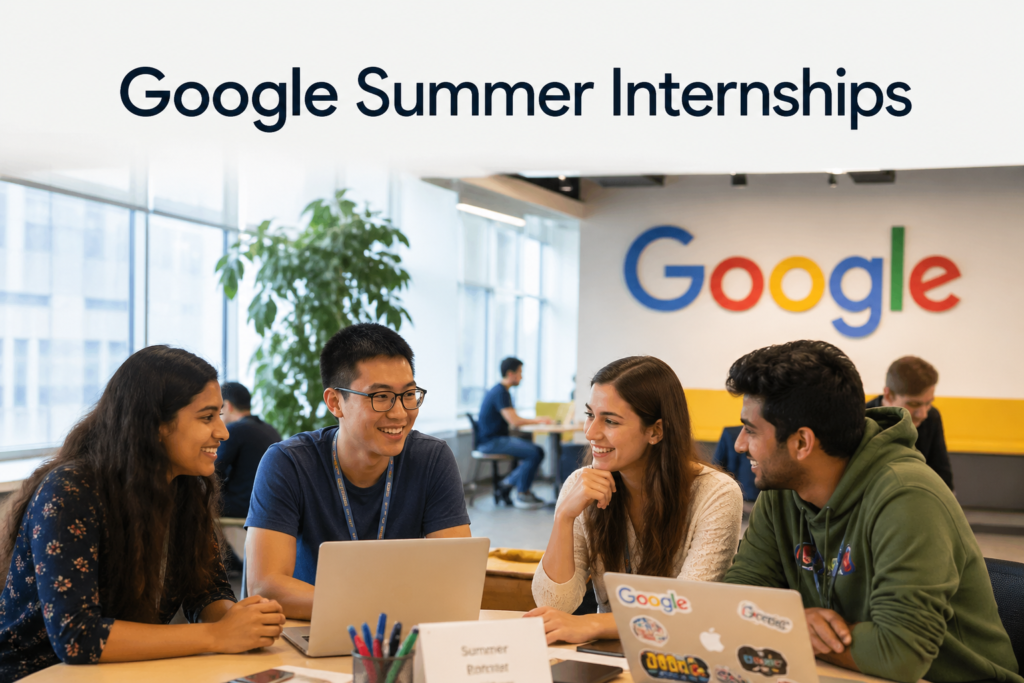
If you have been looking for a way to spend your summer doing something that truly matters for your career, the Google Summer Internships 2026 might be exactly what you need. Google runs some of the most recognized internship programs in the world, and every year thousands of students from different countries compete for a limited number of spots. Whether you are a computer science student, a policy enthusiast, or a developer interested in open-source software, there is likely a Google summer program designed for someone like you.

This article covers everything you need to know about the Google Summer Internships 2026, including the different programs available, who can apply, what benefits you will receive, how the selection process works, and a clear step-by-step guide to applying. Read carefully and bookmark this page because the information here could help you land one of the most competitive internships in the tech world.
What Are the Google Summer Internships 2026?
The phrase “Google Summer Internships 2026” does not refer to just one program. Google runs several distinct summer internship and fellowship opportunities, and each one targets a different profile of student. The three most widely searched programs are the Google Summer of Code (GSoC), the Google Public Policy Fellowship, and the Google Software Engineering Internship through Google Careers. Understanding which one matches your background is the first and most important step before you apply.
Each of these programs is legitimate, well-structured, and comes with a stipend. They differ in terms of focus area, eligibility requirements, duration, and application process. Let us break down each one so you know exactly what you are signing up for.
Program 1: Google Summer of Code (GSoC) 2026
Google Summer of Code, widely known as GSoC, is probably the most well-known of all Google summer programs among the student developer community. It is a global, online program that connects students and beginner developers with established open-source organizations. The goal is simple but powerful: bring new contributors into the world of open-source software development and help them build real skills under the guidance of experienced mentors.
GSoC has been running since 2005, and over that period, more than 1,000 open-source organizations have mentored over 21,000 new contributors from all over the world. The program has a track record that speaks for itself, and many of today’s prominent open-source developers started their journey through GSoC.
What You Will Do
As a GSoC contributor, you will spend 12 or more weeks working on a coding project with an open-source organization. Before the coding period begins, there is a community bonding phase that lasts about three weeks. During this time, you get to know your mentor, understand the codebase, set up your working environment, and agree on the milestones for the summer. This phase is not optional downtime; it is a critical part of the program that sets the foundation for everything that follows.
Once the official coding period begins, you work on your project with guidance from your assigned mentor. Midterm and final evaluations are conducted by mentors to assess your progress. You submit your final code and documentation at the end of the program, and your work becomes part of the open-source project for the world to use.
GSoC 2026 Stipend
The stipend for Google Summer of Code 2026 varies depending on your country of residence. Most participants receive between $3,000 and $6,600 USD for the duration of the program, with stipends paid in two installments: one after the midterm evaluation and one after the final evaluation. The exact amount for your country is published on the official GSoC website. The program is entirely remote, so there is no requirement to travel or relocate. You work from wherever you are.
GSoC 2026 Eligibility
To be eligible for Google Summer of Code 2026, you must meet the following criteria:
- You must be at least 18 years old at the time of registration.
- You must reside in a country that is not currently under a United States embargo.
- You should be a newcomer or beginner to open-source software development. GSoC is specifically designed for people who are new to contributing to open-source projects. Experienced contributors are generally not eligible.
- No formal college degree is required. GSoC is open to anyone who meets the age requirement and is new to open source, including coding school students and self-taught developers.
- You cannot have participated as a GSoC contributor two or more times previously.
- Participants from Russia, Belarus, and certain restricted regions are currently ineligible due to program rules.
One important thing to note is that GSoC is not a traditional internship where you get hired by Google. Participants are independent developers who receive a stipend for completing a project. It is also not a recruitment program, and participation does not guarantee employment at Google. The primary goal is to grow the open-source ecosystem.
GSoC 2026 Timeline
Here is the key timeline you need to follow for GSoC 2026:
- Mentoring organizations submitted their applications in late January and early February 2026.
- Accepted mentoring organizations were announced on February 21, 2026.
- Contributors could begin submitting applications from March 18, 2026, with the deadline on April 2, 2026.
- Accepted projects were revealed on May 1, 2026.
- The Community Bonding Period ran from May 1 to May 24, 2026.
- The official coding period began after the bonding phase, running for 12 or more weeks depending on the project scope (which can range from 8 to 22 weeks).
- Midterm and final evaluations are conducted at set points during the coding period.
Even if you are reading this after some deadlines have passed for 2026, it is never too early to start preparing for next year. The strategies and preparation steps covered later in this article apply regardless of which cycle you are targeting.
How to Apply for GSoC 2026
The GSoC application process is different from most internships. Here is how it works:
- Create an account on the Google Summer of Code platform and familiarize yourself with the program rules and contributor guide.
- Browse the list of accepted mentoring organizations and identify one to three projects that genuinely interest you. Quality matters more than quantity. Applying to too many organizations with generic proposals is a common mistake that leads to rejection.
- Start contributing to your chosen organization’s project before the application period opens. This is one of the most important things you can do. Mentors look for candidates who are already engaged with the community. Fix bugs, improve documentation, and submit pull requests to show your interest and capability.
- Join the organization’s communication channels, whether that is Slack, Discord, IRC, or mailing lists, and introduce yourself to the community.
- Draft your project proposal and share it with your target mentor for feedback. Do this early and iterate based on their input. A strong proposal includes a clear problem statement, your proposed solution, a detailed week-by-week timeline, your background, and why you are the right person for the project.
- Submit your final proposal through the official GSoC platform before the deadline.
One mistake that eliminates most candidates is applying without making any prior contributions. Mentors view this as a sign that you are not genuinely interested in the project. Your GitHub profile and contribution history matter. Start early, contribute meaningfully, and communicate openly with the mentoring organization.
You can apply for Google Summer of Code 2026 on the official GSoC website.
Program 2: Google Public Policy Fellowship 2026
The Google Public Policy Fellowship is another summer program under Google that is less focused on coding and more oriented toward technology policy, digital rights, and internet governance. This program is sometimes referred to as the Google Summer Internship in a general sense, but it is specifically about public policy work.
Selected fellows are placed with partner organizations that work on issues related to technology policy, cybersecurity regulation, privacy law, digital inclusion, and internet freedom. This is a program for students who are passionate about the intersection of technology and public policy, rather than software engineering alone.
Public Policy Fellowship Benefits
The fellowship comes with a stipend of up to $12,000 for full-time participants or $6,000 for part-time participants during the internship period. The exact amount depends on the nature of the placement and the duration of the fellowship. This funding supports students while they work with leading public interest organizations and gain exposure to real-world policy debates and research.
Public Policy Fellowship Eligibility
Unlike GSoC, this fellowship does not require a computer science background. Undergraduate, postgraduate, and PhD students from any academic discipline can apply, as long as they demonstrate a genuine interest in technology policy. Students who have previously participated in the Google Policy Fellowship are not eligible to apply again.
How to Apply for the Public Policy Fellowship
Applications are evaluated based on your academic background, the quality of your application materials, and your demonstrated interest in technology policy issues. Shortlisted applicants are matched with partner organizations working in relevant areas, and the final selection is communicated by email. Applicants are strongly advised to track the application timeline carefully and submit before the deadline to avoid disqualification.
You can find more information and apply through the Google Careers portal where fellowship listings are posted when available.
Program 3: Google Software Engineering Internship 2026
The Google Software Engineering Internship is what most people picture when they think of interning at Google. This is a traditional, paid internship where students join a Google team, work on real products, collaborate with experienced engineers, and get access to Google’s internal tools, infrastructure, and mentorship programs.
This is perhaps the most competitive of all Google summer internship programs because the number of available spots is limited and the pool of applicants is enormous. Students from top universities around the world apply for this internship, and the selection process is rigorous.

What Google Software Engineering Interns Do
As a software engineering intern at Google, you will be assigned to a specific team and work on a project that has real impact. Interns collaborate with full-time engineers, attend technical talks and workshops, and are given access to mentors who guide them through the summer. The work includes software design, development, testing, and in some cases, deploying features that reach millions of users.
The internship typically runs for 10 to 12 weeks during the summer. Locations include Google offices across the United States, Canada, India, Europe, and other regions. While some remote or hybrid arrangements have been offered in recent years, most software engineering internships are primarily in-office experiences.
Software Engineering Internship Eligibility
To apply for the Google Software Engineering Summer Internship 2026, you need to meet the following conditions:
- You must be currently enrolled in a Bachelor’s, Master’s, or PhD program in Computer Science, Computer Engineering, or a closely related technical field.
- You should have a strong foundation in at least one major programming language such as C++, Java, Python, or Go.
- You need demonstrated skills in data structures, algorithms, software design, and problem-solving.
- You should be expected to graduate after the internship ends, meaning you should still have coursework remaining after the summer.
- International students are welcome to apply, as long as they meet the eligibility criteria and are enrolled in a recognized academic institution.
Stipend and Benefits for Software Engineering Interns
Google does not publicly disclose the exact stipend figures for its software engineering internships, as these vary based on role, location, and seniority level. In India, for example, interns have been known to receive between approximately 80,000 and 1,20,000 rupees per month, with additional perks such as housing assistance and travel support. In the United States and other high-cost regions, compensation is among the highest in the industry for student internships. Additional benefits include free meals, networking events, mentorship sessions, and access to Google facilities.
Many interns who perform well during their summer internship also receive pre-placement offers or are invited to return for full-time positions after graduation. This makes the Google Summer Internship not just a learning experience but potentially a direct entry point into a full-time career at Google.
Selection Process for Google Software Engineering Internship
The selection process for the Google Software Engineering Internship involves multiple stages:
- Resume and application review: Google reviews your academic background, relevant projects, internship experience, and technical skills.
- Online assessment: Shortlisted candidates are asked to complete coding assessments that test their knowledge of algorithms, data structures, and problem-solving.
- Technical interviews: Candidates who pass the online assessment are invited to participate in one or more technical interviews. These interviews focus on coding, algorithm design, and sometimes system design depending on the level of the role.
- Behavioral and cultural fit evaluation: Google also assesses how well you collaborate, communicate, and align with the company’s culture.
- Final selection: Successful candidates receive an offer and are matched with a team based on their skills and available projects.
Google uses a rolling recruitment model, which means positions are filled as applications are reviewed rather than all at once after a fixed deadline. This makes it important to apply as early as possible. Waiting until the last moment significantly reduces your chances of being considered.
You can search and apply for available internship roles directly through the Google Careers student portal.
STEP Internship: A Path for Early-Stage Students
One program worth mentioning alongside the main Software Engineering Internship is the STEP Internship, which stands for Student Training in Engineering Program. STEP is specifically designed for first-year and second-year undergraduate students who are underrepresented in the technology industry.
STEP interns work on software development projects, receive mentorship, and often go on to apply for the standard software engineering internship in subsequent years. If you are an early-stage student who is not yet eligible for the main internship program, STEP is an excellent way to build your profile and get your foot in the door at Google early. Many STEP alumni have successfully transitioned into the main internship program after gaining experience through the STEP track.
Tips to Increase Your Chances of Getting Selected
With thousands of applicants competing for a limited number of spots in any Google summer program, preparation makes a significant difference. Here are some practical strategies that can help you stand out.
Build Your Technical Foundation
For both GSoC and the Software Engineering Internship, technical skills are non-negotiable. Focus on mastering core computer science concepts including data structures such as arrays, linked lists, trees, graphs, stacks, and queues, as well as algorithms including sorting, searching, recursion, and dynamic programming. For the Software Engineering Internship specifically, system design is also increasingly important for more advanced roles.
Practice coding problems regularly on competitive programming platforms. Participate in open challenges like Google Code Jam or Kick Start. These not only help you build skills but also demonstrate your engagement with the developer community.
Contribute to Open Source Before Applying for GSoC
For GSoC specifically, the single most important thing you can do before applying is to make meaningful contributions to the open-source project you are targeting. Read the codebase, understand the project structure, fix existing bugs, improve documentation, and submit pull requests. This shows mentors that you are serious and capable. Organizations use your prior contribution history as one of the strongest signals when deciding which proposals to accept.
Build a Strong Resume
Your resume should highlight relevant projects, technical skills, academic achievements, and any prior internship or research experience. Use clear headings and quantify your impact wherever possible. Tailor your resume for each role you apply to, making sure the skills and experience you highlight match what the job description or project description requires.
Write a Detailed GSoC Proposal
For GSoC, your proposal is your primary selling document. A strong proposal includes a clear description of the project, a detailed explanation of your technical approach, a week-by-week timeline with specific milestones, and a section about yourself that explains why you are the right person to complete this work. Share your draft proposal with the mentoring organization early and iterate based on their feedback. The more conversations you have with the community before you submit, the better your chances of being selected.
Apply Early
Whether you are applying for GSoC, the Policy Fellowship, or the Software Engineering Internship, applying early consistently improves your chances. Google reviews applications on a rolling basis for most programs, which means earlier applicants get more attention and positions fill up before the formal deadline. Do not wait.
Network with the Community
Join communities relevant to your target program. For GSoC, this means getting active in the mailing lists, Discord servers, or Slack channels of the organizations you are interested in. For the Software Engineering Internship, connecting with current Google interns or employees on professional networks can provide valuable insight into the interview process and what Google looks for in candidates.
What Happens After the Internship
Completing a Google summer internship, regardless of which program you participate in, opens doors in several meaningful ways. For GSoC alumni, many continue contributing to open-source projects and become active members of the developer community. Some organizations offer further involvement opportunities such as mentorship roles or freelance collaboration after the program ends.
For Google Software Engineering interns, strong performance during the summer can lead directly to a return offer for the following summer or a full-time offer upon graduation. Google interns who perform well are sometimes given a pre-placement offer, making the internship a direct runway into a full-time engineering career at one of the world’s most influential companies.
Even if a full-time offer does not follow immediately, the Google name on your resume carries significant weight. It signals technical competence, the ability to perform under high standards, and exposure to large-scale systems and professional engineering culture. Recruiters across the industry take note of this
Final Thoughts
The Google Summer Internships 2026 represent some of the most valuable opportunities available to students anywhere in the world. Whether you are interested in open-source development through GSoC, technology policy through the Public Policy Fellowship, or hands-on engineering through the Software Engineering Internship, there is a Google program that could fit your profile and ambitions.
The key to success in any of these programs is preparation, authenticity, and early action. Do not wait until applications open to start getting ready. Build your skills, engage with relevant communities, contribute to open-source projects if you are targeting GSoC, and refine your application materials well in advance of any deadline.
If you are serious about your future in tech or technology policy, a Google summer internship can be a defining experience. It is competitive, yes, but thousands of students earn a spot every year. The ones who do are the ones who started preparing early, applied with intention, and put genuine effort into every step of the process.
Ready to take the next step? Apply for Google Summer of Code 2026 here or visit the Google Careers student page to browse open internship roles and start your application today.