
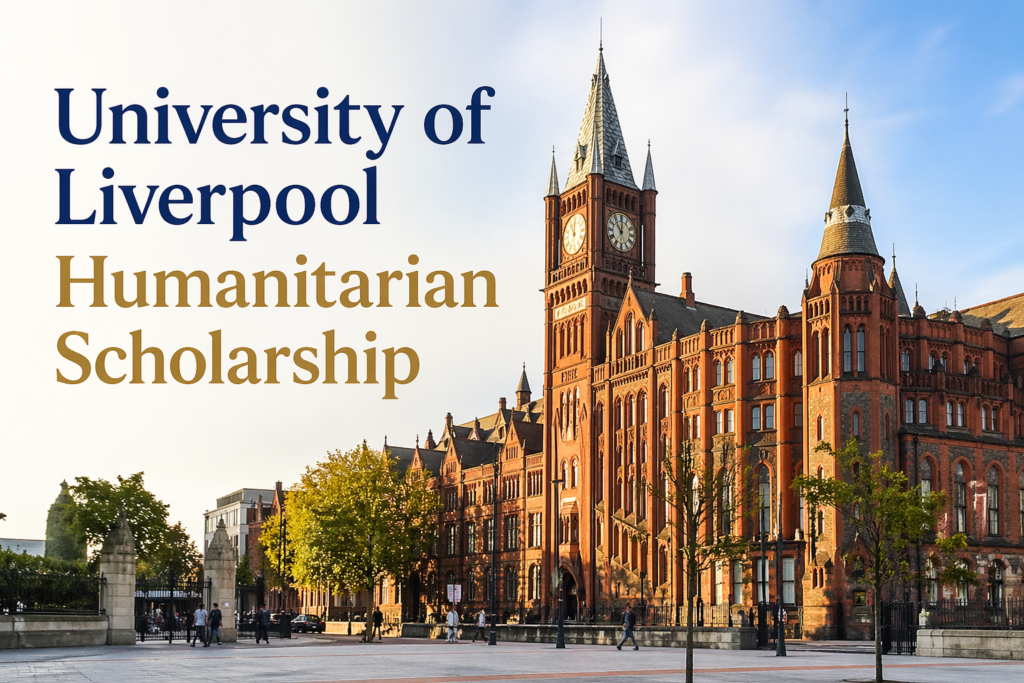
There are very few scholarship opportunities in the world that combine academic excellence, cultural solidarity, and full financial support in the way this one does. The University of Liverpool Humanitarian Scholarship in Irish Studies 2026 is an extraordinary opportunity created specifically for Palestinian students who have been displaced and are seeking to continue their postgraduate education in a safe, academically rigorous environment. If you are a Palestinian student who has sought international protection outside the United Kingdom and you have a deep interest in research, history, politics, or cultural studies, this scholarship could open a door that you may have thought was closed.

This article gives you a complete, detailed overview of everything you need to know about this scholarship. We cover what it is, who it is for, exactly how much financial support it provides, what the MRes programme in Irish Studies involves, how the application process works step by step, what the deadlines are, and how to write a personal statement that gives you a genuine shot at being selected. By the end of this guide, you will have all the information you need to decide whether to apply and to put together the strongest possible application.
About the University of Liverpool
The University of Liverpool is one of the United Kingdom’s most respected research universities. Founded in 1881, it is a member of the prestigious Russell Group, which brings together the UK’s leading research-intensive universities. Located in Liverpool, a city in northwest England known for its rich cultural history and welcoming, diverse population, the university has built a strong reputation for international student support, interdisciplinary research, and community engagement.
Liverpool as a city has its own deep and meaningful historical connections to global migration, social justice movements, and cultural exchange. It is a place that has historically welcomed people from all over the world, and that spirit of openness is reflected in the university’s approach to creating educational opportunities for students from difficult circumstances.
The university offers a wide range of postgraduate taught and research programmes across its faculties, and it has invested significantly in student support infrastructure, including dedicated services for international students, refugee students, and those navigating complex visa and financial situations.
About the Institute of Irish Studies
The Institute of Irish Studies at the University of Liverpool is the academic home of this scholarship. It is one of the leading centres for Irish Studies research in the world, and it brings together scholars whose expertise spans an impressive range of disciplines. The Institute specialises in the multidisciplinary study of Irish history, politics, literature, and language, with particular strengths in medieval and modern Irish history, peace and conflict studies, the politics of divided societies, Irish literature, and the Irish Language.
What makes the Institute of Irish Studies particularly relevant for Palestinian students is the thematic overlap between Irish and Palestinian experiences. Both societies have rich traditions of resistance, cultural survival, literature rooted in displacement, and complex relationships with political division, colonial history, and the pursuit of national self-determination. Scholars at the Institute are genuinely interested in exploring the connections between Ireland and Palestine, and the scholarship is designed with that intellectual bridge in mind.
Studying at the Institute means working alongside researchers who take the politics of divided societies seriously, who understand the lived experience of conflict and displacement, and who are committed to producing scholarship that has real meaning beyond the walls of the academy.
What Is the Humanitarian Scholarship in Irish Studies?
The University of Liverpool Humanitarian Scholarship in Irish Studies is a fully funded postgraduate scholarship that covers the cost of one academic year of study on the MRes in Irish Studies programme. It is offered in partnership between the university’s central scholarships team and the Institute of Irish Studies, and it is specifically designed to support one Palestinian postgraduate student per cycle.
The scholarship was created to enable access to higher education for individuals who have sought international protection, recognising that displacement should not mean the permanent end of someone’s academic or professional journey. It is part of a broader commitment by the University of Liverpool to support humanitarian causes and to provide pathways to education for students who have been affected by conflict and crisis.
This is not a partial bursary or a modest tuition discount. It is a comprehensive funding package that is designed to make it genuinely possible for a displaced Palestinian student to travel to Liverpool, begin a postgraduate research degree, and complete it successfully without facing insurmountable financial barriers.
Scholarship Benefits: What Does It Cover?
The financial support offered through this scholarship is substantial and covers almost every major cost associated with coming to Liverpool and completing the MRes programme. Here is a full breakdown of what is included.
Full Tuition Fee Waiver
The scholarship covers the complete cost of tuition fees for the one-year MRes in Irish Studies programme. You will not be expected to pay anything toward your course fees. This alone represents a significant sum, as international postgraduate tuition fees in the UK typically range from several thousand to over twenty thousand pounds per year depending on the subject and institution.
Accommodation Costs
University accommodation is arranged and covered as part of the scholarship package. You will be placed in university halls of residence, which removes one of the most stressful elements of relocating to a new country. The cost of accommodation is deducted from the maintenance stipend, so you will need to factor that into your financial planning for the year.
Living Stipend of Up to £18,688
A maintenance stipend of up to £18,688 is provided to support your living costs during the programme. This stipend is intended to cover everyday expenses such as food, local transport, clothing, and personal items. It is worth noting that after accommodation costs are deducted from this amount, you will need to plan your monthly budget carefully to make the most of what remains.
Travel Costs to Liverpool
The scholarship arranges and covers the cost of travel from your current location to Liverpool. This includes a meet-and-greet service upon your arrival via Manchester, which means someone from the university will be there to meet you when you arrive, helping you navigate your first moments in the UK with some support around you.
Visa Guidance and Reimbursement
Applying for a UK student visa involves upfront costs, including the visa application fee itself and the Immigration Health Surcharge. These costs are reimbursed after you arrive in the UK. The scholarship team also provides guidance on the visa application process, which is especially helpful for students who may be navigating UK immigration requirements for the first time or who face particular complications due to their refugee or humanitarian protection status.
Language Assistance and Integration Support
The university provides language assistance, access to student facilities and services, and integration support to help you settle into life in Liverpool and into the academic community. For students who may face challenges with academic English or with adjusting to a new country’s culture and systems, this kind of support can make a meaningful difference to both wellbeing and academic performance.
What the Scholarship Does Not Cover
It is important to be aware of one key limitation. The scholarship does not provide financial or administrative support for family members. If you have dependents or family members who would be accompanying you or who would need support during your time in the UK, you will need to make separate arrangements for them. The scholarship is structured entirely around the individual student recipient.
Students should also be prepared to cover some initial living expenses during their first few weeks in the UK while financial arrangements are being set up. A UK bank account is required to receive stipend payments, so setting that up promptly after arrival is an important early step.
The MRes in Irish Studies: What Will You Be Studying?
The Master of Research in Irish Studies is a research-focused postgraduate programme. Unlike a taught master’s degree, which is structured primarily around lectures and coursework modules, an MRes is centred on independent research. The heart of the programme is a substantial research project that you design, develop, and complete under the supervision of an academic member of staff at the Institute of Irish Studies.
The research areas available within the MRes are broad and genuinely interdisciplinary. Past and current areas of inquiry within the Institute cover medieval Irish history, modern Irish political history, the politics of divided societies, peace and conflict studies, Irish literature across different periods and genres, and the Irish Language. The Institute’s expertise is both deep and varied, which means there is significant flexibility in how you frame your research project.
For students applying through this humanitarian scholarship, the personal statement and research proposal should clearly discuss how the research will focus on links between Ireland and Palestine. This is not a bureaucratic requirement but a genuine intellectual invitation. The connections between Ireland and Palestine are rich and multi-layered, spanning shared histories of colonial experience, cultural resistance through literature and language, the politics of national partition, diaspora communities, and solidarity movements. Students who approach this thematic connection with curiosity and rigour will find a great deal of meaningful scholarly territory to explore.
Your research project could take a historical angle, examining how Irish and Palestinian nationalist movements have influenced one another or responded to similar political conditions. It could take a literary approach, comparing how displacement, loss, and cultural identity are expressed in Irish and Palestinian writing. It could focus on peace and conflict studies, examining how models of conflict resolution developed in the Irish context might hold lessons for other divided societies. The space for genuinely original and important scholarship here is real.
Eligibility Criteria: Who Can Apply?
The eligibility requirements for this scholarship are specific and you should check them carefully before beginning your application. Meeting all of the criteria is essential, as incomplete or ineligible applications will not be considered.
Palestinian Student Status
You must be a Palestinian student. There are two ways to satisfy this requirement. The first is to be a Palestinian student registered with the United Nations Relief and Works Agency for Palestine Refugees in the Near East, known as UNRWA, and to be able to provide evidence of that registration. The second is to be a Palestinian student from Gaza or the West Bank, with evidence of that status. Either pathway is acceptable, and the scholarship team will tell you what documentation is required to verify your status when you reach the application stage.
Currently Resident Outside the United Kingdom
You must currently be living outside the UK. This scholarship is intended for students who are abroad and seeking to come to the UK for their studies. Students who are already based in the UK are not eligible to apply for this particular award.
Seeking International Protection
The scholarship is designed for students who have sought international protection outside the UK. This reflects the humanitarian purpose of the award, which is to support individuals whose education has been disrupted by displacement and who are now living in circumstances that make accessing higher education difficult without financial assistance.
Academic Eligibility
You must be applying to study the Irish Studies MRes at the University of Liverpool. You cannot use this scholarship to fund a different programme. You must also demonstrate the academic potential to succeed in a postgraduate research degree, which will be assessed through your academic history, personal statement, and research proposal as part of your course application.
How to Apply: A Step-by-Step Guide
The application process has two distinct parts. You need to apply for the academic course first, and then separately apply for the scholarship. Both steps are required, and there are specific deadlines for each. Here is exactly how the process works.
Step One: Apply for the Irish Studies MRes
Your first action is to apply for the MRes in Irish Studies at the University of Liverpool. This application is submitted online through the university’s postgraduate application portal. You will need to complete your full education history, provide academic transcripts, and write a personal statement outlining your learning ambitions and research interests.
The personal statement is particularly important for this scholarship. You should clearly explain how your proposed research will focus on the connections between Ireland and Palestine. Be specific about the angle you want to take. Whether your interest is historical, literary, political, or cultural, describe it in detail. A vague statement of general interest will not be competitive. Show the selection panel that you have thought seriously about your research direction and that you have a genuine academic reason for wanting to pursue it at the Institute of Irish Studies.
The deadline to submit your course application is 1 April 2026. This deadline is firm. Applications submitted after this date will not be considered for the scholarship.
Step Two: Apply for the Scholarship
Once you have submitted your course application, you can proceed to apply for the scholarship itself. Scholarship applications open on 15 March 2026 and close on 1 May 2026. The application is made through an online form provided by the university’s scholarships team.
As part of the scholarship application, you will need to provide proof of your status as a Palestinian student. This means either evidence of your UNRWA registration or documentation confirming your connection to Gaza or the West Bank. Instructions on how to submit this documentation are included in the application form, and you must follow them carefully. Applications where this proof has not been provided will not be considered regardless of their academic merit.
Do not complete the scholarship application form until you have received either an unconditional offer or a conditional offer that you have already met. The scholarships team cannot consider applications from candidates who have not yet received a confirmed offer to study.
Step Three: Receive Your Offer
Once your course application has been reviewed, you will receive either a conditional or an unconditional offer to study the MRes in Irish Studies. A conditional offer means there are additional requirements you need to meet before the offer becomes confirmed, such as submitting further academic documentation or demonstrating English language proficiency. An unconditional offer means you have already satisfied all of the admission requirements and your place is confirmed.
Priority in the scholarship selection process may be given to applicants who hold unconditional offers, so if you can address any conditions quickly and efficiently, it is in your interest to do so.
Step Four: Meet Any Offer Conditions
If you have received a conditional offer, you will need to satisfy those conditions before proceeding. One common condition is demonstrating English language proficiency. The University of Liverpool accepts the Duolingo English Test as an accessible option, and limited vouchers for this test may be available for eligible scholarship candidates. Contact the scholarships team at wpscholarships@liverpool.ac.uk to ask about this if cost is a barrier for you.
Step Five: Await the Selection Decision
After the scholarship application window closes on 1 May 2026, applications are reviewed by a panel of university staff from both the central scholarships team and the Institute of Irish Studies. Selection is based on the completeness of the application, the quality of the course application and personal statement, receipt of an offer to study, and the submission of all required eligibility documentation. Successful candidates are expected to be notified in early June 2026.
Due to the extremely high volume of applications the scholarships team receives, they are not able to acknowledge receipt of individual applications or provide updates on application progress. You should not contact the team to check the status of your application unless you have a specific question about the process itself.
Visa Requirements and What to Expect When You Arrive
Studying in the UK requires a valid student visa. The scholarship team provides guidance on the visa application process, but students are responsible for initiating and managing their own visa applications. There are upfront costs involved in applying for a UK student visa, including the visa application fee and the Immigration Health Surcharge, which covers access to NHS healthcare during your time in the UK. Both of these costs will be reimbursed by the university after you arrive, so you need to be in a position to cover them initially. If this is a significant barrier, contact the scholarships team as early as possible to discuss your circumstances.
If you require a transit visa to travel through a third country on your way to the UK, you are responsible for arranging and funding that yourself. It is worth thinking through your travel route carefully and identifying whether any transit visas are needed well in advance of your travel date.
When you arrive, the scholarship includes a meet-and-greet service at Manchester. Someone from the university or a university-arranged support service will meet you and help you with the initial stage of your journey to Liverpool. This kind of support on arrival can make an enormous difference when you are arriving in a new country for the first time, especially after a period of displacement and instability.
Once you arrive and are settled, you will need to set up a UK bank account to receive your stipend payments. This is a practical early priority, and the university’s student support services can advise you on how to do this.
Why This Scholarship Matters
This scholarship is more than a financial award. It is a statement of solidarity and a genuine investment in the future of a Palestinian student who has faced extraordinary circumstances. The combination of full tuition coverage, a living stipend, accommodation, and travel support means that the financial barriers to coming to Liverpool and completing this degree are genuinely removed for the successful recipient.
The thematic heart of the programme, which is the exploration of links between Ireland and Palestine, places the scholarship within a broader tradition of solidarity between two communities that have both experienced the pain of division, displacement, and the long struggle for cultural and political recognition. Studying this connection in a rigorous academic setting at one of the UK’s leading research universities is an opportunity to produce work that matters, both intellectually and in the real world.
For Palestinian students who have had their education disrupted and who carry both the personal experience of displacement and a deep desire to understand and articulate that experience through scholarship, the MRes in Irish Studies at Liverpool offers a remarkable space to do exactly that.
Tips for a Strong Application
Because only one scholarship award is made per cycle, the competition is intense and the quality of your application needs to be as high as possible. Here are some practical suggestions for making your application as strong as it can be.