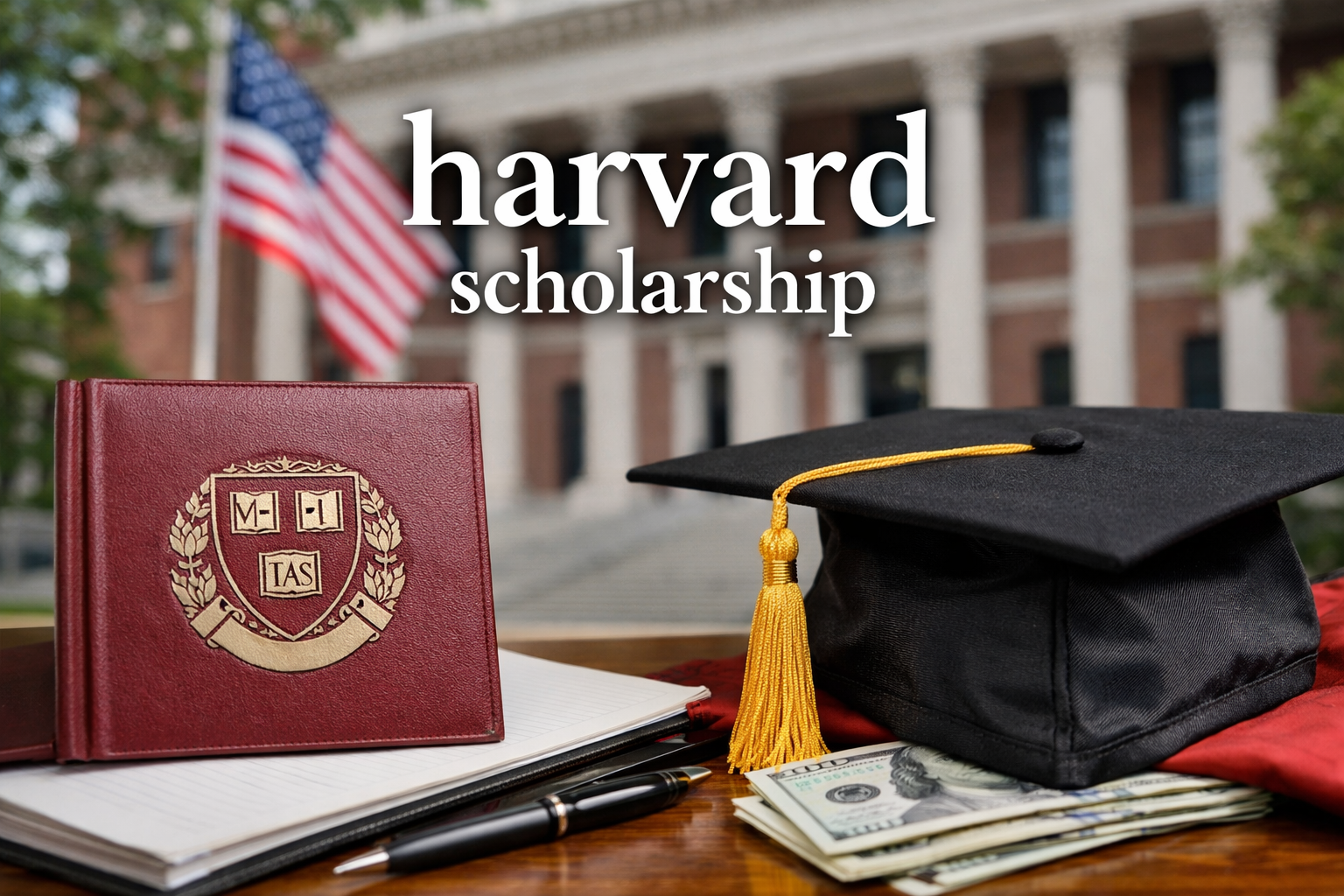
Harvard Scholarship: For most students around the world, Harvard University sits at the very top of their dream list. It is one of the oldest and most prestigious universities on the planet, and a degree from Harvard carries weight in virtually every professional field imaginable. The one thing that often stops people from even trying, though, is the assumption that Harvard is simply too expensive. That assumption, as it turns out, is largely wrong.

Harvard has one of the most generous scholarship and financial aid programs of any university in the world. In fact, in 2025 the university made headlines by announcing that starting from the 2025-2026 academic year, Harvard would be completely free for students whose families earn $100,000 or less per year. This was a significant step up from the previous threshold of $85,000, which itself had been raised multiple times over the past two decades. And for families earning up to $200,000 per year, Harvard covers the full cost of tuition entirely.
This guide is designed to give you a complete, honest, and practical understanding of every Harvard scholarship and financial aid opportunity available in 2026, from undergraduate grants to graduate fellowships to specialized programs for international students. Whether you are a high school student dreaming of studying at Harvard College, a graduate student exploring options at Harvard Kennedy School or Harvard Law School, or an international applicant from the UK, Australia, Canada, or another country, this article covers what you need to know.
Understanding How Harvard Scholarships Work
Before diving into the specific programs, it is important to understand the philosophy behind how Harvard funds its students. Harvard’s financial aid model is almost entirely need-based at the undergraduate level. Unlike many universities that offer merit-based scholarships to attract high-achieving students, Harvard College does not distribute scholarship money based on academic performance, GPA, or standardized test scores. Every student admitted to Harvard is admitted on merit. The financial aid system then works separately to make sure that every admitted student can actually afford to attend.
This distinction matters because it changes how you think about applying. You do not need a perfect SAT score or a 4.0 GPA to qualify for financial aid at Harvard. You need to demonstrate financial need, get admitted, and then Harvard will do the work of figuring out how much support your family requires.
The funds that Harvard uses to pay for student scholarships come from multiple sources: the university’s endowment (which is the largest of any university in the world), gifts from alumni, general tuition revenues, and federal and state grants. The Faculty of Arts and Sciences Scholarship program alone includes more than 2,000 individual endowment and gift funds. Harvard has awarded more than $3.6 billion in undergraduate financial aid since launching its Harvard Financial Aid Initiative in 2004, and the annual financial aid budget for the 2025-2026 academic year is $275 million.
Loans are never required as part of a Harvard financial aid package. Every dollar of financial assistance you receive from Harvard is in the form of grants that you never have to repay. In 2007, Harvard eliminated loans entirely from its financial aid offers, which was a bold and meaningful decision that set it apart from most other universities.
Harvard Undergraduate Scholarship: The Financial Aid Program
If you are applying for a bachelor’s degree at Harvard College, the primary source of scholarship funding is Harvard’s need-based financial aid program. Here is how it works in practical terms for the 2025-2026 academic year.
Free Attendance for Families Earning Up to $100,000
For students whose families have an annual income of $100,000 or less with typical assets, Harvard is completely free. This covers all billed expenses: tuition, food, housing, health insurance, and estimated travel costs between home and campus. Additionally, students in this income bracket receive a $2,000 start-up grant during their first year to help with the transition to university life, and a $2,000 launch grant during their junior year to help prepare for life after Harvard. Harvard also covers winter gear and event fees for these students.
To put this in context, Harvard’s sticker price for the 2024-2025 academic year was approximately $82,866 for undergraduate students. That full amount becomes zero for qualifying families. This is not a small scholarship. It is a complete transformation of what Harvard costs.
Free Tuition for Families Earning Up to $200,000
For families with annual incomes between $100,000 and $200,000, Harvard covers the full cost of tuition, which for 2024-2025 was $59,320. Beyond tuition, these students are also individually evaluated for additional financial aid to cover other billed expenses like room and board depending on their specific financial circumstances.
Aid for Families Earning Above $200,000
Even families earning above $200,000 per year may receive financial assistance depending on their individual circumstances. Harvard’s financial aid officers work personally with every family to assess their unique situation. Factors like family size, number of children in college simultaneously, unusual medical expenses, and other financial obligations are all taken into account. Home equity in the primary residence and retirement savings are typically not counted when Harvard calculates what a family can contribute.
Currently, 55 percent of Harvard undergraduates receive financial aid of some kind, which means more than half the student body is not paying the full sticker price.
Student Work Contribution
As part of the financial aid package, students are expected to contribute to their own education through part-time employment. The typical expectation is around 10 to 12 hours of work per week during term time, which comes to roughly $3,500 per academic year in personal expenses. Jobs on campus are plentiful and varied. Around two-thirds of Harvard students work during the academic year regardless of their financial aid status.
How to Apply for Harvard Undergraduate Financial Aid
To apply for financial aid as an undergraduate, you need to complete the CSS Profile through the College Board, which collects detailed information about your family’s financial situation. If you are a US citizen or permanent resident, you also need to submit the Free Application for Federal Student Aid (FAFSA), which determines your eligibility for federal Pell Grants and Supplemental Educational Opportunity Grants (SEOG). International students submit the CSS Profile and additional documentation.
Your financial aid application is completely separate from your admission application, and crucially, your financial circumstances have no effect on your chances of being admitted to Harvard. Harvard practices need-blind admissions for US students, which means that whether or not you apply for financial aid has no bearing on the admissions decision.
You can start your Harvard undergraduate financial aid application on the official Harvard College financial aid page, where you can also use the Net Price Calculator to estimate what your family would be expected to contribute before you even apply.
Harvard Scholarship for International Students
International students are a frequent concern when it comes to Harvard financial aid. The reassuring answer is that international students at Harvard College are eligible for financial aid on exactly the same basis as American students. Harvard College is need-blind for US students in admissions, though for international applicants the university is need-aware, meaning your financial need may be considered during the admissions process. However, once admitted, international students receive the same generous need-based support as domestic students.
For graduate students, international funding is more varied and depends heavily on which school you are applying to. Harvard has a Committee on General Scholarships (CGS) that administers special financial aid, scholarship, and fellowship programs for full-time, in-residence Harvard graduate and undergraduate students, including students from specific countries or regions. Some CGS scholarships are restricted to students from particular cities, states, countries, or ancestries. International students are also encouraged to explore external fellowship opportunities, many of which specifically fund study at Harvard.
The Frank Knox Memorial Fellowship
One of the most well-known external scholarships that funds graduate study at Harvard is the Frank Knox Memorial Fellowship, which is specifically for students from Australia, Canada, New Zealand, and the United Kingdom.
The Frank Knox Memorial Fellowship was established in 1945 by Annie Reid Knox, wife of Frank Knox, who served as U.S. Secretary of the Navy in the 1940s and was a prominent businessman and politician. Knox believed strongly in the importance of cross-cultural exchange between the United States and the nations of the British Commonwealth as a foundation for international peace. Since the first Knox Fellowships were awarded in 1948, more than 625 Knox Fellows have studied at Harvard.
What the Frank Knox Fellowship Covers
A Knox Fellowship pays the full Harvard tuition for the recipient’s graduate program, plus mandatory health insurance fees. It also provides a stipend of at least $32,000 per year to cover living expenses for a 10-month academic year. For students in programs that require more than one year of study, Knox Fellowship funding is guaranteed for up to two years, provided the student remains in good academic standing. Renewal beyond the second year is considered on a case-by-case basis by the Committee on General Scholarships.
Eligibility for the Frank Knox Fellowship
To be eligible, you must be a citizen or permanent resident of Australia, Canada, New Zealand, or the United Kingdom. For UK applicants, you must normally be resident in the UK at the time of application. You must be studying for a first or higher degree and due to graduate in the relevant academic year, or you must have completed a first or higher degree and graduated no earlier than a specified number of years before the application. You must not already be in the United States at the time of application.
Selection is based on academic excellence and personal qualities described in the Deed of Gift: future promise of leadership, strength of character, keen mind, balanced judgment, and devotion to the democratic ideal. The Knox Fellowship is not available for part-time programs or Executive Education programs.
Importantly, the Knox Fellowship does not guarantee admission to Harvard. You must apply for admission separately to the Harvard graduate school of your choice, and the fellowship award at interview in January is contingent on gaining admission to the university.
Harvard Kennedy School Scholarships and Fellowships
Harvard Kennedy School (HKS), which is Harvard’s graduate school of public policy, offers a range of scholarships and fellowships for both US and international students pursuing master’s degrees in public policy, public administration, and international development.
Unlike Harvard College, which is entirely need-based in its aid approach, Harvard Kennedy School offers both need-based financial aid and merit-based scholarships and fellowships. Some of the institutional funding at HKS is restricted to specific criteria such as a student’s area of study, career focus, or geographic background.
Here are some of the key fellowship programs at Harvard Kennedy School.
Harvard Kennedy School General Fellowships
HKS offers a variety of fellowships based on merit and areas of interest. These include support for students with demonstrated interest in science, technology, national security, and international relations. There are fellowships for students interested in energy and environmental policy, for students from Arab League countries, and for students committed to dismantling systemic barriers to equity across society.
The Committee on General Scholarships (CGS) at Harvard also administers CGS restricted scholarships and CGS international fellowships for HKS students. CGS restricted scholarships are awarded based on specific geographic or ancestral criteria and typically range in amount from a few thousand dollars upward as supplementary funding. CGS international fellowships are country-specific and require a separate application process distinct from the general HKS financial aid application.
To apply for HKS scholarships, you must complete the HKS Financial Aid Application after submitting your application for admission. There are very few opportunities to apply for fellowship or scholarship funding after you are already admitted or enrolled, so it is important to complete your financial aid application during the admissions process.
The Harvard Academy Scholars Program
For postdoctoral researchers, Harvard offers the Harvard Academy Scholars Program, which is administered by the Weatherhead Center for International Affairs. This is one of the most prestigious postdoctoral appointments in the social sciences and law.
The Harvard Academy Scholars Program identifies and supports outstanding scholars at the very beginning of their research careers whose work combines disciplinary excellence in the social sciences or law with a command of a language and the history or culture of a non-Western country, region, or region. Their scholarship may address domestic, comparative, or transnational issues, both historical and contemporary.
Benefits of the Harvard Academy Scholars Program
Academy Scholars receive an annual stipend of $75,000. This stipend is supplemented by funding for conference and research travel, research assistants, and health insurance coverage. Each year, four to six Academy Scholars are named for two-year appointments. Some teaching is permitted during the appointment but it is not required. Academy Scholars are expected to reside in the Cambridge and Boston area for the duration of their appointments except when traveling for pre-approved research purposes.
How to Apply for the Harvard Academy Scholars Program
The application requires you to create a new account on the application portal and submit a cover letter that succinctly describes your academic field, country or region of specialization, and proposed research topic. You also need to submit a curriculum vitae including a list of publications, a research proposal of up to 2,500 words that covers your intellectual objectives and planned methodological and disciplinary work, and three confidential letters of recommendation. All parts of the application, including the recommendation letters, must be submitted online as PDF documents.
The Boustany MBA Harvard Scholarship
If you are aiming to pursue an MBA at Harvard Business School, one of the most notable external scholarships available is the Boustany MBA Harvard Scholarship, awarded by the Boustany Foundation.
The Boustany Foundation is a charitable organization with the goal of improving educational opportunities for talented students from less privileged backgrounds. Its Harvard MBA scholarship is awarded every two years, making it one of the more selective and less frequent scholarship opportunities at Harvard. The scholarship is intended for students of exceptional academic ability who want to use their education to make a positive contribution to the world.
What the Boustany Scholarship Covers
The Boustany scholarship provides full tuition coverage for the Harvard MBA program. One distinctive feature of this scholarship is that it includes a two-month internship at the Boustany Foundation itself. During this internship, scholars work on the Foundation’s projects and gain practical experience applying their academic learning to real-world situations. This hands-on component is seen as central to the scholarship’s mission of preparing leaders who can bridge theory and practice.
How to Apply for the Boustany Scholarship
You must first apply to and receive an offer of admission from Harvard Business School. Only after receiving an admission offer can you apply for the Boustany scholarship. The application is submitted online to the Boustany Foundation and includes a copy of your curriculum vitae, a photograph, your GMAT scores, and your acceptance letter from Harvard Business School. Shortlisted candidates are invited for an interview, which may be held online or in person at the Boustany Foundation.
Harvard South Africa Fellowship Program
One of Harvard’s more specialized international fellowships is the Harvard South Africa Fellowship Program (HSAFP). This program was established in 1979 by Harvard President Derek Bok specifically to address the educational needs of South Africans who had been denied access to advanced education under Apartheid. The program was a direct response to advocacy by Harvard students and faculty and reflects the university’s long-standing commitment to using education as a tool for social justice.
The HSAFP supports South African students in pursuing graduate-level study at Harvard. Applications are typically due in mid-April each year, and interested applicants should monitor the program’s announcements for the latest details and deadlines.
Other Notable Harvard Scholarship and Fellowship Opportunities
Beyond the major programs discussed above, Harvard has dozens of additional scholarship and fellowship opportunities through its various schools and through the Committee on General Scholarships. Here are several worth knowing about.
The Radcliffe Engaged Student Grant Program
This program provides $1,500 stipends per project to support the research, creative, and service work of Harvard undergraduate and graduate students. Projects must be related to specific focus areas set by the Radcliffe Institute, which have recently included topics like law, education, justice, and climate change. This is a relatively accessible grant program open to current Harvard students from various schools.
The Ashton Award for Student Research
This award is valued at $4,000 and supports investigations by graduate and advanced undergraduate students working on Asian tropical forest biology. It is a specialized award within the natural sciences but represents the kind of niche research funding that is available throughout Harvard’s many departments and research centers.
Aga Khan Foundation Scholarships
The Aga Khan Foundation provides a limited number of scholarships each year for postgraduate study to outstanding students from developing countries. Scholarships are awarded on a 50 percent grant and 50 percent loan basis through a competitive application process. The Foundation gives priority to master’s level applicants but will also consider PhD applications where a doctoral degree is clearly necessary for the applicant’s career objectives. Harvard students and applicants can use these awards toward their degree costs.
The Kennedy Scholarship
The Kennedy Scholarship is specifically for British students and allows recipients to fund graduate study at either Harvard or MIT. It can be used across a wide range of programs at Harvard’s graduate schools, from a PhD to an LLM, from an MPH to an MArch. It can also fund Special Studentships for students seeking a non-degree program of study. The Kennedy Scholarship is administered through the Kennedy Memorial Trust and is one of the UK’s most prestigious scholarships for study in the United States.
Tips for Applying Successfully for a Harvard Scholarship
Applying to Harvard is a deeply personal process, and the same is true for its scholarship and financial aid programs. Here is practical advice to help you put your best foot forward.
Start the financial aid process early, not after you have been admitted. For undergraduate applicants, submit your CSS Profile and FAFSA at the same time as your admission application. For graduate applicants, complete the school-specific financial aid application as soon as it is available. Leaving financial aid to the last minute is one of the most common and costly mistakes applicants make.