
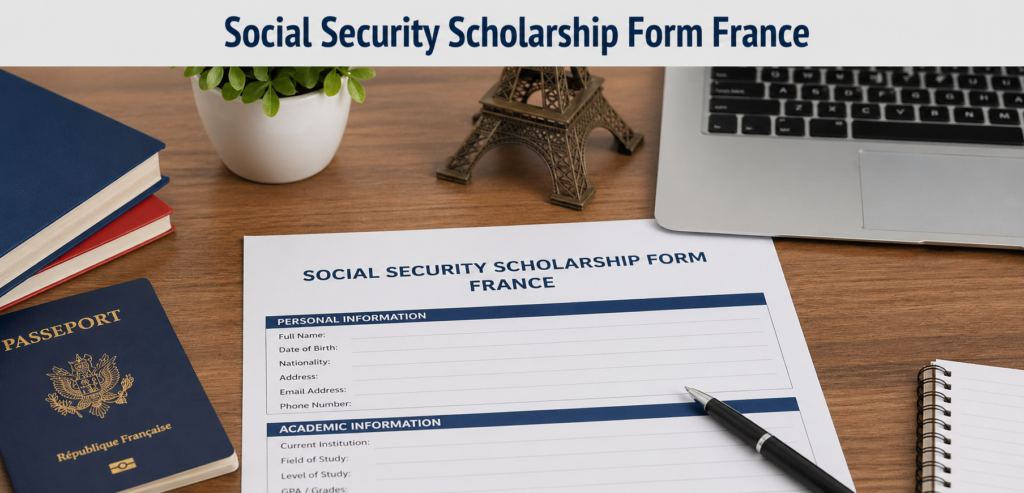
France is one of the most popular study destinations in the world, and for good reason. Its universities are internationally respected, its cultural richness is unparalleled, and its higher education system offers some genuinely impressive financial support to students who need it. One of the most important and widely used forms of that support is what the French government calls the bourse sur criteres sociaux, which translates into English as the scholarship on social criteria, or more commonly referred to as the social security scholarship in France.

For the 2026-2027 academic year, this scholarship is now open for applications, and it represents a meaningful opportunity for students who are facing real financial difficulties in pursuing their higher education in France. Whether you are already studying in France, about to begin your studies, or an international student trying to understand what financial support the French government offers, this guide is for you.
We are going to cover everything from scratch: what the social security scholarship actually is, who qualifies, how much you can receive, what additional benefits come with it, how it connects to French social security registration, and exactly how to apply before the deadline. Read through to the end because there is genuinely useful, specific information in every section.
What Is the Social Security Scholarship in France?
The social security scholarship in France, officially called the bourse d’enseignement superieur sur criteres sociaux (BCS), is a financial grant awarded by the French state to students who are experiencing material difficulties that could prevent them from pursuing higher education. It is administered by the regional student welfare organizations known as CROUS, which stands for Centres Regionaux des Oeuvres Universitaires et Scolaires. Each academic region in France has its own CROUS, and it is through your regional CROUS that your application is processed and your grant is managed.
The term “social security scholarship” is sometimes used by international students and scholarship information platforms to describe this grant because one of its key benefits is that it includes access to the French social security system at no cost, along with a range of other protections and privileges. However, the scholarship itself is fundamentally a needs-based financial grant tied to the family’s income level, the size of the household, and the distance between the student’s place of study and their family home.
The scholarship is not a one-time payment. It is paid monthly across the academic year, typically in ten monthly installments from September to June. In some cases, students under certain conditions can receive the grant during the summer holiday period as well, which results in a slightly higher monthly rate.
For the 2026-2027 academic year, the French government has formally confirmed the scholarship amounts by decree issued on 26 March 2026. The application window for this academic year runs from 1 March to 31 May 2026, and the application must be made online through the Dossier Social Etudiant, commonly abbreviated as DSE.
Why This Scholarship Matters: The Social Benefits Included
Beyond the monthly financial grant, the bourse sur criteres sociaux comes with a cluster of additional advantages that together make it one of the most comprehensive forms of student support offered by any European government. Here is what scholarship recipients are entitled to:
Exemption from University Registration Fees
Students who hold a bourse sur criteres sociaux are fully exempt from paying their university registration fees. In France, public university registration fees are relatively low compared to many other countries, but for students who are already in financial difficulty, even modest fees can be a barrier. This exemption removes that obstacle entirely.
Exemption from the CVEC Contribution
The CVEC, or Contribution Vie Etudiante et de Campus, is an annual contribution that all students enrolled in French higher education institutions are normally required to pay. It is a modest fee that contributes to student life and campus services. Scholarship holders under the bourse sur criteres sociaux are automatically exempt from paying this contribution.
Priority Access to CROUS Student Housing
Finding affordable accommodation as a student in France, especially in cities like Paris, Lyon, or Bordeaux, can be extremely challenging. Scholarship holders are given priority over non-scholarship students in the allocation of CROUS university residences, which offer subsidized and often significantly cheaper accommodation compared to the private rental market. This priority access is one of the most practically valuable benefits of holding this scholarship, especially for students moving to a new city for their studies.
Access to 1-Euro Meals at University Restaurants
Since May 2026, all students in France can access meals at CROUS university restaurants for one euro. Previously, this heavily subsidized meal price was reserved exclusively for scholarship holders and students in proven financial difficulty. While this benefit has now been extended to all students, scholarship holders remain guaranteed access to this scheme without needing to take any additional steps. Eating for one euro per meal in a university restaurant is a significant practical saving for students managing tight monthly budgets.
Access to French Social Security
All students enrolled in French higher education institutions, whether French or international, are required to register with the French social security system. This registration is free of charge, and it gives students access to partial reimbursement of healthcare costs such as visits to the doctor, medical tests, and prescriptions. For scholarship holders, the connection to French social security is a key feature of the support package. Students who hold a social security scholarship awarded through the French embassy network abroad receive coverage arranged through Campus France, including temporary insurance while they wait for their social security membership to be confirmed.
The Pass Sport Grant
Scholarship holders automatically receive the Pass Sport, which is a 50 euro grant to help cover the cost of registering with a sports association or club. This benefit is provided without any additional application steps.
Additional Local Reductions
Beyond these national-level benefits, scholarship holders typically qualify for a range of locally available reductions including discounts on public transport in their region, reduced access to cultural events, theatre tickets, museums, and leisure activities. The exact offers vary by city and region, but the scholarship status itself acts as a key that unlocks a wide range of student discounts.
How Much Is the Social Security Scholarship Worth? Understanding the Echelon System
The bourse sur criteres sociaux is not a flat rate. The amount you receive depends on your eligibility level, which is determined by what the French system calls an echelon. There are eight echelons in total, numbered from 0bis through to 7, with echelon 0bis being the lowest level and echelon 7 being the highest.
Each echelon corresponds to a specific income threshold and a set of what the system calls “points de charge,” or charge points. These charge points are calculated based on your family situation and the geographic distance between your family home and your place of study. The more charge points you accumulate and the lower your family income, the higher your echelon and therefore the higher your monthly grant.
For the 2026-2027 academic year, scholarship amounts have remained unchanged from the previous year. The exact annual amounts by echelon are confirmed in the decree of 26 March 2026 fixing the scholarship rates. The grants are typically paid in ten monthly installments across the academic year, with the first payment arriving in September at the start of the academic year.
For students at echelon 0bis, the scholarship does not include a monthly cash payment, but it does provide access to all the non-monetary benefits listed above, including the registration fee exemption, CVEC exemption, priority housing access, and the social security benefits. From echelon 1 upward, a monthly financial allowance is paid alongside these benefits. The amounts increase progressively with each echelon, reaching their highest level at echelon 7.
You can calculate your potential echelon before submitting your application using the official online simulator available on the government’s student services portal. This tool allows you to input your family’s income, household composition, and distance from your study location to get an indicative echelon before you formally file your DSE.
Who Is Eligible for the Social Security Scholarship in France 2026?
Eligibility for the bourse sur criteres sociaux is determined by several conditions that must all be met simultaneously. Missing even one of these conditions means you will not qualify. Here is a clear breakdown of every requirement:
Enrollment Condition
You must be enrolled in initial full-time higher education in France or in another country of the European Union. The institution must be a public higher education institution or a private institution that is authorized to receive scholarship holders. Part-time students are not eligible. Students in paid work-study programmes such as apprenticeships or alternance contracts are also excluded since they receive a salary from their employer, which is not compatible with the scholarship.
Age Condition
For a first application, you must be under 28 years of age on 1 September of the academic year in which you are applying. If you are already receiving the scholarship and turn 28 during your studies, you can continue to receive it as long as you do not interrupt your studies. The age limit can be extended in certain circumstances, including for time spent doing civic service, military service, or international volunteering. The age limit is also extended by one year for each child you are raising. Students with a recognized disability as notified by the CDAPH commission face no age limit whatsoever.
Diploma Condition
You must hold the baccalauréat or an equivalent diploma that is recognized in France as qualifying you for higher education. You must be enrolled in a first or second cycle programme in an institution under the authority of the Ministry of Higher Education.
Income Condition
Your family’s income must not exceed the applicable ceiling for your echelon. For the 2026-2027 academic year, the income taken into account is the gross overall income (revenu brut global) shown on the 2025 tax assessment, which reflects income earned in 2024. If you are married, in a civil partnership (PACS), or have a dependent child, only your own household income is considered rather than your parents’ income. In exceptional cases, more recent income from 2025 or even 2026 can be taken into account if there has been a significant and lasting change in financial circumstances.
What Students Cannot Be Doing
You cannot receive the scholarship if you are registered as a jobseeker with France Travail (formerly Pole Emploi), if you are a civil servant, a trainee civil servant, or if you are in a paid alternance or apprenticeship contract.
Duration of the Scholarship
The scholarship can be received for a maximum of seven years across your entire higher education career. This is not seven years per degree, but seven years in total. It is therefore important to apply sensibly and only for the years where you genuinely need the financial support, as the clock runs regardless of whether the money was essential in a given year.
Can International Students Apply for the Social Security Scholarship in France?
This is one of the most important questions for non-French students reading this article. The answer is yes, but with specific conditions that differ depending on your nationality.
European Union, EEA and Swiss Students
Students who are citizens of EU member states, countries in the European Economic Area, or Switzerland can apply for the bourse sur criteres sociaux if at least one of the following conditions is met: either they have worked in France themselves (on a full-time or part-time basis), or at least one of their parents or legal guardians has earned income in France during the income reference year (which for 2026-2027 is 2024). This employment connection to France is what establishes eligibility for non-French EU citizens.
Students from Outside the EU
Students who are citizens of countries outside the European Union face stricter conditions. To be eligible for the bourse sur criteres sociaux, a non-EU international student must meet all three of the following requirements:
- Hold a valid residence permit (titre de sejour) or a resident card in France
- Have been residing in France for at least two years
- Have parents or legal guardians who have been paying taxes in France
These conditions mean that newly arrived international students from outside the EU will generally not be eligible for the bourse sur criteres sociaux in their first year or two in France. However, students who have established longer-term residence in France and whose families have financial connections to the French tax system do have a pathway to this scholarship.

The Social Security Scholarship Awarded by French Embassies Abroad
There is a separate category of social security scholarship that is specifically for international students coming to France on a government scholarship awarded by a French embassy or the Ministry of Foreign Affairs abroad. This is what Campus France refers to as the “social coverage scholarship” or the “social security scholarship” in its international student guide.
Under this arrangement, international students who are awarded a scholarship by the Cultural Action and Cooperation Service of a French Embassy receive social security coverage organized through Campus France for the duration of their stay. This coverage includes temporary health insurance arranged through an insurer appointed by Campus France while the student completes their social security registration. This type of scholarship does not include a monthly living allowance or housing benefit, so students need to have their own financial resources covering approximately 800 to 1,000 euros per month in addition to the social coverage provided.
For students in this category, it is absolutely critical to inform Campus France of your arrival in France from the very first day. If you fail to do this, your health coverage will not be activated and you will have to pay all medical costs out of pocket during the period before you register with the French social security system directly.
The Dossier Social Etudiant (DSE): The Gateway to Applying
The entire application process for the bourse sur criteres sociaux flows through one centralized system: the Dossier Social Etudiant, or DSE. This is the digital student social file that you must create and submit online to apply for both the scholarship and, if relevant, for CROUS student housing.
The DSE application window for the 2026-2027 academic year runs from 1 March 2026 to 31 May 2026. Applications submitted by 31 May are given priority in the processing queue and are much more likely to result in the first scholarship payment arriving at the start of the academic year in September. Applications submitted after this date are still possible in cases of significant life changes such as marriage, divorce, death of a parent, parental unemployment, or serious illness, but they are handled outside the standard cycle and may take longer to process.
An important practical note: you do not need to know your exact study programme or have received a university admission offer to start filling in your DSE. The system allows you to indicate probable programmes of study. This means you can and should start your DSE as early as possible without waiting for a final admission confirmation, since the processing of scholarship files takes time and filing early maximizes your chances of everything being in place for September.
Step-by-Step: How to Apply for the Social Security Scholarship France 2026
Here is a practical, step-by-step breakdown of how the application process works:
Step 1: Create or access your account on the student services portal. The DSE is submitted through the messervices.etudiant.gouv.fr platform. If you have previously registered on Parcoursup or have submitted a DSE in a previous year, you already have an account. Use your existing email address and password. If you are new, you will need to create an account using your student national identification number (INE), which can be found on your student card or your baccalaureat registration confirmation.
Step 2: Gather the documents you need before starting the form. The most important document is the revenu brut global figure from the 2025 tax assessment (avis d’imposition 2025, covering income from 2024) for the household to which you are fiscally attached. You will also need your baccalaureat certificate, proof of your identity and nationality, and any documents relevant to your specific family situation such as a divorce judgment, death certificate, or proof of disability status if applicable.
Step 3: Complete the online DSE form. The form asks for details about your study situation, your family composition, the income of your household, and the geographic distance between your family home and your place of study. Be accurate and honest in every section. The CROUS will cross-reference the information you provide with tax authority records.
Step 4: Indicate your housing preference if applicable. Within the same DSE form, you can also request CROUS student housing. If you wish to apply for a CROUS residence as a scholarship holder, tick the relevant box within the form. The housing allocation process runs on a separate timeline, with proposals going out weekly between early June and the end of June. Scholarship holders are prioritized in this process.
Step 5: Submit your DSE and watch for confirmation emails. After submitting, you will receive an email confirming that your application has been received. If your file is incomplete, you will receive a second email listing the missing documents, which you must then upload to your account. An incomplete file cannot be processed, so responding promptly to document requests is important.
Step 6: Receive your conditional scholarship notification. After your file is reviewed by the CROUS, you will receive a conditional scholarship notification by email. This notification confirms your echelon and your scholarship status. You should transmit this notification to your higher education institution as it proves your status as a scholarship holder and entitles you to exemption from registration fees and the CVEC.
Step 7: Complete your university enrollment. Once you have enrolled administratively at your institution, you will receive your final scholarship notification. The payment of your first monthly allowance is then generated automatically. No additional steps are required on your part to trigger the payment.
To begin your application, access the official student services portal to create or log in to your DSE account. You can also visit the official etudiant.gouv.fr page on social criteria scholarships for the most up-to-date official information about eligibility and amounts for 2026-2027.
The Merit Grant: An Additional Scholarship for High-Achieving Students
If you are already receiving the bourse sur criteres sociaux and you obtained a mention tres bien (highest honours) in your final baccalaureat session, you may be entitled to an additional grant called the aide au merite. This merit-based supplementary grant is worth 900 euros per year and is paid in nine monthly installments of 100 euros each, with no payment during the summer vacation.
The aide au merite is not something you apply for separately. It is automatically assigned by the academic rector’s office, which compiles the list of students who obtained the mention tres bien in the most recent baccalaureat session and passes this information to the CROUS. The only prerequisite on your part is having filed your DSE.
The aide au merite can be awarded for a maximum of three years. If you lose your bourse sur criteres sociaux for any reason, you also automatically lose the aide au merite. It is a supplementary benefit that is entirely dependent on your continued eligibility for the main scholarship.