Last Updated: 19 May 2026 at 11:36 PM
Updated By: Uwandu Chinwe
- 1. Overview of the Julius Berger Vocational Support Programme 2026
- 2. About Julius Berger Nigeria Plc
- 3. Julius Berger’s CSR & Skills Development Track Record
- Automotive Technical Training
- Masonry, Carpentry & Plumbing
- Electrical Installation & Solar Technology (New)
- 4. 2026 Training Tracks & Technical Disciplines
- Electrical Installation
- Solar Technology
- Masonry
- Carpentry
- Plumbing
- Automotive (Previous Track)
- 5. Programme Benefits — What You Get
- Zero-Cost Training
- Monthly Stipend
- On-the-Job Industry Experience
- NSQF Certification (Level 1 & 2)
- GIZ-Backed International Standards
- Structured Mentorship
- Career Pathway into Construction & Energy
- Access to Julius Berger’s Professional Network
- 6. The GIZ Partnership: What It Means for Participants
- 7. NSQF Certification: Your Industry-Recognised Credential
- 8. Eligibility Criteria
- Core Eligibility Requirements
- Inclusion & Equal Opportunity — Priority Groups
- Women in Technical Fields
- Persons with Disabilities (PWDs)
- Internally Displaced Persons (IDPs)
- 9. Required Documents
- 10. Step-by-Step Application Guide
- Confirm Your Eligibility
- Choose Your Preferred Training Track
- Prepare Your Documents
- Write a Strong Personal Statement
- Visit the Official Application Portal
- Fill In the Application Form Accurately
- Upload Supporting Documents
- Submit Your Application
- Await Selection Communication
- Report for Training Commencement
- 11. Julius Berger VSP vs Other Nigerian Youth Training Programmes
- Start Your Application Today
The Julius Berger Vocational Support Programme (VSP) 2026 is now open for applications. Run through the prestigious Julius Berger Academy, Nigeria’s most recognised construction company is offering free technical training, a monthly stipend, and an internationally benchmarked NSQF certification all at zero cost to participants.

This guide covers every dimension of the programme: who runs it, what you will learn, what you will receive, how previous batches performed, what the new 2026 GIZ partnership means for curriculum quality, and a step-by-step walkthrough of the application process. Whether you are a fresh school leaver, a young artisan looking to formalise your skills, a woman breaking into technical trades, or a person from a disadvantaged background this is a programme worth knowing about.
1. Overview of the Julius Berger Vocational Support Programme 2026
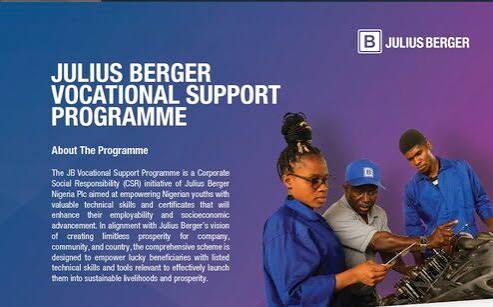
The Julius Berger Vocational Support Programme (VSP) is a structured technical training initiative operated by Julius Berger Nigeria Plc through its in-house training institution, the Julius Berger Academy. The programme is a flagship component of Julius Berger’s broader Corporate Social Responsibility (CSR) strategy, targeted specifically at youth empowerment, skills development, and sustainable capacity building in Nigerian host communities.
Each annual batch runs for approximately 10 months, combining classroom instruction, hands-on practical workshops, and real on-site industry exposure within Julius Berger’s active construction operations. The 2026 batch is scheduled to commence in late April 2026 and is the most ambitious to date, introducing two entirely new training streams backed by a strategic international partnership.
| Programme Detail | Information |
|---|---|
| Programme Name | Julius Berger Vocational Support Programme 2026 |
| Organised By | Julius Berger Nigeria Plc (JBN) |
| Delivery Institution | Julius Berger Academy |
| Location | Abuja, Federal Capital Territory, Nigeria |
| Programme Type | Vocational / Technical Skills Training (not a university scholarship) |
| Duration | Approximately 10 months |
| Expected Start Date | Late April 2026 |
| Cost to Participants | Completely free — zero tuition or training fees |
| Financial Support | Monthly stipend provided throughout the programme |
| Certification Awarded | NSQF Level 1 and Level 2 (Nigerian Skills Qualification Framework) |
| International Partner | GIZ (Deutsche Gesellschaft für Internationale Zusammenarbeit) |
| Target Group | Nigerians aged 18–28 residing in Abuja; women, PWDs, and IDPs especially encouraged |
| Application Portal | forms.office.com/e/WZQXBcM9s7 |
| Application Deadline | Not yet specified — apply as early as possible |
2. About Julius Berger Nigeria Plc
Julius Berger Nigeria Plc (JBN) is one of Africa’s most respected and experienced construction and infrastructure companies, standing at the absolute forefront of Nigeria’s built environment for over six decades. The company provides comprehensive, integrated services spanning the full project lifecycle: planning, design, engineering, construction, operation, and maintenance of buildings, infrastructure, and industrial projects across the country.
Julius Berger holds an ISO certification for its Quality Management Systems, reflecting its commitment to consistently meeting client needs and continuously improving quality across all operations. The company has constructed some of Nigeria’s most iconic and critical infrastructure, including major highway networks, bridges, airports, power plants, and landmark buildings.
Some of the company’s defining characteristics include:
- Execution of Nigeria’s first project-financed independent power project
- Emergency rehabilitation of the Nnamdi Azikiwe International Airport runway completed ahead of a near-impossible 6-week schedule
- Construction of one of the first LEED-certified buildings in West Africa — a 15-storey mixed-use tower on the Lagos skyline
- Design and construction of the permanent campus of a premier parliamentary academic and research institution
- Major road and bridge projects across multiple Nigerian states, including a 10km bypass with 62,000 m³ of rock excavation
- A 51km railway line encompassing eleven bridges and four road underpasses
- Listed on the Nigerian Stock Exchange (NGX)
Beyond infrastructure, Julius Berger operates with a deep sense of responsibility toward the communities in which it works. This ethos is embodied in its robust Corporate Social Responsibility programme, of which the Vocational Support Programme is the most direct investment in Nigerian human capital.
3. Julius Berger’s CSR & Skills Development Track Record
The 2026 Vocational Support Programme does not exist in isolation — it is the product of a deliberate and growing multi-year strategy by Julius Berger to invest in Nigerian youth. Understanding the programme’s history places the 2026 opportunity in its proper context and underscores the company’s seriousness of purpose.
Total CSR Investment by Julius Berger in 2024
Allocated to Education & Human Capital Development (2024)
Invested in Community Development & Inclusivity (2024)
Batch 2025 Graduates (out of 40 enrolled)
The evolution of the programme across its three active years demonstrates clear institutional commitment and a willingness to scale:
Automotive Technical Training
The programme launched with a focus on automotive repair and maintenance. 36 participants enrolled, of whom 30 successfully graduated. This inaugural batch established the Julius Berger Academy’s core training framework, combining classroom learning with practical workshop sessions.
Masonry, Carpentry & Plumbing
The programme expanded into construction trades. 40 participants were enrolled, with 36 completing the full 10-month programme — including two female graduates, a milestone reflecting the programme’s inclusion goals. All graduates received NSQF Level 1 and Level 2 certifications. A graduation ceremony was held in Abuja, presided over by senior Julius Berger leadership.
Electrical Installation & Solar Technology (New)
The 2026 batch is the most ambitious yet — introducing two brand-new high-demand training streams backed by an international partnership with GIZ. Applications are currently open. Commencement is scheduled for late April 2026.
“This is more than a graduation ceremony — it is a celebration of purpose and measurable impact. CSR must be measurable, sustainable, and impactful. The Vocational Support Programme clearly meets these standards. Our vision is to scale this initiative sustainably, ensuring more Nigerian youths acquire certified technical skills that contribute meaningfully to the economy.”
— Dr Abdulaziz Isa Kaita, Director of Administration, Julius Berger Nigeria Plc
4. 2026 Training Tracks & Technical Disciplines
The 2026 batch of the Julius Berger Vocational Support Programme introduces a carefully expanded set of technical training disciplines. Julius Berger has described the 2026 curriculum as designed to focus on skills that will remain commercially viable for the foreseeable future particularly as Nigeria accelerates its infrastructure expansion and clean energy transition.
Electrical Installation
A brand-new 2026 stream covering residential, commercial, and industrial electrical wiring, circuit design, safety standards, and practical installation techniques.
- Wiring systems & conduit work
- Electrical safety standards
- Circuit design & testing
- Distribution boards & panels
- On-site installation practice
Solar Technology
A new, future-facing 2026 stream addressing Nigeria’s rapidly growing renewable energy sector. Covers solar panel installation, off-grid systems, maintenance, and safety.
- Solar PV system design
- Panel installation & mounting
- Battery & inverter systems
- Off-grid & hybrid setups
- Maintenance & fault finding
Masonry
Core construction trade covering brickwork, blockwork, plastering, and site safety. Graduates from the 2025 batch demonstrated skills in block laying and wall construction to professional standards.
- Block laying & bricklaying
- Mortar preparation
- Plastering & rendering
- Foundation work basics
- Site safety & standards
Carpentry
Hands-on wood construction training covering joinery, furniture fabrication, form work, and the construction of wooden structures across both residential and commercial applications.
- Timber framing & joinery
- Door & window fitting
- Furniture construction
- Roofing & formwork
- Tools & equipment handling
Plumbing
Full plumbing trade training from basic pipe fitting to advanced water system design and installation, including the latest drainage standards and sanitary fittings.
- Water system installation
- Pipe fitting & jointing
- Sanitary fittings & fixtures
- Drainage & waste systems
- Leak detection & repair
Automotive (Previous Track)
The 2024 founding track. Covered motor vehicle diagnosis, maintenance, and repair across Julius Berger’s construction fleet and commercial vehicle operations.
- Engine diagnostics
- Brake & suspension systems
- Fleet maintenance
- Electrical fault tracing
- Heavy equipment basics
5. Programme Benefits — What You Get
The Julius Berger Vocational Support Programme 2026 offers a comprehensive package designed to ensure participants gain not just skills but a complete foundation for a productive career in technical trades. Here is a full breakdown of what every participant receives:
Zero-Cost Training
The entire 10-month vocational training programme is provided at absolutely no cost to participants. No tuition, no registration fees, no hidden charges whatsoever.
Monthly Stipend
All enrolled participants receive a monthly financial stipend throughout the programme to support their living and transport costs during the 10-month training period.
On-the-Job Industry Experience
Training is delivered within Julius Berger’s live construction operations — giving participants genuine industry exposure and site experience that no classroom alone can replicate.
NSQF Certification (Level 1 & 2)
All graduates who complete the programme receive official Nigerian Skills Qualification Framework (NSQF) Level 1 and Level 2 certifications — nationally recognised credentials that enhance employability across Nigeria’s formal and informal construction markets.
GIZ-Backed International Standards
The 2026 curriculum is being strengthened by GIZ Germany’s international development organisation ensuring training materials, methods, and infrastructure meet global technical standards.
Structured Mentorship
Participants receive mentorship from experienced Julius Berger engineers, site managers, and technical professionals building career networks and professional values alongside practical skills.
Career Pathway into Construction & Energy
The programme positions graduates for direct entry into Nigeria’s construction, engineering, and renewable energy sectors industries with growing demand for certified skilled technicians.
Access to Julius Berger’s Professional Network
Completing the programme gives participants credibility and visibility within one of Nigeria’s most respected engineering organisations, opening doors to employment and entrepreneurship.
6. The GIZ Partnership: What It Means for Participants
The single most significant upgrade in the 2026 batch is the formal partnership between Julius Berger Nigeria Plc and GIZ (Deutsche Gesellschaft für Internationale Zusammenarbeit) Germany’s internationally acclaimed development agency, operating across more than 120 countries and widely respected for its technical cooperation and vocational education programmes in developing economies.
GIZ has provided an integrated technical expert directly embedded within the Julius Berger Academy to support the following areas for the 2026 programme:
- Curriculum development — revising and strengthening all training syllabi to align with international vocational education benchmarks
- Training materials — developing high-quality instructional resources that reflect best-practice technical education globally
- Tools and equipment — ensuring participants train on appropriate industry-standard tools and instruments
- Infrastructure — advising on and supporting the upgrade of workshop and training facilities to meet international standards
- Trainer capacity — supporting the professional development of Julius Berger’s internal trainers and assessors
What this means practically for 2026 participants is straightforward: the quality of training has been significantly elevated compared to previous batches. A programme that was already delivering strong results with a 90% completion rate in 2025 is now being benchmarked against global technical education standards. For participants completing the programme in 2026, this translates to credentials and competencies that carry genuine weight in both the Nigerian labour market and potentially beyond.
7. NSQF Certification: Your Industry-Recognised Credential
Every participant who successfully completes the Julius Berger Vocational Support Programme 2026 receives Nigerian Skills Qualification Framework (NSQF) Level 1 and Level 2 certifications. Understanding what these certifications mean is important for appreciating the full career value of the programme.
The Nigerian Skills Qualification Framework (NSQF) is Nigeria’s national framework for recognising, standardising, and validating vocational and technical skills. It was developed to ensure that vocational qualifications earned in Nigeria are consistent, comparable, and credible to employers both within the country and internationally.
| Certification Level | What It Represents | Career Implication |
|---|---|---|
| NSQF Level 1 | Foundation competency — demonstrates basic understanding and ability to perform supervised tasks in the technical discipline | Entry-level employment readiness; eligible for apprenticeship and entry construction roles |
| NSQF Level 2 | Intermediate competency — demonstrates ability to perform skilled tasks independently and solve on-site technical problems | Qualified artisan status; eligible for semi-skilled contracts, subcontracting, and formal employment in construction firms |
Critically, the 2025 batch graduation confirms that these are genuine certifications awarded after formal assessment — not mere participation certificates. The 10% attrition rate (4 of 40 trainees did not graduate) demonstrates that standards are maintained and completion of the programme is a meaningful achievement.
8. Eligibility Criteria
The entry requirements for the Julius Berger Vocational Support Programme 2026 are deliberately accessible to ensure young Nigerians from all walks of life can apply. However, all requirements are mandatory — partial compliance will result in disqualification.
Core Eligibility Requirements
Inclusion & Equal Opportunity — Priority Groups
Julius Berger has explicitly stated its commitment to inclusion in the Vocational Support Programme. The following groups are strongly encouraged to apply and receive favourable consideration during the selection process: